

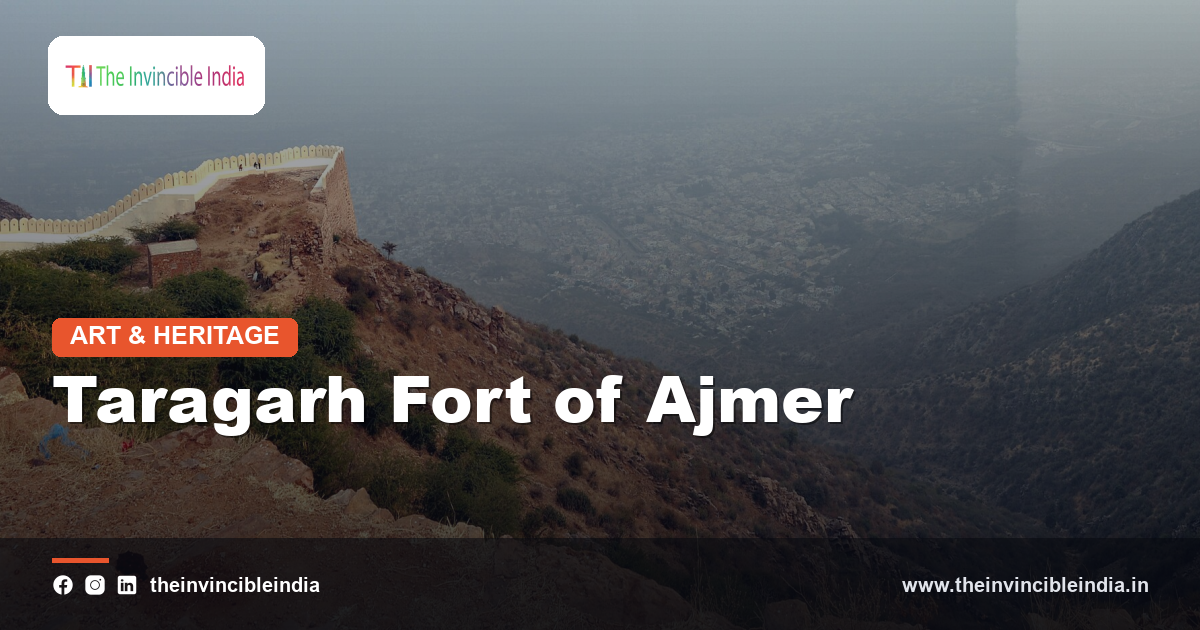
Taragarh Fort Ajmer, also called the Star Fort, Taragarh Ajmer or Ajmer Fort, crowns a steep hill of the Aravalli range directly above the old city of Ajmer in Rajasthan. For centuries its walls controlled the passes and approaches around the town, making it one of the most strategic hill fortresses of the region. The fort belongs to the same tradition of mountain strongholds described in the guide to the great forts of India, yet it has its own distinctive character, shaped by the sacred city that lies at its feet. This guide explains its history, architecture and living heritage.
Quick answer: Taragarh Fort Ajmer is a hilltop fortress on the Aravalli range overlooking the city of Ajmer in Rajasthan, often called the Star Fort because of its lofty position. It is traditionally linked with the Chauhan rulers who made Ajmer a capital, and it later passed through Sultanate, Mughal, Maratha and British hands. Its ramparts, bastions, reservoirs and a Muslim saint’s dargah make it an important example of Rajasthan’s hill-fort heritage.
Key Takeaways
- Taragarh Fort is a hill fort standing on a ridge of the Aravalli range above Ajmer in Rajasthan.
- The name Taragarh is commonly understood as the Star Fort, a reference to its lofty, star-like position above the plains.
- Tradition links the foundation of the fort with the Chauhan dynasty, who ruled from Ajmer, although exact dates remain debated.
- The fort was held in turn by several powers, including the Mughals, the Marathas and the British.
- Inside the walls are reservoirs, bastions and the dargah of Miran Sayyid Hussain Khing Sawar.
- A different Taragarh Fort stands at Bundi, so the two should not be confused.
The sections below describe how the fort was built, who held it, and what survives for the modern visitor.
Quick Facts
| Detail | Information |
|---|---|
| Location | Taragarh hill, above Ajmer city, Rajasthan |
| Also known as | Star Fort, Ajmer Fort, Taragarh Ajmer |
| Type | Hill fort on the Aravalli range |
| Traditional founders | Chauhan rulers of Ajmer |
| Notable features | Ramparts, Bhim Burj bastion, reservoirs, dargah |
| Significance | Strategic guardian of historic Ajmer |
What Is Taragarh Fort in Ajmer?
Taragarh Fort is a medieval hilltop fortress in Ajmer, Rajasthan, built on a commanding spur of the Aravalli range that rises abruptly above the city. It is not a palace-fort of the ornate kind seen at Jaipur or Udaipur but a working military stronghold, designed to hold ground, store water and watch the roads below. Its thick walls follow the contours of the ridge, and its gates and bastions were positioned where an attacker would find the climb most difficult. The fort is also a layered monument, because different dynasties repaired, extended and reused it over many centuries. Much of the interior now lies in a ruined state, which gives the place a quiet, weathered grandeur. Taragarh therefore stands as one of the clearest surviving examples of how Rajasthani hill forts protected a major city and the sacred sites around it.
Where Is Taragarh Fort Located?
Taragarh Fort is located on Taragarh hill immediately above the old city of Ajmer, in the central part of Rajasthan. Ajmer sits in a bowl of low Aravalli hills, and the fort occupies the highest and most defensible point of that ring. From its ramparts the visitor can look down upon the lanes of the old town, the shining waters of Ana Sagar lake and the long line of ridges that separate the city from the open plains. The position explains the fort’s importance, because anyone controlling the heights also controlled movement through the surrounding valleys. Ajmer lies close to Pushkar and sits on historic routes that linked the Gangetic plain with Gujarat and Malwa. The fort’s location thus combined three advantages at once, namely height, visibility and command of the roads that fed the city.
Why Is It Called the Star Fort?
Taragarh is commonly translated as the Star Fort, because the Hindi word tara means star and garh means fort. The name is generally explained by the fort’s lofty position, which made its walls seem to glitter like a star above the town when seen from the plains. Other local traditions offer alternative explanations, and the origin of the name is not settled by firm documentary evidence, so it is best treated as a matter of tradition. What is certain is that the name has been attached to the hill for many centuries and has become a familiar part of Ajmer’s identity. The poetic character of the title also suits the setting, since the fort is most striking at dawn and dusk when the Aravalli ridge catches the light. The name Star Fort therefore captures both its height and its romance.
Chauhan Origins and Early Tradition
The foundation of Taragarh is traditionally associated with the Chauhan dynasty, the Rajput lineage that made Ajmer one of its principal seats in the early medieval period. Tradition credits a Chauhan ruler named Ajayaraja with founding the city of Ajayameru, the origin of the name Ajmer, and with raising a fortress on the hill above it. The precise date and the exact extent of the original construction remain debated among historians, and later rebuilding has hidden much of the earliest fabric. Even so, the association with the Chauhans is strong in local memory and in the broader story of Rajput history. The Chauhans are remembered as defenders of this region, and their capital at Ajmer made the fort a symbol of dynastic power. Taragarh thus preserves, in tradition if not in every stone, the memory of an early Rajput stronghold.
Ajmer as a Medieval Capital and Frontier
Ajmer held a special place in medieval India as a capital, a pilgrimage centre and a frontier town on the road between northern and western India. A fortress above such a city had to serve many purposes at once, acting as a refuge in time of siege, a treasury, an arsenal and a visible emblem of authority. When the political map of northern India changed, control of Ajmer and its hill passed between Rajput, Sultanate and later imperial rulers. Each change affirmed the fort’s strategic value, because whoever held Ajmer commanded the approaches to Rajasthan. The fort therefore appears again and again in the chronicles of the region as a prize to be defended, besieged or rebuilt. Its long career as a contested stronghold explains why its walls bear the marks of so many different periods of repair.
Sultanate and Mughal Control
After the Chauhan era Ajmer came under the sway of the Delhi Sultanate and later of the Mughal empire, and Taragarh served each power as a fortified anchor above the city. The Mughals in particular valued Ajmer highly, partly because of its strategic location and partly because of the reverence in which the dargah of Khwaja Moinuddin Chishti was held by the imperial court. Emperors and princes visited the city on pilgrimage and sometimes stayed for extended periods, and the hill fort formed part of the defensive and administrative apparatus that supported this royal attention. Garrisons were stationed on the heights, and the fort was kept in repair as long as it remained useful. The Mughal chapter shows how a Rajput hill fort could be absorbed into a larger imperial system. Taragarh thus belongs to the shared heritage of both Rajput and Mughal India.
Ramparts, Gates and Military Design
The ramparts of Taragarh are its most impressive surviving feature, running along the crest of the hill in long, irregular lines that follow the natural rock. Their builders did not impose a geometric plan on the terrain but let the cliffs and ridges dictate the shape of the defences, a practice typical of Indian hill fortification. Massive walls, rounded bastions and narrow gateways were arranged so that anyone climbing toward the fort would be exposed to fire from above for a long stretch. The gates were commonly set at turns of the approach, forcing attackers into confined spaces where they could be stopped. Loopholes and parapets allowed defenders to shoot while sheltered behind stone. The combination of natural steepness and constructed obstacles made the fort extremely difficult to storm. Taragarh’s ramparts therefore illustrate the defensive intelligence of Rajasthani military architecture.
Bhim Burj and the Great Bastion
One of the best known structures within the fort is the large bastion called Bhim Burj, a broad, rounded platform on which heavy artillery was once mounted. Popular accounts connect a famous large cannon of the fort with this bastion, and the structure is often presented to visitors as the main gun platform of Taragarh. Its position gave defenders a wide field of fire over the approaches to the city, and its thick masonry could withstand the shock of firing heavy guns. Details of the history of individual cannon are usually based on local tradition, so the story is best read as part of the folklore of the fort rather than as settled record. Even so, the bastion clearly reflects the arrival of gunpowder warfare, when forts had to be adapted to carry artillery. Bhim Burj stands as a reminder of how the age of cannon reshaped hill-fort design.
Water Reservoirs and Life on a Hilltop
A fort on a high hill is only as strong as its water supply, and Taragarh was equipped with reservoirs and cisterns cut into the rock to catch and store rain. These tanks allowed a garrison to survive prolonged sieges without depending on supplies from the town below. Channels and catchment surfaces guided monsoon rain into the storage tanks, a technique used in many Rajasthan forts where wells were impractical on rocky summits. Remains of structures within the walls suggest barracks, stores and shelters that once supported daily life. The careful management of water reflects the practical knowledge of the builders, who understood that survival depended on logistics as much as on walls. Today the tanks and cisterns remain among the most instructive features of the site, showing how an entire community could live on a barren ridge. Water engineering was thus a quiet but essential part of the fort’s strength.
The Dargah of Miran Sayyid Hussain Khing Sawar
Within the fort stands the dargah of Miran Sayyid Hussain Khing Sawar, a Muslim saint and warrior associated in tradition with the defence of the stronghold. Local accounts describe him as a governor of the fort who fell in battle, after which his tomb became a site of veneration for devotees of many communities. The shrine adds a spiritual dimension to what would otherwise be a purely military site, reflecting the composite religious culture of Ajmer, where Hindu and Muslim devotional traditions have long lived side by side. Pilgrims have traditionally climbed the hill to pay respects, and the shrine remains an active place of devotion. The specific details of the saint’s life are carried largely by tradition rather than by documents, so they are best described with care. The dargah makes Taragarh a place where defence and devotion share the same hilltop.
What Role Did the Marathas and the British Play at Taragarh?
The Marathas and the British both left their mark on Taragarh during the later centuries of its history. In the eighteenth century, as Mughal authority weakened, Ajmer came under the influence of Maratha power, and the fort again served as a strategic point in a contested region. Later the British took control of Ajmer and the surrounding territory, and the hill fort lost its original military purpose as new forms of warfare and administration took over. A frequently repeated tradition holds that the British used the elevated site as a place of rest and recovery for their troops because of its cooler air, though the details of this use are best treated as general knowledge rather than precise record. The fort gradually passed from active service into a period of neglect. The transfer from garrison to ruin marks the end of its working life and the beginning of its heritage life.
Taragarh and the Wider Heritage of Ajmer
Taragarh cannot be understood in isolation, because it forms part of a rich cultural landscape that includes some of the most important monuments of Rajasthan. Below the fort lies the dargah of Khwaja Moinuddin Chishti, one of the great Sufi shrines of the subcontinent, and nearby stands the Adhai Din Ka Jhonpra, a historic mosque famous for its carved arches and screens. The artificial lake of Ana Sagar adds a Mughal-era garden setting to the scene, while Pushkar, with its sacred lake and temples, lies a short distance away. The fort stands above all of these as their guardian, and in historical terms it protected the city that housed them. Visitors who combine the fort with these sites gain a fuller picture of Ajmer as a place where military, religious and artistic traditions meet. Taragarh is therefore best seen as the high point of a larger heritage circuit.
Is Taragarh Ajmer the Same as Taragarh Fort in Bundi?
Taragarh Fort in Ajmer is not the same monument as the Taragarh Fort at Bundi, although the two share a name and both are hill forts of Rajasthan. The Bundi fortress crowns a hill above that smaller city and is associated with the Hada Chauhans, a branch of the Chauhan family, while the Ajmer fort overlooks a different city and a different historical setting. The repetition of the name reflects the popularity of the star image in Indian fort naming, since the word tara was applied to several lofty strongholds. Travellers searching for information online should therefore check the city name to avoid confusion. Each fort has its own story, architecture and visitor experience, and each deserves separate attention. Understanding the distinction helps place Taragarh Ajmer correctly within the family of Rajasthan’s fortresses.
What Can Visitors See and Experience Today?
Visitors to Taragarh today find a largely ruined but atmospheric fortress, best appreciated for its walls, bastions, reservoirs and sweeping views. The ascent is steep, and many people make the climb on foot, passing the older fortifications before reaching the summit enclosure. Inside the walls one can explore the tanks, the remains of gateways and the area around the dargah. From the ramparts the panorama over Ajmer and its lake is among the finest in the region, and the early morning and late afternoon hours are widely regarded as the best times for light and temperature. Sturdy footwear, drinking water and sun protection are sensible precautions, since there is little shade on the hill. Travellers should also check current access arrangements before setting out, as conditions at heritage sites can change. A visit to Taragarh rewards effort with a vivid sense of the past.
The Landscape of the Aravalli Heights
Taragarh sits within the ancient Aravalli range, one of the oldest mountain systems on Earth, and its setting is as important to its character as its masonry. The rocky slopes, scrub vegetation and dry stream beds around the fort belong to a semi-arid landscape that changes dramatically with the seasons. After the monsoon the hills turn green and the reservoirs fill, while in the dry months the ridge reverts to stark browns and golds. Birds and small wildlife move through the scrub, adding life to the ruins. The landscape also explains the fort’s military logic, since the broken ground made the approach slow and the heights gave defenders a clear view in every direction. Seen in this setting, Taragarh appears less like an imposed structure than like an extension of the hill itself. The Aravalli heights are therefore an essential part of the fort’s story.
Conservation and the Challenge of Preservation
Preserving a large hill fort is difficult, because exposure to sun, rain and wind steadily wears away old masonry, and the remote summit makes repair work costly. At Taragarh, collapsed walls, overgrown vegetation and the pressure of visitors all pose challenges for conservation. Heritage bodies and local authorities have a role in stabilising structures, clearing growth and managing access, and community interest in the fort helps to sustain these efforts. Good conservation also depends on careful documentation, so that repairs respect the original character of the fabric rather than disguising it. Responsible tourism contributes by keeping visitors on safe paths and discouraging damage to the stones. The fort’s survival into the present is itself an achievement, given its age and exposure. Continued care will determine whether future generations can still walk its ramparts and read its history in the stones.
Taragarh Fort Today
Taragarh Fort today stands as a ruined but evocative monument, watching over Ajmer as it has done for centuries. It no longer serves as a garrison, yet it remains a landmark that shapes the skyline and the memory of the city. For residents it is a familiar presence on the hill, and for visitors it offers a rare chance to walk a medieval ridge-top fortress with long views in every direction. The fort connects the early Chauhan story, the imperial Mughal era and the later Maratha and British periods in a single, tangible setting. It also joins the sacred and the strategic, through the dargah within its walls and the great shrines below. For anyone interested in the forts of Rajasthan, Taragarh is a rewarding place to understand how geography, faith and power combined. The Star Fort continues to shine as a symbol of Ajmer’s long and layered past.
Sources & Further Reading
- Archaeological Survey of India (asi.nic.in).
- Rajasthan Tourism, Government of Rajasthan (tourism.rajasthan.gov.in).
Frequently Asked Questions
What is Taragarh Fort in Ajmer?
Taragarh Fort is a medieval hill fort on the Aravalli range overlooking Ajmer in Rajasthan, often called the Star Fort. It is traditionally linked with the Chauhan rulers and later served the Mughals, Marathas and British. Today it is a ruined but atmospheric heritage site with ramparts, reservoirs and a dargah.
Who built Taragarh Fort Ajmer?
Tradition credits the Chauhan rulers of Ajmer, particularly a king named Ajayaraja, with founding the fort. The exact date and extent of the original construction remain debated among historians. Later rulers rebuilt and extended the walls over many centuries.
Why is Taragarh called the Star Fort?
Taragarh means Star Fort, from the Hindi words tara for star and garh for fort. The name is usually explained by the fort’s lofty hilltop position, which made it seem like a star above the plains. Alternative local explanations exist, and the origin is not firmly documented.
Is Taragarh Fort in Ajmer the same as the one in Bundi?
No, the two forts are different monuments in different cities of Rajasthan that happen to share a name. The Ajmer fort overlooks the city of Ajmer, while the Bundi fort crowns a hill above Bundi and is linked with the Hada Chauhans. Travellers should check the city name when planning a visit.
What can visitors see at Taragarh Fort?
Visitors can see the long hilltop ramparts, the Bhim Burj bastion, rock-cut reservoirs and the dargah of Miran Sayyid Hussain Khing Sawar. The panoramic views over Ajmer and Ana Sagar lake are a major attraction. The climb is steep, so sturdy shoes and water are advisable.
Is Taragarh Fort a good place to combine with other Ajmer sights?
Yes, the fort is easily combined with the dargah of Khwaja Moinuddin Chishti, the Adhai Din Ka Jhonpra and Ana Sagar lake, all within the city. Pushkar lies a short distance away. Together these sites give a rounded picture of Ajmer’s heritage.


