

The Bhauma-Kara dynasty, also called the Kara dynasty or the Bhaumakaras, was an early medieval ruling house that governed much of coastal Odisha, then known as Toshala and Utkala, roughly between the eighth and tenth centuries. Its inscriptions describe rulers who patronised Buddhism, supported Shaiva shrines and, unusually, allowed several queens to rule in their own right. The neighbouring Rashtrakutas, whom our guide to the Rashtrakuta dynasty describes, were among the major powers of the wider region. Exact dates, the location of the capital and the origin of the name Bhauma are debated, and this guide therefore keeps to broad outlines.
Quick answer: The Bhauma-Kara dynasty was an early medieval royal house of Odisha, also known as the Kara dynasty, which ruled the region called Toshala roughly between the eighth and tenth centuries. It is remembered for patronising Buddhist centres such as Ratnagiri, Udayagiri and Lalitgiri, for early Odishan temple building at Bhubaneswar and for having several women rulers. Its exact chronology and capital are debated, and it was later succeeded by the Somavamshi kings.
Key Takeaways
- The Bhauma-Kara dynasty, also called the Kara dynasty, ruled coastal Odisha, known as Toshala, in the early medieval period.
- Its rulers are described in inscriptions as supporters of Buddhism, and the Buddhist centres of Ratnagiri, Udayagiri and Lalitgiri flourished in this era.
- Several queens, including Tribhuvana Mahadevi, are recorded as ruling in their own right, which is a notable feature of the dynasty.
- The Vaital Deul temple at Bhubaneswar is commonly associated with this period, though the dating of early Bhubaneswar temples is discussed.
- The location of the capital, often given as Guhadevapataka, and the precise chronology remain debated by historians.
- The dynasty was later followed in Odisha by the Somavamshi rulers.
Read on for the history, culture, and legacy in detail.
Quick Facts
| Detail | Information |
|---|---|
| Dynasty | Bhauma-Kara (Kara) dynasty |
| Region | Coastal Odisha, called Toshala and Utkala |
| Approximate Period | Roughly the eighth to the tenth century CE |
| Religion Patronised | Mahayana and Vajrayana Buddhism, alongside Shaiva traditions |
| Notable Feature | Several ruling queens recorded in copper-plate inscriptions |
| Heritage Sites | Ratnagiri, Udayagiri, Lalitgiri and early Bhubaneswar temples |
What Was the Bhauma-Kara Dynasty?
The Bhauma-Kara dynasty was a royal house of early medieval Odisha whose rulers governed the coastal region of Toshala and parts of the neighbouring uplands. Its members are known chiefly from copper-plate land grants and inscriptions, which record royal genealogies, donations and titles. The dynasty is notable for its support of Buddhism at a time when the religion was declining in many other parts of India, and for its tradition of ruling queens. Historians often treat its era as a creative phase in Odishan culture, marking the transition between ancient Kalinga and the great temple age that followed. The dynasty is thus a vital link in the long history of the region.
Where and When Did the Bhauma-Karas Rule?
The Bhauma-Karas ruled the coastal Odisha region of Toshala, extending across parts of the Mahanadi delta, the Jajpur area and neighbouring districts, in a period generally placed between the eighth and tenth centuries. Scholars disagree about the exact boundaries and the sequence of reigns, because the inscriptions follow their own regnal conventions and some copper plates are hard to date. The region was fertile, well connected to the sea and linked to inland routes. Its position allowed contact with eastern and southern kingdoms and with Southeast Asia through maritime trade. The broad chronology is accepted, even though the precise dating remains a subject of discussion.
Why Are They Called Bhauma-Kara?
The compound name Bhauma-Kara combines two terms, with Kara referring to the ruling family and Bhauma appearing in connection with their lineage. Some scholars link Bhauma to the idea of descent from an earth-born ancestor, possibly echoing the Pragjyotisha tradition of the east, though this interpretation is debated. Others use the shorter name Kara dynasty and treat Bhauma as an epithet used in some records. The uncertainty is typical of early medieval royal naming, which often combined mythic claims with local tradition. For general readers, both forms refer to the same ruling house of Odisha, and each is widely used in modern writing.
The Political Setting of Early Medieval Odisha
The Bhauma-Karas ruled during a period when eastern India was shaped by competition among regional powers such as the Palas, the Pratiharas and the Rashtrakutas. Odisha lay at the crossroads of these rivalries, as well as being close to the southern kingdoms of the Deccan. The Kara kings managed this environment through a mixture of diplomacy, marriage ties and defence, and the region remained largely stable for a long time. Earlier Odisha had been governed by the Shailodbhavas, while later it passed to the Somavamshis. The Kara period therefore occupies a middle position in Odisha’s political sequence.
Capital and Administration
The capital of the Bhauma-Karas is often given in inscriptions as Guhadevapataka, but its exact location is uncertain and has been proposed in several places. The government worked through provincial officers, village heads and a royal court that issued land grants to temples, monasteries and Brahmins. Copper plates preserve the formal language of royal orders and name many officials. Revenue came mainly from agriculture, supplemented by trade and port dues. Although details are limited, the surviving records show an organised and literate administration that maintained order and supported religious and cultural institutions.
How Did Buddhism Flourish Under the Karas?
Buddhism flourished under the Karas because the rulers supported monasteries, schools and image-making on a considerable scale. Inscriptions describe several kings as devoted followers of the Buddha, and the dynasty is associated with the growth of Mahayana and Vajrayana traditions in Odisha. The major Buddhist sites of the Jajpur area developed or expanded in this period, and the region became a notable centre of Buddhist learning and art. Pilgrims and scholars from other lands were attracted by its reputation. The dynasty’s religious policy therefore gave Odisha a distinctive place in the late history of Indian Buddhism.
The Diamond Triangle: Ratnagiri, Udayagiri and Lalitgiri
Ratnagiri, Udayagiri and Lalitgiri are three hill sites in the Jajpur district of Odisha that together are often called the Diamond Triangle of Odishan Buddhism. Excavations have revealed monasteries, stupas, sculptures and inscribed seals, and the sites are now protected as heritage locations. Their sculpture includes images of the Buddha and bodhisattvas such as Avalokiteshvara and Tara, carved with refined detail. These centres flourished in the Kara era and continued to be active in later periods. The Diamond Triangle remains the most important physical evidence of the dynasty’s Buddhist patronage.
Why Was Odisha Connected to Buddhist Scholarship Abroad?
Odisha was connected to Buddhist scholarship abroad because its monasteries took part in the wider exchange of texts and teachers across Asia. Chinese records mention a Buddhist manuscript, the Gandavyuha, being presented from the court of Odisha to the Tang emperor of China around the end of the eighth century, and the text was later translated there. This episode, though lightly documented, shows that Odishan Buddhism was known beyond the subcontinent. Earlier, the Chinese pilgrim Xuanzang had described Buddhist communities in the region. The evidence suggests that Odisha played a respected part in the international Buddhist world.
Ruling Queens of the Bhauma-Karas
The Bhauma-Karas are especially notable for the number of queens who held the throne in their own right. Copper-plate inscriptions name rulers such as Tribhuvana Mahadevi and Dandi Mahadevi, who issued grants and bore royal titles, a practice that was rare in early medieval India. Historians discuss the reasons for this development, which may include succession crises and the influence of regional custom, but the inscriptions themselves are clear that these women ruled. Their reigns show a flexible approach to authority and give the dynasty a distinctive place in the history of Indian women. They remain among the most remarkable features of the Kara era.
Where Is the Vaital Deul Temple?
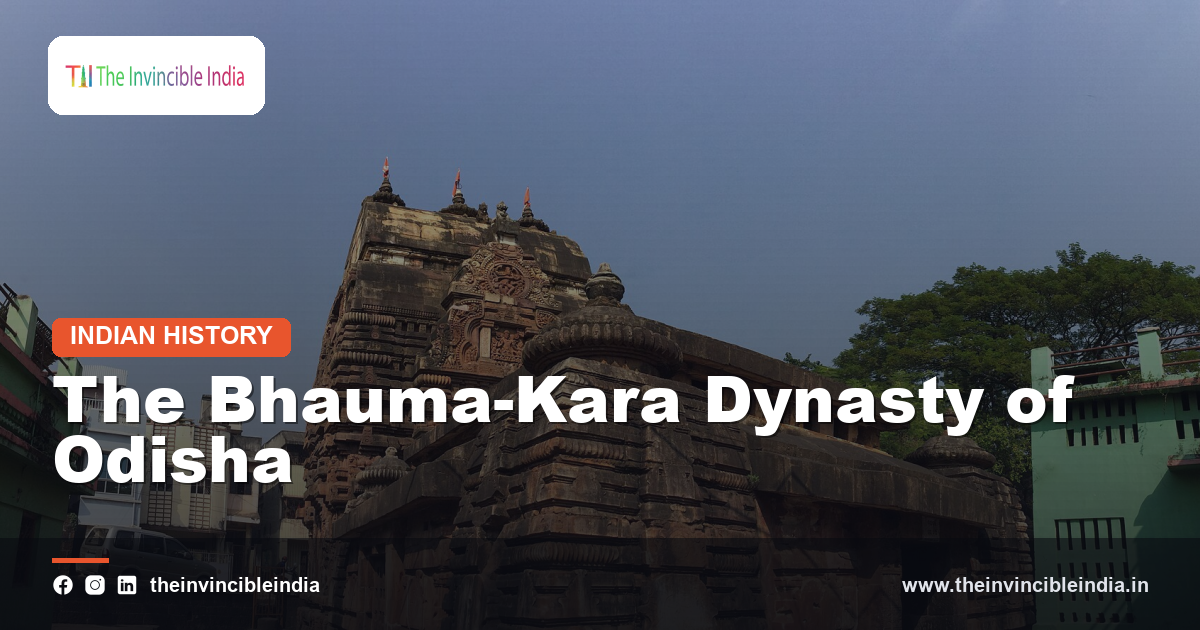
The Vaital Deul is a temple in the old city of Bhubaneswar, Odisha, and it is commonly associated with the period of the Bhauma-Karas. It has a distinctive wagon-vaulted roof, known as a khakhara, rather than the curved tower seen in later Odishan temples, and its interior contains an image of Chamunda. The carvings include figures and motifs linked to Tantric traditions. Its date is generally placed in the eighth century, but scholars discuss the chronology of early Bhubaneswar temples with caution. The Vaital Deul is one of the best-known surviving monuments from the early medieval period of Odisha.
Temples and the Shaiva Tradition
Although the Karas supported Buddhism, they also patronised Shaiva shrines, and several early temples in Bhubaneswar belong to or near their time. Monuments such as the Parasurameshvara temple, often dated to the earlier Shailodbhava period, and others from the Kara era show the evolution of Odishan architecture from simple forms to more elaborate designs. The coexistence of Buddhist and Shaiva patronage illustrates the religious pluralism of the period. Temple builders experimented with sculpture, proportion and ornament in ways that prepared the ground for the great monuments of later centuries. The Kara era is therefore important in the story of Odishan temple architecture.
Art and Sculpture of the Kara Period
The art of the Kara period is marked by elegant, balanced sculpture in both Buddhist and Hindu settings. Stone images of the Buddha, Tara and Avalokiteshvara display calm expressions and finely worked ornaments, while temple walls show graceful figures and decorative patterns. The artists of this period worked in local stone and developed a refined style that influenced later Odishan sculpture. Surviving pieces are found in site museums and in the Odisha State Museum. The art of the Karas reveals a confident and cultured society, and it remains a major source for the study of early medieval Indian visual culture.
Maritime Trade and Economy
The economy of the Kara realm relied on agriculture, craft production and the maritime trade of the Odisha coast. Rice cultivation in the river deltas supported a large population, while ports on the Bay of Bengal connected the region to southern India and Southeast Asia. Odisha had a long tradition of sea voyages, and cultural links with places such as Java and Bali are remembered in modern festivals. The kings supported this trade by maintaining order and protecting routes. The combination of agricultural wealth and maritime access gave the dynasty the resources needed to build monuments and sustain religious institutions.
Decline and Succession
The Bhauma-Kara dynasty declined in the tenth century as internal disputes and the rise of rival families weakened the royal house. The Somavamshis, who rose from the western part of Odisha and neighbouring regions, eventually took control of the coast. Historians discuss how much the transition was a conquest and how much a gradual replacement, because the sources are limited. The shift also brought changes in religious patronage, with Hindu temple building becoming more prominent and Buddhism slowly declining. The end of the Kara dynasty marks the close of a distinctive phase in Odishan history.
Why Is the Bhauma-Kara Dynasty Important Today?
The Bhauma-Kara dynasty is important today because it left a rich legacy of Buddhist sites, early temples and records of ruling women. Its monuments are central to the heritage tourism and archaeology of Odisha, and scholars use its inscriptions to study early medieval administration and religion. The dynasty also challenges simple assumptions about the decline of Buddhism and the role of women in Indian politics. It shows how a regional kingdom could combine pluralism with creativity. Its legacy therefore reaches beyond Odisha and contributes to the wider understanding of India’s past.
The Bhauma-Kara Dynasty Today
The Bhauma-Kara dynasty is remembered today through protected monuments, museum collections and continuing research. Visitors can explore the hills of Ratnagiri, Udayagiri and Lalitgiri, walk through the temple precincts of old Bhubaneswar and see sculptures in site museums. Historians continue to refine the chronology and to study the copper plates that preserve the voices of its rulers. The dynasty’s story, with its Buddhist patronage and ruling queens, remains a source of pride and curiosity in Odisha. It stands as a reminder of the creativity of early medieval India.
Sources & Further Reading
- Archaeological Survey of India (asi.nic.in).
- Ministry of Culture, Government of India (indiaculture.gov.in).
Frequently Asked Questions
Who were the Bhauma-Karas?
The Bhauma-Karas were an early medieval ruling dynasty of Odisha, also called the Kara dynasty, who governed the region of Toshala roughly between the eighth and tenth centuries. They are known for Buddhist patronage and for having several women rulers.
Where was the Bhauma-Kara capital?
The capital is named in inscriptions as Guhadevapataka, but its exact location is uncertain and debated. Several sites in coastal Odisha have been proposed by scholars.
Which queens ruled under the Bhauma-Karas?
Queens such as Tribhuvana Mahadevi and Dandi Mahadevi are named in copper-plate inscriptions as ruling in their own right. This was a rare feature in early medieval India.
What is the Vaital Deul?
The Vaital Deul is an early temple in Bhubaneswar, Odisha, commonly linked to the Bhauma-Kara period. It is known for its wagon-vaulted roof and its image of Chamunda.
What is the Diamond Triangle of Odisha?
The Diamond Triangle is the group of three Buddhist sites at Ratnagiri, Udayagiri and Lalitgiri in Jajpur district. They flourished largely in the Kara era and preserve monasteries, stupas and sculpture.
What happened to the Bhauma-Kara dynasty?
The dynasty declined in the tenth century and was succeeded in Odisha by the Somavamshi rulers. The details of the transition are limited and discussed by historians.


