

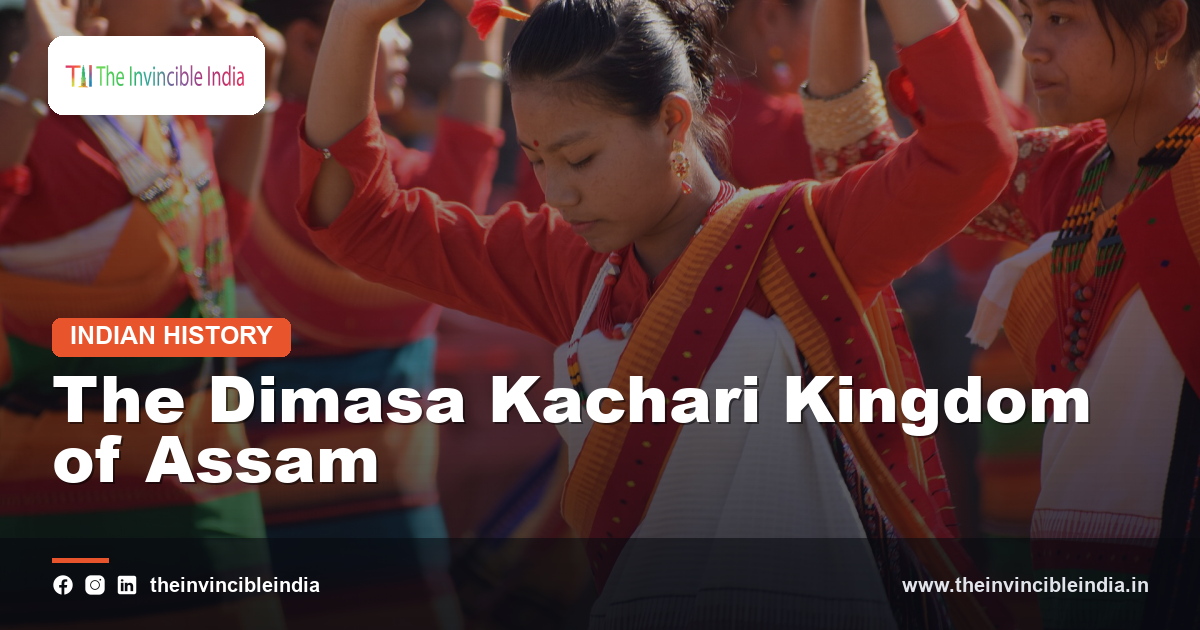
The Dimasa Kachari kingdom, also called the Kachari kingdom or Heramba in some older sources, was a medieval and early modern state of the Dimasa people in the Brahmaputra and Barak valleys of present-day Assam and Nagaland. Unlike the Rajput houses described in our guide to the Rajputs, the Dimasa rulers drew on a Tibeto-Burman tribal heritage while also adopting selected Hindu titles and customs over time. Their capitals moved from Dimapur to Maibang to Khaspur and beyond, leaving ruins that still stand across the region. Many details of early chronology remain debated, so this guide describes the kingdom in general terms.
Quick answer: The Dimasa Kachari kingdom was a state of the Dimasa people, a Tibeto-Burman-speaking community of north-eastern India, which ruled parts of the Dhansiri, Kopili and Barak valleys in present-day Assam and Nagaland. Its best-known capitals were Dimapur, Maibang and Khaspur, and its rulers were eventually displaced by Ahom pressure and then British annexation. The exact dates of its early phases are debated among historians.
Key Takeaways
- The Dimasa Kachari kingdom was the historical state of the Dimasa people, also known as the Kachari kingdom.
- Its main capitals, in broad order, were Dimapur, Maibang and Khaspur, reflecting a gradual shift from the Brahmaputra side toward the Barak valley.
- Dimapur preserves large carved monoliths and tank remains linked to the Kachari rulers.
- Dimasa society was organised around clans traced through male and female lines.
- The Ahom kingdom and later the British East India Company were the major outside powers that reshaped Kachari territory.
- Today the Dimasa are largely concentrated in Dima Hasao, Cachar and Karbi Anglong in Assam, and in Dimapur in Nagaland.
Read on for the history, culture, and legacy in detail.
Quick Facts
| Detail | Information |
|---|---|
| Kingdom | Dimasa Kachari kingdom (also Kachari or Heramba) |
| Region | Dhansiri, Kopili and Barak valleys of Assam and Nagaland |
| Major Capitals | Dimapur, Maibang, Khaspur |
| People | Dimasa, a Tibeto-Burman-speaking community |
| Rival Neighbour | The Ahom kingdom of the Brahmaputra valley |
| End of Independent Rule | British annexation of the Cachar plains in the nineteenth century |
What Was the Dimasa Kachari Kingdom?
The Dimasa Kachari kingdom was a long-lived regional state ruled by Dimasa kings in the hill and valley country of the Northeast. It stood between the Ahom realm of the upper Brahmaputra and the Bengal-facing plains of the south, and its rulers controlled forests, rivers and river-crossings that carried trade and troops. Because the Dimasa are often grouped under the wider label Kachari, the kingdom appears in older records simply as the Kachari state. Historians generally treat it as one of the principal political powers of medieval Assam, alongside the Koch and the Ahoms. The kingdom is best understood as a state that evolved over many centuries, with changing capitals and borders rather than a single fixed territory.
Who Are the Dimasa People?
The Dimasa are a Tibeto-Burman-speaking people whose homeland lies in Dima Hasao, Cachar and parts of Karbi Anglong in Assam, with a presence in Nagaland. The name Dimasa is commonly interpreted as meaning children of the great river, a reference to the Brahmaputra or one of its tributaries, although such etymologies are traditional rather than proven. Their language belongs to the Bodo-Garo group, and they remain a distinct community with strong clan identity. The kingdom grew out of this tribal base, which explains why its political culture mixed hill customs with the courtly forms seen elsewhere in India. The Dimasa people therefore stand at the centre of any account of the kingdom.
Where Did the Kachari Kingdom Rule?
The Kachari kingdom ruled across the Dhansiri valley, the Kopili basin, the North Cachar hills and later the plains of the Barak valley. At its earlier extent, tradition places its influence along the southern bank of the Brahmaputra and in the foothills of the Naga and Karbi ranges. As Ahom power expanded, the centre of gravity moved south and west, until the plains of Cachar became the heartland. Modern districts such as Dima Hasao, Cachar, Dimapur and parts of Karbi Anglong all preserve Kachari place names, ruins and memories. The shifting geography shows how the kingdom adapted to pressure while keeping control of strategic river valleys.
Origins, Legends and the Name Heramba
The origins of the Kachari kingdom blend history with tradition, and no single account is accepted by all scholars. Dimasa tradition and Assamese chronicles speak of an early realm sometimes called Heramba, and some stories link the kings to the Mahabharata figure Hidimba, whose name is echoed in the place name Dimapur. These links are best read as the community’s own way of placing itself in the wider Indian epic world rather than as established fact. Archaeology and inscriptions point to organised Kachari kingship over a long period, but the early centuries are poorly documented and chronology is debated. A cautious reading keeps legend and evidence apart while respecting both.
Dimapur: The Early Capital
Dimapur, on the Dhansiri river in present-day Nagaland, is the best-known early Kachari capital. Its ruins include large carved stone pillars, often described as mushroom-shaped, along with the remains of tanks, gateways and brick or stone structures that once formed part of a royal settlement. Local and scholarly tradition associates the site with the Kachari kings, and the monoliths are often interpreted as having ritual or commemorative significance, although their exact purpose is discussed rather than settled. The town stood at a crossroads between hill peoples and valley kingdoms, which helps explain why it mattered. Dimapur remains the single most visible reminder of the early Kachari state.
Maibang: The Hill Capital
Maibang, in the Dima Hasao district of Assam, served as a later capital in the hills after pressure from the Ahoms shifted Kachari fortunes. Its ruins include carved stone remains and structures that show a blend of local and wider Indian architectural ideas. The hill setting offered natural defence and distance from the plains, which suited a kingdom that was by then contending with a stronger eastern neighbour. Maibang is also associated with the royal use of stone for sacred and ceremonial buildings, a feature that links it to earlier Dimapur traditions. As a result, the town is regarded as a key stage in the kingdom’s long journey from the Brahmaputra side toward the south.
The Ahom Rivalry and the Shift Southward
The rivalry with the Ahom kingdom was the central political story of the Kachari state in the later medieval period. The Ahoms, expanding from the upper Brahmaputra valley, pressed against Kachari territory in the Dhansiri region during the sixteenth century, and the Kacharis eventually lost their early heartland. Historians generally describe the Kachari retreat as a gradual shift rather than a single catastrophe, with new capitals established further south and west. The rivalry was not purely military, since marriage, tribute and diplomacy also linked the courts at various moments. In this way the Ahom contest shaped both the geography and the political outlook of the Kachari kingdom.
Khaspur and the Cachar Plains
Khaspur, in the Cachar plains of the Barak valley, became the principal seat of the Kachari kings in the later period. The site preserves ruins of royal buildings, gateways and temples, including remains associated with the goddess Ranachandi, and is protected as a heritage location. The move to the plains brought the court into closer contact with Bengal, Manipur and Tripura, and with the Bengali-speaking population of the valley. These contacts influenced court language, religion and administration, even as the Dimasa tribal base remained in the hills. Khaspur thus represents the plains phase of the kingdom, when it looked as much toward Bengal as toward the old Dimasa homeland.
How Were the Kings and Court Organised?
The Kachari kings ruled through a court that combined tribal councils with courtly offices borrowed from wider Indian practice. Over time, the royal family adopted Sanskritised names and titles and claimed a place within the Hindu social order, a pattern seen in many tribal kingdoms of the Northeast. Officials and military leaders drawn from Dimasa clans supported the king, while local chiefs managed villages and forest resources. This blended arrangement allowed the court to command loyalty in the hills while communicating with neighbouring Hindu kingdoms in a shared political language. The result was a flexible form of kingship that adjusted its outward forms without abandoning its clan foundations.
How Was Dimasa Society Organised?
Dimasa society was organised around a distinctive clan system with lines traced through both men and women. Male clans, known as sengphong, and female clans, known as julu, together structured marriage, ritual and inheritance, and each person belonged to one of each kind. This dual descent system gave women an unusual formal place in the social order, even though political authority at the royal level was held by men. Village life centred on cultivation, hunting and weaving, and community decisions often passed through clan elders. The clan structure helped keep the Dimasa people cohesive through centuries of political change, and it remains central to their identity.
Religion, Belief and Ritual
Religion in the Kachari kingdom combined traditional Dimasa belief with elements of Hinduism that grew stronger at court. Traditional faith recognises a supreme being and a number of household and ancestral deities, and rituals are marked by community offerings and village priests. As kings adopted Hindu customs, temples and goddess worship, such as the cult of Ranachandi at Khaspur, entered royal practice alongside older observances. The two streams coexisted rather than replacing one another, and many Dimasa families continue to observe both. This layered religious life is one of the most characteristic features of the kingdom and of Dimasa culture in general.
Language, Festivals and Everyday Culture
Dimasa language and festivals form the living cultural core of the former kingdom. The language belongs to the Tibeto-Burman family and carries an oral tradition of songs, proverbs and tales that preserve community memory. The harvest festival Bushu Dima is the best-known celebration, marked by dance, music and communal feasting after the agricultural season. Women weave distinctive textiles, including the traditional wrap known as rijamphai, which remains an emblem of Dimasa identity. These cultural forms survived the end of royal rule because they belonged to the community rather than to the court, and they continue to be performed and taught today.
Economy: Agriculture, Forests and Trade
The kingdom’s economy rested on cultivation, forest produce and the control of river routes. Hill cultivation and valley rice farming supplied food, while forests provided timber, bamboo, cane and other goods valued in regional exchange. Rivers such as the Dhansiri, Kopili and Barak served as channels for movement and trade between the hills, the Brahmaputra valley and Bengal. Kachari rulers also drew revenue from levies on goods and from service owed by local communities. This combination of agriculture, forest wealth and strategic location gave a modest but durable economic base, sufficient to sustain a court and an army across many generations.
Why Did the Kachari Kingdom Decline?
The Kachari kingdom declined through a combination of external pressure, internal difficulty and colonial intervention. Ahom expansion cost the kingdom its early heartland, and later struggles with neighbouring powers and with succession disputes weakened the court in the plains. In the nineteenth century the British East India Company took control of the Cachar plains after the death of the last Kachari king without a direct heir, and the hill areas followed under colonial administration. Local leaders such as Tularam Senapati and Sambhudhan Phonglo are remembered for resisting colonial rule. The end of royal authority was therefore gradual, shaped by both regional rivalry and the larger expansion of British power.
Colonial Rule and Autonomy
British rule changed the status of the Dimasa from subjects of a kingdom to residents of administered districts. The Cachar plains were brought under the Bengal-linked colonial administration, while the North Cachar hills were governed as a separate hill area with its own special arrangements. After independence, the Constitution recognised the distinct character of such tribal hill regions through the Sixth Schedule, which created autonomous district councils. The Dima Hasao Autonomous Council, headquartered at Haflong, is the best-known example for the Dimasa homeland. These arrangements reflect the continuing recognition of a community whose political tradition once found expression in a kingdom.
The Dimasa Kachari Kingdom Today
The Dimasa Kachari kingdom survives today in monuments, memory and a living community. The ruins at Dimapur, Maibang and Khaspur draw scholars, students and travellers who wish to understand the political past of the Northeast, and conservation work continues at several sites. Dimasa festivals, textiles and language carry the culture forward, while historians continue to refine the chronology of the kingdom’s phases. Its story also corrects a common assumption that tribal communities stood outside the history of states and kingdoms. In truth, the Kachari kingdom shows how a tribal people built, defended and adapted a durable state, and its heritage remains a valued part of India’s wider cultural landscape.
Sources & Further Reading
- Archaeological Survey of India (asi.nic.in).
- Ministry of Culture, Government of India (indiaculture.gov.in).
Frequently Asked Questions
What was the Dimasa Kachari kingdom?
The Dimasa Kachari kingdom was a historical state of the Dimasa people in the valleys and hills of present-day Assam and Nagaland. It is also called the Kachari kingdom, and its rulers moved their capitals several times as political pressures changed.
Where were the capitals of the Kachari kingdom?
The main capitals were Dimapur, Maibang and Khaspur. Dimapur in Nagaland was the early seat, Maibang in Dima Hasao served as a hill capital, and Khaspur in Cachar became the principal plains capital.
What are the Dimapur monoliths?
The Dimapur monoliths are large carved stone pillars found at the Kachari ruins, often described as mushroom-shaped. Their exact purpose is discussed by scholars, with ritual or commemorative uses commonly suggested.
Who defeated the Kachari kingdom?
No single event ended the kingdom. Ahom pressure in the sixteenth century cost it the early heartland, and the British East India Company later annexed the Cachar plains in the nineteenth century after the line of kings ended without a direct heir.
What does the name Dimasa mean?
The name Dimasa is commonly interpreted as meaning children of the great river, referring to the Brahmaputra or a major tributary. This etymology is traditional and is not universally treated as proven.
Where do the Dimasa people live today?
The Dimasa live mainly in Dima Hasao, Cachar and Karbi Anglong districts of Assam, with a presence in Dimapur district of Nagaland. Many also live in other parts of the Northeast.


