

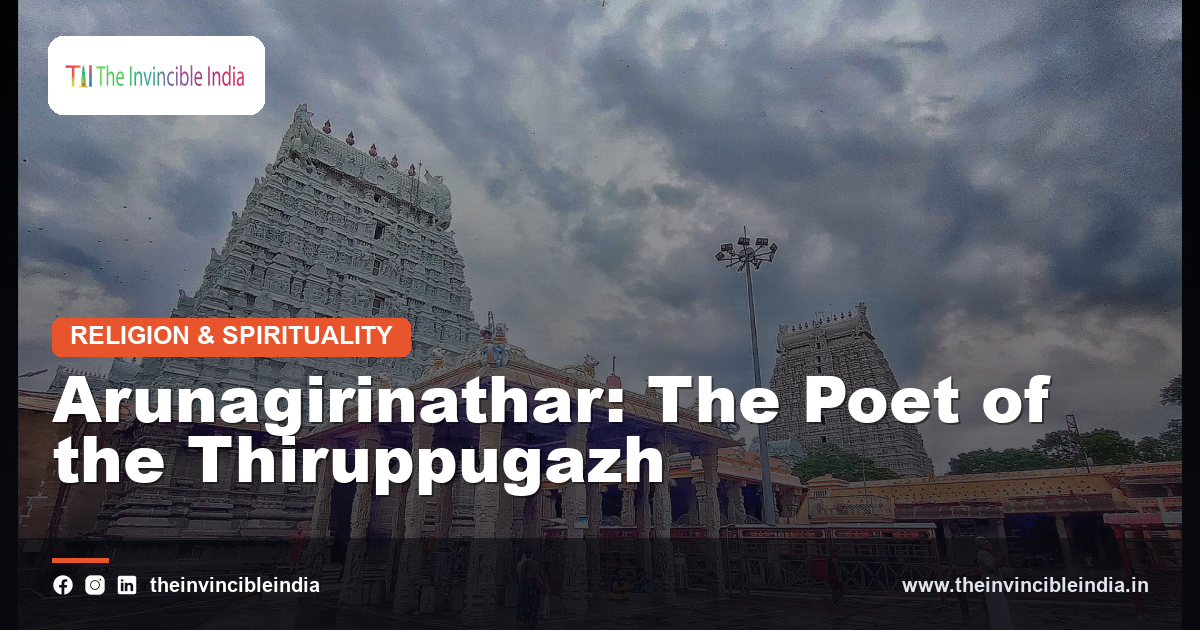
Arunagirinathar was a fifteenth-century Tamil poet-saint devoted to Murugan, also called Kartikeya and Subramanya, the son of Shiva, and he is honoured above all as the composer of the Thiruppugazh, one of the most celebrated bodies of Tamil devotional song. He is closely associated with Thiruvannamalai in Tamil Nadu, the great temple town of the Arunachaleswara temple, and with the many shrines of Murugan that he sang of in his travels. His hymns are admired both for their devotion and for their extraordinary rhythmic artistry. His life and work belong to the wider world of Tamil devotion and the worship of Murugan within the family of Shaivism, and though the story of his life comes largely through tradition, his standing as a great poet-saint is firmly held.
Quick answer: Arunagirinathar was a fifteenth-century Tamil poet-saint devoted to Murugan, the son of Shiva, honoured as the composer of the Thiruppugazh. Associated with Thiruvannamalai in Tamil Nadu and with many shrines of Murugan, he is celebrated for hymns admired for both devotion and rhythmic mastery. His story of early waywardness and redemption is cherished as a devotional tradition, and his songs remain a living part of Tamil worship.
Key Takeaways
- Arunagirinathar was a fifteenth-century Tamil poet-saint devoted to Murugan, the son of Shiva.
- He is honoured as the composer of the Thiruppugazh, a celebrated body of Tamil devotional songs.
- He is associated with Thiruvannamalai and the Arunachaleswara temple in Tamil Nadu.
- Murugan is also known as Kartikeya, Subramanya and Skanda.
- His songs are admired for both their devotion and their intricate rhythm.
- His story of early waywardness and redemption is cherished as a devotional tradition.
The sections below explain his life as told by tradition, his devotion to Murugan, the Thiruppugazh, its artistry, his link with Thiruvannamalai and his continuing place in Tamil devotion.
Quick Facts
| Detail | Information |
|---|---|
| Also known as | Arunagiri |
| Tradition | Tamil devotion to Murugan, within the Shaiva family |
| Era | Fifteenth century, traditionally dated |
| Region | Thiruvannamalai, Tamil Nadu |
| Language of works | Tamil |
| Principal work | The Thiruppugazh |
| Deity | Murugan (Kartikeya, Subramanya) |
| Principal shrine | Arunachaleswara temple, Thiruvannamalai |
Who Was Arunagirinathar?
Arunagirinathar was a Tamil poet-saint of the fifteenth century who is honoured as one of the greatest devotees of Murugan and as the composer of the Thiruppugazh, a celebrated body of Tamil devotional song. His life was given to the praise of Murugan, the son of Shiva.
He is remembered as a poet of extraordinary skill whose hymns united deep devotion with a mastery of rhythm and language rarely equalled in Tamil verse. Tradition links him with Thiruvannamalai and with the many shrines of Murugan across the Tamil country, which he is said to have visited and sung of in his travels. Although the story of his life comes largely through devotional tradition, his hymns survive and reveal a saint wholly absorbed in the love of Murugan, and they have secured his place as a great poet-saint of Tamil devotion.
Who Is Murugan, the Deity of Arunagirinathar?
Murugan is the deity to whom Arunagirinathar devoted his life and song, the son of Shiva widely worshipped in the Tamil country and across southern India. He is also known as Kartikeya, Subramanya, Skanda and by many other names, and he is honoured as a god of youth, valour and grace.
Murugan holds a special place in Tamil devotion, with great temples and hill shrines dedicated to him across the land. He is often depicted bearing a sacred spear and riding a peacock, and he is loved as a god close to his devotees. Arunagirinathar’s devotion was directed wholly to Murugan, and his Thiruppugazh sings the praises of the god at his many shrines. Understanding the place of Murugan in Tamil devotion helps a reader appreciate the setting and the spirit of the poet-saint’s hymns.
When and Where Did Arunagirinathar Live?
Arunagirinathar is traditionally placed in the fifteenth century, and because the sources are largely devotional it is wise to describe his era in general terms while holding to the broadly accepted period. He is associated above all with Thiruvannamalai, the great temple town in Tamil Nadu.
Thiruvannamalai is famed for the Arunachaleswara temple and the sacred hill of Arunachala, and it is the place with which the poet-saint’s memory is most closely bound. From this centre, tradition says, he travelled to the many shrines of Murugan across the Tamil country, singing of the god at each. Because the story of his life comes largely through tradition, careful writers describe his region and period with confidence while leaving finer details open, in keeping with the respectful caution the sources invite.
What Is the Story of Arunagirinathar's Early Life?
The story of Arunagirinathar’s early life, as told in devotional tradition, relates that he lived a wayward and dissolute youth before undergoing a profound change of heart and turning wholly to the worship of Murugan. This account is cherished as devotional tradition rather than documented history.
Tradition tells that, in deep despair, the young man was saved and transformed by the grace of Murugan, who is said to have appeared to him and set him on the path of devotion and song. From that turning point, the story holds, he became a poet-saint whose life was given to the praise of the god. This account of waywardness and redemption is treasured by devotees as an image of the saving power of divine grace, and it should be understood as a devotional belief that conveys a spiritual truth rather than a historical record.
How Did Arunagirinathar Turn to Devotion?
Arunagirinathar turned to devotion, as tradition relates, through the grace of Murugan, which lifted him from despair and set him on the path of song and worship. This turning is the heart of the devotional story of his life.
The tradition holds that at his lowest point the grace of the god reached him and transformed him utterly, so that the one who had been lost became a singer of the Lord’s praise. From that moment, the story says, the gift of poetry and devotion flowed from him in the hymns of the Thiruppugazh. For devotees this turning is the great lesson of his life, showing that no one is beyond the reach of divine grace and that a transformed heart can become an instrument of praise. The account is cherished as devotional belief and understood in that spirit.
What Is the Thiruppugazh?
The Thiruppugazh is the great body of Tamil devotional songs composed by Arunagirinathar in praise of Murugan, honoured as one of the masterpieces of Tamil devotional literature. Its name may be understood as holy praise or sacred glory, fitting for songs that celebrate the god.
The Thiruppugazh consists of many songs addressed to Murugan at his various shrines across the Tamil country, expressing devotion, praise and the longing of the soul for the god. The songs are renowned not only for their devotion but for their extraordinary rhythmic complexity, which sets them apart in Tamil poetry. They are sung in temples and gatherings and are a cherished part of the worship of Murugan. The Thiruppugazh stands as the crowning achievement of Arunagirinathar and the heart of his legacy as a poet-saint.
Why Is the Thiruppugazh Admired for Its Rhythm?
The Thiruppugazh is admired for its rhythm because Arunagirinathar composed its songs in intricate rhythmic patterns of great complexity and beauty, uniting the devotion of the words with a musical structure rarely equalled in Tamil verse. This rhythmic mastery is one of the marks of his genius.
The songs are built on elaborate metrical and rhythmic schemes that give them a flowing, dancing quality when recited or sung, delighting the ear even as the words move the heart. This union of devotion and rhythmic art makes the Thiruppugazh a treasure both of religion and of Tamil literature. Musicians and devotees prize the songs for the way their rhythm carries the praise of Murugan. The rhythmic artistry of the Thiruppugazh is widely regarded as one of its most distinctive and admired features, setting it apart among devotional hymns.
What Themes Appear in the Thiruppugazh?
The Thiruppugazh is marked by praise of Murugan, by the expression of devotion and surrender, and by reflection on the grace of the god and the longing of the soul for him. Its songs celebrate the god at his many shrines across the Tamil land.
The hymns dwell on the beauty, valour and grace of Murugan, on the smallness of the self and the greatness of divine mercy, and on the devotee’s yearning for the god. They often draw on the stories, forms and shrines of Murugan as known to the tradition, and some reflect on the passing nature of worldly things in contrast to the lasting worth of devotion. For devotees these songs are both praise and a path, a way of turning the heart to the god. They are valued for their devotion, their wisdom and their place in the Tamil devotional heritage.
How Is Arunagirinathar Linked to Thiruvannamalai?
Arunagirinathar is linked above all to Thiruvannamalai, the great temple town in Tamil Nadu famed for the Arunachaleswara temple and the sacred hill of Arunachala. Tradition associates the turning point of his life and much of his devotion with this holy place.
Thiruvannamalai is one of the most revered centres of worship in the Tamil country, sacred in the Shaiva tradition and bound up with the memory of the poet-saint. Tradition holds that it was here, at the great temple, that the decisive transformation of his life took place through the grace of Murugan. The association of Arunagirinathar with Thiruvannamalai gives his memory a firm and sacred setting, and for pilgrims and devotees the link keeps alive the story of the poet-saint and the songs he sang in praise of the god.
How Did Arunagirinathar Travel to the Shrines of Murugan?
Arunagirinathar is said in tradition to have travelled to the many shrines of Murugan across the Tamil country and beyond, composing songs of the Thiruppugazh in praise of the god at each place he visited. These travels are a cherished part of the devotional account of his life.
The shrines of Murugan, including the famed hill temples long revered by his devotees, are celebrated in the songs of the Thiruppugazh, which address the god in his various forms and settings. Through these travels, tradition holds, the poet-saint spread his devotion and his song across the land, linking the many shrines in a single body of praise. This picture of the wandering devotee singing of the god at each holy place is treasured by devotees, and it reflects the deep bond between the Thiruppugazh and the sacred geography of the worship of Murugan.
How Do Arunagirinathar's Songs Express Devotion?
Arunagirinathar’s songs express devotion through heartfelt praise of Murugan, through the longing of the soul for the god, and through the surrender of the devotee who seeks the grace and protection of the Lord. His devotion is direct, personal and wholehearted.
He often sings in the voice of a devotee who yearns for the presence and grace of Murugan, calling on the god with love and trust. His songs unite this devotion with the beauty of rhythm and language, so that the praise rises as both prayer and art. For devotees these hymns are a way of training the heart to seek the god with the same wholehearted love that the poet-saint himself displayed after his transformation. The devotion of Arunagirinathar, expressed in the Thiruppugazh, remains a living model and inspiration in the worship of Murugan.
What Other Works Are Attributed to Arunagirinathar?
Besides the Thiruppugazh, tradition attributes to Arunagirinathar other Tamil devotional works in praise of Murugan, so that he is honoured as the author of several compositions. The Thiruppugazh remains by far the most celebrated and beloved of these.
The further works attributed to him continue the themes of devotion to Murugan and share something of the artistry of his greatest work, though they are less widely known. Because these compositions belong to the living tradition and are studied within it, careful accounts describe them in general terms rather than claiming detailed knowledge of every text. Their attribution to Arunagirinathar deepens the portrait of him as a poet of devotion whose gift was poured out in the praise of the god, with the Thiruppugazh standing as the crown of his achievement.
How Is Arunagirinathar Honoured in Tradition and Art?
Arunagirinathar is honoured in Tamil tradition and art as a great poet-saint of Murugan, remembered in the temples of the god and wherever the Thiruppugazh is sung. His memory is especially cherished at Thiruvannamalai and at the shrines of Murugan he celebrated.
His image is honoured among the devotees and saints of the tradition, and the art expresses his character as a singer of the god’s praise rather than any worldly rank. The songs of the Thiruppugazh are recited and sung in worship, keeping his devotion alive in the temples. The honour given to Arunagirinathar reflects the love in which the poet-saint and his songs are held, and keeps his memory present in the devotional and musical life of the worship of Murugan in the Tamil country.
Why Does Arunagirinathar Still Matter Today?
Arunagirinathar still matters today because the Thiruppugazh remains a living and beloved part of the worship of Murugan, sung in temples and homes across the Tamil country and beyond. His songs continue to carry devotion to new generations.
For devotees he is a great poet-saint whose life, as tradition tells it, shows the saving power of divine grace, and whose songs unite devotion with incomparable artistry. Scholars and musicians value the Thiruppugazh as a treasure of Tamil literature and devotional music. Careful readers honour the context of his tradition and treat the story of his waywardness and redemption, and the other accounts of his life, as devotional belief, while recognising the enduring beauty and importance of the songs that have made him one of the great saints of Tamil devotion.
Arunagirinathar Today
Arunagirinathar today is remembered as the great poet-saint of Murugan and the composer of the Thiruppugazh, honoured at Thiruvannamalai and at the shrines of the god across the Tamil country. His songs remain a living presence in the worship of Murugan and in Tamil devotional music.
Through his hymns he gave the worship of Murugan some of its most beloved and artful songs, and through the devotional story of his transformation he offered an image of the saving grace of the god. The story of his life comes largely through tradition, yet the survival and daily singing of the Thiruppugazh give a clear and constant witness to his devotion and his genius. His legacy endures as a reminder that devotion and art can rise together in the praise of the divine, lifting both the heart and the ear.
Sources & Further Reading
- Ministry of Culture, Government of India (indiaculture.gov.in).
- Sahitya Akademi general references on Tamil devotional literature.
Frequently Asked Questions
Who was Arunagirinathar?
Arunagirinathar was a fifteenth-century Tamil poet-saint devoted to Murugan, the son of Shiva, honoured as the composer of the Thiruppugazh. He is associated with Thiruvannamalai in Tamil Nadu and is celebrated for songs admired for both devotion and rhythmic mastery.
What is the Thiruppugazh?
The Thiruppugazh is the great body of Tamil devotional songs composed by Arunagirinathar in praise of Murugan at his various shrines. Its name may be understood as holy praise, and it is renowned for both its devotion and its extraordinary rhythmic complexity.
Who is Murugan?
Murugan is the deity to whom Arunagirinathar was devoted, the son of Shiva widely worshipped in the Tamil country and across southern India. He is also known as Kartikeya, Subramanya and Skanda, and is honoured as a god of youth, valour and grace.
What is the story of Arunagirinathar's life?
Tradition relates that Arunagirinathar lived a wayward youth before a profound change of heart turned him wholly to the worship of Murugan, saved by the grace of the god. This account of waywardness and redemption is cherished as a devotional tradition rather than documented history.
Why is the Thiruppugazh famous?
The Thiruppugazh is famous for uniting deep devotion to Murugan with intricate and beautiful rhythmic patterns rarely equalled in Tamil verse. This union of devotion and rhythmic artistry makes it a treasure of both religion and Tamil literature.
Where is Arunagirinathar associated?
Arunagirinathar is associated above all with Thiruvannamalai in Tamil Nadu, famed for the Arunachaleswara temple and the sacred hill of Arunachala. Tradition also links him with the many shrines of Murugan he visited and sang of in his travels.


