

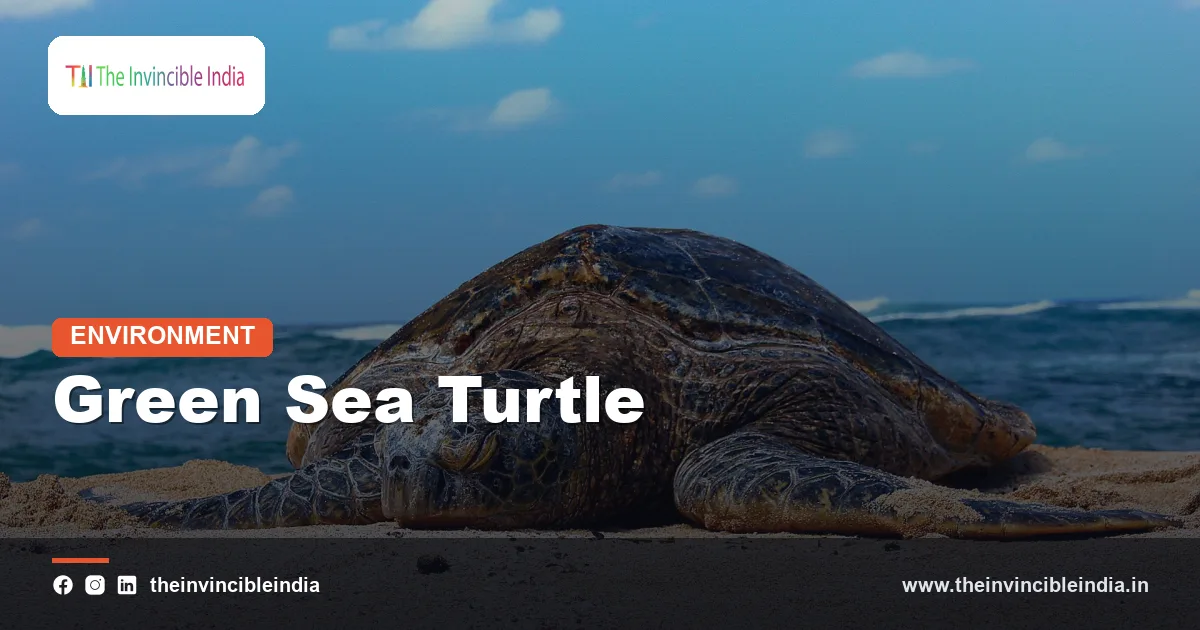
The green sea turtle (Chelonia mydas) is a large marine turtle that grazes on seagrass and algae and nests on Indian islands and coasts, notably in Lakshadweep, the Andaman and Nicobar Islands and Gujarat. In India it is a protected species under the Wildlife (Protection) Act, 1972, and it plays an important role in keeping seagrass meadows and coral reef ecosystems healthy.
The green sea turtle is named not for the colour of its shell but for the greenish tint of its body fat, which comes from a diet of marine plants. This explainer covers where the green sea turtle lives in India, what it eats, why it matters for coastal ecosystems, what threatens it and how it is protected. Population figures are described in broad terms because counts vary by site and season. Last reviewed: 17 October 2026.
| Attribute | Detail |
|---|---|
| Common name | Green sea turtle (also green turtle) |
| Scientific name | Chelonia mydas |
| Family | Cheloniidae (hard-shelled sea turtles) |
| Adult size | Shell length around 80 to 120 centimetres; weight commonly about 70 to 190 kilograms |
| Diet | Mainly seagrass and algae as adults; juveniles are more omnivorous |
| Main Indian nesting regions | Lakshadweep, Andaman and Nicobar Islands, Gujarat coast and, in smaller numbers, other coasts |
| Major Indian feeding area | Seagrass beds of the Gulf of Mannar and Palk Bay, Tamil Nadu |
| Legal protection in India | Wildlife (Protection) Act, 1972 (listed among the most strictly protected species) |
| Global status | Listed as Endangered for many years; recent assessments report improvement overall, but local populations vary |
Key Takeaways
- The green sea turtle (Chelonia mydas) is the main herbivorous sea turtle in Indian waters and feeds largely on seagrass and algae as an adult.
- Green sea turtles in India nest on islands and coasts such as Lakshadweep, the Andaman and Nicobar Islands and Gujarat, and feed on seagrass beds in places such as the Gulf of Mannar.
- By grazing seagrass, the green sea turtle keeps meadows short and healthy, which supports fish, invertebrates and the carbon stored in coastal sediments.
- The major threats to the green sea turtle in India are accidental capture in fishing gear, poaching of eggs and meat, coastal development, pollution and climate change.
- The green sea turtle is protected under India’s Wildlife (Protection) Act, 1972, and by international agreements including CITES and the Convention on Migratory Species.
- Female green sea turtles return to nest on or near the beaches where they hatched, so the loss of a nesting beach can affect a population for decades.
What is the green sea turtle?
The green sea turtle is a large, long-lived marine reptile in the family Cheloniidae that spends most of its life at sea and comes ashore only for females to lay eggs. It occurs in tropical and subtropical oceans around the world and is one of the five sea turtle species recorded in Indian waters.
Like all sea turtles, the green sea turtle breathes air, so it must surface to breathe, although it can rest underwater for long periods. Its limbs are modified into paddle-shaped flippers that suit powerful swimming. Adults are strong swimmers and make long migrations between feeding areas and nesting beaches.
The species name, Chelonia mydas, was given in the eighteenth century. In many regions, including parts of coastal India, the green sea turtle has long been hunted for its meat and eggs, which is one reason why it needed legal protection.
What does the green sea turtle look like and how big does it grow?
An adult green sea turtle has a smooth, heart-shaped shell that is olive, brown or black, often marked with streaks, and a relatively small head with a rounded snout. It grows to a shell length of roughly 80 to 120 centimetres and a weight that is commonly in the range of 70 to 190 kilograms.
The green sea turtle can be told from the hawksbill turtle by its blunt, rounded beak and the single pair of scales between its eyes, whereas the hawksbill has a narrow, pointed beak. Its underside is pale yellowish or white. Hatchlings are dark above and light below, which helps camouflage them from predators when seen from above or below in the water.
The bill of an adult has finely serrated edges, which help the turtle tear tough seagrass blades. The internal fat is the green colour that gave the animal its common name.
Where does the green sea turtle live and nest in India?
The green sea turtle lives in the warm coastal waters around India and nests mainly on the islands of Lakshadweep and the Andaman and Nicobar Islands and on parts of the Gujarat coast. It feeds in shallow areas with seagrass and algae, notably the Gulf of Mannar and Palk Bay.
| Region | Role for the green sea turtle | Notes |
|---|---|---|
| Lakshadweep | Nesting and feeding | Uninhabited islets and atolls, such as Suheli and Bangaram, are known nesting sites; the lagoons have seagrass |
| Andaman and Nicobar Islands | Nesting and feeding | Several beaches host nests; the islands also support seagrass and coral habitats |
| Gujarat | Nesting and feeding | Includes areas near the Gulf of Kachchh, where a marine national park protects seagrass and coral areas |
| Gulf of Mannar and Palk Bay, Tamil Nadu | Feeding grounds | Among the best-known seagrass areas in India; the green sea turtle is commonly seen here |
| Other coasts | Occasional nesting or foraging | Records exist along parts of the east and west coasts; numbers are generally low |
Distribution within India is patchy, and the best-protected sites are generally islands and marine protected areas. Researchers also track turtles that move between India, Sri Lanka and the wider Indian Ocean, which shows that the animals do not recognise national borders.
What does the green sea turtle eat?
The green sea turtle is the only mainly herbivorous sea turtle, and adults feed chiefly on seagrass and algae, while young turtles eat a mix of plants and small animals. This diet distinguishes it from the hawksbill, which eats sponges, and the leatherback, which eats jellyfish.
Hatchlings and small juveniles live in open water and eat jellyfish, small crustaceans and other plankton-like prey. When they reach a size of roughly 20 to 40 centimetres, they settle in shallow coastal waters and change over to a plant diet. In India this change generally brings them into seagrass meadows in lagoons and bays.
Because it eats plants, the green sea turtle is a primary consumer in the marine food web. The shift from animal to plant diet is gradual, and individual turtles may still take sponges, jellyfish or other items opportunistically.
Why is the green sea turtle important for seagrass and reef health?
The green sea turtle is important for seagrass and reef health because its grazing keeps seagrass meadows short and productive, recycles nutrients and prevents overgrown beds from decaying. Ecologists often compare the turtle’s role to that of grazers on land.
Seagrass meadows provide nursery habitat for many commercially important fish and invertebrates, protect shorelines from erosion and store carbon in their sediments. By cropping the blades, turtles encourage new growth, which makes the meadows denser and more nutritious. Grazing also reduces the build-up of old, shaded blades that may rot and encourage disease in the bed.
The turtle also contributes to nutrient transfer. Nutrients taken from the sea are carried to nesting beaches in the form of eggs and hatchling remains, which feed beach vegetation and animals. Where green sea turtle numbers fall sharply, seagrass beds can become overgrown, and the food webs that depend on them may change.
- It supports fish nurseries by maintaining healthy seagrass.
- It helps nutrient cycling in shallow lagoons.
- It transfers nutrients to nesting beaches and dunes.
- It acts as an indicator of coastal ecosystem health.
How does the green sea turtle’s life cycle work?
The green sea turtle’s life cycle begins when a female lays eggs in a sand nest, the hatchlings enter the sea, grow for decades in the ocean and coastal waters and return as adults to breed. It is among the slowest-maturing animals in the sea, with sexual maturity often reached only after two to four decades.
Nesting
Females crawl ashore at night, dig a body pit and then an egg chamber and lay roughly 100 or more eggs per clutch. A female may nest several times in a season, and then skip two to five years before nesting again. Eggs hatch after about two months, depending on sand temperature.
Hatchlings and the lost years
Hatchlings emerge mostly at night, crawl to the sea and swim offshore. The early years are spent drifting in the open ocean and are poorly known, which is why scientists call them the lost years.
Sex and temperature
The sex of green sea turtle hatchlings is set by the temperature of the sand during incubation, with warmer nests producing more females. Because of climate change, researchers are concerned that rising temperatures could skew sex ratios on some beaches.
What threats does the green sea turtle face in India?
The main threats to the green sea turtle in India are accidental capture in fishing gear, the collection of eggs and meat, the loss or degradation of nesting beaches and seagrass, marine pollution and climate change. Different threats dominate in different regions.
- Fisheries bycatch: Turtles drown when caught in trawl nets, gillnets and longlines. Abandoned nets, known as ghost gear, also trap them. Turtle excluder devices (TEDs) are designed to let turtles escape from trawl nets and are required in some Indian trawl fisheries, though compliance and enforcement vary.
- Poaching: Eggs and, in some places, adult turtles are still taken illegally for food. Historically, turtle meat was consumed in several island communities.
- Coastal development: Ports, resorts, roads, sea walls and sand mining can destroy nesting beaches. Artificial lighting confuses hatchlings, which move toward bright lights instead of the sea.
- Seagrass loss: Dredging, trawling, sedimentation and pollution damage the meadows that adults need for food.
- Plastic and pollution: Turtles ingest plastic bags and get entangled in debris.
- Disease: Fibropapillomatosis, a tumour-forming disease, has been recorded in green turtles worldwide, and is linked to polluted coastal waters.
- Predators and climate: Dogs, jackals, crabs and monitor lizards raid nests, while sea-level rise and hotter sand reduce nesting success.
How is the green sea turtle protected in India?
The green sea turtle is protected in India mainly by the Wildlife (Protection) Act, 1972, which bans hunting, trade and the collection of eggs, and by marine protected areas and coastal regulations. International agreements add further obligations.
| Instrument | What it does |
|---|---|
| Wildlife (Protection) Act, 1972 | Lists sea turtles among the most strictly protected species and prohibits killing, capture and trade (readers should check the current schedules) |
| Coastal Regulation Zone (CRZ) rules | Restrict construction near the sea and give recognition to turtle nesting sites as sensitive areas |
| Marine protected areas | Include the Gulf of Mannar Marine National Park and the Gulf of Kachchh Marine National Park, both created in the early 1980s, and Mahatma Gandhi Marine National Park in the Andamans |
| CITES | Regulates international trade in green sea turtles and their products |
| Convention on Migratory Species (CMS) | Encourages cooperation among countries that share migratory turtle populations |
| IOSEA Marine Turtle MoU | A voluntary Indian Ocean and South-East Asia agreement on marine turtles, which India joined in the early 2000s |
Fisheries rules also matter. Some coastal states and the central government have introduced seasonal fishing restrictions, TED requirements and guidelines to reduce bycatch. India has also published national guidance and action plans for marine turtle conservation in the 2020s, which set priorities for research, habitat protection and community involvement.
Which organisations and projects conserve green sea turtles in India?
Green sea turtle conservation in India is carried out by state forest departments, research institutions and non-governmental organisations, often with the help of coastal communities. State forest departments patrol beaches and manage hatcheries, while scientists carry out surveys and satellite tracking.
The Wildlife Institute of India, the Zoological Survey of India and university groups study turtle ecology. Non-profit organisations and networks, such as Dakshin Foundation and the Students’ Sea Turtle Conservation Network, work on monitoring, community engagement and fishery issues. In the Andaman and Nicobar Islands, local teams and researchers monitor nesting beaches, and in Lakshadweep, the administration and local communities are involved in protecting nesting islets.
Community involvement is important because coastal residents are often the first to find nests, stranded turtles or entangled animals. Training fishers to release turtles safely from nets is one of the most practical conservation actions.
Is the green sea turtle endangered?
The green sea turtle was listed as Endangered by the IUCN for many years, and recent assessments have reported an improving global picture, but regional populations remain at risk and the species still depends on conservation measures. The status can differ between ocean basins and nesting sites.
Global trends are driven largely by a few very large nesting populations. Some of these have grown since hunting was banned, which shows that protection can work. In contrast, smaller populations, such as those in parts of South Asia, have had less monitoring, and trends are less certain. Readers who want the current classification should check the IUCN Red List directly.
The lesson from India is that green sea turtle recovery depends on long-term beach protection, safe fisheries and healthy seagrass, not only on legal listing.
Bottom Line
The green sea turtle is India’s main seagrass-grazing marine turtle and a keystone of shallow coastal ecosystems. It is legally protected, but bycatch, poaching, coastal development and climate change still threaten it. Protecting nesting beaches, seagrass meadows and fishing practices together offers the best chance of long-term recovery.
Frequently Asked Questions
Where do green sea turtles nest in India?
Green sea turtles nest in India mainly on the islands of Lakshadweep and the Andaman and Nicobar Islands and on parts of the Gujarat coast. Smaller numbers nest elsewhere along the mainland coast. Many nesting beaches are remote, which helps protect them.
What do green sea turtles eat?
Adult green sea turtles eat mostly seagrass and algae, which makes them the main herbivores among sea turtles. Juveniles eat a more varied diet that includes jellyfish and small animals. The change to a plant diet happens as they settle in shallow coastal waters.
Why is the green sea turtle important to the ocean?
The green sea turtle is important because its grazing keeps seagrass meadows healthy and productive. Healthy seagrass supports fish nurseries, protects shorelines and stores carbon. Turtles also move nutrients from the sea to nesting beaches.
Is it legal to keep or trade green sea turtles in India?
No, it is illegal to hunt, keep, sell or trade green sea turtles, their eggs or products in India. The species is protected under the Wildlife (Protection) Act, 1972, and is also covered by CITES. Offences can lead to imprisonment and fines, and readers should check the latest provisions of the law.
What is the biggest threat to green sea turtles in India?
Accidental capture in fishing gear is widely regarded as one of the biggest threats to green sea turtles in India, alongside poaching and coastal development. Turtles that get caught in nets cannot surface to breathe and may drown. Turtle excluder devices and safe release practices can reduce this risk.
How can I help protect green sea turtles?
You can help protect green sea turtles by avoiding single-use plastic, keeping nesting beaches dark and clean at night and reporting stranded or entangled turtles to the forest department. Visitors should never touch nests or disturb nesting females. Supporting responsible seafood and community conservation programmes also helps.
{“@context”:”https://schema.org”,”@graph”:[{“@type”:”FAQPage”,”mainEntity”:[{“@type”:”Question”,”name”:”Where do green sea turtles nest in India?”,”acceptedAnswer”:{“@type”:”Answer”,”text”:”Green sea turtles nest in India mainly on the islands of Lakshadweep and the Andaman and Nicobar Islands and on parts of the Gujarat coast. Smaller numbers nest elsewhere along the mainland coast. Many nesting beaches are remote, which helps protect them.”}},{“@type”:”Question”,”name”:”What do green sea turtles eat?”,”acceptedAnswer”:{“@type”:”Answer”,”text”:”Adult green sea turtles eat mostly seagrass and algae, which makes them the main herbivores among sea turtles. Juveniles eat a more varied diet that includes jellyfish and small animals. The change to a plant diet happens as they settle in shallow coastal waters.”}},{“@type”:”Question”,”name”:”Why is the green sea turtle important to the ocean?”,”acceptedAnswer”:{“@type”:”Answer”,”text”:”The green sea turtle is important because its grazing keeps seagrass meadows healthy and productive. Healthy seagrass supports fish nurseries, protects shorelines and stores carbon. Turtles also move nutrients from the sea to nesting beaches.”}},{“@type”:”Question”,”name”:”Is it legal to keep or trade green sea turtles in India?”,”acceptedAnswer”:{“@type”:”Answer”,”text”:”No, it is illegal to hunt, keep, sell or trade green sea turtles, their eggs or products in India. The species is protected under the Wildlife (Protection) Act, 1972, and is also covered by CITES. Offences can lead to imprisonment and fines, and readers should check the latest provisions of the law.”}},{“@type”:”Question”,”name”:”What is the biggest threat to green sea turtles in India?”,”acceptedAnswer”:{“@type”:”Answer”,”text”:”Accidental capture in fishing gear is widely regarded as one of the biggest threats to green sea turtles in India, alongside poaching and coastal development. Turtles that get caught in nets cannot surface to breathe and may drown. Turtle excluder devices and safe release practices can reduce this risk.”}},{“@type”:”Question”,”name”:”How can I help protect green sea turtles?”,”acceptedAnswer”:{“@type”:”Answer”,”text”:”You can help protect green sea turtles by avoiding single-use plastic, keeping nesting beaches dark and clean at night and reporting stranded or entangled turtles to the forest department. Visitors should never touch nests or disturb nesting females. Supporting responsible seafood and community conservation programmes also helps.”}}]}]}


