

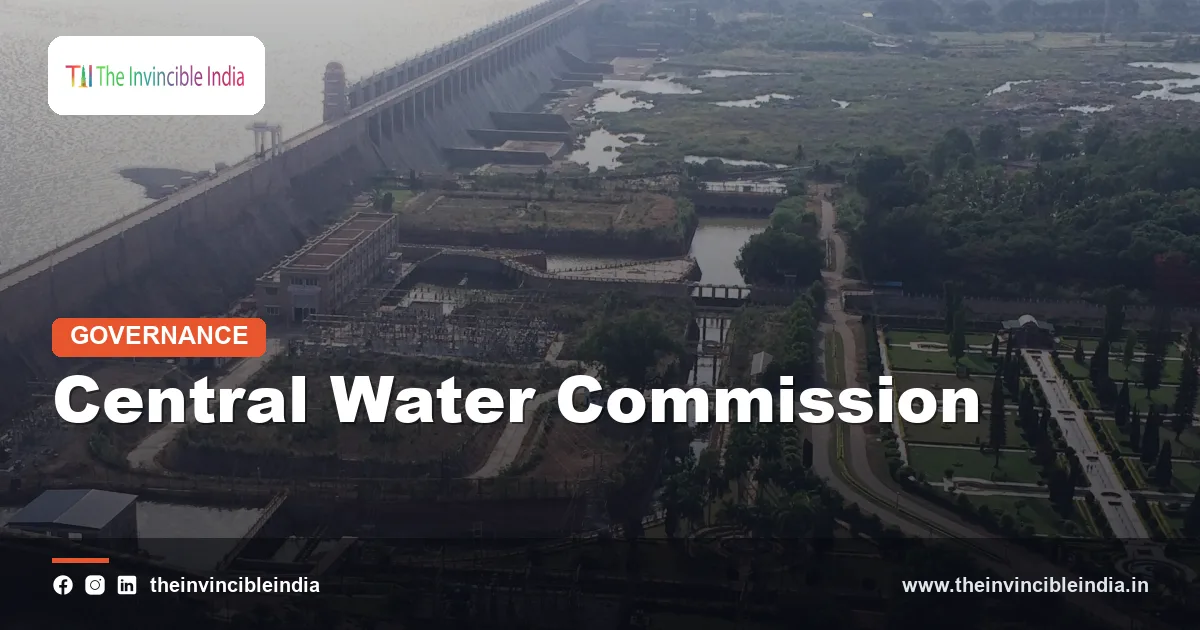
The Central Water Commission (CWC) is India’s premier technical organisation for water resources, set up in 1945 and now functioning under the Ministry of Jal Shakti, Government of India. It advises the Union Government and the States on rivers, dams, floods and irrigation projects, and it runs the country’s best-known network for river gauging and flood forecasting.
Most people meet the Central Water Commission through a flood bulletin on the news or a weekly reservoir storage figure. Behind those headlines lies a much larger engineering and data organisation, which this explainer breaks down in plain terms, including its history, wings, powers and limits. Last updated: 17 October 2026.
| Full name | Central Water Commission (CWC) |
|---|---|
| Established | 1945, originally as the Central Waterways, Irrigation and Navigation Commission |
| Parent ministry | Ministry of Jal Shakti (Department of Water Resources, River Development and Ganga Rejuvenation) |
| Nature of body | Attached technical office of the Government of India |
| Headed by | A Chairman, who is also ex-officio Secretary to the Government of India |
| Headquarters | Sewa Bhawan, R.K. Puram, New Delhi |
| Core functions | Flood forecasting, hydrological data, dam safety support, project appraisal, river basin planning |
| Best-known outputs | Flood forecasts, weekly reservoir storage bulletins, National Register of Large Dams |
| Legal status of water | Water is mainly a State subject under the Constitution, so CWC is advisory and technical rather than a controlling authority |
Key Takeaways
- The Central Water Commission was established in 1945 and is India’s apex technical body for surface water resources, working under the Ministry of Jal Shakti.
- The Central Water Commission operates one of Asia’s largest river-gauging and flood-forecasting networks, with hundreds of stations across the Indian river basins.
- The Central Water Commission publishes a regular storage bulletin for India’s major reservoirs, which helps in judging drought, power generation and irrigation prospects.
- The Central Water Commission appraises the technical and economic soundness of large irrigation, flood-control and multipurpose projects, but it does not build most of them.
- The Central Water Commission supports implementation of the Dam Safety Act, 2021 and maintains the National Register of Large Dams.
- The Central Water Commission is a technical adviser, not a regulator, because water is mainly a State subject under the Constitution of India.
What is the Central Water Commission?
The Central Water Commission is the Government of India’s senior technical body for planning, designing and monitoring surface water resources such as rivers, reservoirs and canals. It collects the hydrological data on which flood warnings, dam operations and irrigation planning depend, and it examines project proposals sent by State governments before they are cleared at the Centre.
The organisation is not a ministry and has no political head. It is staffed by engineers and hydrologists drawn largely from the Central Water Engineering Service, and it reports to the Department of Water Resources, River Development and Ganga Rejuvenation, which sits inside the Ministry of Jal Shakti. That ministry was formed in 2019 by combining the earlier water resources ministry with the drinking water and sanitation ministry.
Think of the Central Water Commission as the national hydrology and dam-engineering desk. States own most rivers’ day-to-day management, so the Commission supplies the numbers, models, designs and expert opinions that States and the Centre rely on when taking decisions.
When and why was the Central Water Commission created?
The Central Water Commission was created in 1945, in the final years of British rule, as the Central Waterways, Irrigation and Navigation Commission, after floods, famines and uneven irrigation had shown the need for a single national technical agency. The move is widely linked to the efforts of Dr B.R. Ambedkar, then the Labour Member in the Viceroy’s Executive Council, who pushed for river valley development and multipurpose projects. A.N. Khosla is generally recalled as its first chairman.
After Independence, India launched ambitious river valley projects, and the Commission became the technical backbone of that era. It contributed to the design and appraisal of early multipurpose schemes that became symbols of the planning period, including works on the Damodar, Mahanadi and Sutlej rivers. In later decades the focus widened from building dams to managing floods, sharing data, rehabilitating ageing dams and planning for climate-driven variability.
Milestones in brief
- 1945: the Commission is founded as the Central Waterways, Irrigation and Navigation Commission.
- 1950s: river valley projects begin to multiply, and the Commission takes on large design and appraisal work.
- 1958: the first scientific flood forecast is issued for Delhi on the Yamuna, widely regarded as the start of formal flood forecasting in India.
- 1980s onwards: the hydrological observation network expands and data management improves.
- 2019: the Commission comes under the newly created Ministry of Jal Shakti.
- 2021: the Dam Safety Act is enacted, giving the Commission a larger technical role in dam safety oversight.
How is the Central Water Commission organised?
The Central Water Commission is organised into a headquarters with several wings and a network of regional and field offices spread across river basins. The Chairman leads the organisation, supported by Members who look after the main wings.
- Design and Research wing: prepares and reviews designs of dams, barrages, spillways and hydraulic structures, and supports model studies and testing.
- River Management wing: handles flood management, flood forecasting, hydrological observation, and the operation of the national river-gauging network.
- Water Planning and Projects wing: carries out techno-economic appraisal of projects, basin planning, inter-state aspects and project monitoring.
Beneath these wings, the Commission runs basin-wise and regional organisations, including offices responsible for large river systems such as the Ganga, Brahmaputra, Godavari, Krishna, Mahanadi and Narmada. Its field offices measure river levels, discharge and sediment, and they feed the data to forecasting centres.
Specialised bodies sit alongside the Commission but are separate organisations. The Ganga Flood Control Commission, the Brahmaputra Board and the National Water Development Agency each have their own mandates, and the National Water Informatics Centre handles national water data portals.
What does the Central Water Commission do?
The Central Water Commission performs five broad jobs: observing rivers, forecasting floods, appraising projects, supporting dam safety, and advising on inter-state and international water matters. Each job rests on the same foundation, which is accurate and continuous hydrological data.
Hydrological observation
The Commission measures river water level, discharge, sediment load and water quality at a large number of gauge sites. These long-running records are used by dam designers, irrigation planners, researchers and disaster managers alike.
Project appraisal and planning
State governments send detailed project reports for major and medium irrigation, flood-control and multipurpose schemes to the Commission for technical and economic scrutiny. Advisory bodies of the ministry then use the Commission’s findings when deciding on central assistance and clearances.
Basin planning and studies
The Commission prepares river basin assessments, water balance studies and reports on water availability. These help the country plan how much water exists in each basin and how it may be shared among uses.
Technical support in disputes and treaties
The Commission supplies technical data and expertise in inter-state water discussions and in cooperation with neighbouring countries on shared rivers. It does not settle disputes; that role belongs to tribunals and the courts.
How does the Central Water Commission forecast floods?
The Central Water Commission forecasts floods by combining real-time river level and rainfall readings from its gauge network with hydrological models, then issuing warnings to State governments and disaster agencies. It issues two main kinds of forecast: a level forecast, which predicts the height of water at a downstream site, and an inflow forecast, which predicts the volume of water entering a dam or barrage.
Forecasts are usually issued for sites where a river is expected to cross its warning or danger level. The warning level signals that the river is rising towards a risk zone, while the danger level indicates that flooding of nearby land and settlements is likely. The Highest Flood Level (HFL) is the record peak for that site.
The Commission describes flood situations in simple categories, which range from low flood through moderate and high flood to unprecedented flood. Its bulletins are shared with State water resources departments, district authorities, the National Disaster Management Authority, the National Disaster Response Force and the media. Lead times are usually measured in hours to a day or two, which is enough time for evacuations but not for long-range planning.
Accuracy depends on rainfall inputs from the India Meteorological Department, on upstream gauge data, and on how quickly a river responds. Flash floods in small hilly catchments are harder to forecast than slow rises in large plains rivers such as the Ganga.
What role does the Central Water Commission play in dam safety?
The Central Water Commission supports dam safety by maintaining the National Register of Large Dams, advising on design standards, reviewing the condition of ageing dams and assisting the bodies created under the Dam Safety Act, 2021. The Act established the National Committee on Dam Safety and the National Dam Safety Authority, and it requires State Dam Safety Organisations to monitor dams in their territory.
India has thousands of large dams, and a significant share are several decades old. The Commission has promoted inspection routines before and after the monsoon, instrumentation, emergency action plans and risk assessment. The Dam Rehabilitation and Improvement Programme (DRIP), supported by external funding, was one major effort to repair and modernise selected dams.
The Commission also issues guidelines on reservoir operation, flood cushions, spillway adequacy and the design flood used to size a dam’s overflow capacity. These technical documents are used by dam owners across the country.
How does the Central Water Commission monitor reservoirs?
The Central Water Commission monitors reservoirs by collecting storage data from a large set of major reservoirs and publishing a periodic bulletin that compares current storage with last year’s level and the ten-year average. The bulletin is widely quoted during summers and the monsoon.
The figures matter for several reasons. Reservoir levels indicate the likely availability of drinking water and irrigation for the coming season, they influence hydropower planning, and they offer an early view of drought stress. A reservoir filling faster than usual may also signal flood risk downstream.
- Storage is usually reported as a percentage of live storage capacity.
- Regional breakdowns by North, East, West, Central and South help show where the stress lies.
- The coverage is of large reservoirs, so small tanks and village ponds are not included.
Who runs the Central Water Commission and who does it report to?
The Central Water Commission is run by a Chairman, who is ex-officio Secretary to the Government of India and reports to the Secretary of the Department of Water Resources, River Development and Ganga Rejuvenation and, through the department, to the Union Minister of Jal Shakti. The post is held by a senior engineer from the Central Water Engineering Service.
The Chairman is assisted by Members in charge of the three wings, and by Chief Engineers who head directorates and regional offices. Because office-holders change over time, readers who need the current names should check the official ministry notifications.
Is water a Central or a State subject, and where does the Commission fit?
Water is mainly a State subject in India, covered by Entry 17 of the State List in the Seventh Schedule, while the Union has power over the regulation and development of inter-state rivers and river valleys to the extent declared by Parliament under Entry 56 of the Union List. This split is the reason the Central Water Commission advises and supports rather than directs.
Article 262 of the Constitution allows Parliament to provide for the adjudication of disputes over inter-state rivers. Parliament has used it to pass the Inter-State River Water Disputes Act, 1956 and the River Boards Act, 1956. The Commission is not a tribunal under these laws, but its data is often essential evidence.
| Body | Main role |
|---|---|
| Central Water Commission | Technical data, forecasting, appraisal, dam engineering support |
| Central Ground Water Board | Groundwater survey, assessment and management |
| National Water Development Agency | Studies for linking rivers and transferring water between basins |
| Brahmaputra Board | Planning and development in the Brahmaputra and Barak basins |
| Inter-State River Water Disputes Tribunals | Adjudicating specific river-sharing disputes |
| India Meteorological Department | Rainfall observation and weather forecasts feeding flood forecasts |
How can ordinary people use Central Water Commission information?
Ordinary people can use Central Water Commission information by checking its flood bulletins, river-level data and reservoir storage reports published on official government portals, which are free to view. Farmers, journalists, researchers, local officials and residents in flood-prone areas all benefit from these numbers.
- Residents near rivers can watch the warning and danger levels at the nearest forecasting station.
- Farmers and water managers can follow storage trends to plan sowing and release schedules.
- Students and researchers can use long-term discharge and sediment data for studies.
- Journalists can compare current reservoir storage with the previous year and the ten-year average.
The data are often shown through the India Water Resources Information System (India-WRIS), a national platform developed with the Indian Space Research Organisation, and through the Commission’s own websites and mobile applications. For emergency action, local district authorities remain the first point of contact.
What are the limits and challenges of the Central Water Commission?
The main limits of the Central Water Commission are its advisory status, the difficulty of forecasting sudden flash floods, ageing infrastructure and the pressure of climate variability. The Commission can recommend but cannot compel States to follow its advice on reservoir operation or project design.
- Short lead time: in steep, small catchments, rivers can rise faster than a forecast can be issued.
- Data gaps: unmonitored tributaries and small streams reduce forecasting accuracy.
- Ageing dams: a large number of dams need repair, instrumentation and updated flood estimates.
- Climate variability: heavier short bursts of rain and shifting monsoon patterns challenge historical design assumptions.
- Coordination: river basins cross state lines, and decisions in one State affect another.
Efforts to meet these challenges include newer telemetry, satellite-based inputs, better rainfall-runoff models and closer cooperation with the India Meteorological Department and State agencies.
Bottom Line
The Central Water Commission is the technical memory and early-warning system of India’s rivers. It cannot stop a flood or order a State to release water, but its data, forecasts, designs and appraisals shape almost every major decision about dams, floods and irrigation in the country.
Frequently Asked Questions
What is the Central Water Commission in simple words?
The Central Water Commission is India’s top technical agency for rivers, dams and floods. It collects river data, forecasts floods, reviews big water projects and supports dam safety. It works under the Ministry of Jal Shakti and was set up in 1945.
Does the Central Water Commission control dams in India?
No, the Central Water Commission does not own or operate most dams. Dams are usually owned and run by State governments, public sector undertakings or private owners. The Commission provides design review, technical guidelines, data and support under the Dam Safety Act, 2021.
How does the Central Water Commission issue flood warnings?
The Central Water Commission issues flood warnings by using real-time river level and rainfall data from its gauge stations and running forecasting models. It sends the forecasts to State governments, disaster management authorities and the public, usually with a lead time of hours to a day or two. The warnings are based on levels such as the warning level and the danger level at each site.
Where is the headquarters of the Central Water Commission?
The Central Water Commission has its headquarters at Sewa Bhawan, R.K. Puram, in New Delhi. It also runs regional and field offices across river basins in the country. These offices gather river data and support project work in their regions.
Is the Central Water Commission the same as the Central Ground Water Board?
No, the two are separate organisations with different jobs. The Central Water Commission deals mainly with surface water such as rivers, reservoirs and floods, whereas the Central Ground Water Board studies and manages groundwater. Both work under the Ministry of Jal Shakti.
Can the public access Central Water Commission data?
Yes, a large amount of Central Water Commission data is available to the public through official portals and bulletins, including flood forecasts and reservoir storage reports. India-WRIS also presents river and reservoir data in map form. Some detailed or sensitive datasets may need formal permission or a request to the department.
{“@context”:”https://schema.org”,”@graph”:[{“@type”:”FAQPage”,”mainEntity”:[{“@type”:”Question”,”name”:”What is the Central Water Commission in simple words?”,”acceptedAnswer”:{“@type”:”Answer”,”text”:”The Central Water Commission is India’s top technical agency for rivers, dams and floods. It collects river data, forecasts floods, reviews big water projects and supports dam safety. It works under the Ministry of Jal Shakti and was set up in 1945.”}},{“@type”:”Question”,”name”:”Does the Central Water Commission control dams in India?”,”acceptedAnswer”:{“@type”:”Answer”,”text”:”No, the Central Water Commission does not own or operate most dams. Dams are usually owned and run by State governments, public sector undertakings or private owners. The Commission provides design review, technical guidelines, data and support under the Dam Safety Act, 2021.”}},{“@type”:”Question”,”name”:”How does the Central Water Commission issue flood warnings?”,”acceptedAnswer”:{“@type”:”Answer”,”text”:”The Central Water Commission issues flood warnings by using real-time river level and rainfall data from its gauge stations and running forecasting models. It sends the forecasts to State governments, disaster management authorities and the public, usually with a lead time of hours to a day or two. The warnings are based on levels such as the warning level and the danger level at each site.”}},{“@type”:”Question”,”name”:”Where is the headquarters of the Central Water Commission?”,”acceptedAnswer”:{“@type”:”Answer”,”text”:”The Central Water Commission has its headquarters at Sewa Bhawan, R.K. Puram, in New Delhi. It also runs regional and field offices across river basins in the country. These offices gather river data and support project work in their regions.”}},{“@type”:”Question”,”name”:”Is the Central Water Commission the same as the Central Ground Water Board?”,”acceptedAnswer”:{“@type”:”Answer”,”text”:”No, the two are separate organisations with different jobs. The Central Water Commission deals mainly with surface water such as rivers, reservoirs and floods, whereas the Central Ground Water Board studies and manages groundwater. Both work under the Ministry of Jal Shakti.”}},{“@type”:”Question”,”name”:”Can the public access Central Water Commission data?”,”acceptedAnswer”:{“@type”:”Answer”,”text”:”Yes, a large amount of Central Water Commission data is available to the public through official portals and bulletins, including flood forecasts and reservoir storage reports. India-WRIS also presents river and reservoir data in map form. Some detailed or sensitive datasets may need formal permission or a request to the department.”}}]}]}


