

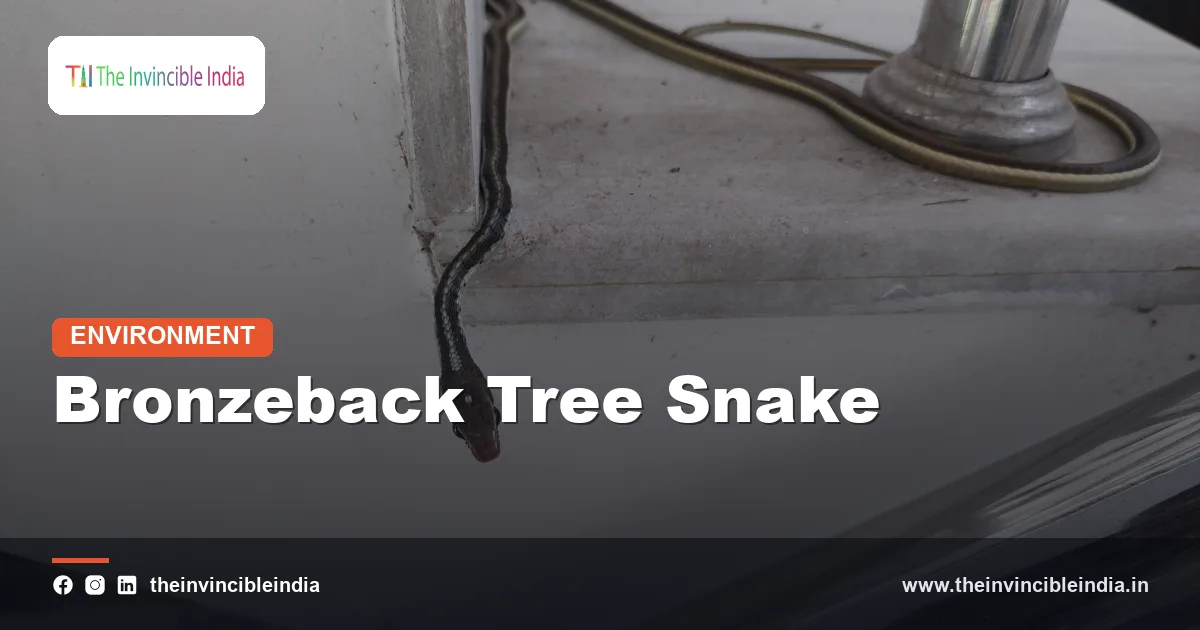
The bronzeback tree snake is a slim, fast, day-active arboreal snake of the genus Dendrelaphis, recognised by a bronze-coloured stripe or sheen along its back and by flashes of blue skin between its scales when it is alarmed. Bronzeback tree snakes are non-venomous, harmless to people, and feed mainly on lizards and frogs, which they hunt among shrubs, hedges and the canopy across much of India.
Because the bronzeback tree snake is long, thin and extremely quick, it is frequently mistaken for a dangerous species and killed needlessly. This explainer describes how to identify the bronzeback tree snake, where it lives, what it eats, how it behaves and why it deserves to be left alone, using stable and widely documented facts about the group.
| Attribute | Detail |
|---|---|
| Common name | Bronzeback tree snake (often just “bronzeback”) |
| Genus | Dendrelaphis (family Colubridae) |
| Best-known Indian species | Common bronzeback (Dendrelaphis tristis), with several other bronzebacks in the Western Ghats, the north-east and the islands |
| Typical length | Roughly 1 to 1.5 metres in adults, very slender |
| Activity | Diurnal (active by day) and largely arboreal |
| Venom status | Non-venomous; harmless to humans |
| Diet | Lizards, geckos, frogs and occasionally other small animals |
| Reproduction | Egg-laying (oviparous) |
| Legal protection | Native snakes are protected under the Wildlife (Protection) Act, 1972 |
Key Takeaways
- The bronzeback tree snake belongs to the genus Dendrelaphis and is a non-venomous member of the family Colubridae.
- Bronzeback tree snakes are diurnal, which means they hunt in daylight, unlike many snakes that are active only at night.
- A threatened bronzeback tree snake inflates its throat to reveal bright blue skin between its scales, a defensive display that is not a sign of venom.
- Lizards and frogs form the bulk of the bronzeback tree snake’s diet, so the species helps keep garden and orchard animal populations in balance.
- The common bronzeback (Dendrelaphis tristis) is the species most often seen near Indian homes, farms and gardens.
- Bronzeback tree snakes are protected as native wildlife in India, and the safest response to one is to leave it alone or call a trained rescuer.
What is a bronzeback tree snake?
A bronzeback tree snake is a thin, long-tailed, non-venomous colubrid snake that lives mostly off the ground, in bushes and trees, and belongs to the genus Dendrelaphis. The genus name comes from Greek roots meaning roughly “tree” and “snake”, and it describes the group’s lifestyle well.
The genus has many species across South and South-East Asia, and India hosts a good number of them. Taxonomists have revised the group repeatedly in recent decades, splitting populations once lumped together into separate species. As a result, older books may name only a single widespread bronzeback, while newer references list several distinct ones, including species restricted to the Western Ghats, the north-east and the Andaman and Nicobar Islands.
Bronzeback tree snakes are sometimes called whip snakes in casual speech because their long, thread-like tails and slim bodies resemble a whip. They should not be confused with the true whip snakes of other parts of the world, and in India they are also quite different from the green vine snake, a separate group with a distinct head shape.
How do you identify a bronzeback tree snake?
A bronzeback tree snake can be identified by its very slim body, large eyes with round pupils, a long thin tail, and a coppery or bronze-brown back that often carries a pale stripe running along each side. The belly is usually lighter, and the throat can be yellowish or cream.
Several features help separate the bronzeback tree snake from other slender snakes.
- Colour: The upper body is olive, bronze or coppery brown, sometimes with a metallic gleam in sunlight. The head can look slightly greenish or bluish in some species.
- Stripes: Many bronzebacks show a dark streak through the eye and thin light lines along the flanks. The exact pattern varies between species and individuals.
- Eyes: The eyes are large and prominent, with round pupils, which supports excellent daytime vision.
- Body shape: The body is laterally slim, and the belly scales are slightly angled at the edges, a feature that helps the snake grip bark and twigs.
- Size: Adults are commonly around a metre or a little more in length, though most of that length is slender body and tail.
Colour can be misleading, because skin condition, light and age all change the apparent shade. Photographic identification at species level often needs close examination of scale counts, which is why even experienced herpetologists rely on detailed keys for the finer distinctions between bronzeback species.
Where does the bronzeback tree snake live in India?
The bronzeback tree snake lives in forests, plantations, scrub, gardens and villages across much of peninsular India, the Western Ghats, the Eastern Ghats and the north-east, with different species occupying different regions. The common bronzeback in particular is widespread and adapts well to human-altered landscapes.
Habitat preferences are broad but share a common thread: vegetation that provides climbing routes. Bronzeback tree snakes are often seen in the following places.
- Hedges, bamboo clumps and thick shrubs at the edges of fields and gardens
- Coconut, areca nut, coffee, cardamom and rubber plantations
- Forest edges and clearings where sunlight filters through the canopy
- Creepers and ornamental plants on house walls and compound fences
- Moist deciduous and evergreen forest in the hills
Because several bronzeback species have limited ranges, a snake seen in the Western Ghats may be a different species from one seen in the north-east. Exact distributions and population sizes are still being refined by field research, and wildlife assessments should be treated as evolving rather than final.
What does the bronzeback tree snake eat?
The bronzeback tree snake eats mainly lizards and frogs, with garden lizards, geckos, skinks and tree frogs among its common prey. Some individuals also take small birds’ eggs, nestlings or other small animals, though lizards remain the staple.
The snake hunts actively by day, relying on sharp vision. It moves through foliage, spots a lizard from a distance, and then closes in with a sudden burst of speed. Like all colubrids of this type, the bronzeback tree snake seizes prey in its jaws and swallows it whole, often head first. It does not use venom to subdue prey, and any prey that is overpowered is killed by pressure and by being swallowed.
The snake is sometimes seen at the edge of rain-filled puddles or on branches near water, where tree frogs gather. Its feeding habits make it a quiet ally of anyone who gardens, because lizard and frog numbers around homes stay in check when bronzebacks are present.
Is the bronzeback tree snake venomous or dangerous?
The bronzeback tree snake is not venomous and poses no medical danger to humans. It has no medically significant venom, and its bite, which is rare, is at most a shallow scratch from small teeth.
The bronzeback tree snake is highly defensive when handled or cornered, which is where the confusion starts. A frightened bronzeback may flatten and swell its neck, strike with an open mouth, and vibrate its tail. These theatrics are bluffs. The snake would rather flee up a branch than fight, and most encounters end without any contact.
Anyone bitten by an unidentified snake should still wash the wound, keep calm and seek medical advice, because identifying snakes from a quick glance is unreliable. But for this particular snake, the risk is negligible, and there is no good reason to kill it.
Why does the bronzeback tree snake show blue skin?
The bronzeback tree snake shows blue skin because, when threatened, it inflates its throat and forward body so that the skin stretched between the scales becomes visible, and that skin is bright blue or blue-black. The display is a defensive warning and a bluff, not a sign of poison.
Under normal conditions the scales overlap tightly and hide the stretched skin. When the snake puffs up with air, the scales spread apart, and the contrasting colour appears suddenly. The effect can startle a predator and gives the snake a moment to retreat. Observers often describe the display as sudden and surprising, which is exactly its purpose.
Several other harmless snakes use similar tricks. The behaviour shows how non-venomous species rely on appearance, speed and bluffing rather than chemical defence.
How does the bronzeback tree snake move through trees?
The bronzeback tree snake moves through trees by gliding along branches in smooth, fast waves, using its slender body, its long tail and the angled edges of its belly scales to grip bark and twigs. It can cross gaps between branches by stretching its body out nearly straight and bridging the space.
Several adaptations make this possible.
- Lightweight build: A slender body distributes weight so the snake can travel along thin twigs that would not hold a heavier animal.
- Keeled belly edges: Small ridges on the lateral edges of the belly scales act like climbing grips on rough bark.
- Long tail: The tail helps with balance and sometimes anchors the snake while the front body reaches forward.
- Binocular vision: Forward-facing eyes allow accurate judgement of distance when lunging at prey or bridging a gap.
Speed is the bronzeback tree snake’s main asset. A person who disturbs one in a hedge will usually see only a flicker of brown disappearing into leaves. That combination of speed, climbing skill and camouflage is why the species often goes unnoticed even where it is common.
How does the bronzeback tree snake breed?
The bronzeback tree snake breeds by laying eggs, and females typically deposit a small clutch in a hidden spot such as a hollow in a tree, rotting vegetation or leaf litter. The eggs are long and narrow compared with those of many other snakes, and the mother does not usually guard them after laying.
Clutch size varies with species and the size of the female, and published figures differ between sources, so any single number should be treated as approximate. Young bronzebacks hatch fully formed and independent, and they begin hunting small lizards and frogs soon after emerging. Timing is often linked to the monsoon, when moisture and prey are abundant, though the exact breeding season differs by region and species.
Which snakes are mistaken for the bronzeback tree snake?
The snakes most often mistaken for the bronzeback tree snake are the green vine snake, various other slender colubrids, and in some regions young rat snakes. Each can be separated by a few clear features, summarised below.
| Snake | Key difference from a bronzeback | Risk to people |
|---|---|---|
| Bronzeback tree snake | Round pupil, bronze back, blue skin when puffed up, normal rounded head | Harmless |
| Green vine snake | Bright green, pointed snout, horizontal keyhole-shaped pupil | Mildly venomous rear-fanged snake, rarely a danger |
| Rat snake | Much thicker body, larger overall size, different head | Non-venomous |
| Other slender colubrids | Pattern and scalation differ, often less metallic sheen | Mostly harmless |
The key lesson is to look at the eye, the head and the body build, not just the colour. Experts caution against guessing, and wildlife organisations in India generally recommend photographing a snake from a safe distance and asking a local rescue group to identify it.
What should you do if you find a bronzeback tree snake at home?
If you find a bronzeback tree snake at home, the best action is to stay calm, keep a distance, and let the snake leave on its own, because it will almost always move away quickly. Pets and children should be kept back until it is gone.
- Do not try to catch, strike or pin the snake, since a handled snake is more likely to bite in self-defence.
- Open a clear path to an exit, such as a door or gap in a fence, and keep still.
- Photograph it from a distance if you want an identification, but do not crowd it.
- If it is inside a building and does not leave, call the local forest department helpline or a trained snake rescuer.
- Reduce clutter and dense creepers near walls if you want to discourage visits.
Killing a bronzeback tree snake is unnecessary and, since native snakes are covered by wildlife law in India, may also carry legal consequences.
Why does the bronzeback tree snake matter to ecosystems?
The bronzeback tree snake matters because it is both predator and prey, controlling lizard and frog numbers while itself feeding larger animals such as birds of prey, mongooses and other snakes. It connects the canopy layer of the food web with the ground layer.
Healthy bronzeback populations are often seen as a sign of intact vegetation, since the snake needs shrubs and trees to hunt and shelter. Habitat loss, hedge removal, roadkill and persecution are the main pressures on the group, though the common bronzeback is considered widespread. Because several forest species have small ranges, careful monitoring is still needed.
Bottom Line
The bronzeback tree snake is one of India’s most graceful and misunderstood snakes: fast, slender, harmless to people and useful as a controller of lizards and frogs. The correct response to meeting one is respect and distance, not fear.
Frequently Asked Questions
Is the bronzeback tree snake poisonous?
No, the bronzeback tree snake is not venomous or poisonous. It lacks medically significant venom and is harmless to humans. Its bite is rare and, at worst, produces a minor scratch.
Why does the bronzeback tree snake have blue skin?
The blue colour is the stretched skin between the scales, which becomes visible when the snake inflates its throat and body in a threat display. It is a bluff to scare off predators. It does not indicate venom.
What does a bronzeback tree snake eat?
A bronzeback tree snake eats mainly lizards and frogs. Garden lizards, geckos and tree frogs are typical prey, and it sometimes takes other small animals. It hunts by day and swallows prey whole.
Can a bronzeback tree snake climb walls and enter houses?
Yes, a bronzeback tree snake can climb rough walls, creepers and trees, and may occasionally enter a house while chasing lizards. It usually leaves quickly on its own. Staying calm and opening an exit path is the safest response.
How can I tell a bronzeback tree snake from a green vine snake?
The bronzeback tree snake is bronze or brown with a round pupil, while the green vine snake is bright green with a pointed snout and a horizontal pupil. The vine snake is also mildly venomous but rarely a danger. Looking at the eye and head shape is more reliable than relying on colour alone.
Is it legal to kill or keep a bronzeback tree snake in India?
No, killing, capturing or keeping a native snake such as the bronzeback tree snake is generally prohibited under the Wildlife (Protection) Act, 1972. Violations can attract penalties. If a snake needs to be moved, a trained rescuer or the forest department should be contacted.
{“@context”:”https://schema.org”,”@graph”:[{“@type”:”FAQPage”,”mainEntity”:[{“@type”:”Question”,”name”:”Is the bronzeback tree snake poisonous?”,”acceptedAnswer”:{“@type”:”Answer”,”text”:”No, the bronzeback tree snake is not venomous or poisonous. It lacks medically significant venom and is harmless to humans. Its bite is rare and, at worst, produces a minor scratch.”}},{“@type”:”Question”,”name”:”Why does the bronzeback tree snake have blue skin?”,”acceptedAnswer”:{“@type”:”Answer”,”text”:”The blue colour is the stretched skin between the scales, which becomes visible when the snake inflates its throat and body in a threat display. It is a bluff to scare off predators. It does not indicate venom.”}},{“@type”:”Question”,”name”:”What does a bronzeback tree snake eat?”,”acceptedAnswer”:{“@type”:”Answer”,”text”:”A bronzeback tree snake eats mainly lizards and frogs. Garden lizards, geckos and tree frogs are typical prey, and it sometimes takes other small animals. It hunts by day and swallows prey whole.”}},{“@type”:”Question”,”name”:”Can a bronzeback tree snake climb walls and enter houses?”,”acceptedAnswer”:{“@type”:”Answer”,”text”:”Yes, a bronzeback tree snake can climb rough walls, creepers and trees, and may occasionally enter a house while chasing lizards. It usually leaves quickly on its own. Staying calm and opening an exit path is the safest response.”}},{“@type”:”Question”,”name”:”How can I tell a bronzeback tree snake from a green vine snake?”,”acceptedAnswer”:{“@type”:”Answer”,”text”:”The bronzeback tree snake is bronze or brown with a round pupil, while the green vine snake is bright green with a pointed snout and a horizontal pupil. The vine snake is also mildly venomous but rarely a danger. Looking at the eye and head shape is more reliable than relying on colour alone.”}},{“@type”:”Question”,”name”:”Is it legal to kill or keep a bronzeback tree snake in India?”,”acceptedAnswer”:{“@type”:”Answer”,”text”:”No, killing, capturing or keeping a native snake such as the bronzeback tree snake is generally prohibited under the Wildlife (Protection) Act, 1972. Violations can attract penalties. If a snake needs to be moved, a trained rescuer or the forest department should be contacted.”}}]}]}


