

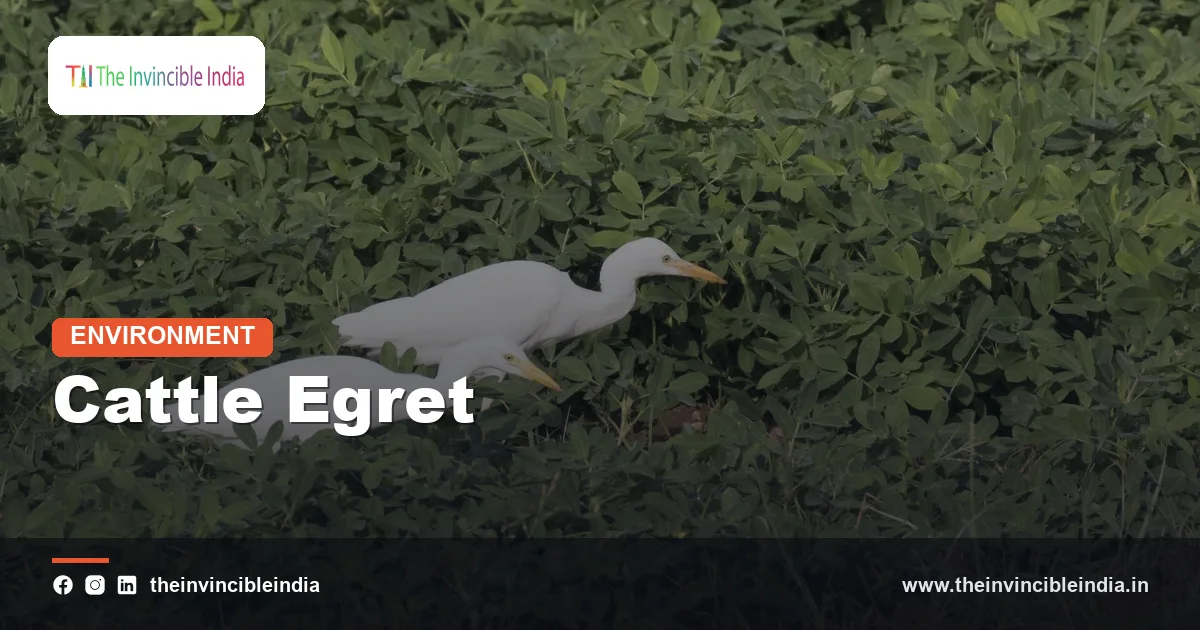
The cattle egret (Bubulcus ibis) is a small, stocky white heron-family bird that walks beside grazing cattle, buffalo and ploughing tractors to catch the insects they disturb, and it is one of the most familiar birds of Indian farmland. Unlike most egrets, it spends much of its time on dry fields and pasture rather than in water, and it breeds in noisy colonies together with other herons.
This guide explains what the cattle egret looks like, why it follows livestock, where it lives in India, what it eats, how it nests, how it has spread across the world and how to tell it from similar white birds. Last updated: 23 October 2026.
| Attribute | Detail |
|---|---|
| Common name | Cattle egret (Asian birds are often called the eastern or Asian cattle egret) |
| Scientific name | Bubulcus ibis (some authorities place it in the genus Ardea) |
| Family | Ardeidae (herons, egrets and bitterns) |
| Typical body length | Roughly 45 to 55 cm |
| Plumage | White, with buff-orange plumes on head, neck and back in the breeding season |
| Main habitat | Grazing land, farmland, paddy fields, wetland edges and garbage dumps |
| Nesting | Colonial; builds stick nests in trees within mixed heronries |
| Key behaviour | Follows cattle, buffalo and farm machinery to catch disturbed insects |
| IUCN status | Least Concern |
Key Takeaways
- The cattle egret (Bubulcus ibis) is a small white heron-family bird, roughly 45 to 55 cm long, that is common across the plains of India.
- The cattle egret feeds mainly on insects such as grasshoppers and crickets that are flushed out as cattle, buffalo or tractors move through grass and fields.
- The cattle egret develops buff-orange plumes on the head, neck and back, and a more colourful bill and legs, during the breeding season.
- The cattle egret breeds in colonies called heronries, usually in trees alongside other herons, egrets and cormorants.
- The relationship between cattle egrets and grazing animals is best described as commensalism, in which the bird gains a clear benefit and the animal gains little or none.
- The cattle egret is classified as Least Concern by the International Union for Conservation of Nature (IUCN) and has expanded its range across many continents in the last century and a half.
What is the cattle egret?
The cattle egret is a small, compact member of the heron family, Ardeidae, named for its habit of feeding close to livestock. Its scientific name is Bubulcus ibis, and the genus name comes from a Latin word associated with cattle or oxen.
Compared with the tall, slender egrets that stalk lake edges, the cattle egret has a shorter neck, shorter legs and a stouter yellow bill, which give it a heavier and less elegant look. It is also less tied to water. While most other herons are almost always found in marshes, rivers or ponds, the cattle egret regularly forages on dry land, in short grass, in crop fields and along roadsides.
Two forms are generally recognised, one in Africa and southern Europe and one in Asia and Australasia, and some experts treat them as separate species. The Asian form, which occurs throughout India, is often called the eastern cattle egret.
What does the cattle egret look like?
The cattle egret looks like a small, mostly white bird with a hunched posture, a short thick neck and a short, stout yellow bill, and in the breeding season it acquires patches of orange-buff colour. It is easily separated from other white egrets by this stocky build.
Non-breeding plumage
Outside the breeding season the cattle egret is white all over, with a yellow bill and yellowish-green or dark legs. The face looks rounded, and the throat often seems fuller than that of other egrets because of the short, thick neck. The bird has no streaks or dark markings.
Breeding plumage
During breeding the Asian cattle egret grows orange-buff feathers on the head, neck and breast, and long, loose plumes on the back. The bill and legs may become bright orange-red for a short period at the peak of courtship, then fade as the nesting cycle progresses. The colour change is one of the most noticeable seasonal transformations among common Indian birds.
In flight
In flight the cattle egret flaps with steady, rhythmic wingbeats, with its neck pulled back into an S-shape and its legs trailing behind. At dusk, flocks fly in lines or loose V-shaped formations towards a shared roost, a spectacle visible over many Indian towns and villages.
Why does the cattle egret follow cattle?
The cattle egret follows cattle because grazing animals disturb insects hidden in the grass, and the bird can catch these insects far more easily than it could by searching alone. Each time a cow, buffalo or goat takes a step, grasshoppers, crickets, beetles and flies jump or fly up, and the egret snaps them up.
Field studies in several countries have reported that egrets feeding next to livestock catch more prey per minute than those feeding on their own, and this is the basis of the behaviour. The bird usually stays close to the animal’s head and feet, where the disturbed insects are most likely to appear.
The cattle egret does not limit itself to cattle. It also follows:
- Buffalo, sheep and goats in grazing areas.
- Tractors, ploughs and harvesters that turn over soil and flush insects.
- Grass fires and mowing machines, which drive out small animals.
- Wild grazers and other large animals in national parks and reserves.
This flexible habit explains why the bird thrives wherever people keep livestock or work the land, and it is the reason the species is often among the first birds noticed from a train window in rural India.
Is the relationship between cattle egrets and cattle mutualism?
The relationship between cattle egrets and cattle is usually described as commensalism rather than true mutualism, because the egret clearly benefits while the cattle receive little or no measurable gain. In popular accounts it is often called mutualism, since egrets sometimes pick ticks and flies from the animals’ skin.
Scientists have found that parasites form only a small part of the cattle egret’s diet in most places. The main benefit to the bird is the stream of insects stirred up by the grazing animal. The animal, in turn, may gain a slight benefit from a reduction in some biting insects and may be alerted to danger by the egrets’ sudden flight, but the evidence for a strong advantage is limited.
Farmers generally tolerate the birds and often welcome them, partly because they eat crop-damaging insects. The relationship is therefore best understood as a loose, flexible partnership that depends on the circumstances rather than a fixed, mutually dependent bond.
Where does the cattle egret live in India?
The cattle egret lives across almost all of India, in lowland farmland, grazing land, wetland margins and outskirts of towns, and it is one of the most widespread egrets in the country. It is mainly a resident, though flocks move locally in response to rainfall, crop cycles and the availability of food.
Typical Indian habitats include:
- Pastures, village commons and fallow fields where cattle graze.
- Flooded and dry paddy fields, sugarcane and wheat farmland.
- Margins of ponds, tanks, canals, rivers and reservoirs.
- Garbage dumps, cattle markets and roadsides near villages and towns.
The species is less common in dense forest, in very arid desert interiors and in high mountains, though it can appear at some distance from water. Outside India, the Asian cattle egret occurs through much of South and South-East Asia, and other forms of the species live in Africa, Europe and the Americas.
What does the cattle egret eat?
The cattle egret eats mainly insects, especially grasshoppers, locusts, crickets, flies and beetles, along with spiders, earthworms, frogs and sometimes small reptiles, fish and rodents. Its diet is flexible, and the mix depends on what is available in the season and habitat.
In dry fields and pastures, the bird relies heavily on insects and other invertebrates. Near wetlands it also catches frogs, tadpoles and small fish. Near human settlements, it may feed at garbage heaps and slaughter areas, where it picks up scraps and the flies they attract.
Because insects form such a large share of its diet, the cattle egret is generally regarded as beneficial to farmers, particularly when it removes crop pests. The bird usually does not harm crops, and it is rarely treated as a pest, though large roosts can create noise and droppings problems for nearby residents.
How does the cattle egret breed?
The cattle egret breeds in dense colonies called heronries, building small platform nests of sticks in trees and shrubs, and in much of India nesting is linked to the monsoon season. Colonies are often mixed, with the cattle egret sharing trees with pond herons, little egrets, night herons, cormorants and storks.
Courtship and nesting
Males arrive at the colony first and display from a chosen nest site, stretching their necks, showing off their breeding plumes and calling to attract a female. Once a pair forms, the male brings sticks and the female arranges them into a flimsy platform. Pairs often steal twigs from neighbouring nests, a common habit in crowded colonies.
Eggs and chicks
The female typically lays two to five pale bluish-white eggs. Both parents take turns incubating, and the eggs hatch after roughly three weeks. The chicks are fed regurgitated food at the nest, and they stay for several weeks before they can fly. In colonies, the chicks hatch at slightly different times, so younger chicks may lose out when food is scarce.
Many heronries are located in village trees, temple groves and city parks, and communities in several Indian states have a tradition of protecting these colonies.
How did the cattle egret spread around the world?
The cattle egret spread around the world by naturally expanding its range from Africa and Asia to the Americas and Australia during the late nineteenth and twentieth centuries, helped by the spread of cattle farming. It is one of the most successful examples of a bird extending its range without direct human introduction.
The key milestones, in broad terms, are summarised below.
| Period | Development |
|---|---|
| Before the 1800s | Native range covered parts of Africa, southern Europe and southern and eastern Asia |
| Late 1800s | Birds from Africa crossed the Atlantic and reached northern South America |
| Early to mid 1900s | The species spread through the Caribbean and into North America, with breeding recorded in the United States by the 1950s |
| Mid 1900s | Birds from Asia colonised parts of northern Australia |
| Late 1900s onwards | Further spread into new regions, and population growth in many places |
Researchers link this expansion to the global increase in cattle ranching and to the bird’s ability to use many types of food and habitat. In India, where cattle and farmland have long existed, the species has been established for far longer.
How can you tell a cattle egret from other white egrets?
A cattle egret can be told from other white egrets by its stocky build, short thick neck, yellow bill and habit of feeding on dry land near livestock. Most other white egrets are taller, more slender and strongly tied to water.
| Bird | Size and shape | Bill and legs | Typical behaviour |
|---|---|---|---|
| Cattle egret | Small, stocky, short neck | Yellow bill; legs yellowish-green or dark | Feeds on dry ground beside livestock and tractors |
| Little egret | Slender, medium-sized | Black bill; black legs with yellow feet | Hunts fish and frogs in shallow water |
| Intermediate egret | Larger, medium-long neck | Yellow bill; black legs | Feeds in wetlands and flooded fields |
| Great egret | Tall and long-necked | Large yellow bill; black legs | Wades in deeper water and marshes |
| Indian pond heron | Small, hunched; streaked brown at rest | Yellowish bill with dark tip | Waits at the edge of ponds and paddy fields |
The easiest rule is that a white bird on a field walking among cattle is almost certainly a cattle egret. In flight, the cattle egret also looks compact and heavy-bodied compared with other egrets.
Is the cattle egret threatened?
The cattle egret is not threatened; the IUCN classifies it as Least Concern because it is abundant and widespread. In most regions its population is thought to be large and stable or increasing, although precise numbers are not known and local counts vary with season and conditions.
Local threats still exist. These include:
- Felling of colony trees, which destroys nesting and roosting sites.
- Pesticide use in farmland, which can reduce insect prey and affect the birds directly.
- Loss of grazing land as villages and towns expand.
- Disturbance, egg collection or hunting around some colonies.
The cattle egret is a protected wild bird in India under the Wildlife (Protection) Act, 1972. Many village communities protect heronries, and colonies in sacred groves and temple trees often survive for decades.
Why does the cattle egret matter to farmers and ecosystems?
The cattle egret matters because it controls many insects in farmland and pasture, recycles nutrients through its droppings and acts as a visible link between livestock, crops and wetlands. Its large flocks are also easy to observe, which makes it a good species for monitoring changes in rural landscapes.
For farmers, the bird is generally a quiet helper that removes grasshoppers and other pests, although it does not replace proper pest management. For ecologists, heronries with cattle egrets are valuable sites because they support many other species, from cormorants and storks to the insects and fish that sustain them.
Culturally, the white birds walking beside cattle are an everyday sight in rural India and have long been part of the visual landscape of the countryside, appearing in photographs, paintings and folk descriptions of village life.
Bottom Line
The cattle egret is a small, adaptable white heron that has built a successful life around grazing animals and farm work. It is common, harmless and helpful in India, and its behaviour offers an easy way to understand how birds can profit from other species without harming them.
Frequently Asked Questions
What is a cattle egret?
A cattle egret is a small, stocky white bird of the heron family, with the scientific name Bubulcus ibis. It is named for its habit of walking beside cattle and other livestock to catch the insects they disturb. It is common across farmland in India.
Why do cattle egrets sit on cattle?
Cattle egrets sit on or walk beside cattle because the animals disturb insects and the elevated perch gives a good view of prey. They also sometimes pick flies and ticks from the skin. The main benefit to the bird is the steady supply of flushed insects.
Is the cattle egret and cattle relationship mutualism?
The relationship is usually classed as commensalism, not true mutualism. The cattle egret clearly benefits from the insects that livestock disturb, while the cattle gain little or no proven advantage. Some tick and fly removal may help the animals slightly.
What does a cattle egret eat?
A cattle egret eats mainly insects such as grasshoppers, crickets, flies and beetles. It also takes spiders, earthworms, frogs and small fish or reptiles when available. Its flexible diet lets it live in dry fields, pastures and wetland edges.
How is a cattle egret different from a little egret?
A cattle egret is shorter, stockier and has a yellow bill with a short, thick neck, while a little egret is slim with a black bill and black legs. The cattle egret feeds on dry land near livestock, whereas the little egret hunts in shallow water.
Is the cattle egret protected in India?
Yes, the cattle egret is a wild bird protected under India’s Wildlife (Protection) Act, 1972. Although the species is common and classified as Least Concern by the IUCN, capturing or killing it is not permitted. Local communities often protect heronries too.
{“@context”:”https://schema.org”,”@graph”:[{“@type”:”FAQPage”,”mainEntity”:[{“@type”:”Question”,”name”:”What is a cattle egret?”,”acceptedAnswer”:{“@type”:”Answer”,”text”:”A cattle egret is a small, stocky white bird of the heron family, with the scientific name Bubulcus ibis. It is named for its habit of walking beside cattle and other livestock to catch the insects they disturb. It is common across farmland in India.”}},{“@type”:”Question”,”name”:”Why do cattle egrets sit on cattle?”,”acceptedAnswer”:{“@type”:”Answer”,”text”:”Cattle egrets sit on or walk beside cattle because the animals disturb insects and the elevated perch gives a good view of prey. They also sometimes pick flies and ticks from the skin. The main benefit to the bird is the steady supply of flushed insects.”}},{“@type”:”Question”,”name”:”Is the cattle egret and cattle relationship mutualism?”,”acceptedAnswer”:{“@type”:”Answer”,”text”:”The relationship is usually classed as commensalism, not true mutualism. The cattle egret clearly benefits from the insects that livestock disturb, while the cattle gain little or no proven advantage. Some tick and fly removal may help the animals slightly.”}},{“@type”:”Question”,”name”:”What does a cattle egret eat?”,”acceptedAnswer”:{“@type”:”Answer”,”text”:”A cattle egret eats mainly insects such as grasshoppers, crickets, flies and beetles. It also takes spiders, earthworms, frogs and small fish or reptiles when available. Its flexible diet lets it live in dry fields, pastures and wetland edges.”}},{“@type”:”Question”,”name”:”How is a cattle egret different from a little egret?”,”acceptedAnswer”:{“@type”:”Answer”,”text”:”A cattle egret is shorter, stockier and has a yellow bill with a short, thick neck, while a little egret is slim with a black bill and black legs. The cattle egret feeds on dry land near livestock, whereas the little egret hunts in shallow water.”}},{“@type”:”Question”,”name”:”Is the cattle egret protected in India?”,”acceptedAnswer”:{“@type”:”Answer”,”text”:”Yes, the cattle egret is a wild bird protected under India’s Wildlife (Protection) Act, 1972. Although the species is common and classified as Least Concern by the IUCN, capturing or killing it is not permitted. Local communities often protect heronries too.”}}]}]}


