

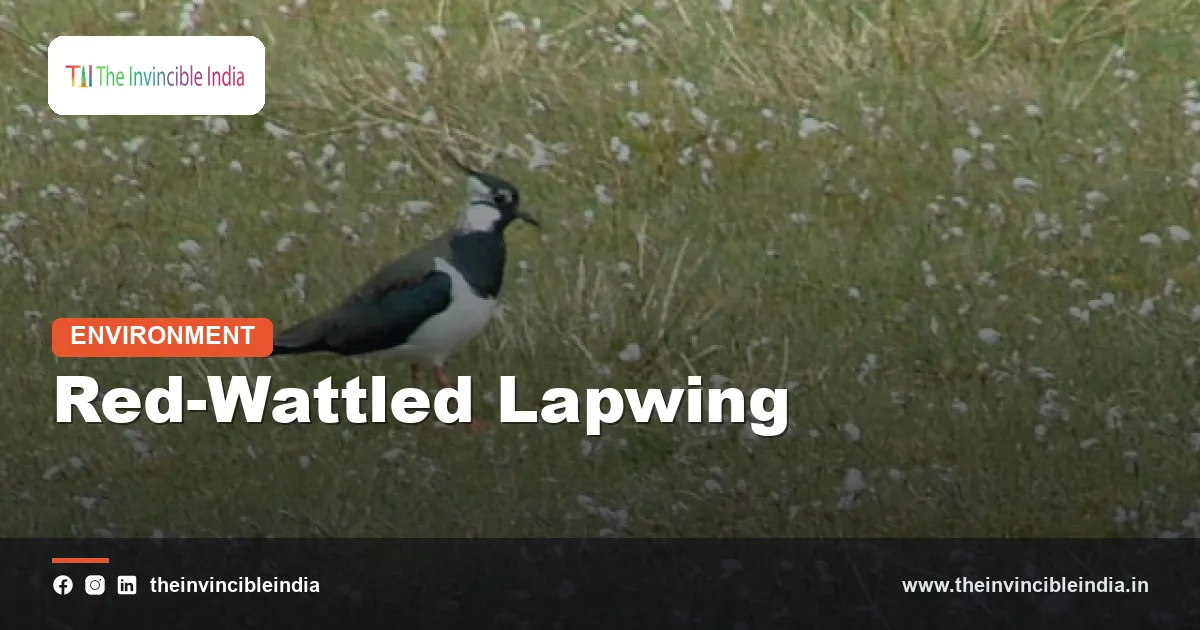
The red-wattled lapwing (Vanellus indicus) is a long-legged, ground-dwelling wader of the plover family, easily recognised by the bright red fleshy wattle in front of its eye, its black head and breast, its white belly and its loud, repeated alarm call that sounds like “did-he-do-it”. The red-wattled lapwing is a common resident of open fields, wetland edges, riverbanks and even city outskirts across India, and it is one of the noisiest and boldest birds of the Indian countryside.
This guide explains how to identify the red-wattled lapwing, where it lives, what it eats, how it nests on bare ground, why it dive-bombs intruders and how it appears in Indian folklore. It is written for beginners, students and general readers.
| Attribute | Detail |
|---|---|
| Common name | Red-wattled lapwing |
| Scientific name | Vanellus indicus |
| Family | Charadriidae (plovers and lapwings) |
| Body length | About 32 to 35 centimetres |
| Distinctive features | Red wattle and bill base, black head, throat and breast, white belly, brown back, yellow legs |
| Typical diet | Insects, termites, beetles, worms, snails and other small invertebrates |
| Nest type | Shallow scrape on bare ground, often ringed with small stones |
| Conservation status | Least Concern on the IUCN Red List |
| Range | Middle East and South Asia to Southeast Asia; widespread resident in India |
Key Takeaways
- The red-wattled lapwing (Vanellus indicus) is a resident wader found across most of India, usually in open fields, wetland edges and dry grassland.
- The red-wattled lapwing is identified by its red facial wattle, black throat and breast, white belly, brown back and long yellow legs.
- The red-wattled lapwing is known for its loud, repeated alarm call, often described as “did-he-do-it” or “pity-to-do-it”, which it gives by day and also on moonlit nights.
- The red-wattled lapwing lays about four camouflaged eggs in a shallow scrape on bare ground, and both parents defend the nest against intruders.
- The red-wattled lapwing is listed as Least Concern by the IUCN, though ground nests are vulnerable to ploughing, dogs and trampling.
- The red-wattled lapwing appears in Indian folklore as a bird said to sleep on its back with its legs raised, and its nest site is traditionally linked to forecasts of the monsoon.
What is the red-wattled lapwing?
The red-wattled lapwing is a medium-large wader in the plover family Charadriidae, and despite belonging to a group of shorebirds it lives mostly on dry land. Its scientific name, Vanellus indicus, places it in the genus of lapwings, which are characterised by broad, rounded wings and a tendency to nest and feed on open ground.
The English word lapwing is thought to refer to the bird’s flapping, wavering flight, and the word wattle describes the loose fold of skin on the face. In Hindi and several other Indian languages the bird is known as titihari or a similar name that imitates its call, though regional names vary widely.
Taxonomists recognise several subspecies across the bird’s range. Birds in western Asia, peninsular India and the north-east differ slightly in the amount of white on the head and neck, and in the size of the wattle. The exact number of subspecies and their boundaries are matters on which authorities do not fully agree.
How can you identify a red-wattled lapwing?
A red-wattled lapwing can be identified by its bright red wattle and bill base, black head, throat and upper breast, a clear white stripe from behind the eye down the neck, a sandy-brown back and a white belly. The long yellow legs and the black-tipped red bill complete a pattern that is easy to spot in open ground.
In flight, the red-wattled lapwing shows a bold contrasting pattern: black flight feathers, a white wing bar, a white rump and a tail with a black band at the tip. The wings are broad and rounded, and the flight is strong and erratic when the bird is alarmed. A small spur at the bend of each wing can be used in fights.
Key field marks
- Wattle: a red, fleshy patch in front of each eye, extending to the bill base.
- Head and breast: glossy black from the crown down to the upper chest.
- Neck: a white band running from the cheek down the sides of the neck to the belly.
- Back: pale brown with a faint purplish or bronzy sheen.
- Legs: long and yellow, built for walking and running.
Males and females look alike. Juveniles are paler, with a smaller wattle and some buff edges to the feathers. The yellow-wattled lapwing, a related species of drier country, is smaller, has a yellow wattle and lacks the black breast, so the two are rarely confused.
Where is the red-wattled lapwing found in India?
The red-wattled lapwing is found across most of India, from the plains of the north and west to the peninsula and the east, and it is mostly resident, meaning it stays near the same area through the year. It prefers flat, open ground with short vegetation and some water nearby.
Typical habitats include:
- Ploughed fields, fallow land and stubble after harvest.
- Edges of ponds, village tanks, reservoirs and slow rivers.
- Dry grassland, open scrub and wasteland.
- Airfields, playgrounds, golf courses and large lawns.
- Gravel and sand bars along rivers, and the margins of salt pans and wetlands.
Outside India, the red-wattled lapwing ranges from the Middle East and Pakistan through South Asia to Southeast Asia. The bird tends to avoid thick forest and very high mountains, but it can be found in clearings and on open lower slopes. In many areas, local movements follow rain, with birds spreading to temporarily flooded land during the monsoon.
What does the red-wattled lapwing eat?
The red-wattled lapwing eats mostly insects and other small invertebrates, including beetles, grasshoppers, ants, termites, caterpillars, earthworms and snails, which it picks from the ground or from shallow water. This diet makes the bird a helpful consumer of agricultural pests.
The feeding style is typical of plovers: the bird runs a few steps, stops, looks around, and then pecks at its prey. It may also tap the ground with a foot to bring worms and insects to the surface, a behaviour sometimes called foot trembling. Lapwings often forage in loose groups outside the breeding season.
Does the red-wattled lapwing feed at night?
Yes, the red-wattled lapwing is active both by day and at night, and it often feeds and calls after dark, especially on moonlit nights. Night feeding helps the bird to avoid midday heat and to take advantage of insects that are active after sunset. The loud night calls can carry across fields and villages and are one reason the lapwing is so well known by its voice.
Why does the red-wattled lapwing make so much noise?
The red-wattled lapwing makes so much noise because its loud, repeated call is an alarm and a warning to intruders, and it helps the bird to defend its ground nest and young. The call is commonly written as “did-he-do-it” or “pity-to-do-it”, and it can be sustained for minutes at a time.
The lapwing acts as a sentinel for other animals. When a predator, a dog or a person approaches, the lapwing’s call alerts nearby birds, deer, cattle and even people. This has earned the bird a reputation as a guardian of open land.
The bird has several calls. A sharp alarm call is given when danger is near, a more conversational series of notes is used between pairs, and a rapid, excited series accompanies display flights. Calls become more frequent and intense during the breeding season.
How does the red-wattled lapwing nest?
The red-wattled lapwing nests on the ground, making a shallow scrape in bare soil, gravel or dry grass and typically laying four pear-shaped, buff-coloured eggs with dark blotches that blend perfectly with the surroundings. The scrape is often lined with small pebbles, bits of earth or dried material, which helps the clutch to look like part of the ground.
The breeding season varies with region and rainfall but is concentrated in the hot, dry months and extends into the monsoon in many areas. A typical sequence is:
- The pair chooses a site in open ground, sometimes on a flat roof, a gravel track or a dry paddy field.
- The female lays about four eggs, and both parents take turns incubating for roughly four weeks.
- The chicks hatch covered in down and are able to walk and feed themselves within hours, a condition called precocial.
- The parents guard the chicks, lead them to feeding areas and brood them in the heat or cold, until the young can fly after several weeks.
Because the nest is on the open ground, eggs and chicks are exposed to predators such as crows, kites, mongooses, snakes and stray dogs. They are also at risk from ploughing, vehicles and trampling by livestock. The bird relies on camouflage, alertness and aggression to protect its young.
Why does the red-wattled lapwing dive-bomb intruders?
The red-wattled lapwing dive-bombs intruders to drive them away from its nest or chicks, swooping low over a predator, screaming and sometimes striking with its wings. The behaviour is a form of mobbing and can be directed at crows, kites, dogs, cattle, mongooses and humans.
Defence takes several forms:
- Alarm calling: loud, continuous calls warn intruders and alert other birds.
- Dive-bombing: the bird dives at the intruder’s head or back, veering away at the last moment.
- Distraction display: the parent runs away from the nest with a drooping wing, as if injured, to draw a predator away. This is often called a broken-wing display.
- Crouching and freezing: chicks crouch low and stay still, relying on their mottled down for camouflage.
Lapwings are bold enough to attack animals much larger than themselves. If you are dive-bombed by a lapwing, the best response is to move away calmly and avoid the nest area. The birds are not dangerous, and the display is a sign that a nest or chicks are close by.
What do Indian folklore and tradition say about the red-wattled lapwing?
Indian folklore says that the red-wattled lapwing sleeps on its back with its legs in the air to hold up the sky, and that the bird can forecast the monsoon from the placement of its nest. These beliefs are widely repeated in rural India, though they are traditions rather than scientific facts.
- The sky-prop belief: farmers and villagers have long said that the bird lies with its legs raised to stop the sky from falling, a story that makes the lapwing a symbol of vigilance.
- Monsoon forecasting: a nest on high ground is said to predict heavy rain, and a nest in low ground is said to predict a weak monsoon. There is no solid evidence that the bird can predict rainfall.
- Panchatantra: the ancient collection of animal fables includes a tale of a pair of birds called tittibha, often rendered as lapwing or sandpiper, who vow to empty the ocean after it carries off their eggs. The story is usually told to illustrate determination and the value of allies.
- Omen lore: in some regions, the call of the bird at night is considered a bad omen, while elsewhere it is believed to bring good luck.
The scientific truth is simpler. The bird chooses nest sites on open, flat ground to see predators, and it may choose higher ground to avoid flooding, which is probably the origin of the rain-forecast belief.
How is the red-wattled lapwing different from other lapwings and plovers?
The red-wattled lapwing is different from other lapwings and plovers because of its red wattle, black-and-white head pattern and loud voice. The table below compares it with several waders that are found in similar habitats in India.
| Bird | Approximate size | Key feature | Status in India |
|---|---|---|---|
| Red-wattled lapwing | 32 to 35 cm | Red wattle, black head and breast, white belly | Common resident |
| Yellow-wattled lapwing | About 26 to 28 cm | Yellow wattle, black cap, brown breast | Resident of drier regions |
| River lapwing | About 29 to 32 cm | Black crest and throat, grey breast, white belly | Resident along large rivers |
| Little ringed plover | About 14 to 16 cm | Black collar, yellow eye ring, small size | Resident and winter visitor |
| Northern lapwing | About 28 to 31 cm | Long crest, green-black back, white face | Winter visitor in the north |
The red-wattled lapwing is the most widespread and noisiest of these species. Its habit of living near human settlements makes it the lapwing most Indians have seen or heard.
Is the red-wattled lapwing threatened?
The red-wattled lapwing is not threatened and is classified as Least Concern by the International Union for Conservation of Nature (IUCN), because it is widespread and adaptable and the overall population is believed to be large. The exact number of birds is not known, and trends vary by region.
Threats are local and mainly affect breeding success:
- Ploughing and harvesting that destroy ground nests.
- Dogs, crows and other predators that thrive near human settlements.
- Loss of wetlands, fallow land and open grassland to construction.
- Pesticide use that reduces insect food.
- Disturbance, vehicle traffic and trampling at nest sites.
The bird is protected as a native wild species under the Wildlife (Protection) Act, 1972. Farmers, builders and landowners can help by leaving nests undisturbed when they are noticed and by waiting until chicks have left before working on the area.
Bottom Line
The red-wattled lapwing (Vanellus indicus) is a loud, bold, ground-nesting wader found in open habitats across India. Its red wattle, black-and-white pattern, alarm call and dive-bombing defence make it one of the most recognisable and best-loved birds of the Indian plains.
Frequently Asked Questions
Why is it called the red-wattled lapwing?
The bird is called the red-wattled lapwing because of the bright red fleshy wattle in front of each eye. The word lapwing refers to the bird’s flapping, wavering flight, and the species belongs to the plover family.
What does the red-wattled lapwing’s call mean?
The red-wattled lapwing’s loud call is mainly an alarm and a warning to intruders. It is often described as “did-he-do-it” or “pity-to-do-it”, and it is given when a predator, dog or person approaches, as well as during territorial and breeding displays.
Where does the red-wattled lapwing lay its eggs?
The red-wattled lapwing lays its eggs in a shallow scrape on bare ground, often among small stones, in open fields, gravel or dry grass. The usual clutch is about four buff, blotched eggs that blend with the soil.
Why does the red-wattled lapwing attack people and animals?
The red-wattled lapwing attacks to protect its nest and chicks. It dive-bombs intruders, calls loudly and sometimes pretends to be injured to lure predators away, and the behaviour is a clue that a nest is nearby.
Does the red-wattled lapwing sleep on its back?
No, the idea that the red-wattled lapwing sleeps on its back with its legs in the air is a folk belief and not a scientific fact. In Indian tradition the bird is said to prop up the sky this way, but real lapwings sleep upright or crouched on the ground like other waders.
Is the red-wattled lapwing found in cities?
Yes, the red-wattled lapwing is found in many cities and towns, especially on open ground such as playgrounds, airfields, campuses, wasteland and the edges of lakes. It adapts well to human-altered landscapes as long as there is open ground for feeding and nesting.
{“@context”:”https://schema.org”,”@graph”:[{“@type”:”FAQPage”,”mainEntity”:[{“@type”:”Question”,”name”:”Why is it called the red-wattled lapwing?”,”acceptedAnswer”:{“@type”:”Answer”,”text”:”The bird is called the red-wattled lapwing because of the bright red fleshy wattle in front of each eye. The word lapwing refers to the bird’s flapping, wavering flight, and the species belongs to the plover family.”}},{“@type”:”Question”,”name”:”What does the red-wattled lapwing’s call mean?”,”acceptedAnswer”:{“@type”:”Answer”,”text”:”The red-wattled lapwing’s loud call is mainly an alarm and a warning to intruders. It is often described as “did-he-do-it” or “pity-to-do-it”, and it is given when a predator, dog or person approaches, as well as during territorial and breeding displays.”}},{“@type”:”Question”,”name”:”Where does the red-wattled lapwing lay its eggs?”,”acceptedAnswer”:{“@type”:”Answer”,”text”:”The red-wattled lapwing lays its eggs in a shallow scrape on bare ground, often among small stones, in open fields, gravel or dry grass. The usual clutch is about four buff, blotched eggs that blend with the soil.”}},{“@type”:”Question”,”name”:”Why does the red-wattled lapwing attack people and animals?”,”acceptedAnswer”:{“@type”:”Answer”,”text”:”The red-wattled lapwing attacks to protect its nest and chicks. It dive-bombs intruders, calls loudly and sometimes pretends to be injured to lure predators away, and the behaviour is a clue that a nest is nearby.”}},{“@type”:”Question”,”name”:”Does the red-wattled lapwing sleep on its back?”,”acceptedAnswer”:{“@type”:”Answer”,”text”:”No, the idea that the red-wattled lapwing sleeps on its back with its legs in the air is a folk belief and not a scientific fact. In Indian tradition the bird is said to prop up the sky this way, but real lapwings sleep upright or crouched on the ground like other waders.”}},{“@type”:”Question”,”name”:”Is the red-wattled lapwing found in cities?”,”acceptedAnswer”:{“@type”:”Answer”,”text”:”Yes, the red-wattled lapwing is found in many cities and towns, especially on open ground such as playgrounds, airfields, campuses, wasteland and the edges of lakes. It adapts well to human-altered landscapes as long as there is open ground for feeding and nesting.”}}]}]}


