

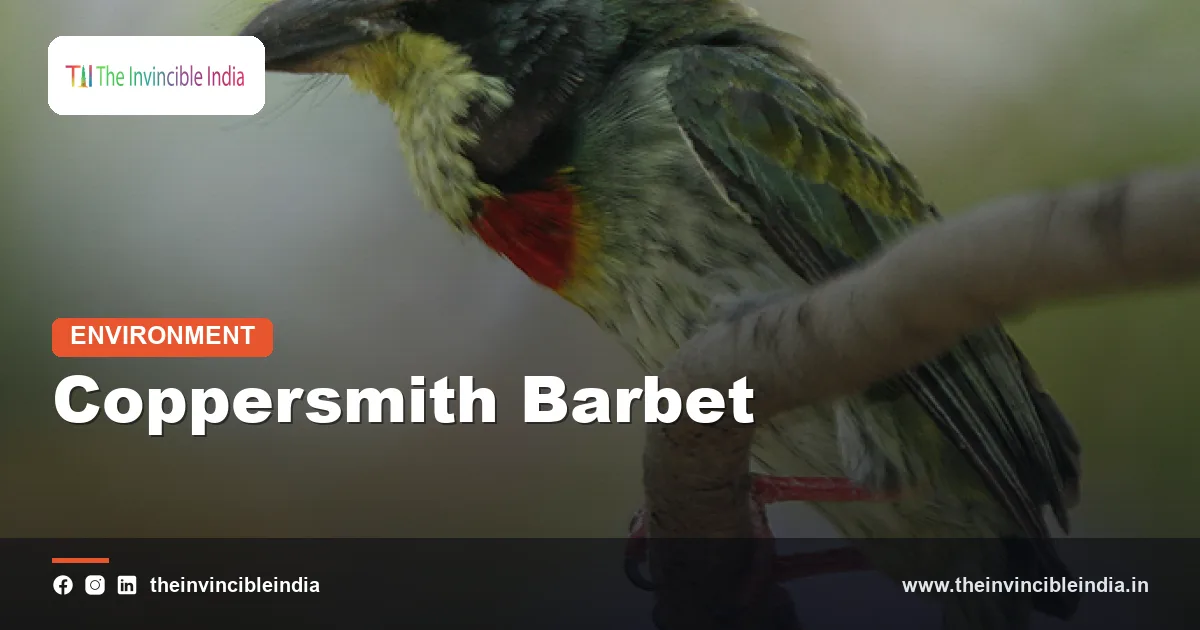
The coppersmith barbet (Psilopogon haemacephalus) is a small, plump, bright green bird with a crimson forehead and breast patch, a yellow throat and eye-ring, and a loud, metronomic “tuk-tuk-tuk” call that sounds like a hammer tapping on metal, and it is a common resident of gardens, avenues and open woodland across India. The coppersmith barbet is named after this call, which echoes the sound of a coppersmith beating a metal vessel, and it is one of the most easily heard sounds of the Indian summer.
This guide explains how to identify the coppersmith barbet, where it lives, what it eats, how it nests in tree holes, why its call is so distinctive and how it compares with other Indian barbets. It is written for beginners, students and general readers.
| Attribute | Detail |
|---|---|
| Common name | Coppersmith barbet (also called crimson-breasted barbet) |
| Scientific name | Psilopogon haemacephalus |
| Family | Megalaimidae (Asian barbets) |
| Body length | About 15 to 17 centimetres |
| Distinctive features | Green plumage, crimson forehead and chest patch, yellow throat and eye-ring, streaked underparts |
| Typical diet | Figs, berries and other fruit, with some insects |
| Nest type | Hole excavated in a dead or rotting branch or trunk |
| Conservation status | Least Concern on the IUCN Red List |
| Range | Indian subcontinent and Southeast Asia, including Indonesia and the Philippines |
Key Takeaways
- The coppersmith barbet (Psilopogon haemacephalus) is a small green Asian barbet found in most of India, and it is identified by its crimson forehead and breast patch.
- The coppersmith barbet is named for its call, a steady, repeated “tuk” note that resembles a coppersmith hammering metal.
- The coppersmith barbet feeds mostly on fruit, especially figs from banyan, peepal and other Ficus trees, and it helps to spread tree seeds.
- The coppersmith barbet excavates its own nest hole, usually in a dead or soft branch, and both partners help to dig it.
- The coppersmith barbet is listed as Least Concern by the IUCN and is a common bird in many Indian towns and cities.
- The coppersmith barbet is mostly heard rather than seen, because its green plumage blends into leaves, and the call is especially loud in hot weather.
What is the coppersmith barbet?
The coppersmith barbet is a small, stocky, fruit-eating bird belonging to the Asian barbet family Megalaimidae, and its scientific name is Psilopogon haemacephalus. The word barbet comes from the bristles around the base of the bill, which look like a small beard, and the family is related to woodpeckers and toucans.
The species was previously placed in the genus Megalaima, but modern classification includes it in Psilopogon. Older field guides therefore list the coppersmith barbet as Megalaima haemacephala, which is the same bird. The English name crimson-breasted barbet is used in some books, and Hindi and regional names such as chhota basanta are used by many Indian birdwatchers, though local names vary.
Several subspecies are recognised across the bird’s range, including mainland Indian forms and island races in Southeast Asia and the Philippines. They differ slightly in size and in the shade of green or crimson. The exact number of subspecies is a matter on which authorities differ.
How can you identify a coppersmith barbet?
A coppersmith barbet can be identified by its grass-green body, bright crimson forehead, crimson patch on the chest, yellow throat and yellow ring around the eye, and a thick, dark, slightly curved bill. The underparts are pale yellowish-white with broad green streaks, and the tail is short.
The bird is small, only slightly larger than a sparrow, and it sits very still among leaves, which makes it hard to spot. Males and females look almost the same, though the females may be slightly duller. Juveniles lack the crimson and have a paler, streaky look.
Key field marks
- Forehead: a bright crimson patch above the bill.
- Throat: yellow, bordered by black streaks and a black line through the face.
- Breast: a crimson patch surrounded by a green and yellow streaked belly.
- Eyes: surrounded by a yellow ring of bare skin.
- Legs: red to coral, strong and short, suited to clinging to branches.
Several other green Indian birds are similar, including the brown-headed barbet, the white-cheeked barbet and the large green barbet. The coppersmith barbet is smaller, has red on the forehead and breast and lacks a large brown head or a big blue throat.
Where is the coppersmith barbet found in India?
The coppersmith barbet is found across most of India, from the foothills of the Himalayas to the southern peninsula, and it is a resident that stays in the same area through the year. The bird is common in lowland gardens, farmland with trees, village groves, roadside avenues and open forests, and it is also seen in many large cities.
Typical places where the bird is seen include:
- Avenues lined with mature fig, neem, mango and tamarind trees.
- Parks, campuses, temple compounds and old cemeteries.
- Orchards, plantations and farmland with scattered trees.
- Open deciduous forests and the edges of forests.
- Large residential colonies with fruiting trees.
Outside India, the species ranges east through Southeast Asia to Indonesia and the Philippines. It generally avoids very high mountains and dense evergreen forest. Local movements may follow the fruiting of trees, with birds appearing in an area when figs ripen and disappearing when the fruit is finished.
Why is it called the coppersmith barbet?
The coppersmith barbet is called the coppersmith because its call, a ringing, metallic “tuk, tuk, tuk” repeated for long periods, sounds like a smith tapping a copper or brass vessel with a hammer. Coppersmiths, who make pots, pans and temple vessels by hand, were once a common sight in Indian bazaars, and the comparison was natural.
The call is given by both sexes but more often by males. A bird sits in an exposed spot and calls with its bill closed or nearly closed, bobbing its head with each note, and the sound may be repeated at a steady rate for many minutes. The call is a territorial and contact signal and may be answered by a neighbour.
When is the coppersmith barbet most vocal?
The coppersmith barbet is most vocal in the hot months, especially in spring and early summer, when it begins breeding, although it can call at other times as well. The sound often carries across a whole neighbourhood in the morning and late afternoon, and it can continue through the heat of the day when many other birds fall silent. This is why many Indians associate the call with summer.
What does the coppersmith barbet eat?
The coppersmith barbet eats mostly fruit, particularly figs, berries and small fleshy fruits, and it supplements its diet with insects such as beetles, termites and caterpillars. Fig trees are central to the bird’s life, and a fruiting banyan, peepal or other Ficus tree can attract many barbets at once.
The bird swallows small fruits whole and digests the pulp, then passes the seeds in its droppings or regurgitates them. This makes the coppersmith barbet an important seed disperser, and many trees grow from seeds left by birds on walls, roofs and in the cracks of buildings.
- Fig fruits from banyan, peepal, pilkhan and gular trees.
- Berries from trees such as neem, mulberry, lantana and various shrubs.
- Papaya, banana and other cultivated fruit in gardens.
- Insects, especially in the breeding season, when chicks need protein.
Barbets are sometimes seen in flocks around fruiting trees, together with parakeets, mynas, bulbuls and koels. They are generally not regarded as serious pests, though they may occasionally nibble at ripe fruit in orchards.
How does the coppersmith barbet nest?
The coppersmith barbet nests in a hole that it excavates itself, usually in a dead or soft branch or trunk, and the pair lays a small clutch of white eggs inside the cavity. The nest hole is typically a round entrance leading to a vertical chamber, and it is dug mostly by the bill.
The breeding season in India generally runs from late winter through summer, though it varies with region and rainfall. A typical sequence is:
- The pair selects a suitable branch, often one that is dry or partly rotten, and excavates a hole over several days or weeks.
- The female lays a small clutch, commonly in the range of two to four eggs.
- Both parents incubate, taking turns on the eggs, for roughly two weeks.
- Both parents feed the chicks with fruit and insects until the young leave the hole after around three to four weeks.
Barbets often use the same tree for several years. Old barbet holes are then used by other cavity nesters such as sparrows, mynas, parakeets and small owls, which makes the barbet a kind of habitat provider for other species. Roosting is also done in holes at night.
How is the coppersmith barbet different from other Indian barbets?
The coppersmith barbet differs from other Indian barbets mainly in size, head colour and call, because it is the smallest of the commonly seen barbets and the only one with a crimson forehead and breast. The table below compares several of the barbets that birdwatchers meet in India.
| Species | Approximate size | Key feature | Call |
|---|---|---|---|
| Coppersmith barbet | About 15 to 17 cm | Crimson forehead and breast, yellow throat | Metallic “tuk-tuk-tuk” |
| Brown-headed barbet | About 27 to 29 cm | Brown head and neck, green body, large size | Loud, repeated, rolling notes |
| White-cheeked barbet | About 23 cm | Streaked head, white cheek patch, red patch near the bill | Loud, repeated, rolling notes |
| Large green barbet | About 27 cm | Green with brown head streaks, found in hill forests | Loud, monotonous “piyo, piyo” |
| Blue-throated barbet | About 23 cm | Blue face and throat, red patch at the nape, found in wooded hills | Loud, ringing, repeated notes |
The brown-headed barbet is often heard at the same time as the coppersmith barbet in many cities. Its call is deeper, slower and less metallic, so the two species are easy to separate by ear.
Is the coppersmith barbet threatened?
The coppersmith barbet is not threatened and is classified as Least Concern by the International Union for Conservation of Nature (IUCN), because it has a large range and a large overall population, and it is common in many human-modified areas. Population numbers are not precisely known, and trends vary by region.
The main pressures on coppersmith barbets include:
- Felling of old trees and removal of dead branches, which reduces nest sites.
- Loss of fig trees and other native fruiting species from cities and farmland.
- Use of pesticides, which may reduce insect food for chicks.
- Competition for cavities with other hole-nesting birds such as mynas and parakeets.
- Collision with glass windows and vehicles in urban areas.
The bird is a native wild species covered by the Wildlife (Protection) Act, 1972. Planting native fig trees and leaving dead branches in place, where they are not a safety hazard, helps to support barbets and many other cavity-nesting birds.
How can you spot a coppersmith barbet?
You can spot a coppersmith barbet by first listening for its steady “tuk-tuk-tuk” call and then scanning the tops of nearby trees, because the bird sits still on exposed branches while calling. It often chooses a bare twig or the crown of a tree, which gives a clear view with binoculars.
These tips can help beginners:
- Visit parks and avenues in the early morning or late afternoon in spring and summer.
- Check fruiting fig trees, where barbets feed in the company of other birds.
- Look for the bobbing head as the bird calls, which gives away its position.
- Check dead branches for round nest holes, but keep your distance and do not disturb the birds.
- Record sightings and calls on citizen-science platforms such as eBird to support bird monitoring.
A patient observer in almost any Indian town with mature trees has a good chance of seeing a coppersmith barbet within a few visits.
Bottom Line
The coppersmith barbet (Psilopogon haemacephalus) is a small, green, fruit-eating bird whose hammer-like call is a sound of Indian summers. Its crimson forehead, fig-based diet and tree-hole nests make it a widespread, easily learned and ecologically valuable urban bird.
Frequently Asked Questions
Why is the coppersmith barbet called a coppersmith?
The coppersmith barbet is called a coppersmith because its repeated “tuk-tuk-tuk” call sounds like a smith hammering a copper vessel. The comparison is old and widely used, and the bird is known by this name across India and Southeast Asia.
What does the coppersmith barbet eat?
The coppersmith barbet eats mostly fruit, especially figs and berries, and it also takes some insects. Fruiting banyan and peepal trees are important food sources, and the bird helps to spread the seeds of the trees it feeds on.
Where does the coppersmith barbet nest?
The coppersmith barbet nests in a hole that it digs itself, usually in a dead or soft branch or trunk. The pair lays a small clutch of white eggs, commonly about two to four, and both parents incubate and feed the chicks.
When is the coppersmith barbet’s call heard most?
The coppersmith barbet’s call is heard most in the hot months, particularly in spring and early summer during the breeding season. The call can continue through the day, which is why many people link it with summer in India.
Is the coppersmith barbet common in Indian cities?
Yes, the coppersmith barbet is common in many Indian cities and towns that have mature trees, especially fig trees. It thrives in parks, avenues, campuses and gardens, and it is often heard before it is seen.
How can I tell a coppersmith barbet from other green birds?
You can tell a coppersmith barbet from other green birds by its crimson forehead and chest patch, yellow throat, small size and metallic call. Parakeets have long tails and curved red bills, while larger barbets lack the red patches and have different calls.
{“@context”:”https://schema.org”,”@graph”:[{“@type”:”FAQPage”,”mainEntity”:[{“@type”:”Question”,”name”:”Why is the coppersmith barbet called a coppersmith?”,”acceptedAnswer”:{“@type”:”Answer”,”text”:”The coppersmith barbet is called a coppersmith because its repeated “tuk-tuk-tuk” call sounds like a smith hammering a copper vessel. The comparison is old and widely used, and the bird is known by this name across India and Southeast Asia.”}},{“@type”:”Question”,”name”:”What does the coppersmith barbet eat?”,”acceptedAnswer”:{“@type”:”Answer”,”text”:”The coppersmith barbet eats mostly fruit, especially figs and berries, and it also takes some insects. Fruiting banyan and peepal trees are important food sources, and the bird helps to spread the seeds of the trees it feeds on.”}},{“@type”:”Question”,”name”:”Where does the coppersmith barbet nest?”,”acceptedAnswer”:{“@type”:”Answer”,”text”:”The coppersmith barbet nests in a hole that it digs itself, usually in a dead or soft branch or trunk. The pair lays a small clutch of white eggs, commonly about two to four, and both parents incubate and feed the chicks.”}},{“@type”:”Question”,”name”:”When is the coppersmith barbet’s call heard most?”,”acceptedAnswer”:{“@type”:”Answer”,”text”:”The coppersmith barbet’s call is heard most in the hot months, particularly in spring and early summer during the breeding season. The call can continue through the day, which is why many people link it with summer in India.”}},{“@type”:”Question”,”name”:”Is the coppersmith barbet common in Indian cities?”,”acceptedAnswer”:{“@type”:”Answer”,”text”:”Yes, the coppersmith barbet is common in many Indian cities and towns that have mature trees, especially fig trees. It thrives in parks, avenues, campuses and gardens, and it is often heard before it is seen.”}},{“@type”:”Question”,”name”:”How can I tell a coppersmith barbet from other green birds?”,”acceptedAnswer”:{“@type”:”Answer”,”text”:”You can tell a coppersmith barbet from other green birds by its crimson forehead and chest patch, yellow throat, small size and metallic call. Parakeets have long tails and curved red bills, while larger barbets lack the red patches and have different calls.”}}]}]}


