

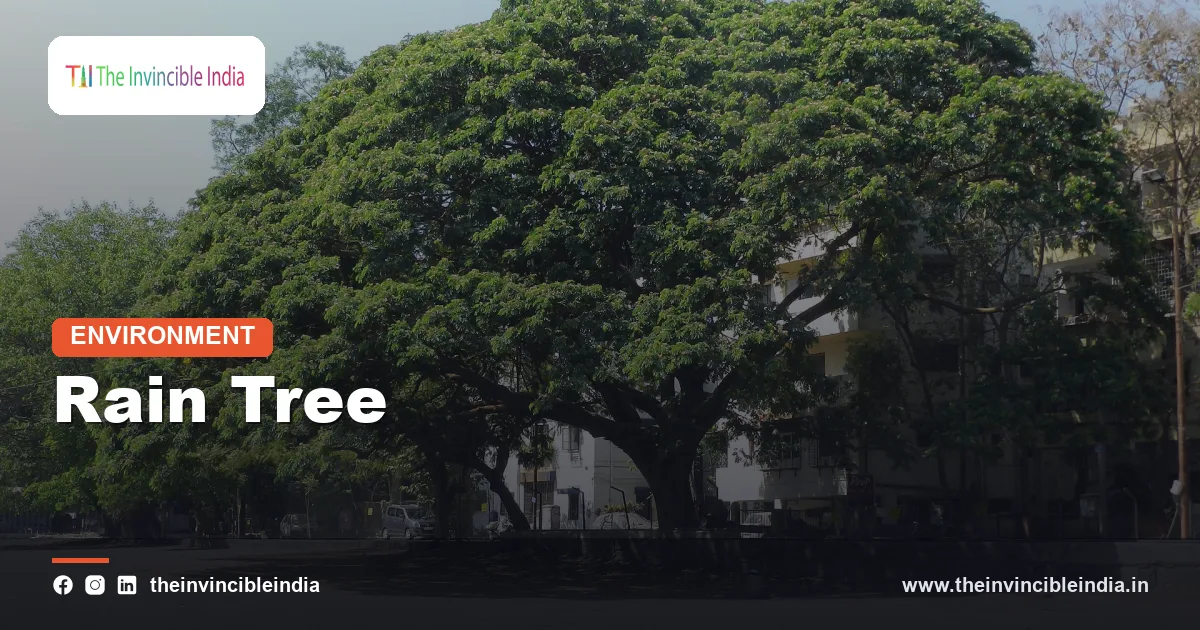
The rain tree (Samanea saman) is a large, fast-growing shade tree with a broad, umbrella-shaped canopy whose feathery leaflets fold together at dusk and before rain, and it is one of the most widely planted avenue trees in Indian cities. Native to tropical Central and South America, the rain tree was introduced to India during the colonial era and is now a familiar sight along roads, in parks and in old campuses from Bengaluru to Kolkata.
The rain tree is also called monkeypod, samán or, in Hindi, belati siris or vilayati siris, meaning foreign siris. This explainer, last updated 23 October 2026, covers the botany, leaf movements, history in India, ecology, uses, drawbacks and planting advice for the rain tree.
| Quick Fact | Detail |
|---|---|
| Scientific name | Samanea saman (also written Albizia saman or Pithecellobium saman) |
| Plant family | Fabaceae (legume or pea family), mimosoid subfamily |
| Common names | Rain tree, monkeypod, saman, belati siris (Hindi), thoongu moonji maram (Tamil) |
| Native range | Tropical Central America and northern South America |
| Status in India | Introduced during the colonial period; widely planted and naturalised in places |
| Tree size | Typically 15 to 25 metres tall, with a crown often as wide as or wider than the tree is tall |
| Flowers and fruit | Pink, powder-puff flower heads; long, flat, dark brown pods with sweet pulp |
| Leaf behaviour | Leaflets fold at night and in dull, rainy or overcast weather |
| Main uses | Shade and avenue planting, ornamental timber, fodder pods, habitat for epiphytes |
Key Takeaways
- The rain tree, scientifically Samanea saman, is a large legume tree native to tropical America that was introduced to India and is now a common avenue and park tree.
- The rain tree has a broad umbrella-like crown that can spread wider than the tree is tall, so a single rain tree can shade a very large area.
- Rain tree leaflets fold together at dusk and in overcast or rainy weather, a daily movement known as nyctinasty or sleep movement.
- The rain tree fixes nitrogen through root nodules, as most members of the legume family do, and is used as a shade tree over crops such as coffee, cocoa and tea in some countries.
- The rain tree produces long brown pods with sweet, sticky pulp that cattle, horses and wild animals eat, and the tree spreads partly through animals dispersing the seeds.
- The rain tree has weaknesses, including shallow surface roots that lift pavements and brittle branches that may fall in strong storms, so planting space and maintenance matter.
What is the rain tree?
The rain tree is a large, spreading, semi-evergreen tree of the legume family that is grown mainly for shade, and it is best recognised by its wide, dome-shaped crown. The tree’s scientific name Samanea saman has had several older names, including Pithecellobium saman and Albizia saman, and it is related to the Indian siris trees (Albizia species).
A mature rain tree has a short, stout trunk that divides low into several heavy, spreading limbs, and a crown whose width can equal or exceed the height of the tree. The bark is grey-brown and rough. The leaves are bipinnate, which means that each leaf is divided into several pairs of branches that carry many small oval leaflets, giving the foliage a soft, fern-like look. Most rain trees do not lose all their leaves at once. In the dry season, the tree drops foliage gradually and quickly grows new leaves.
Why is it called the rain tree?
The rain tree is called the rain tree because its leaflets fold up before rain, and in some regions because a fine drip of liquid appears to fall from the branches during dry weather. The folding of the leaflets in overcast conditions has made farmers and villagers treat the tree as a rough weather indicator, although the movement follows light levels and is not a precise forecast.
The dripping explanation is often given for the name. Small sap-sucking insects, such as froghopper or cicada nymphs, feed on the tree’s twigs and excrete surplus liquid, which falls as a light shower under the canopy. The explanation is common in descriptions of the species in several countries, though how often and how strongly it occurs varies with place and season. The Tamil name, thoongu moonji maram, means sleeping-face tree and refers to the tree’s folding leaves.
How do the leaves of the rain tree fold?
The leaflets of the rain tree fold by changes in water pressure in small swellings at the leaflet bases, so that the leaflets close together as light falls at dusk and in heavy cloud and open again in the morning. This movement is called nyctinasty, or sleep movement, and it is shared by many legume trees and herbs, including the touch-me-not plant (Mimosa pudica) and the tamarind tree.
The result is that the dense green canopy looks sparse and open at night and in gloomy weather, letting more rain, light and air pass through. Researchers have suggested several benefits of the movement, such as reducing heat loss at night, limiting water loss or reducing damage by heavy rain, and the exact value is still discussed. The rain tree responds to light and temperature, not directly to the approach of rain, so the tree is a hint and not a weather instrument.
How did the rain tree come to India?
The rain tree came to India from tropical America through the global exchange of plants in the colonial period, and it was planted in British-era gardens, cantonments, roads and railway lines from the nineteenth century onwards. Botanic gardens and the horticultural departments of the time played a major role in spreading shade trees in this way.
Because the tree grows fast, provides dense shade and tolerates many soils, the rain tree became a favourite for tree-lined avenues. Old rain trees survive today in city parks, university campuses, club grounds and heritage gardens, such as those in Bengaluru, Kolkata, Chennai and Mumbai, and many have grown into landmarks. The tree has spread from Latin America to much of the tropics, including Southeast Asia, Hawaii, the Pacific islands and Africa.
What does the rain tree look like through the year?
The rain tree carries pink flower heads in the warmer months, develops long pods in the following months and renews its leaves in the dry season. Flowering time varies with local climate, but in much of India it falls in the spring and early summer.
- Flowers: small flowers are grouped in rounded heads about 4 to 5 centimetres across, with long pink-and-white stamens that look like powder puffs and give off a faint sweet scent.
- Pods: straight to slightly curved, flat, thick, dark brown to black pods up to about 20 centimetres long that contain a sticky, sweet pulp around hard seeds.
- Leaves: bipinnate leaves with two to six pairs of branches, each carrying small leaflets that close at night.
- Trunk and branches: short, thick trunk with large, nearly horizontal limbs, often covered with ferns, orchids and other plants growing on the bark.
The pulp inside the pods is sweet and has a slight liquorice-like taste, and children and animals eat it. The pods fall in large numbers and can make a mess on pavements and cars.
How does the rain tree help the environment?
The rain tree helps the environment by cooling urban areas with dense shade, enriching soil through nitrogen fixation, and providing a habitat for birds, insects and epiphytic plants. Studies of tree shade in cities show that large canopies can lower ground and air temperatures noticeably in the shade, though the exact effect depends on the site.
Like other legumes, the rain tree has root nodules with nitrogen-fixing bacteria, so it can grow in poor soils and add nitrogen to the soil through leaf fall. In coffee, cocoa and tea estates in several countries, large rain trees are used as shade trees above the crop. Old trunks and limbs support epiphytes, such as ferns, orchids, mosses and bromeliads, and birds nest in the crown. Squirrels, monkeys and parakeets may also use the tree. Flowers attract bees, butterflies and moths.
What are the uses of the rain tree?
The rain tree is used mainly as a shade and ornamental tree, and its wood, pods and leaves have secondary uses in carving, fodder and soil improvement. The timber is known as monkeypod wood in the trade and is valued for its attractive grain and colour.
| Part | Use | Comment |
|---|---|---|
| Canopy | Shade for avenues, parks, campuses, plantations | Main use in India |
| Wood | Furniture, bowls, carvings, panelling, boxes | Medium-weight, attractive grain, seasons well |
| Pods | Livestock fodder (pulp and seeds) | Sweet pulp is eaten by cattle, horses and goats |
| Leaves | Green manure and fodder | Used in some tropical farming systems |
| Bark and other parts | Folk remedies in some countries | Based on tradition rather than strong clinical evidence |
In some Pacific islands, such as Hawaii, rain tree wood is made into bowls, platters and decorative carvings sold to visitors. In India, the wood is used for furniture and packing cases in smaller quantities, mostly from trees felled for safety or road widening.
What are the drawbacks of the rain tree?
The main drawbacks of the rain tree are its shallow, spreading roots, its brittle branches and its large size, which make it a poor choice for narrow streets and small plots. The surface roots can lift kerbs, cracks pavements and damage drains and compound walls, and falling pods and leaves need regular cleaning.
- Branch failure: heavy, wide limbs can break in cyclones and gales, especially in old trees with internal decay, so inspection and pruning by trained arborists is important.
- Space needs: a mature rain tree needs a great deal of room above and below the ground.
- Shading of other plants: the dense canopy limits the growth of plants beneath it.
- Spread outside gardens: in some tropical islands the tree has spread into natural vegetation, though it is generally treated as a planted tree in India.
Urban foresters therefore increasingly recommend native species for new plantings, with the rain tree reserved for large open sites, and they encourage the care of existing mature rain trees, which have grown into valuable shade assets.
How is the rain tree planted and cared for?
The rain tree is planted from seed or saplings at the beginning of the monsoon in a sunny site with plenty of space, and it grows rapidly with little care once it is established. Seeds have a hard coat, so they are usually soaked in warm water or scratched before sowing to improve germination.
Young trees need watering in the first dry seasons, staking if the site is windy and light formative pruning to create a strong central structure. The tree prefers full sun and tolerates a variety of soils from sandy to clayey, as long as they are not permanently waterlogged. A good rule is to plant the rain tree at least several metres from buildings, boundary walls and underground services, and to avoid planting beneath power lines. In suitable conditions the tree can grow a metre or more a year when young.
Bottom Line
The rain tree is a generous but demanding tree. Samanea saman gives city dwellers broad shade, a fascinating daily leaf movement and a home for wildlife, and the rain tree works best in large parks, campuses and wide avenues where its size and roots have room to spread.
Frequently Asked Questions
What is the scientific name of the rain tree?
The scientific name of the rain tree is Samanea saman. Older names include Albizia saman and Pithecellobium saman. The tree belongs to the legume family, Fabaceae.
Is the rain tree native to India?
No, the rain tree is not native to India. The rain tree comes from tropical Central and South America and was introduced to India during the colonial period. It is now widely planted in Indian cities and has become a familiar shade tree.
Why do the leaves of the rain tree close at night?
The leaflets of the rain tree close at night because of changes in water pressure at their bases, triggered by falling light. This daily movement is called nyctinasty or sleep movement. The leaflets also close in dull, rainy weather, which is how the tree earned its name.
How tall does a rain tree grow?
A rain tree usually grows 15 to 25 metres tall, and the crown often spreads as wide as or wider than the height of the tree. In good conditions the tree grows fast when young. Its wide canopy makes it one of the best shade trees in the tropics.
Is the rain tree a good tree to plant near a house?
No, the rain tree is generally not a good choice near a house or on a small plot. The tree becomes very large, and its shallow roots can damage foundations, pavements and drains. A rain tree is better suited to large open areas such as parks, campuses and farms.
Can you eat the pods of the rain tree?
The pods of the rain tree contain a sweet, sticky pulp that animals such as cattle and horses eat, and people in some countries also chew the pulp. The pods are mainly valued as livestock fodder and not as a human food. Anyone unsure about eating wild or roadside pods should avoid them.
{“@context”:”https://schema.org”,”@graph”:[{“@type”:”FAQPage”,”mainEntity”:[{“@type”:”Question”,”name”:”What is the scientific name of the rain tree?”,”acceptedAnswer”:{“@type”:”Answer”,”text”:”The scientific name of the rain tree is Samanea saman. Older names include Albizia saman and Pithecellobium saman. The tree belongs to the legume family, Fabaceae.”}},{“@type”:”Question”,”name”:”Is the rain tree native to India?”,”acceptedAnswer”:{“@type”:”Answer”,”text”:”No, the rain tree is not native to India. The rain tree comes from tropical Central and South America and was introduced to India during the colonial period. It is now widely planted in Indian cities and has become a familiar shade tree.”}},{“@type”:”Question”,”name”:”Why do the leaves of the rain tree close at night?”,”acceptedAnswer”:{“@type”:”Answer”,”text”:”The leaflets of the rain tree close at night because of changes in water pressure at their bases, triggered by falling light. This daily movement is called nyctinasty or sleep movement. The leaflets also close in dull, rainy weather, which is how the tree earned its name.”}},{“@type”:”Question”,”name”:”How tall does a rain tree grow?”,”acceptedAnswer”:{“@type”:”Answer”,”text”:”A rain tree usually grows 15 to 25 metres tall, and the crown often spreads as wide as or wider than the height of the tree. In good conditions the tree grows fast when young. Its wide canopy makes it one of the best shade trees in the tropics.”}},{“@type”:”Question”,”name”:”Is the rain tree a good tree to plant near a house?”,”acceptedAnswer”:{“@type”:”Answer”,”text”:”No, the rain tree is generally not a good choice near a house or on a small plot. The tree becomes very large, and its shallow roots can damage foundations, pavements and drains. A rain tree is better suited to large open areas such as parks, campuses and farms.”}},{“@type”:”Question”,”name”:”Can you eat the pods of the rain tree?”,”acceptedAnswer”:{“@type”:”Answer”,”text”:”The pods of the rain tree contain a sweet, sticky pulp that animals such as cattle and horses eat, and people in some countries also chew the pulp. The pods are mainly valued as livestock fodder and not as a human food. Anyone unsure about eating wild or roadside pods should avoid them.”}}]}]}


