

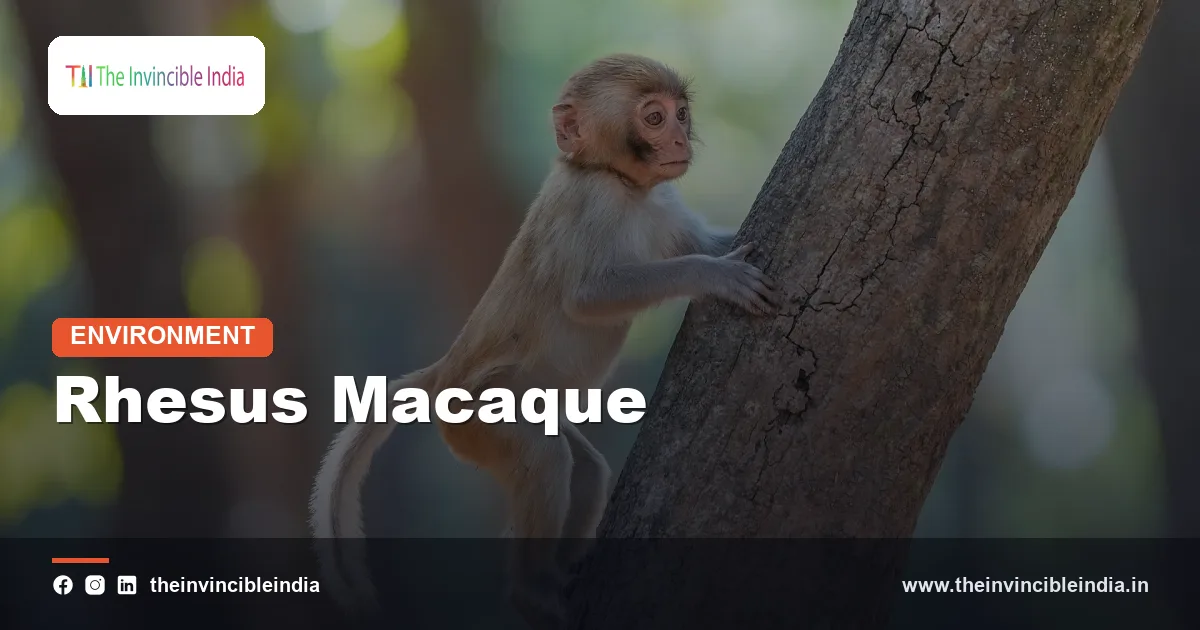
The rhesus macaque (Macaca mulatta) is a medium-sized, brown-furred Old World monkey with a pinkish-red face that is native to much of South and Southeast Asia and is among the most familiar wild primates of northern and central India. The rhesus macaque thrives in forests, farmland, village edges, railway stations and temple complexes, which is why many Indians meet it far more often than any other non-human primate.
Few animals have influenced human life as quietly as the rhesus macaque. Its blood gave the world the name of the Rh factor, its kidney cells helped produce polio vaccines, and its close genetic resemblance to people made it a mainstay of biomedical research for much of the twentieth century. At the same time, its boldness around humans has made it the centre of one of India’s most persistent urban wildlife conflicts. This explainer, last reviewed 23 October 2026, sets out the species in plain terms.
| Attribute | Detail |
|---|---|
| Scientific name | Macaca mulatta |
| Family and order | Cercopithecidae (Old World monkeys); order Primates |
| Typical size | Roughly 47 to 64 cm head-and-body length; adult males commonly weigh about 7 to 11 kg and females somewhat less |
| Appearance | Buff-brown to grey-brown coat, bare pink-red face and rump, medium-length tail |
| Social structure | Multi-male, multi-female troops, usually led by a female-centred hierarchy |
| Diet | Omnivore: fruits, seeds, leaves, roots, flowers, insects, plus human food waste |
| Habitat in India | Forests, scrub, farmland, towns, temples and rail yards across the north, centre and east |
| Conservation status | Least Concern on the IUCN Red List (global assessment); protected under Indian wildlife law |
Key Takeaways
- The rhesus macaque (Macaca mulatta) is a brown, pink-faced Old World monkey that is widespread across northern, central and eastern India.
- Rhesus macaque troops are organised around related females, while young males typically leave the troop where they were born when they mature.
- The Rh blood-group factor in humans takes its name from the rhesus monkey, whose red blood cells were used in the 1940 experiments that revealed it.
- Rhesus macaques adapt readily to cities and temples, and feeding by people is a major reason for conflict in many Indian towns.
- The rhesus macaque is classed as Least Concern globally, but it is still protected under India’s Wildlife (Protection) Act, 1972, so harming it is an offence.
- India restricted the export of rhesus macaques for research in the late 1970s, ending what had been a large international trade.
What is the rhesus macaque?
The rhesus macaque is a species of macaque, a genus of monkeys within the family Cercopithecidae, and it is one of the most widely distributed non-human primates in the world. Its range runs from Afghanistan and Pakistan through the Indian subcontinent and Nepal into Myanmar, Thailand, Vietnam and southern China.
The English name “rhesus” is a historical label that has little meaning for the animal itself; it was applied in the eighteenth century and stuck. The species name mulatta refers to its brownish colouring. Scientists treat the rhesus macaque as an adaptable generalist, meaning it can live in many habitats and eat many foods. That flexibility explains both its global success and its frequent encounters with people.
Within India, the rhesus macaque is one of several macaque species. The bonnet macaque of peninsular India, the lion-tailed macaque of the Western Ghats, the Assamese macaque and the Arunachal macaque of the north-east are all relatives, but the rhesus macaque is the one most people picture when they say “monkey” in the northern plains.
How do you identify a rhesus macaque?
A rhesus macaque is identified by its sandy-brown or greyish coat, a bare pink to red face, a reddish hairless rump and a tail that is shorter than the body, usually around 20 to 30 cm long. Adult males are larger and heavier than females, with stronger canine teeth that are used in displays and fights.
Young animals have a paler, rosier face that darkens and reddens as they mature. The cheeks hold pouches that allow a macaque to stuff food quickly and chew it later in a safer spot, a habit that is easy to observe at feeding sites. The fingers are dexterous, and the opposable thumb lets a rhesus macaque unscrew lids, open bags and pull open latches.
Because several monkeys share Indian settlements, a quick comparison helps.
| Feature | Rhesus macaque | Bonnet macaque | Hanuman (grey) langur |
|---|---|---|---|
| Face | Pink-red, bare | Pale, with a whorl of hair like a cap on the crown | Black, framed by pale hair |
| Tail | Short to medium, held low | Long, often arching | Very long, looping over the back |
| Build | Stocky | Slim and long-limbed | Slender, long-limbed |
| Main diet | Omnivorous | Omnivorous | Mostly leaves |
| Typical region | North, central and east India | Peninsular and southern India | Across much of the subcontinent |
Where do rhesus macaques live in India?
Rhesus macaques live across a large belt of northern, central and eastern India, from the Himalayan foothills down through the Gangetic plains and into peninsular regions where they overlap with other monkeys. The species is also found in the Himalaya at moderate elevations, where it copes with cold winters by growing a thicker coat.
The rhesus macaque occupies deciduous and mixed forests, riverbanks, scrub, agricultural land, canal embankments and human settlements. In states such as Uttar Pradesh, Rajasthan, Haryana, Himachal Pradesh, Uttarakhand, Delhi, Madhya Pradesh and Bihar it is a regular urban and peri-urban presence. In the south the bonnet macaque largely takes over, though the ranges of the two species can meet in a transition zone.
Wherever there are reliable water, shade and food, the species can establish itself. Old fortifications, ghats, pilgrimage towns, railway stations and government complexes all offer ledges and trees that function like cliffs and forest canopy. Researchers describe this as a “commensal” lifestyle, meaning that the monkeys live alongside people and benefit from them.
How do rhesus macaque troops work?
A rhesus macaque troop is a stable social group of roughly 20 to 200 animals in which related females form the permanent core and adult males move between groups. Troop size varies with food supply, and urban troops that receive plentiful food may be unusually large before they split into smaller groups.
Females stay in the troop where they were born for life, forming matrilines of mothers, daughters, sisters and aunts. Rank is inherited in a predictable way: daughters usually take a rank just below their mother’s, and younger sisters often outrank older ones. High-ranking females gain better access to food and safer resting places. Males, by contrast, typically leave around puberty and join other troops, which keeps the gene pool mixed.
Communication and grooming
- Grooming, in which one monkey picks through another’s fur, is the main way bonds are built and repaired.
- An open-mouth stare is a threat, while a fixed grin with bared teeth often signals fear or submission.
- Rhesus macaques use a repertoire of coos, barks, screams and grunts to coordinate movement and warn of danger.
Breeding
Females usually give birth to a single infant after a pregnancy of about five and a half months, and births cluster in particular seasons in many regions. Infants cling to the mother’s belly at first and then ride on her back. Lifespans in the wild are commonly in the range of 15 to 25 years, and longer in captivity.
How intelligent is the rhesus macaque?
The rhesus macaque is a highly intelligent animal that can learn rules, remember individual faces and social relationships, and solve practical problems. Laboratory studies over several decades have shown that rhesus macaques can learn to categorise objects, follow sequences and respond to symbols, which is a big reason they became standard research subjects.
In daily life the evidence of intelligence is easy to see. Troop members remember who is dominant, who is a friend and who is a rival. They coordinate grooming alliances, and they learn which people carry food, which shops leave goods unguarded and which times of day a street is quiet. Urban troops have learnt to snatch bags, open fridges and unlatch gates.
Some intelligence is cultural rather than inherited. Techniques such as washing food, cracking nuts or raiding a particular building can spread through a troop by imitation. The species is also sensitive to being watched: a macaque will often avoid a direct stare, and will treat a raised stick as a threat. Intelligence, in other words, is a key reason rhesus macaques do so well in cities and a reason that simple deterrents often stop working after a few weeks.
What do rhesus macaques eat?
Rhesus macaques are omnivores that eat fruits, seeds, flowers, leaves, buds, roots, tubers, tree gum, insects and occasionally small animals such as eggs and young birds. In natural settings, they follow the fruiting calendar of trees such as fig, mango, jamun and banyan.
Near people, the diet shifts sharply. Rhesus macaques eat chapatis, bananas, peanuts, biscuits, vegetables from stalls, crops in the field and food left as offerings. Ripe crops, particularly maize, vegetables and fruit orchards, are an easy target, and farmers in many hill and plains districts regard the monkey as a serious agricultural pest.
The species also plays an ecological role. By eating fruit and moving across the landscape it disperses seeds, and by foraging in leaf litter and bark it takes insects. Experts caution that food handed out by humans can make the diet less balanced, increase aggression and encourage troops to grow beyond what the surrounding area can sustain.
Why are rhesus macaques found in temples and cities?
Rhesus macaques are found in temples and cities because these places offer steady food, water, safe perches and, in many cases, religious tolerance. Pilgrimage sites in particular have long been feeding grounds, since devotees regard feeding monkeys as an act of merit.
In Hindu tradition, monkeys are linked with Hanuman, the devoted companion of Rama in the Ramayana, and many people associate the animal with that deity. This cultural respect has protected monkeys in many temple towns for generations. Temples in places such as Vrindavan, Shimla, Jaipur and Delhi are well known for resident troops.
Urban design adds to the effect. Buildings with ledges, overhead cables, rooftops and trees offer routes that mimic natural forest. Dumped food waste and open garbage bins supply calories year-round. Over time the monkeys lose their wariness of crowds and traffic, and a population that once lived at the forest edge becomes a permanent resident of the city. Scientists often call this process habituation.
What problems arise between rhesus macaques and people?
The main problems between rhesus macaques and people are crop damage, food theft, property damage, bites and scratches, and the risk of disease transmission. These conflicts are widely reported in Indian cities, hill towns and farming districts, and they affect pedestrians, schoolchildren, shopkeepers, hospital staff and government offices alike.
- Bites and injuries: Bites occur most often when people try to feed, tease or snatch items back from a monkey. Medical advice is to wash any bite thoroughly and seek treatment, including rabies prophylaxis where advised.
- Disease risk: Macaques can carry pathogens that affect humans, including, in some captive and free-ranging populations, a herpesvirus known as macacine herpesvirus 1 (formerly B virus). Cases in people are rare but serious.
- Agriculture: Troops raid standing crops and orchards, particularly in hill districts, with losses that are hard to measure precisely.
- Accidents: Monkeys on power lines and balconies can cause outages or falls. A widely reported incident in Delhi in 2007 involved a senior civic official who died after a fall at his residence while reportedly trying to ward off monkeys.
Authorities have tried many responses, including relocating troops, sterilisation programmes, trained langur handlers, fencing and awareness campaigns. Capture and relocation often fails, because displaced monkeys either return or become a problem elsewhere. Sterilisation of monkeys has been carried out in states such as Himachal Pradesh, and the Central government has, in some years and locations, allowed limited culling as a measure for crop protection, a policy that remains debated. Wildlife biologists generally argue that reducing available food, especially garbage and deliberate feeding, is the most reliable long-term measure.
How did rhesus macaques shape medicine and space research?
Rhesus macaques shaped medicine and space research by serving as the main non-human primate model in twentieth-century laboratories, and they gave their name to the Rh blood-group factor discovered in 1940. In that year Karl Landsteiner and Alexander Wiener reported that antibodies raised in rabbits and guinea pigs by injecting rhesus monkey red blood cells also reacted with the red cells of most people, leading to the naming of the “Rh” system.
The Rh factor matters in everyday medicine. A person is described as Rh-positive or Rh-negative depending on the presence of a particular antigen on red blood cells, and mismatches between a mother and a foetus can cause haemolytic disease of the newborn. Modern research has shown that the human antigen and the monkey protein are related but not identical, yet the name has remained unchanged for more than eighty years.
| Milestone | Role of the rhesus macaque |
|---|---|
| 1940 | Red blood cells used in experiments that revealed the Rh factor |
| 1949 | A rhesus macaque named Albert II became the first monkey to reach space aboard a US V-2 rocket, though the flight ended fatally |
| 1950s | Monkey kidney cell cultures were widely used to grow and test polio vaccines |
| 1959 | A rhesus macaque named Able flew with a squirrel monkey named Baker and survived the flight |
| 2007 | The rhesus macaque genome was published, helping comparisons with human biology |
The rhesus macaque has also been important in research on vaccines, HIV and AIDS, neuroscience, ageing and the development of the visual system. India was historically a major source of animals for these programmes. In the late 1970s, India placed a ban on the export of rhesus macaques for research, a decision often traced to concerns about large-scale trapping and about how the animals were being used abroad. Since then, laboratories elsewhere have relied on breeding colonies, though research using macaques remains a subject of ethical debate.
What is the legal and conservation status of the rhesus macaque in India?
The rhesus macaque is a protected species under India’s Wildlife (Protection) Act, 1972, so hunting, capturing or harming it without permission is a punishable offence. Schedule placements under the Act were revised by amendments, including the 2022 amendment, so readers should check the current schedules for the exact classification.
Globally, the International Union for Conservation of Nature (IUCN) lists the rhesus macaque as Least Concern, reflecting a very large range and a population believed to be large. Even so, local declines have been reported where forest is lost or where animals were once trapped heavily for export. Experts also point out that high numbers in towns do not necessarily mean a healthy wild population, since urban troops can inflate impressions of abundance.
State governments have the authority to manage conflict through forest departments, and municipal bodies are responsible for waste management that affects monkey behaviour. Courts, including the Delhi High Court on several occasions, have directed civic and forest authorities to tackle monkey menace in the capital, reflecting how serious the issue has become. Population figures for India are uncertain and are best treated as estimates rather than fixed counts.
How should people behave around rhesus macaques?
People should behave calmly and keep a distance from rhesus macaques, avoid eye contact, never feed them and never carry visible food in the open. A monkey interprets a direct stare, bared teeth or sudden movement as a challenge, and feeding rewards pushy behaviour.
- Keep food, bags and drinks covered and zipped, especially at temples and tourist spots.
- Do not run, because running may trigger a chase.
- Do not try to grab an item back; let it go if a monkey takes it.
- Do not tease or photograph at close range, and keep children close.
- Close windows, balcony doors and rooftop access in monkey-prone areas.
- If bitten or scratched, wash the wound with soap and running water for several minutes and consult a doctor promptly.
Communities can also reduce conflict by securing garbage, putting up signs against feeding, and supporting scientific management rather than ad hoc measures. These steps benefit people and the monkeys alike, because wild troops that depend on human food are more likely to be injured, hit by vehicles or electrocuted.
Bottom Line
The rhesus macaque is a clever, social and extremely adaptable monkey that has become both a scientific landmark and an everyday neighbour in northern India. Understanding its troop life, its diet and its bold use of human spaces is the first step towards living with it safely, and managing food and waste matters far more than any single control measure.
Frequently Asked Questions
Why is it called the rhesus macaque?
The name “rhesus” is a historical label given in the eighteenth century and has no special connection to the animal’s biology. “Macaque” refers to the genus Macaca, and the species name mulatta refers to its brownish colouring. The name later became famous through the Rh blood-group factor, which was named after the rhesus monkey.
Is the rhesus macaque dangerous to humans?
A rhesus macaque is not usually aggressive without cause, but it can bite or scratch if it feels threatened or is teased, especially around food. Bites carry a risk of infection and, in some cases, rabies, so medical attention is advisable. Staying calm, keeping food out of sight and avoiding eye contact greatly reduces the chance of conflict.
Why are monkeys associated with Hanuman and temples in India?
Monkeys are associated with Hanuman because of the Ramayana, in which Hanuman, a devoted monkey-like figure, serves Rama. Many devotees therefore treat monkeys with respect and offer them food at temples. This tradition has helped monkey troops persist in pilgrimage towns, although scientists advise against feeding because it increases dependence and conflict.
What is the Rh factor and how is it linked to the rhesus macaque?
The Rh factor is a protein on the surface of red blood cells; people who have it are Rh-positive and those who lack it are Rh-negative. It was named after the rhesus monkey because Landsteiner and Wiener used rhesus red blood cells in the 1940 experiments that led to its discovery. The human and monkey molecules are related but not identical.
Is the rhesus macaque protected in India?
Yes, the rhesus macaque is protected under India’s Wildlife (Protection) Act, 1972, which restricts hunting, capture and harm. Its schedule placement has been revised through amendments, so the current schedule should be verified. Globally the species is classed as Least Concern by the IUCN because of its wide range.
How can cities reduce conflict with rhesus macaques?
Cities can reduce conflict most effectively by cutting off easy food through better garbage management and by discouraging public feeding. Other measures include sterilisation programmes, protecting forest habitat, using barriers and educating residents. Relocating monkeys alone seldom works, because displaced animals tend to return or cause problems elsewhere.
{“@context”:”https://schema.org”,”@graph”:[{“@type”:”FAQPage”,”mainEntity”:[{“@type”:”Question”,”name”:”Why is it called the rhesus macaque?”,”acceptedAnswer”:{“@type”:”Answer”,”text”:”The name “rhesus” is a historical label given in the eighteenth century and has no special connection to the animal’s biology. “Macaque” refers to the genus Macaca, and the species name mulatta refers to its brownish colouring. The name later became famous through the Rh blood-group factor, which was named after the rhesus monkey.”}},{“@type”:”Question”,”name”:”Is the rhesus macaque dangerous to humans?”,”acceptedAnswer”:{“@type”:”Answer”,”text”:”A rhesus macaque is not usually aggressive without cause, but it can bite or scratch if it feels threatened or is teased, especially around food. Bites carry a risk of infection and, in some cases, rabies, so medical attention is advisable. Staying calm, keeping food out of sight and avoiding eye contact greatly reduces the chance of conflict.”}},{“@type”:”Question”,”name”:”Why are monkeys associated with Hanuman and temples in India?”,”acceptedAnswer”:{“@type”:”Answer”,”text”:”Monkeys are associated with Hanuman because of the Ramayana, in which Hanuman, a devoted monkey-like figure, serves Rama. Many devotees therefore treat monkeys with respect and offer them food at temples. This tradition has helped monkey troops persist in pilgrimage towns, although scientists advise against feeding because it increases dependence and conflict.”}},{“@type”:”Question”,”name”:”What is the Rh factor and how is it linked to the rhesus macaque?”,”acceptedAnswer”:{“@type”:”Answer”,”text”:”The Rh factor is a protein on the surface of red blood cells; people who have it are Rh-positive and those who lack it are Rh-negative. It was named after the rhesus monkey because Landsteiner and Wiener used rhesus red blood cells in the 1940 experiments that led to its discovery. The human and monkey molecules are related but not identical.”}},{“@type”:”Question”,”name”:”Is the rhesus macaque protected in India?”,”acceptedAnswer”:{“@type”:”Answer”,”text”:”Yes, the rhesus macaque is protected under India’s Wildlife (Protection) Act, 1972, which restricts hunting, capture and harm. Its schedule placement has been revised through amendments, so the current schedule should be verified. Globally the species is classed as Least Concern by the IUCN because of its wide range.”}},{“@type”:”Question”,”name”:”How can cities reduce conflict with rhesus macaques?”,”acceptedAnswer”:{“@type”:”Answer”,”text”:”Cities can reduce conflict most effectively by cutting off easy food through better garbage management and by discouraging public feeding. Other measures include sterilisation programmes, protecting forest habitat, using barriers and educating residents. Relocating monkeys alone seldom works, because displaced animals tend to return or cause problems elsewhere.”}}]}]}


