

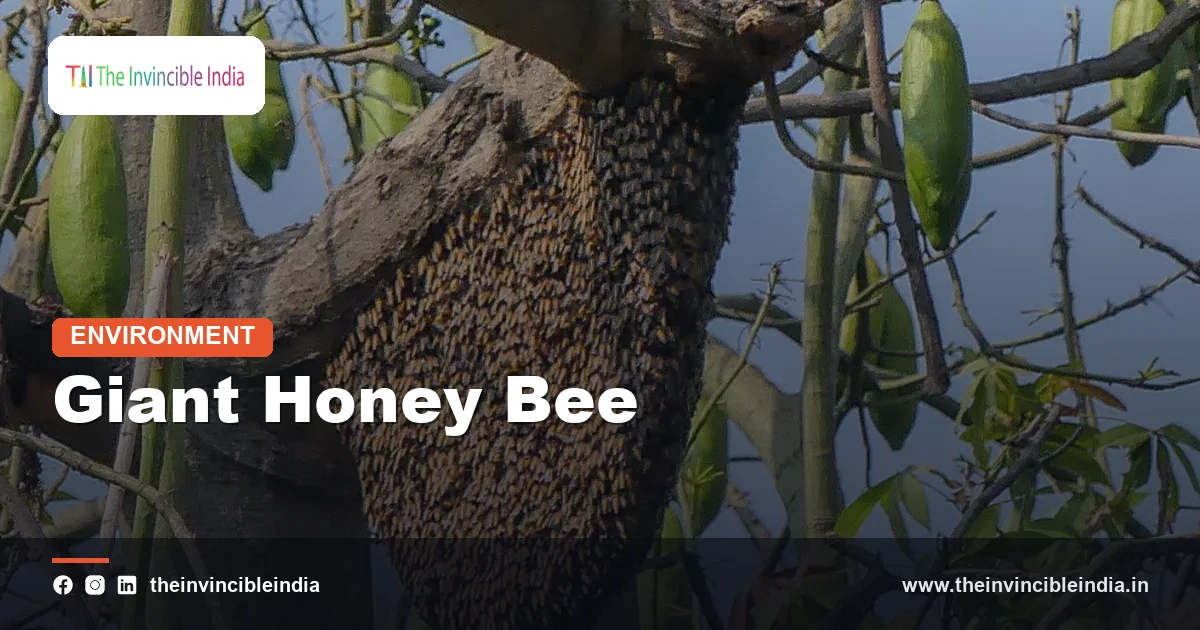
The giant honey bee, known in India as the rock bee (Apis dorsata), is the largest honey bee of South and Southeast Asia and a wild species that builds one huge, open, curtain-like honeycomb hanging from cliffs, tall trees, water tanks and buildings. Giant honey bees cannot be kept in boxes like domestic hive bees, and their colonies migrate seasonally, which is why the large dark combs seem to appear and vanish across Indian landscapes.
The giant honey bee is a vital pollinator of wild plants and farm crops and is a major source of wild honey in India. It is also a defensive insect that stings in large numbers when disturbed, so knowing how to behave near a nest protects both people and the bees. This explainer covers its appearance, nests, migration, defence, honey harvesting and safety rules.
Quick Facts
| Attribute | Detail |
|---|---|
| Common names | Giant honey bee, rock bee |
| Scientific name | Apis dorsata (Fabricius, 1793) |
| Family | Apidae (bees), genus Apis (true honey bees) |
| Worker size | Roughly 17 to 20 mm long, the largest of the Asian honey bees |
| Nest type | A single exposed vertical comb, often around a metre or more across, hung from a rock face, branch or ledge |
| Range | South Asia and Southeast Asia, including most of the Indian mainland below the higher Himalaya |
| Behaviour | Seasonal migration between nesting sites; strong group defence |
| Domestication | Cannot be kept in hives; remains a wild bee |
| Importance | Wild pollinator and a major source of forest honey and beeswax |
Key Takeaways
- The giant honey bee (Apis dorsata), called the rock bee in India, is the largest honey bee in Asia, with workers about 17 to 20 mm long.
- A giant honey bee colony builds a single huge open comb on a cliff, tall tree or building, covered by a thick living curtain of worker bees.
- Giant honey bee colonies migrate seasonally, moving between lowland and hill areas as nectar flowers change, and often return to the same nest sites.
- The giant honey bee cannot be domesticated, so wild colonies provide an important share of forest honey and beeswax in India.
- Giant honey bees defend their nests fiercely by stinging in large numbers, so the safest response to a nest is to keep away and never disturb it.
- The giant honey bee is a beneficial pollinator of forest trees, orchards and oilseed crops, and its survival depends on protecting nesting trees and flower-rich habitats.
What does a giant honey bee look like?
A giant honey bee is a large, robust bee with a banded body that is distinctly bigger than the common domestic honey bee. Workers are about 17 to 20 mm long and have a dark brown to black head and thorax with yellowish-orange bands on the abdomen, while the queen is larger still and the drones are stout with big eyes.
The difference in size is easy to see when a giant honey bee lands on a flower beside a smaller Indian honey bee. Its wings are strong and its flight is fast and direct. The sting is a barbed needle like that of other honey bees, which is left behind in the skin of a mammal, causing the bee to die after stinging.
Giant honey bee, hornet or wasp?
People sometimes confuse the giant honey bee with hornets or large wasps. A bee has a hairy body that carries pollen, and a rock bee nest is a single open wax comb. Hornets and wasps have smoother, less hairy bodies and usually build papery enclosed nests.
Where does the giant honey bee build its nest?
The giant honey bee builds its nest in the open, hanging a single sheet of wax comb from an overhanging rock, a high tree branch, the underside of a bridge, a water tank, a window ledge or the eaves of a building. The site is usually high above the ground and sheltered from rain by an overhang.
The comb is built of beeswax and is vertical, shaped like a semicircle that grows downwards from the support. It can be about a metre or more across in an established colony. A dense curtain of bees, several layers deep, covers the whole surface, so the comb itself is rarely visible. The upper part stores honey, the middle section holds pollen and the lower and central area contains the brood, or developing young bees.
Colonies in clusters
Giant honey bees often nest in clusters. A single large tree or cliff may carry a few dozen colonies side by side, and local people may call it a bee tree. Colonies often return year after year to the same favoured sites, a trait known as nest-site fidelity, so a rock face or tree that hosts bees one season will usually host them again.
How does a giant honey bee colony work?
A giant honey bee colony works as a tightly organised society headed by a single queen, with tens of thousands of workers that share tasks such as feeding the young, building wax, guarding the nest and foraging for nectar and pollen. Drones, the male bees, appear in the breeding season and exist only to mate with queens from other colonies.
Because the comb is exposed, the colony cannot hide inside a cavity. The bees at the surface form a living wall that keeps the comb at the right temperature, protects it from rain and sun, and guards the entrance. Foragers return to the comb and communicate the location of flowers through the waggle dance, a figure-eight movement that shows direction in relation to the sun and distance through the length of the waggle. Giant honey bees can dance on the open, vertical surface of the comb, which made the species a favourite subject for scientists studying bee communication.
Giant honey bees also forage at night when the moon is bright, a habit rare among honey bees. This allows them to exploit night-blooming flowers and to continue gathering during peak flowering periods.
Why do giant honey bee colonies migrate?
Giant honey bee colonies migrate because food becomes scarce at one location and plentiful at another, and the exposed nest allows the whole colony to pick up and move. Over a year, a colony may travel tens or even hundreds of kilometres between lowland and hill sites that bloom at different times.
When the colony leaves, the queen and workers fly together as a dark swarm and settle on a new site, often a tree branch, where they hang temporarily before building a new comb. Many colonies leave behind an empty comb that is gradually eaten by wax moths or removed by weather. Migration also explains why bees seem to arrive suddenly on a building. The colony may stay only a few days or weeks before moving on.
Reasons for moving
- Seasonal changes in nectar and pollen availability.
- Monsoon rains and heavy winds that threaten exposed combs.
- Repeated disturbance by predators such as hornets, birds and humans.
- Heat or lack of water at the nest site.
Why is the giant honey bee so defensive?
The giant honey bee is defensive because its nest hangs in the open with no walls to shield it, so the colony protects its comb through quick, coordinated, mass attacks. Guard bees release an alarm scent, or pheromone, and many nest mates join the response within moments.
The colony also has subtler defences. When a wasp or hornet approaches, the bees on the comb surface perform a visible ripple called shimmering, a wave of abdomen flicks that sweeps across the curtain like a stadium wave. Research suggests that this display confuses predators and signals that the colony is alert. If the threat continues, the bees break off the curtain and attack in large numbers.
Giant honey bees can be provoked by stones, loud noise, smoke from fires or crackers, shaking of the tree, or vehicles and drones that pass close to the nest. Their stings can be dangerous when many occur together, particularly for children, older people and anyone allergic to bee venom. A single sting is painful but is not usually dangerous to a healthy adult.
How is rock bee honey collected?
Rock bee honey is collected by trained honey hunters who climb to the nest, drive away or calm the bees and cut away the honey-filled part of the comb. Traditional honey hunting is practised by forest communities in many regions of India, including the Sundarbans, the Nilgiris, the Western Ghats and central Indian forests.
Giant honey bees cannot be kept in a wooden box, so the honey comes from wild colonies. A single colony can yield tens of kilograms of honey in a good season, and forest honey and beeswax from the species form an important income for many tribal and forest-dwelling families.
Sustainable and harmful methods
| Method | What happens | Effect on bees |
|---|---|---|
| Cutting only the honey portion, using limited smoke, and leaving the brood comb | The bees keep their young and can rebuild | Colony usually survives |
| Burning the nest or using heavy fire | Many bees and brood die | Colony is destroyed |
| Squeezing out honey and brood together | Honey becomes contaminated and brood is lost | Colony weakens and may abscond |
| Harvesting in the wrong season | Colony loses its food stores | Colony may starve or leave |
Forest departments, community cooperatives and non-governmental organisations in several states promote careful harvesting methods that leave the brood intact. Harvesting rules differ between states and between protected and non-protected forests, so local permission is often required.
Why can’t giant honey bees be kept in hives?
Giant honey bees cannot be kept in hives because they are wired to build a single, open comb in a high, exposed place and to migrate away when conditions change. Efforts to confine them in boxes have not succeeded, since the colony simply abandons the box, a behaviour called absconding.
The bees that beekeepers actually keep are other species. The Indian honey bee, Apis cerana indica, nests in cavities with multiple parallel combs and can be housed in boxes. The European honey bee, Apis mellifera, was introduced to India for commercial beekeeping and is now widely farmed. Stingless bees of the genus Tetragonula are also kept in small boxes by some farmers.
How does the giant honey bee compare with other Indian honey bees?
The giant honey bee differs from other Indian honey bees in size, nest design, temper and whether it can be kept in a hive. The table below summarises the main differences for the four honey-bee species people most often encounter.
| Bee | Nest | Size | Can be kept in a hive? |
|---|---|---|---|
| Giant honey bee, rock bee (Apis dorsata) | One large exposed comb on cliffs, trees or buildings | Largest, about 17 to 20 mm | No |
| Little honey bee (Apis florea) | One small exposed comb on a branch, often in shrubs | Smallest of the Indian honey bees | No |
| Indian honey bee (Apis cerana indica) | Several parallel combs inside a cavity | Medium | Yes |
| European honey bee (Apis mellifera) | Several parallel combs inside a cavity | Medium to large | Yes, widely used in commercial beekeeping |
Researchers also recognise the Himalayan giant honey bee, Apis laboriosa, a close relative that nests on high cliffs in the Himalaya and is sometimes treated as a separate species. Cliff honey hunting in the mountains of Nepal and nearby regions is world-famous.
How does the giant honey bee benefit nature and farming?
The giant honey bee benefits nature and farming mainly by pollinating a very wide range of wild and cultivated flowers. As foragers travel from flower to flower collecting nectar and pollen, they carry pollen between plants, which helps trees and crops set fruit and seed.
Giant honey bees travel long distances and have large colonies, so they can pollinate scattered forest trees that are out of reach of smaller bees. They also visit crops such as mustard, sunflower, coriander, fruit trees and plantation crops. Wild honey bees therefore support both forest regeneration and agriculture, often without any cost to farmers.
Other contributions
- Honey, a food and traditional medicine ingredient in many communities.
- Beeswax, used in candles, cosmetics, polishes and traditional crafts.
- Food for predators and scavengers, as part of forest food webs.
- Income for forest-based communities through sustainable honey collection.
The species faces threats from habitat loss, felling of large nesting trees, pesticide use and destructive honey collection. Protecting old trees, rock outcrops and flower-rich landscapes helps keep these bees in the wild.
What should you do if you find a giant honey bee nest?
If you find a giant honey bee nest, the safest response is to stay well away, keep other people and animals away, and avoid any disturbance such as throwing stones, shouting, burning smoke or using sprays. Most nests are harmless when left alone, and many are only temporary.
- Cordon off the area below and around the nest, and warn children, neighbours and visitors.
- Do not try to remove, burn or knock down the nest yourself.
- Keep doors and windows closed on the side of a building that has a nest, and avoid loud machinery near it.
- Contact the local forest department, municipal body, fire service or a trained bee-rescue group for advice.
- Be patient; colonies on buildings often move away within days or weeks as flowers change.
Professional rescuers can sometimes relocate a colony safely, but relocation is difficult with an exposed wild comb. Whenever possible, waiting until the colony leaves on its own is both safer and kinder to the bees.
What should you do if giant honey bees attack?
If giant honey bees attack, cover your head and face with your arms or clothing and run away from the nest in a straight line to an enclosed place such as a building or vehicle. Bees follow movement, so continuing to run for some distance helps break contact.
- Do not swat at the bees, as this can trigger more stings.
- Do not jump into water, because bees wait for you to surface.
- Scrape stings out with a fingernail or card edge instead of squeezing them.
- Wash the stings and use a cold pack to ease the pain.
- Call the emergency number 112 or go to a hospital at once if there are many stings, or if there is swelling of the face or throat, breathing difficulty, dizziness or fainting.
Children and elderly people need medical attention sooner, because the venom load per body weight is higher. Anyone known to be allergic to bee stings should carry prescribed emergency medication and avoid areas with visible nests.
Bottom Line
The giant honey bee, or rock bee, is a wild, migratory and ecologically valuable insect that must be respected and not provoked. Keeping a safe distance from nests, supporting careful honey harvesting and protecting nesting trees and cliffs lets people and rock bees share the same landscape.
Frequently Asked Questions
What is the giant honey bee, or rock bee?
The giant honey bee, or rock bee (Apis dorsata), is the largest honey bee of South and Southeast Asia. It builds one huge open comb on cliffs, tall trees and buildings. It is a wild species that cannot be kept in hives.
Where do giant honey bees build their nests?
Giant honey bees build their nests in the open, usually high above the ground on rock overhangs, tree branches, bridges, water tanks and building eaves. The single comb hangs under a sheltering support and is covered by a thick curtain of bees. Many colonies often cluster on the same tree or cliff.
Are giant honey bees dangerous?
Giant honey bees can be dangerous if their nest is disturbed, because they defend it by stinging in large numbers. A few stings are painful but not usually dangerous to a healthy adult, while mass stings or an allergic reaction need urgent medical care. Left alone and viewed from a distance, the bees are not aggressive.
Why do giant honey bees migrate?
Giant honey bees migrate to follow flowering seasons and to escape unfavourable weather or repeated disturbance. A colony can travel tens or even hundreds of kilometres to reach areas with more nectar. Many colonies return to the same trees or cliffs in later years.
Can giant honey bees be kept in beehives?
Giant honey bees cannot be kept in beehives, because they naturally build a single open comb and abandon enclosed boxes. Beekeepers keep other species, such as the Indian honey bee (Apis cerana indica) and the European honey bee (Apis mellifera). Rock bee honey therefore comes only from wild colonies.
What should I do if I find a rock bee nest near my home?
Stay away from the nest, keep children and pets away, and do not throw stones, burn smoke or spray insecticide at it. Contact the forest department, municipal authority or a trained bee-rescue group for guidance. Many nests on buildings are temporary, and the colony often leaves by itself within a few weeks.
{“@context”:”https://schema.org”,”@graph”:[{“@type”:”FAQPage”,”mainEntity”:[{“@type”:”Question”,”name”:”What is the giant honey bee, or rock bee?”,”acceptedAnswer”:{“@type”:”Answer”,”text”:”The giant honey bee, or rock bee (Apis dorsata), is the largest honey bee of South and Southeast Asia. It builds one huge open comb on cliffs, tall trees and buildings. It is a wild species that cannot be kept in hives.”}},{“@type”:”Question”,”name”:”Where do giant honey bees build their nests?”,”acceptedAnswer”:{“@type”:”Answer”,”text”:”Giant honey bees build their nests in the open, usually high above the ground on rock overhangs, tree branches, bridges, water tanks and building eaves. The single comb hangs under a sheltering support and is covered by a thick curtain of bees. Many colonies often cluster on the same tree or cliff.”}},{“@type”:”Question”,”name”:”Are giant honey bees dangerous?”,”acceptedAnswer”:{“@type”:”Answer”,”text”:”Giant honey bees can be dangerous if their nest is disturbed, because they defend it by stinging in large numbers. A few stings are painful but not usually dangerous to a healthy adult, while mass stings or an allergic reaction need urgent medical care. Left alone and viewed from a distance, the bees are not aggressive.”}},{“@type”:”Question”,”name”:”Why do giant honey bees migrate?”,”acceptedAnswer”:{“@type”:”Answer”,”text”:”Giant honey bees migrate to follow flowering seasons and to escape unfavourable weather or repeated disturbance. A colony can travel tens or even hundreds of kilometres to reach areas with more nectar. Many colonies return to the same trees or cliffs in later years.”}},{“@type”:”Question”,”name”:”Can giant honey bees be kept in beehives?”,”acceptedAnswer”:{“@type”:”Answer”,”text”:”Giant honey bees cannot be kept in beehives, because they naturally build a single open comb and abandon enclosed boxes. Beekeepers keep other species, such as the Indian honey bee (Apis cerana indica) and the European honey bee (Apis mellifera). Rock bee honey therefore comes only from wild colonies.”}},{“@type”:”Question”,”name”:”What should I do if I find a rock bee nest near my home?”,”acceptedAnswer”:{“@type”:”Answer”,”text”:”Stay away from the nest, keep children and pets away, and do not throw stones, burn smoke or spray insecticide at it. Contact the forest department, municipal authority or a trained bee-rescue group for guidance. Many nests on buildings are temporary, and the colony often leaves by itself within a few weeks.”}}]}]}


