

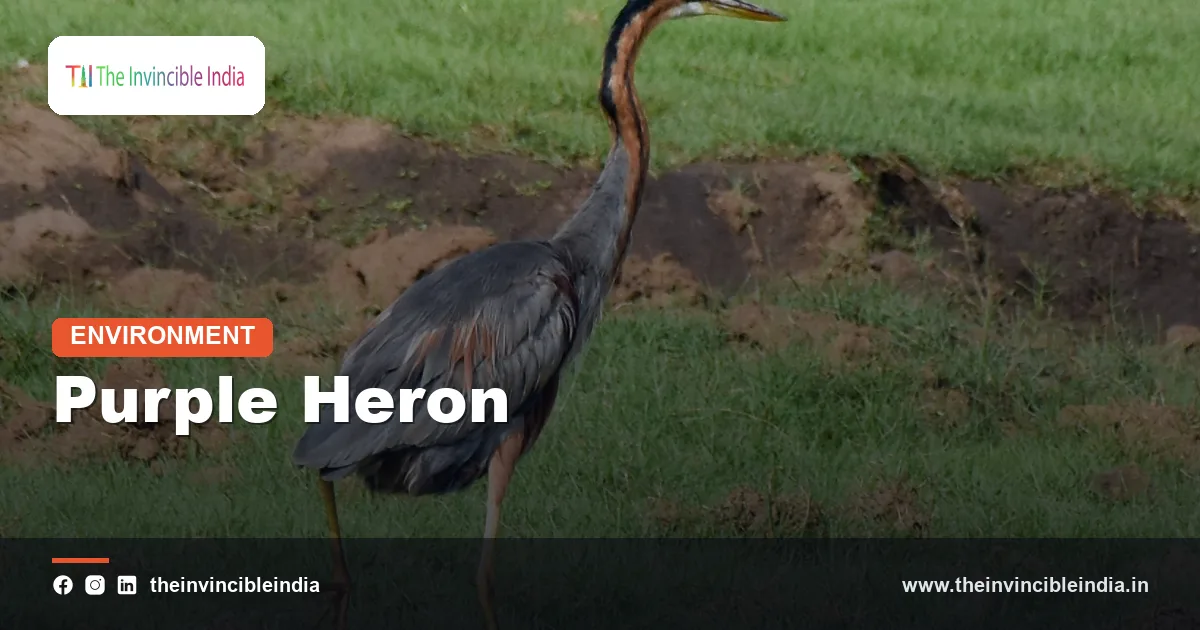
The purple heron (Ardea purpurea) is a slender, reddish-brown and grey wading bird of the family Ardeidae that hides in dense reedbeds and marshes and ambushes fish and frogs with a rapid, snake-like strike of its long neck. It is a resident of many Indian wetlands, from the Gangetic plains and Rajasthan’s lakes to Kerala’s backwaters, and it is far more secretive than its larger cousin, the grey heron.
Many people overlook the purple heron because it spends much of the day standing quietly inside reeds, often visible only as a long, striped neck. This explainer describes how to identify the purple heron, where it lives in India, how it hunts and nests, how it differs from similar herons, and what threatens it. Population statements are kept general because counts differ between years and sites.
| Attribute | Detail |
|---|---|
| Scientific name | Ardea purpurea |
| Family and order | Ardeidae (herons, egrets and bitterns); order Pelecaniformes |
| Typical length | About 78 to 90 cm, with a wingspan of roughly 120 to 150 cm |
| Typical weight | Roughly 0.5 to 1.3 kg |
| Colour | Chestnut and rufous underparts, grey-black back, black-striped rufous neck, dark crown |
| Status in India | Mainly resident with local movements; widespread but patchy and easily overlooked |
| Preferred habitat | Dense reedbeds, marshes, flooded paddy, lake margins and slow-water backwaters |
| Nesting | Platform of reed stems built over water or in low trees, solitary or in small colonies |
| Global conservation status | Least Concern on the IUCN Red List |
Key Takeaways
- The purple heron (Ardea purpurea) is a slim, reed-dwelling heron, about 78 to 90 cm long, with a chestnut body and a black-striped rufous neck.
- The purple heron is not truly purple; the name refers to the dark slate-purple sheen on the back and wings of adults.
- Purple herons hunt by ambush, standing in reeds with the neck stretched upright and striking at fish, frogs and insects with a sudden forward thrust.
- Purple herons nest in dense reedbeds, building platforms of reed stems over water, either singly or in small colonies.
- The IUCN rates the purple heron as Least Concern globally, but drainage of marshes and cutting of reedbeds reduce suitable habitat locally.
- In flight a purple heron shows a distinct bulge in the folded neck and very long toes that trail behind the tail.
What does a purple heron look like?
A purple heron looks like a slim, long-necked heron with a rufous-chestnut neck striped in black, a dark crown with a thin black crest, and a body that is darker and more richly coloured than the grey heron. The back and wing coverts are slate grey with a purplish sheen, which gives the species its name.
The bill is long, narrow and yellowish-brown, usually darker along the upper edge. The legs and feet are greenish-yellow to brownish, and the toes are exceptionally long, which helps the bird balance on floating vegetation and reed stems. During breeding, adults grow narrow plumes on the back and breast, and bare parts such as the bill base and legs may flush a more intense orange.
Juveniles are paler and more uniformly rufous-brown, with little or no black on the neck and with cinnamon edges to the feathers on the upper body. The sexes are similar, although males are slightly bigger.
The purple heron is lighter and slimmer than the grey heron, and when the neck is held erect it looks remarkably thin, almost like a periscope above the reeds. This build is an adaptation for slipping through dense stems.
Where is the purple heron found in India?
The purple heron is found across much of India in freshwater and brackish wetlands that have thick emergent vegetation, including reedbeds, marshes, lake edges and flooded paddy fields. It is widespread but thinly distributed, and it is seen less often than other herons because it prefers cover.
Typical Indian habitats include:
- Reedbeds and cattail marshes around large lakes and jheels
- Slow-moving backwaters, canals and village tanks with thick fringe vegetation
- Flooded paddy fields, especially in the monsoon
- Mangrove edges and brackish creeks in some coastal areas
- Seasonal marshes in river floodplains
Protected wetlands such as Keoladeo National Park in Rajasthan, Chilika Lake in Odisha, Nal Sarovar in Gujarat and the Kerala backwaters are frequently mentioned by birdwatchers as places to look for the species, though sightings depend on water levels and vegetation each year.
Globally, the purple heron breeds across parts of Europe, Africa and Asia. European and western Asian populations are largely migratory and winter in Africa, while the populations of southern and southeastern Asia are mostly resident, with local movements linked to rainfall and water availability. The Asian birds are placed in a distinct subspecies, commonly written as Ardea purpurea manilensis.
How does the purple heron hunt?
The purple heron hunts by ambush, standing or creeping slowly among reeds and then striking at prey with a rapid, snake-like extension of its neck. It prefers to hide at the edge of open water, where fish and amphibians come within reach.
Observers have noted several behaviours:
- Reed stalking: the bird steps carefully through thick vegetation, sometimes climbing onto reed stems using its long toes.
- Sit-and-wait: the heron remains still for long periods, often with the neck raised to resemble a reed.
- Neck stretching: when alarmed, the heron points its bill skyward and sways slightly, which makes it blend with swaying reeds.
- Dusk foraging: activity increases in the early morning and evening, and the species is more active than many herons in low light.
The long neck, with its specially shaped vertebra, folds in an S-curve and can be thrust forward with great speed. The pointed bill spears or grasps the prey, which is often manipulated and swallowed whole.
What does the purple heron eat?
The purple heron eats mostly fish and amphibians, along with aquatic insects, crustaceans, small reptiles, young birds and small mammals. In many wetlands, small fish and frogs make up the largest part of its diet.
Within the wetland food web, the purple heron sits in the middle: it feeds on small aquatic animals and is itself preyed upon, especially at the egg and chick stage, by snakes, monitor lizards, crows, raptors and other predators. Adults are occasionally taken by large raptors.
The type of prey varies by season. During the monsoon, when paddy fields and marshes fill with water, frogs, tadpoles and insects become abundant. In the dry season, when water retreats into pools, the heron concentrates on fish trapped in shallows.
How can you tell a purple heron from a grey heron?
A purple heron differs from a grey heron mainly in being smaller, slimmer, darker and more reddish, with a black-striped rufous neck and a more snake-like profile. The grey heron is paler, with a white neck and a pale grey back, and it usually stands in open shallow water rather than inside dense reeds.
| Feature | Purple heron | Grey heron |
|---|---|---|
| Size | About 78 to 90 cm; slimmer | About 90 to 100 cm; bulkier |
| Neck | Rufous with black stripes; very thin | White with a line of dark streaks |
| Body colour | Chestnut, rufous and dark slate | Pale grey and white |
| Habitat | Dense reeds and marsh edges | Open shallows, banks and mudflats |
| Toes | Very long; useful on floating plants | Long but shorter than the purple heron’s |
| Behaviour | Secretive; often solitary | Bold; often in the open |
In flight, the purple heron shows a more pronounced bulge in the neck and darker underwing than the grey heron. The sharply defined neck stripes, deep chestnut underparts and dark upper body are good field marks.
How does the purple heron breed?
The purple heron breeds in reedbeds and low vegetation over water, building a platform of reed stems and nesting solitarily or in small colonies. In India the breeding season is generally linked to the rains, often falling between about June and October, though timing varies by region and rainfall.
The female usually lays about three to five pale blue-green eggs. Both parents incubate for roughly 25 to 27 days, and they feed the chicks by regurgitating food. The chicks leave the nest at several weeks of age, and may clamber about in the reeds before they can fly strongly.
Colonies are often small and mixed with other herons and egrets. Because the nests are built low, near the water surface, they are vulnerable to flooding, changes in water level, fires set to clear reeds, and predators.
The most important requirement for a nesting purple heron is a dense, undisturbed stand of reeds over water. Harvesting of reeds, burning of marsh vegetation or sudden draw-down of lake levels during the breeding season can ruin whole breeding attempts.
Is the purple heron a migratory bird?
The purple heron is partly migratory worldwide, but in India it is mainly a resident that makes local movements in response to monsoon rains and water levels. European and western Asian birds migrate long distances to Africa, while the southern Asian populations tend to stay within a region.
Local shifts occur when wetlands dry out or flood. A marsh that is empty in summer may hold several purple herons after the monsoon, and some birds may move from inland to coastal wetlands in the dry season. Because the species is secretive, these movements are less well documented than those of showier waterbirds.
Some birds that appear in northern India in winter may be visitors from further north, but the picture is not as clear as with strongly migratory ducks and waders. Detailed ringing and survey data would be needed to describe exact routes and numbers.
Is the purple heron threatened in India?
The purple heron is not globally threatened, as the IUCN lists it as Least Concern, but its Indian habitat is under steady pressure from wetland loss and degradation. The species depends on reedbeds, which are often cleared, burnt, drained or polluted.
The main threats include:
- Drainage and conversion of marshes for farming or construction
- Cutting and burning of reedbeds
- Pollution from sewage, pesticides and industrial discharge
- Invasive aquatic plants that clog open water and reduce fish
- Disturbance at nests from boats, people and dogs
- Loss of fish stocks through overfishing and poor water quality
Wild birds in India are protected by the Wildlife (Protection) Act, 1972. Schedule placements for individual species have changed through amendments, so the current schedules from the Ministry of Environment, Forest and Climate Change should be consulted for precise legal status.
Why is the purple heron important to wetlands?
The purple heron is important because it is a reedbed specialist whose presence suggests that a marsh has enough clean water, fish and uncut vegetation to support secretive wildlife. Reedbeds are among the most productive habitats and also act as natural filters for water.
Reedbeds trap sediments, absorb nutrients and offer cover for fish, amphibians, insects and many other birds, such as bitterns, rails and warblers. Preserving marshes helps the purple heron, but it also protects water quality, supports fisheries and reduces flood risk for nearby communities.
Because purple herons are shy, they are a useful indicator in another way: if they are breeding successfully, the marsh is probably quiet and well vegetated.
How can you spot a purple heron?
The best way to spot a purple heron is to scan the edges of reedbeds at dawn or dusk from a distance, looking for a thin, striped neck rising above the stems. Patience matters more than speed, because the bird often freezes when it notices movement.
- Use binoculars and watch reed margins and floating vegetation, rather than open mudflats.
- Look for a long, rufous neck with dark lines, often pointed skyward.
- Scan the sky for a dark heron with a bulging neck and dangling toes.
- Choose well-known wetlands with extensive reeds, and visit after the monsoon when vegetation is full.
- Stay quiet, avoid boats near nests, and never enter reedbeds during the breeding season.
Bottom Line
The purple heron is a slender, chestnut-and-slate reedbed heron that survives in India because marshes and backwaters still offer cover and prey. It is not globally threatened, but it is a quiet barometer of wetland health. Protecting reedbeds and avoiding disturbance during the breeding season is the most practical way to protect the bird.
Frequently Asked Questions
Why is it called a purple heron?
The purple heron is named for the dark purplish sheen on the back and wings of adult birds, although the bird looks mostly chestnut, rufous and slate grey. The neck is rufous with black stripes. The name can seem odd to observers who expect a bright purple colour.
Is the purple heron found in India all year?
Yes, the purple heron is present in India throughout the year as a resident, with local movements in response to rains and water levels. Some additional birds may arrive from the north in winter. Because it is secretive, it is often under-recorded.
What is the difference between a purple heron and a grey heron?
The purple heron is smaller, slimmer and reddish-brown with a black-striped rufous neck, while the grey heron is larger and mainly grey and white. The purple heron also prefers dense reeds, whereas the grey heron often stands in open shallows. In flight the purple heron has a more pronounced neck bulge.
What does a purple heron eat?
The purple heron eats mainly fish and frogs, plus insects, crustaceans, small reptiles and occasionally young birds or small mammals. It hunts by ambush, standing still in reeds and striking suddenly with its long neck. Its diet changes with the season and the water level.
Where does the purple heron nest?
The purple heron nests in dense reedbeds, building a platform of reed stems over water, or sometimes in low trees or bushes. It nests alone or in small colonies, often mixed with other herons. The usual clutch is about three to five pale blue-green eggs.
Is the purple heron endangered?
No, the purple heron is classed as Least Concern by the IUCN, meaning it is not globally threatened. Locally, however, numbers can fall where marshes are drained or reedbeds are burnt or cut. In India, wild birds are protected under the Wildlife (Protection) Act, 1972, with schedule details subject to amendment.
{“@context”:”https://schema.org”,”@graph”:[{“@type”:”FAQPage”,”mainEntity”:[{“@type”:”Question”,”name”:”Why is it called a purple heron?”,”acceptedAnswer”:{“@type”:”Answer”,”text”:”The purple heron is named for the dark purplish sheen on the back and wings of adult birds, although the bird looks mostly chestnut, rufous and slate grey. The neck is rufous with black stripes. The name can seem odd to observers who expect a bright purple colour.”}},{“@type”:”Question”,”name”:”Is the purple heron found in India all year?”,”acceptedAnswer”:{“@type”:”Answer”,”text”:”Yes, the purple heron is present in India throughout the year as a resident, with local movements in response to rains and water levels. Some additional birds may arrive from the north in winter. Because it is secretive, it is often under-recorded.”}},{“@type”:”Question”,”name”:”What is the difference between a purple heron and a grey heron?”,”acceptedAnswer”:{“@type”:”Answer”,”text”:”The purple heron is smaller, slimmer and reddish-brown with a black-striped rufous neck, while the grey heron is larger and mainly grey and white. The purple heron also prefers dense reeds, whereas the grey heron often stands in open shallows. In flight the purple heron has a more pronounced neck bulge.”}},{“@type”:”Question”,”name”:”What does a purple heron eat?”,”acceptedAnswer”:{“@type”:”Answer”,”text”:”The purple heron eats mainly fish and frogs, plus insects, crustaceans, small reptiles and occasionally young birds or small mammals. It hunts by ambush, standing still in reeds and striking suddenly with its long neck. Its diet changes with the season and the water level.”}},{“@type”:”Question”,”name”:”Where does the purple heron nest?”,”acceptedAnswer”:{“@type”:”Answer”,”text”:”The purple heron nests in dense reedbeds, building a platform of reed stems over water, or sometimes in low trees or bushes. It nests alone or in small colonies, often mixed with other herons. The usual clutch is about three to five pale blue-green eggs.”}},{“@type”:”Question”,”name”:”Is the purple heron endangered?”,”acceptedAnswer”:{“@type”:”Answer”,”text”:”No, the purple heron is classed as Least Concern by the IUCN, meaning it is not globally threatened. Locally, however, numbers can fall where marshes are drained or reedbeds are burnt or cut. In India, wild birds are protected under the Wildlife (Protection) Act, 1972, with schedule details subject to amendment.”}}]}]}


