

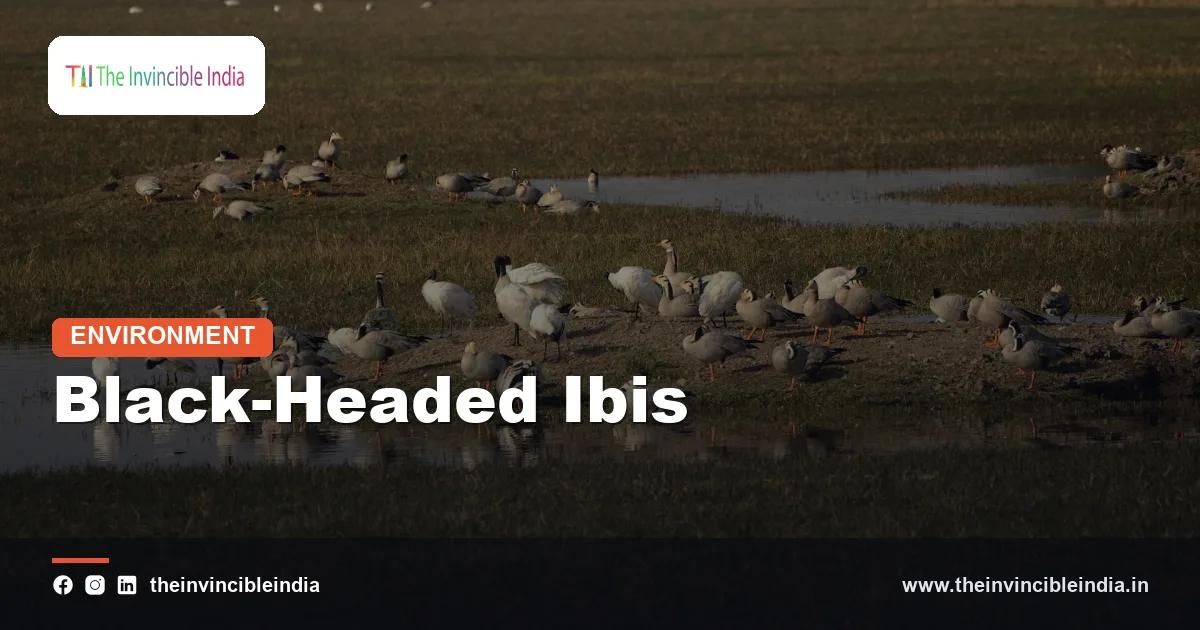
The black-headed ibis (Threskiornis melanocephalus), also called the Oriental white ibis, is a large white wading bird with a bare black head and neck and a thick, down-curved black bill, found in wetlands, marshes and flooded fields across India and the wider region. The species belongs to the ibis and spoonbill family, Threskiornithidae, and is a colonial nester that breeds in trees alongside storks, egrets, cormorants and spoonbills.
The black-headed ibis is one of the most recognisable waterbirds of Indian lakes, reservoirs and rice country, yet it is globally classed as Near Threatened because its wetland habitats are shrinking. This explainer covers how to identify the black-headed ibis, where it lives, what it eats, how it breeds, how it differs from lookalikes and why it needs protection.
| Quick Facts | Details |
|---|---|
| Common names | Black-headed ibis, Oriental white ibis, Indian white ibis |
| Scientific name | Threskiornis melanocephalus |
| Family | Threskiornithidae (ibises and spoonbills) |
| Size | Roughly 65 to 75 cm in length; a large wader |
| Key features | White body, bare black head and neck, heavy down-curved black bill, black legs |
| Habitat | Freshwater and brackish wetlands, tanks, marshes, flooded paddy, mudflats and lake margins |
| Nesting | Colonial, in trees or bushes, often in mixed waterbird colonies |
| IUCN status | Near Threatened, with a declining global population |
| Range | South Asia, extending east to Southeast Asia and parts of East Asia |
Key Takeaways
- The black-headed ibis is a large white wading bird whose bare head and neck are black, which gives the species its name.
- The black-headed ibis has a thick, strongly down-curved bill that it sweeps and probes through mud and shallow water to find food.
- The black-headed ibis nests in colonies in trees, usually in mixed groups with storks, egrets, spoonbills and cormorants.
- The black-headed ibis is listed as Near Threatened by the IUCN because wetland loss, disturbance and hunting have reduced its numbers.
- The black-headed ibis eats insects, frogs, fish, crustaceans, worms and molluscs, so healthy populations signal productive, unpolluted wetlands.
- Juvenile black-headed ibises have feathered, dusky heads and only gain the bare black head as they mature.
What is the black-headed ibis?
The black-headed ibis is a medium-large wading bird of the ibis family that is white in body plumage and black in bare skin on the head, neck and bill. Its scientific name, Threskiornis melanocephalus, literally points to the “black-headed” feature, with melanocephalus coming from Greek roots meaning black head.
The species is a close relative of the African sacred ibis and the Australian white ibis, and older field guides often treated them as one widespread group. Ornithologists now generally treat the Asian bird as its own species. In Indian field guides it is sometimes listed as the Oriental ibis or Oriental white ibis.
Ibises are different from storks and herons in a few ways that matter for identification. Ibises fly with the neck stretched forward, they feed by probing with a curved bill, and they usually move in lines or loose V-shaped flocks. Storks, which often share the same wetlands, have straighter, heavier bills and are typically larger.
How can you identify a black-headed ibis?
A black-headed ibis can be identified by its all-white body, naked black head and neck, and long, thick, down-curved black bill. The bare skin of the head looks smooth and slightly wrinkled, and the legs are dark, often blackish to dark grey.
Plumage and bare parts
- Adults have white feathers on the body and wings, with no feathers on the head or the upper neck.
- Breeding adults grow loose, lacy greyish scapular plumes over the back and rump, which give the bird a shaggy look.
- Patches of bare skin on the underwing and flanks can look pinkish or reddish, and are easiest to see when the bird stretches or flies.
- The eye is dark and difficult to see against the black skin of the face.
Juveniles and non-breeding birds
Young black-headed ibises have partly feathered heads and necks that look dusky, grey or sooty rather than cleanly bare. The head and neck become fully bare and black as the bird matures, and the body plumage is often a shade less pure white than in adults.
In flight
In flight, the black-headed ibis shows a white body and wings, a black head and neck stretched forward, and trailing legs. Flocks often fly in diagonal lines or V formations, with a few flaps followed by short glides.
Where does the black-headed ibis live in India?
The black-headed ibis lives in freshwater and brackish wetlands across much of India, including lakes, village tanks, reservoirs, marshes, coastal lagoons and flooded paddy fields. The bird is found in many states, though it is patchy and tends to gather where shallow water and nesting trees occur together.
Beyond India, the black-headed ibis occurs through the rest of South Asia, including Sri Lanka, Bangladesh and Pakistan, and extends into Southeast Asia, with some birds reaching East Asia. Populations in the north and west of India are partly migratory or nomadic in response to rainfall, while birds in the south are often more settled.
Habitats the species prefers
- Shallow freshwater lakes and jheels with muddy margins.
- Seasonal tanks and irrigation reservoirs, especially those with scattered trees or islands for nesting.
- Flooded paddy fields and wet grasslands during the monsoon and post-monsoon months.
- Estuaries, coastal lagoons, mudflats and salt-pan edges.
- Village ponds and canal banks where people tolerate birds.
What does the black-headed ibis eat and how does it feed?
The black-headed ibis eats a mixed diet of aquatic insects, fish, frogs, crustaceans, molluscs and worms, which it finds by probing shallow water and soft mud with its curved bill. It is an opportunistic feeder, and it also takes grasshoppers, beetles and other insects from wet fields.
The bird walks slowly through shallow water, sweeping the bill from side to side or driving it into the mud. Sensitive nerve endings along the bill help the ibis feel prey that it cannot see. Once prey is caught, the bird often tosses its head back to swallow.
The black-headed ibis often feeds in loose groups, sometimes alongside egrets, storks, spoonbills and other waders. This mixed feeding is common in Indian wetlands, where the water level and the abundance of small prey vary through the year.
How does the black-headed ibis breed?
The black-headed ibis breeds in colonies, building a platform nest of sticks in trees or bushes, often over or near water, and laying a small clutch of pale eggs. Colonies are usually mixed, with ibises sharing trees with painted storks, spoonbills, cormorants, egrets and herons.
Nesting season
The timing of nesting depends on region and rainfall. In northern and western India, breeding generally follows the monsoon, when water levels and food are high. In parts of southern India, birds may nest in the post-monsoon and winter months instead. Breeding is therefore best described as tied to the local rains rather than to a fixed month.
Eggs and chicks
- The clutch is typically two to four pale bluish-white eggs.
- Both parents are generally believed to share incubation and chick feeding.
- Chicks hatch with sparse down, depend on regurgitated food and remain in the nest for several weeks.
- Young birds are vulnerable to falls, storms and predators until they can fly.
The black-headed ibis is not a noisy bird compared with many storks and herons. It gives low grunting or croaking calls, especially at colonies, and it is mostly quiet while feeding or flying.
How is the black-headed ibis different from similar birds?
The black-headed ibis differs from other Indian waders mainly in its white body, bare black head and heavy curved bill, which no other common white wader combines. The table below compares it with birds that people often confuse with it.
| Bird | Body colour | Head and bill | Key difference |
|---|---|---|---|
| Black-headed ibis | White | Bare black head and neck, thick curved black bill | The only common white ibis in India |
| Eurasian spoonbill | White | Feathered head, long flat bill with spoon-shaped tip | Straight, flattened bill and feathered face |
| Red-naped ibis | Dark blackish-brown | Bare black head with red nape patch | Dark body, white shoulder patch |
| Glossy ibis | Dark chestnut with green-purple gloss | Feathered head, slimmer curved bill | Smaller and darker, with a feathered head |
| Great egret | White | Feathered head, long straight yellow bill | Slender, straight bill and long neck |
| Painted stork | White with black bands and pink tertials | Orange-yellow bare face, long yellow curved bill | Larger, with a black breast band |
In practice, the black-headed ibis is easiest to separate from egrets and spoonbills by its black head. From a distance, a flock feeding in a marsh looks like white birds with dark heads, held in a hunched, forward-leaning posture.
Is the black-headed ibis endangered?
The black-headed ibis is not classed as endangered but as Near Threatened by the International Union for Conservation of Nature (IUCN), which means it is close to qualifying for a higher threat category. The global population is thought to be in the tens of thousands and is considered to be declining, though exact figures are uncertain.
Indian law gives wild birds legal protection under the Wildlife (Protection) Act, 1972, and many important colonies sit inside national parks, sanctuaries and protected wetlands. Protection of the site is often more important than protection of the species on paper, because colonies can fail when water or trees disappear.
Main threats
- Loss and drainage of wetlands for farming, housing and industry.
- Drying of tanks and lakes because of diverted water, siltation or poor rainfall.
- Felling of nesting trees or collapse of nesting islands.
- Disturbance at colonies, including egg and chick collection in some areas.
- Pollution from pesticides, fertilisers and untreated waste that reduces food and contaminates water.
- Hunting and accidental shooting in parts of the range.
Why does the black-headed ibis matter to wetlands and farmland?
The black-headed ibis matters because it is a top feeder on aquatic invertebrates and small vertebrates, and its presence is a practical sign of a healthy, productive wetland. Birds that nest in colonies, such as the black-headed ibis, depend on both clean feeding grounds and safe nesting trees, so a thriving colony usually reflects a whole functioning habitat.
In flooded fields, the black-headed ibis eats insects and other small animals that can damage crops, which is a modest but real benefit to farmers. Bird droppings at heronries also enrich the water and soil, though large colonies can sometimes damage the trees they use.
Ibises also draw visitors to birdwatching sites, which supports local guides, boatmen and small businesses near wetlands. This gives communities an economic reason to keep colonies undisturbed.
Where and when can you see the black-headed ibis?
The black-headed ibis can be seen at many large Indian wetlands, usually best during the post-monsoon and winter months when water birds gather and breeding colonies are active. Well-known birding sites in India that have recorded the species include Keoladeo National Park in Rajasthan, Nal Sarovar in Gujarat, Chilika Lake in Odisha and various tanks and sanctuaries in Tamil Nadu, Karnataka and Andhra Pradesh.
Tips for watching
- Visit early morning or late afternoon, when birds are feeding and flying between roosts.
- Use binoculars and keep a respectful distance from nesting trees.
- Scan mixed flocks of egrets, storks and spoonbills, as the black head helps the ibis stand out.
- Avoid flash photography or noise near colonies, which can cause adults to abandon nests.
- Check local sanctuary rules and seasons before planning a trip.
How can people help protect the black-headed ibis?
People can help protect the black-headed ibis by safeguarding wetlands, nesting trees and clean water, and by avoiding disturbance at colonies. The most effective measures are habitat-based, because ibises cannot breed or feed without shallow water and safe trees.
- Protect village tanks and lakes from encroachment, dumping and excessive silt.
- Keep water in key wetlands through the breeding season, where management allows.
- Preserve nesting trees and islands, and plant native species such as babul and other wetland trees.
- Reduce pesticide and plastic pollution in and around wetlands.
- Report egg collection, hunting or illegal netting to local forest or wildlife authorities.
- Support community-based bird conservation, such as village committees that guard colonies.
Bottom Line
The black-headed ibis is a white wading bird with a bare black head and a curved bill, and it is a good indicator of living, well-watered Indian wetlands. Its Near Threatened status shows that wetlands, not just birds, need protection, and keeping village tanks, marshes and nesting trees intact is the surest way to keep the species common.
Frequently Asked Questions
What does a black-headed ibis look like?
A black-headed ibis is a large white wading bird with a bare black head and neck and a thick, down-curved black bill. Adults have dark legs and may show pink or reddish skin under the wings. Juveniles have dusky, partly feathered heads that turn bare and black with age.
Is the black-headed ibis found in India?
Yes, the black-headed ibis is found in many parts of India, in wetlands, lakes, reservoirs, marshes and flooded fields. It is also found in other South Asian countries and extends into Southeast Asia. Numbers are patchy and depend on water levels and the availability of nesting trees.
What does the black-headed ibis eat?
The black-headed ibis eats aquatic insects, small fish, frogs, crustaceans, molluscs, worms and other small animals. It finds prey by sweeping and probing its curved bill through shallow water and mud. It also takes insects such as grasshoppers from wet fields and grasslands.
Is the black-headed ibis endangered?
The black-headed ibis is not officially endangered but is listed as Near Threatened by the IUCN. Its population is believed to be declining because of wetland loss, disturbance and hunting. Protecting colonies and wetlands is the key conservation need.
How does the black-headed ibis differ from the red-naped ibis?
The black-headed ibis is white with a fully black bare head, while the red-naped ibis is dark blackish-brown with a red patch on the nape and a white shoulder patch. The red-naped ibis is also more at home in dry fields and scrub, while the black-headed ibis prefers wetlands. Both belong to the same family, Threskiornithidae.
When does the black-headed ibis breed in India?
The black-headed ibis breeds mainly during the monsoon in northern and western India and often in the post-monsoon and winter months in parts of the south. The timing follows local rainfall and water levels rather than a fixed date. It nests in colonies in trees, usually together with storks, egrets and cormorants.
{“@context”:”https://schema.org”,”@graph”:[{“@type”:”FAQPage”,”mainEntity”:[{“@type”:”Question”,”name”:”What does a black-headed ibis look like?”,”acceptedAnswer”:{“@type”:”Answer”,”text”:”A black-headed ibis is a large white wading bird with a bare black head and neck and a thick, down-curved black bill. Adults have dark legs and may show pink or reddish skin under the wings. Juveniles have dusky, partly feathered heads that turn bare and black with age.”}},{“@type”:”Question”,”name”:”Is the black-headed ibis found in India?”,”acceptedAnswer”:{“@type”:”Answer”,”text”:”Yes, the black-headed ibis is found in many parts of India, in wetlands, lakes, reservoirs, marshes and flooded fields. It is also found in other South Asian countries and extends into Southeast Asia. Numbers are patchy and depend on water levels and the availability of nesting trees.”}},{“@type”:”Question”,”name”:”What does the black-headed ibis eat?”,”acceptedAnswer”:{“@type”:”Answer”,”text”:”The black-headed ibis eats aquatic insects, small fish, frogs, crustaceans, molluscs, worms and other small animals. It finds prey by sweeping and probing its curved bill through shallow water and mud. It also takes insects such as grasshoppers from wet fields and grasslands.”}},{“@type”:”Question”,”name”:”Is the black-headed ibis endangered?”,”acceptedAnswer”:{“@type”:”Answer”,”text”:”The black-headed ibis is not officially endangered but is listed as Near Threatened by the IUCN. Its population is believed to be declining because of wetland loss, disturbance and hunting. Protecting colonies and wetlands is the key conservation need.”}},{“@type”:”Question”,”name”:”How does the black-headed ibis differ from the red-naped ibis?”,”acceptedAnswer”:{“@type”:”Answer”,”text”:”The black-headed ibis is white with a fully black bare head, while the red-naped ibis is dark blackish-brown with a red patch on the nape and a white shoulder patch. The red-naped ibis is also more at home in dry fields and scrub, while the black-headed ibis prefers wetlands. Both belong to the same family, Threskiornithidae.”}},{“@type”:”Question”,”name”:”When does the black-headed ibis breed in India?”,”acceptedAnswer”:{“@type”:”Answer”,”text”:”The black-headed ibis breeds mainly during the monsoon in northern and western India and often in the post-monsoon and winter months in parts of the south. The timing follows local rainfall and water levels rather than a fixed date. It nests in colonies in trees, usually together with storks, egrets and cormorants.”}}]}]}


