

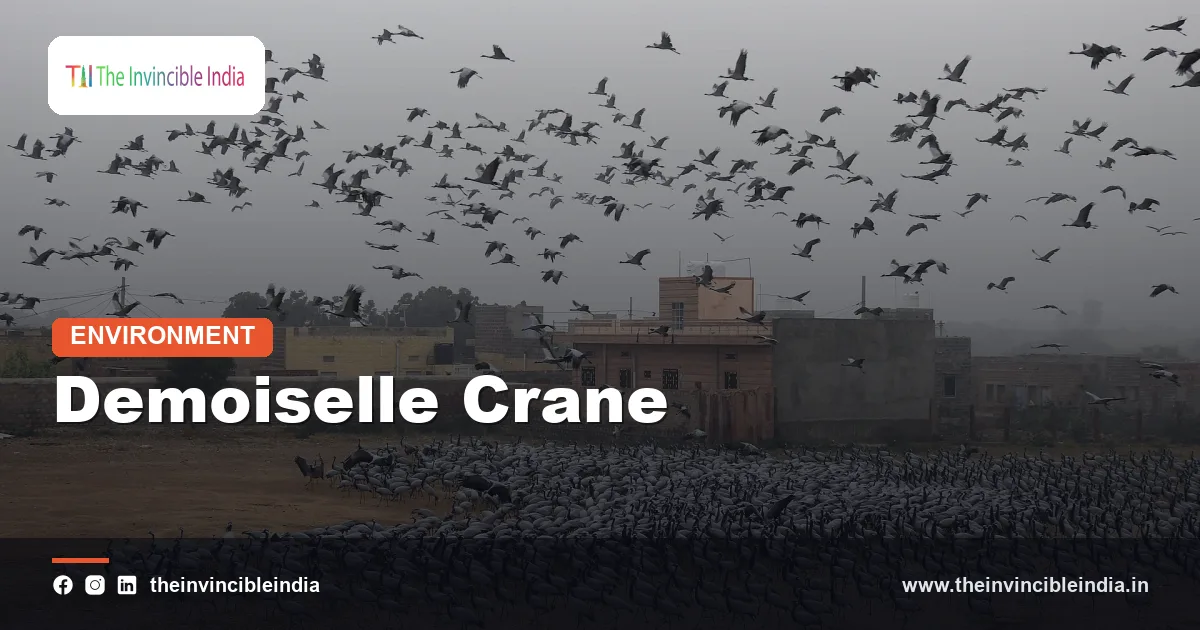
The demoiselle crane (Anthropoides virgo) is the smallest of the world’s crane species, a slender grey-and-black bird that breeds on the steppes of Eurasia and flies to India every winter, where it is known locally as the kurja or kurjan. Each year, flocks that often run into the thousands arrive in Rajasthan, Gujarat and neighbouring states, and the sight of the birds gathering at village feeding grounds such as Khichan has made the demoiselle crane one of the best-known winter visitors to the subcontinent.
The demoiselle crane is remembered above all for its migration, which carries it over the Himalaya between Central Asia and the Indian plains. This explainer covers how to recognise the demoiselle crane, where it breeds and winters, why it travels so far, how Indian villagers have come to feed it, and what conservation challenges it faces.
| Attribute | Detail |
|---|---|
| Common name | Demoiselle crane (Hindi and Rajasthani: kurja, kurjan, koonj) |
| Scientific name | Anthropoides virgo |
| Family | Gruidae (cranes) |
| Size | Roughly 90 to 100 cm tall; the smallest crane species |
| Wingspan | Roughly 155 to 180 cm |
| Status in India | Winter migrant, usually arriving from late summer or early autumn and leaving by spring |
| Famous Indian site | Khichan village, Phalodi district, Rajasthan |
| IUCN status | Least Concern globally, though some regional populations have declined |
| Legal protection in India | Protected under the Wildlife (Protection) Act, 1972 |
Key Takeaways
- The demoiselle crane is the smallest of the world’s crane species and is easily told apart by its black neck, white ear tufts and long black breast plumes.
- Demoiselle cranes breed on grasslands and steppes across Central Asia and Mongolia and spend the winter in India, Pakistan and parts of north-east Africa.
- The demoiselle crane’s autumn migration crosses the Himalaya, one of the most demanding bird journeys in the world, flying at heights of several thousand metres.
- Khichan village in Rajasthan is the best-known demoiselle crane wintering site in India, where villagers have fed the birds grain for decades.
- The demoiselle crane is listed as Least Concern by the IUCN, but loss of steppe, wetland drainage and power-line collisions remain real threats along its flyway.
- Demoiselle cranes are social birds that roost on open water or sandbanks at night and feed in fields by day, often in flocks of hundreds or thousands.
What Is the Demoiselle Crane?
The demoiselle crane is a small, elegant crane species, one of 15 crane species recognised worldwide, and the only one in its genus Anthropoides apart from the blue crane of southern Africa. It stands about a metre tall, weighs only a couple of kilograms and has a lightness of build that sets it apart from the much taller Sarus crane, which is the world’s tallest flying bird and a resident of India.
The name “demoiselle” is French for a young lady. The bird is said to have been named for its graceful, dainty bearing and its stylised courtship dances, a description commonly attributed to French observers of the eighteenth century. In India the bird is called kurja or kurjan in many northern languages, and the same family of names is used for cranes more generally.
Like all cranes, the demoiselle crane is a long-legged, long-necked bird that walks easily on open ground, flies with its neck and legs fully extended, and calls with a loud, rolling, trumpeting voice. Cranes belong to the order Gruiformes and the family Gruidae, a family that also includes Indian residents such as the Sarus crane and winter visitors such as the common crane.
How Do You Identify a Demoiselle Crane?
The demoiselle crane is identified by its soft grey body, black head and neck, and a bold white tuft of feathers that streams back from behind each red eye. The black feathers on the foreneck hang down over the chest in a loose plume, and the bill is short, greenish-yellow and tipped with red, giving the bird a gentler look than larger cranes.
Several features help separate it from other cranes seen in India:
- Size: The demoiselle crane is clearly smaller than the common crane and the Sarus crane and often looks compact and tidy in a mixed flock.
- Head pattern: A black head and neck with a white ear tuft is distinctive, whereas the common crane has a white stripe running down the side of the neck and a red crown patch.
- Bill: The bill is short and delicate rather than long and dagger-like.
- Flight: Flocks fly in V-shaped or wavering lines, calling constantly in flight, with black primary feathers contrasting with the grey wings.
Juvenile demoiselle cranes are paler and browner on the head and lack the long breast plumes and clean white ear tufts of adults, so young birds in a winter flock look slightly washed out beside their parents.
Crane Species Seen in India: A Comparison
| Species | Status in India | Key features |
|---|---|---|
| Demoiselle crane | Winter migrant | Smallest crane; black neck, white ear tufts, grey body |
| Common crane | Winter migrant | Larger; red crown patch and white stripe down the neck |
| Sarus crane | Resident | Tallest flying bird; red head and upper neck; grey body |
| Black-necked crane | Breeds in Ladakh; winters in Arunachal Pradesh and nearby areas | High-altitude species; black neck and head, red crown |
| Siberian crane | Formerly regular winter visitor; now very rare or absent | White body with red face; once famous at Keoladeo, Bharatpur |
Where Does the Demoiselle Crane Breed and Winter?
The demoiselle crane breeds across a broad belt of grassland and semi-desert stretching from the Black Sea region eastward through Central Asia and Mongolia to north-eastern China, and winters in the Indian subcontinent and in north-eastern Africa. A tiny, isolated population once lived in the Atlas region of North Africa, and it is not part of the Indian migration.
In breeding regions the demoiselle crane prefers dry steppe, semi-desert margins and open grassland near water, and unusually for a crane it often nests in drier ground away from marshes. The nest is little more than a scrape on the ground, sometimes ringed with a few pebbles, and the female typically lays two eggs. Both parents share incubation and care for the chicks, which are able to walk soon after hatching.
The birds that reach India are mainly drawn from the Central Asian breeding populations. They travel south through Kazakhstan, Uzbekistan, Turkmenistan and Afghanistan or Pakistan, depending on route, before reaching western India. The birds that winter in Africa follow a separate western route, which is why the demoiselle crane is considered to have more than one flyway.
Why Does the Demoiselle Crane Migrate Over the Himalaya?
The demoiselle crane migrates over the Himalaya because its Central Asian breeding grounds freeze and lose food in winter, while the plains of India offer unfrozen water, open fields and plenty of grain. The simplest route south often means crossing mountain ranges, and the demoiselle crane is one of the few birds known to do so on a regular basis.
Observers have long reported that demoiselle cranes cross the Himalaya at very high altitudes, and satellite-tracking studies in recent decades have confirmed that the birds climb well over four thousand metres on some stages of the journey. Older accounts, sometimes quoted in popular writing, describe flights near the heights at which climbers use supplementary oxygen. The precise upper altitude varies between individuals and routes, and figures should be treated cautiously.
The journey is hazardous. Cold air, thin oxygen, headwinds and predators such as eagles that wait for tired flocks all take a toll, and young birds on their first crossing are most vulnerable. The cranes are believed to use warm updraughts and valley routes wherever they can, saving energy and flying in a coordinated manner while calling to keep contact.
When Do Demoiselle Cranes Arrive and Leave India?
Demoiselle cranes typically arrive in India between late summer and early autumn, with the main build-up in September and October, and depart for their breeding grounds in March or early April. The exact timing shifts from year to year with weather, crop cycles and conditions along the route.
During the intervening months the birds settle into a daily routine. At dawn they leave their night roosts, which are usually shallow water, riverbanks or bare sandy ground, and fly out in small parties to feed in harvested fields. During the heat of the day they rest and drink, and at dusk they return to the roost in a series of noisy flights. Before departure in spring, the flocks grow restless, performing the bowing, leaping and wing-flapping displays for which cranes are famous.
Where Can You See Demoiselle Cranes in India?
The best-known place to see demoiselle cranes in India is Khichan, a village in the Phalodi district of Rajasthan, where large winter flocks gather at a dedicated feeding ground every morning. Other well-known sites include wetlands, reservoirs, riverbanks and fallow fields across western and central India.
| Region | Example sites and notes |
|---|---|
| Rajasthan | Khichan in Phalodi district is the iconic site; birds are also reported around Bikaner, Jodhpur, Jaisalmer and the Thar region’s tanks and fields |
| Gujarat | Kachchh, the Banni grasslands, the Little Rann and several lakes and reservoirs in Saurashtra and north Gujarat |
| Madhya Pradesh | Parts of the Chambal valley and large reservoirs in the central and western districts |
| Haryana and Punjab | Occasional flocks along river floodplains and larger wetlands |
| Uttar Pradesh | Scattered flocks along the Yamuna, Ganga and Chambal river systems |
For birdwatchers, early morning and late afternoon are the best times to watch demoiselle cranes. Visitors should keep a respectful distance, stay quiet and avoid approaching flocks on foot, since disturbance at the feeding ground causes birds to flush and waste valuable energy.
Why Are Demoiselle Cranes Famous at Khichan?
Demoiselle cranes are famous at Khichan because the village has fed them grain for several decades, turning the settlement into one of the largest and most reliable wintering sites for the species in the world. The tradition grew from local charity and a community feeling that feeding birds earns religious merit.
Every morning during the season, villagers scatter grain at a designated spot called the chugga ghar, a walled feeding area that has been developed over time. Cranes arrive in waves, and daily numbers can reach into the thousands, sometimes running to well over ten thousand on peak days, although counts differ between seasons and counters. The birds also drink at a nearby water body, where they can be watched at close range from a distance that does not alarm them.
The Khichan example is widely cited as a case of local, community-led wildlife support. It has also raised sensible questions among conservationists about artificial feeding, dependence on handouts, the spread of disease in dense flocks and the impact of dogs and stray animals. Managed carefully, most observers agree that the system has helped the cranes without removing their natural behaviour.
What Does the Demoiselle Crane Eat?
The demoiselle crane eats mainly seeds, grains, shoots and roots, supplemented with insects, small reptiles and other small animals, particularly during the breeding season. It is an omnivore that adapts its diet to whatever the habitat provides.
On the Indian wintering grounds, the diet shifts heavily toward cereals and pulses left over after harvest, such as millets, sorghum, wheat and gram, as well as groundnut and wild seeds. Because of this the demoiselle crane is sometimes accused of damaging crops, but in most places the damage is minor, and many farmers tolerate or welcome the birds. The cranes also take water daily, which ties them closely to ponds, tanks and rivers.
Is the Demoiselle Crane Endangered?
The demoiselle crane is not considered endangered globally, as the International Union for Conservation of Nature (IUCN) lists it as a species of Least Concern, but several regional populations have declined and some face real pressure. The worldwide population is generally estimated in the low hundreds of thousands, and figures vary by source and survey method.
Threats include:
- Habitat loss: Conversion of steppe to cropland, overgrazing and the drainage of wetlands reduce breeding and stopover habitat in Central Asia.
- Power lines: Collisions with overhead cables and wind turbines are a growing concern for large, low-flying birds, especially in western India.
- Hunting and disturbance: Illegal shooting and trapping have been reported along some migratory routes.
- Climate and water: Drought, shrinking wetlands and shifting rainfall can alter where and when the birds can feed and roost.
- Disease risk: Dense flocks, whether natural or around feeding points, can be exposed to avian diseases.
In India, the demoiselle crane is protected under the Wildlife (Protection) Act, 1972, and it is covered by international agreements on migratory species and waterbirds. Conservation depends heavily on cooperation between states, since the bird passes through many countries on a single journey.
How Does the Demoiselle Crane Behave?
The demoiselle crane is a highly social bird that lives in flocks outside the breeding season and forms long-lasting pair bonds, calling and dancing both for courtship and for communication within the group. The dances include bowing, jumping, running and tossing sticks or grass, and they are performed by young and old birds alike.
Cranes are known for their duets, in which a pair calls in a coordinated manner that helps maintain the bond. The demoiselle crane’s voice is a high, rolling, trumpeting krooo-krooo, quite different from the deeper tones of larger cranes, and a flock overhead can be heard well before it is seen. At night the birds roost standing in shallow water or on sandbars, where predators find it harder to approach unnoticed.
Demoiselle cranes are long-lived, with wild individuals often reaching their twenties or more, and they breed slowly, raising few young per year. This slow reproductive rate is one reason why losses of adult birds on migration matter so much to the population.
How Can People Help Protect Demoiselle Cranes?
People can help protect demoiselle cranes by supporting wetland and grassland conservation, respecting distance at feeding and roosting sites, and backing measures that make power lines and fields safer for large birds. Responsible tourism and local stewardship have done much of the work so far.
- Visit feeding sites quietly, stay on marked paths and avoid flash photography or drones near flocks.
- Support or volunteer with local bird groups that monitor crane numbers and report injured birds.
- Encourage the marking or burying of dangerous power lines in known crane areas.
- Protect village ponds, tanks and open grazing land that serve as roosts and feeding grounds.
- Report injured or dead birds to the forest department or a local wildlife rescuer.
Bottom Line
The demoiselle crane is a small, graceful crane that crosses the Himalaya each year to winter in India, with Khichan in Rajasthan as its most famous haven. Though not globally threatened, the demoiselle crane depends on safe flyways, open water and food, and careful, community-supported protection will matter for its future.
Frequently Asked Questions
What is a demoiselle crane?
The demoiselle crane is the smallest of the world’s crane species, a grey bird with a black head and neck, white ear tufts and long black breast plumes. It breeds in Central Asia and Mongolia and winters in India, where it is called kurja. Its name comes from the French word for a young lady, in reference to its graceful appearance.
Where can I see demoiselle cranes in India?
The best-known place to see demoiselle cranes in India is Khichan village in Phalodi district, Rajasthan, where thousands gather at a feeding ground each winter morning. They are also seen in Gujarat, especially Kachchh and the Rann, and at wetlands and fields in Madhya Pradesh and nearby states. Early morning and late afternoon give the best views.
When do demoiselle cranes come to India?
Demoiselle cranes typically arrive in India between late summer and early autumn, with the main build-up in September and October. They stay through the winter and leave for their breeding grounds in March or early April. Exact dates vary each year with weather and conditions along the route.
Do demoiselle cranes really fly over the Himalaya?
Yes, demoiselle cranes cross the Himalaya on their migration between Central Asia and India. Tracking studies show they climb to several thousand metres, and older accounts describe even greater heights. The crossing is dangerous because of cold, thin air and predators, so many birds, especially young ones, do not survive it.
Is the demoiselle crane an endangered bird?
No, the demoiselle crane is listed as Least Concern by the IUCN, meaning it is not currently threatened with extinction worldwide. However, some regional populations have declined because of habitat loss, power-line collisions and hunting along the flyway. In India it is protected under the Wildlife (Protection) Act, 1972.
What do demoiselle cranes eat in India?
Demoiselle cranes in India eat mostly grains, seeds and shoots, such as millets, sorghum, wheat and gram left over after harvest. They also take insects and other small animals when available. At Khichan, villagers supplement their diet by scattering grain at a dedicated feeding ground.
{“@context”:”https://schema.org”,”@graph”:[{“@type”:”FAQPage”,”mainEntity”:[{“@type”:”Question”,”name”:”What is a demoiselle crane?”,”acceptedAnswer”:{“@type”:”Answer”,”text”:”The demoiselle crane is the smallest of the world’s crane species, a grey bird with a black head and neck, white ear tufts and long black breast plumes. It breeds in Central Asia and Mongolia and winters in India, where it is called kurja. Its name comes from the French word for a young lady, in reference to its graceful appearance.”}},{“@type”:”Question”,”name”:”Where can I see demoiselle cranes in India?”,”acceptedAnswer”:{“@type”:”Answer”,”text”:”The best-known place to see demoiselle cranes in India is Khichan village in Phalodi district, Rajasthan, where thousands gather at a feeding ground each winter morning. They are also seen in Gujarat, especially Kachchh and the Rann, and at wetlands and fields in Madhya Pradesh and nearby states. Early morning and late afternoon give the best views.”}},{“@type”:”Question”,”name”:”When do demoiselle cranes come to India?”,”acceptedAnswer”:{“@type”:”Answer”,”text”:”Demoiselle cranes typically arrive in India between late summer and early autumn, with the main build-up in September and October. They stay through the winter and leave for their breeding grounds in March or early April. Exact dates vary each year with weather and conditions along the route.”}},{“@type”:”Question”,”name”:”Do demoiselle cranes really fly over the Himalaya?”,”acceptedAnswer”:{“@type”:”Answer”,”text”:”Yes, demoiselle cranes cross the Himalaya on their migration between Central Asia and India. Tracking studies show they climb to several thousand metres, and older accounts describe even greater heights. The crossing is dangerous because of cold, thin air and predators, so many birds, especially young ones, do not survive it.”}},{“@type”:”Question”,”name”:”Is the demoiselle crane an endangered bird?”,”acceptedAnswer”:{“@type”:”Answer”,”text”:”No, the demoiselle crane is listed as Least Concern by the IUCN, meaning it is not currently threatened with extinction worldwide. However, some regional populations have declined because of habitat loss, power-line collisions and hunting along the flyway. In India it is protected under the Wildlife (Protection) Act, 1972.”}},{“@type”:”Question”,”name”:”What do demoiselle cranes eat in India?”,”acceptedAnswer”:{“@type”:”Answer”,”text”:”Demoiselle cranes in India eat mostly grains, seeds and shoots, such as millets, sorghum, wheat and gram left over after harvest. They also take insects and other small animals when available. At Khichan, villagers supplement their diet by scattering grain at a dedicated feeding ground.”}}]}]}


