

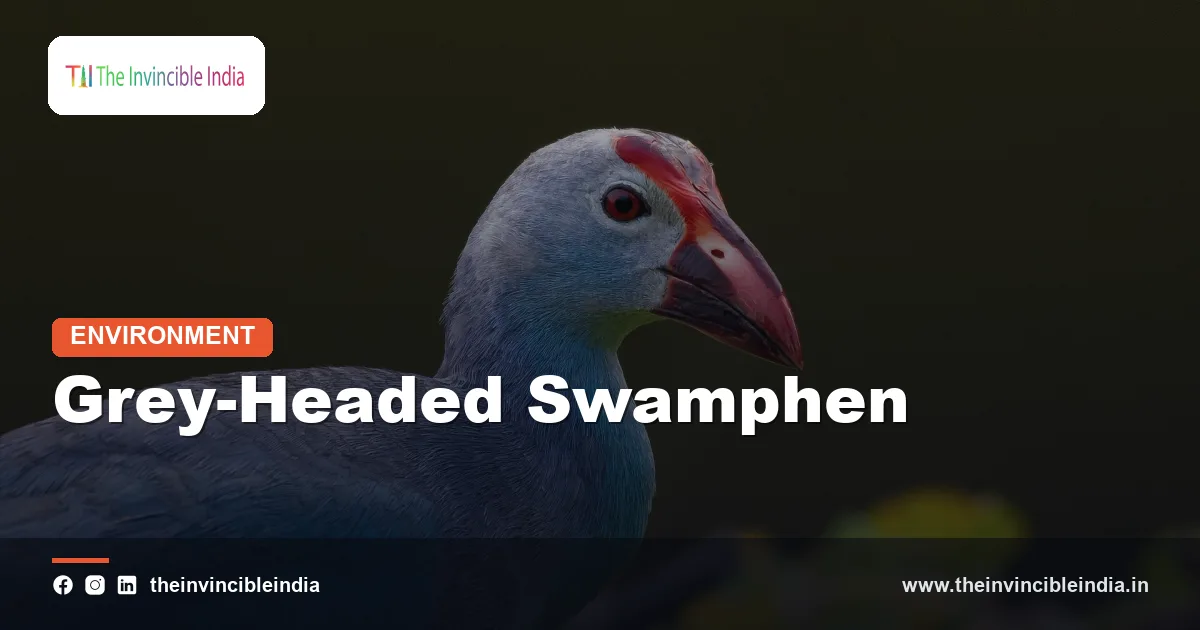
The grey-headed swamphen (Porphyrio poliocephalus) is a large, purple-blue marsh bird with a stout red bill, a red forehead shield and long red legs, found across the reedy wetlands of India and much of South and South-East Asia. Until fairly recently Indian birdwatchers called it the purple swamphen or purple moorhen, and the grey-headed swamphen is the bird most people in India picture when they use those older names.
The grey-headed swamphen is a resident, mostly non-migratory bird, usually seen walking on floating vegetation or clambering through reed stems on its huge toes. This explainer covers how to recognise the grey-headed swamphen, why its name changed, where it lives in India, what it eats, how it breeds and what threatens its wetland homes.
| Attribute | Detail |
|---|---|
| Common name | Grey-headed swamphen (formerly treated as part of the purple swamphen or purple moorhen; Hindi: kaim) |
| Scientific name | Porphyrio poliocephalus |
| Family | Rallidae (rails, crakes, gallinules and coots) |
| Size | Roughly 40 to 50 cm long; much larger than a moorhen |
| Key features | Deep blue-purple body, grey-tinged head, red bill and frontal shield, red legs, white undertail |
| Habitat | Reedbeds, marshes, lake margins, village ponds and flooded paddy |
| Status in India | Widespread resident across most of the country, with local movements |
| IUCN status | Least Concern |
| Diet | Mainly shoots and stems of aquatic plants; also seeds, eggs, snails and insects |
Key Takeaways
- The grey-headed swamphen is a large, iridescent purple-blue rail with a red bill, red forehead shield and long red legs, and it is one of the most conspicuous birds of Indian marshes.
- The grey-headed swamphen was split from the wider purple swamphen group in the 2010s, and the birds of the Indian subcontinent are the grey-headed form.
- Grey-headed swamphens are resident in India, living in reedbeds and wetlands from Kashmir and the Gangetic plains to Kerala and the north-east.
- The grey-headed swamphen feeds largely on the soft stems and shoots of reeds and sedges, often holding food in one foot and nibbling it like a parrot.
- Grey-headed swamphens nest on platforms of trampled reeds, and some groups raise young cooperatively, with more than one adult tending a nest.
- The grey-headed swamphen is listed as Least Concern, but draining and degradation of marshes and ponds in India reduce the habitat that the species depends on.
What Is the Grey-Headed Swamphen?
The grey-headed swamphen is a large member of the rail family (Rallidae) that lives in freshwater marshes, and it is the species of swamphen found throughout the Indian subcontinent. The Rallidae family also includes the common moorhen and the Eurasian coot, both familiar on Indian ponds and lakes, as well as secretive crakes and rails.
Although the grey-headed swamphen is a sizeable bird, with a body about the size of a small hen, it is often hard to see because it lives in dense reed and sedge cover. When feeding in the open, it stalks across floating mats of water hyacinth or lotus leaves, lifting its long toes high with each step, and flicks its tail to show a bright white patch beneath.
In India the bird has several local names. Hindi speakers commonly call it kaim, and the older English name purple moorhen is still heard in some regions even though the bird is not a true moorhen.
How Do You Identify a Grey-Headed Swamphen?
The grey-headed swamphen is identified by its deep purple-blue plumage, a heavy red bill that merges into a large red forehead shield, and long red legs ending in very long toes. The head and upper neck are paler, often greyish, which gives the species its name, while the underparts shimmer violet and turquoise in good light.
- Bill and shield: The bill is deep, strongly built and bright red, flowing directly into the shield on the forehead.
- Legs and toes: The legs are long and red, with very long, unwebbed toes that spread weight over soft vegetation.
- Undertail: A white patch under the tail is flashed by flicking the tail upward when the bird is alarmed or displaying.
- Juveniles: Young birds are duller, greyer or brownish, with a dusky bill and a small shield, and they take months to gain adult colours.
The size and heavy bill separate the grey-headed swamphen from the common moorhen, which is smaller, dark slaty and has a yellow-tipped red bill. The Eurasian coot is also smaller and has a white, not red, bill and shield.
Why Did the Purple Swamphen Become the Grey-Headed Swamphen?
The purple swamphen was split into several separate species after genetic and structural studies showed that the widespread group actually contained distinct populations, and the birds of South Asia were named the grey-headed swamphen. The change was adopted by major checklists during the 2010s, although the older name remains popular in everyday use.
Before the split, the purple swamphen (Porphyrio porphyrio) was treated as one species ranging from Europe and Africa to Australia and the Pacific. Researchers found differences in plumage, size, voice and DNA between regional populations, and taxonomists divided the group into species such as the western swamphen of the Mediterranean, the African swamphen, the black-backed swamphen of South-East Asia, the Australasian swamphen and the grey-headed swamphen of South Asia.
For Indian readers the practical effect is small. The bird in a village pond in Punjab or Kerala has not changed, but field guides, eBird and other references now name it Porphyrio poliocephalus. The name “purple swamphen” may still appear in older books and websites, so both names are useful in searches.
Where Is the Grey-Headed Swamphen Found in India?
The grey-headed swamphen is found across most of India wherever there are freshwater marshes with dense reeds, from the foothills of the Himalaya and the Gangetic plains to peninsular India, Kerala and the north-east. Beyond India its range extends through Pakistan, Nepal, Bangladesh and Sri Lanka and eastward into Myanmar and south-western China.
| Region | Typical places and notes |
|---|---|
| North and north-west India | Reedy lakes, canals and village ponds; Keoladeo National Park in Rajasthan is a classic site |
| Gangetic plains | Oxbow lakes, jheels and flooded fields in Uttar Pradesh and Bihar |
| Eastern India and north-east | Marshes in West Bengal, Assam and Odisha, including Chilika lagoon edges |
| Western and central India | Reservoirs and marshes in Gujarat, Maharashtra and Madhya Pradesh |
| South India | Backwaters, lakes and paddy wetlands in Kerala, Tamil Nadu and Karnataka |
The species is largely sedentary but may move locally after rains or when water levels fall, and wandering birds sometimes appear at new ponds. It tends to be easier to find in protected wetlands and large lakes with extensive reed cover than in small, heavily disturbed village tanks.
What Kind of Habitat Does the Grey-Headed Swamphen Need?
The grey-headed swamphen needs freshwater wetlands with dense emergent vegetation, such as reeds, bulrushes, sedges and cattails, for both food and cover. Shallow water, soft mud and floating plants allow the bird to walk and feed without swimming much.
Typical habitats include:
- Reed-fringed lakes, jheels and oxbow wetlands.
- Marshes beside rivers and canals.
- Flooded paddy fields and irrigation channels.
- Village ponds with thick vegetation, and the edges of urban lakes where reeds survive.
The grey-headed swamphen is a common sight near sanctuaries and Ramsar wetlands, but it is also tolerant of modest human presence when reedbeds remain. It is wary and quick to dart into cover, though birds living near people can become quite bold.
What Does the Grey-Headed Swamphen Eat?
The grey-headed swamphen eats mainly the soft stems, shoots, roots and seeds of aquatic plants, along with occasional animal food such as snails, insects, frogs, fish and the eggs or chicks of other waterbirds. It is a versatile omnivore, but its diet is dominated by plant matter.
The bird has a distinctive way of feeding. It pulls up a reed or lily stem, holds it with one long-toed foot and bites pieces off with the strong bill, much as a parrot handles food. It may also cut down reed stems to reach the tender base, thereby opening small gaps in the reedbed. Swamphens sometimes feed on paddy shoots in flooded fields, which can occasionally cause local complaints, although the damage is usually small.
How Does the Grey-Headed Swamphen Breed?
The grey-headed swamphen breeds in or beside reedbeds, building a bulky platform of reed stems and leaves just above the water, and the breeding season in India is usually tied to the monsoon, roughly from June to September in the north and variable elsewhere. The clutch typically contains three to six buff-coloured eggs with brown spots.
Swamphens are noted for flexible family arrangements. In some populations of the wider swamphen group, several adults share a territory and help to incubate eggs and feed chicks, and similar group behaviour may occur in Indian birds. The chicks are covered in black down, leave the nest within a day or two and follow the adults, who feed them for weeks. Juveniles are dull compared with adults and stay in the reeds while they grow.
How Does the Grey-Headed Swamphen Behave and Sound?
The grey-headed swamphen is a noisy, assertive bird that announces its territory with loud, harsh, hooting and shrieking calls, often at dawn and dusk. The calls carry far across a marsh and are often the first sign that swamphens are present when the birds themselves are hidden.
Swamphens are territorial during the breeding season and can be aggressive towards intruders, including other waterbirds. Displays involve bowing, tail flicking, calling and presenting a piece of vegetation. They are poor, laboured fliers, taking off with trailing legs and flying short distances, yet they can travel between wetlands, usually at night or at dawn.
Despite their size, swamphens are cautious, and predators such as marsh harriers, large snakes, monitor lizards and fishing cats may take eggs or young. Adults often retreat into thick cover at the first sign of danger.
Grey-Headed Swamphen Compared with Other Rails
| Bird | Size | Bill and shield | Colour |
|---|---|---|---|
| Grey-headed swamphen | Large (about 40 to 50 cm) | Heavy red bill and large red shield | Purple-blue with greyish head |
| Common moorhen | Medium (about 32 to 35 cm) | Red shield, bill red with yellow tip | Dark slate with white flank stripe |
| Eurasian coot | Medium (about 36 to 38 cm) | White bill and white shield | Slaty black overall |
| Watercock | Medium | Greenish bill with red base | Males mostly black; secretive |
Is the Grey-Headed Swamphen Under Threat?
The grey-headed swamphen is not globally threatened and is listed as Least Concern by the International Union for Conservation of Nature (IUCN), but it depends entirely on healthy freshwater wetlands, which are shrinking across India. Its adaptability to ponds and paddy has helped the species hold on in many areas.
Key pressures include:
- Wetland loss: Draining, filling and building on marshes and ponds removes breeding and feeding habitat.
- Pollution: Sewage, agricultural runoff and plastic degrade water quality and plant growth.
- Invasive plants: Dense mats of water hyacinth can choke open water, though swamphens sometimes use them.
- Disturbance and hunting: Egg collection and occasional hunting occur in some places, even though wild birds are covered by India’s Wildlife (Protection) Act, 1972.
Protecting reedbeds, maintaining water in village ponds and managing wetlands for birds all help the grey-headed swamphen. Because the species is easy to see and distinctive, it is also a good indicator bird for wetland condition and a popular subject for community bird counts.
Why Does the Grey-Headed Swamphen Matter for Wetlands?
The grey-headed swamphen matters for wetlands because it is both a prominent consumer of marsh plants and a sensitive sign of how well a reedbed is functioning. A pond where swamphens feed and breed usually still has the dense, healthy emergent vegetation that supports fish, frogs, insects and many other birds.
By cutting and trampling reed stems, swamphens create small openings and platforms that other species use, and their nests are sometimes reused by smaller waterbirds. In turn, the swamphen is prey for raptors and carnivores, so it is one link in the marsh food web. When reedbeds are cleared for neat embankments, swamphens are among the first large birds to disappear.
Tips for Watching Swamphens
- Scan the edges of reedbeds and floating vegetation early in the morning, when birds step into the open to feed.
- Listen for loud hooting and shrieking calls, then wait quietly for movement in the reeds.
- Look for the white flash of the undertail as the bird flicks its tail, which often gives its position away.
- Keep a respectful distance during the monsoon breeding season, as disturbance can make adults abandon nests.
- Carry binoculars rather than approaching on foot through marsh edges, where soft mud and snakes can be hazards.
Community counts and citizen-science platforms such as eBird record swamphen sightings across India, and these records help researchers follow the bird’s distribution and detect changes in wetland health over time.
Bottom Line
The grey-headed swamphen is India’s big, iridescent marsh rail, a resident bird of reeds and ponds that has recently been recognised as its own species. Though still common, the grey-headed swamphen depends on reedbeds and clean freshwater, so wetland protection is its best conservation measure.
Frequently Asked Questions
What is a grey-headed swamphen?
The grey-headed swamphen is a large, purple-blue marsh bird with a red bill, red forehead shield and long red legs, belonging to the rail family. It is the swamphen species found across India and South Asia. It was formerly called the purple swamphen or purple moorhen.
Is the grey-headed swamphen the same as the purple swamphen?
The grey-headed swamphen was once treated as part of the purple swamphen, but taxonomists split that group into several species in the 2010s. The birds of India and South Asia are the grey-headed swamphen, Porphyrio poliocephalus. Many people still use the older name purple swamphen in everyday speech.
Where can I see grey-headed swamphens in India?
Grey-headed swamphens can be seen in reedy wetlands across India, including Keoladeo National Park in Rajasthan, Chilika in Odisha, the backwaters of Kerala and many village ponds and lakes. They are resident, so they can be found year-round. Early morning and evening are the best times to spot them at reed edges.
What does a grey-headed swamphen eat?
The grey-headed swamphen eats mainly the stems, shoots and roots of reeds, sedges and other aquatic plants. It also takes seeds, snails, insects and occasionally eggs or small animals. It often holds food in one foot while biting off pieces.
How is a grey-headed swamphen different from a common moorhen?
The grey-headed swamphen is much larger and purple-blue with a heavy all-red bill and big red shield, while the common moorhen is smaller and dark slate with a yellow-tipped red bill. The moorhen also has a white stripe along its flank, which the swamphen lacks. Both belong to the rail family and live in similar wetlands.
Is the grey-headed swamphen protected in India?
The grey-headed swamphen is not globally threatened, being listed as Least Concern by the IUCN. Wild birds in India generally fall under the Wildlife (Protection) Act, 1972, which prohibits hunting and egg collection. Its main risk is the loss and pollution of freshwater wetlands.
{“@context”:”https://schema.org”,”@graph”:[{“@type”:”FAQPage”,”mainEntity”:[{“@type”:”Question”,”name”:”What is a grey-headed swamphen?”,”acceptedAnswer”:{“@type”:”Answer”,”text”:”The grey-headed swamphen is a large, purple-blue marsh bird with a red bill, red forehead shield and long red legs, belonging to the rail family. It is the swamphen species found across India and South Asia. It was formerly called the purple swamphen or purple moorhen.”}},{“@type”:”Question”,”name”:”Is the grey-headed swamphen the same as the purple swamphen?”,”acceptedAnswer”:{“@type”:”Answer”,”text”:”The grey-headed swamphen was once treated as part of the purple swamphen, but taxonomists split that group into several species in the 2010s. The birds of India and South Asia are the grey-headed swamphen, Porphyrio poliocephalus. Many people still use the older name purple swamphen in everyday speech.”}},{“@type”:”Question”,”name”:”Where can I see grey-headed swamphens in India?”,”acceptedAnswer”:{“@type”:”Answer”,”text”:”Grey-headed swamphens can be seen in reedy wetlands across India, including Keoladeo National Park in Rajasthan, Chilika in Odisha, the backwaters of Kerala and many village ponds and lakes. They are resident, so they can be found year-round. Early morning and evening are the best times to spot them at reed edges.”}},{“@type”:”Question”,”name”:”What does a grey-headed swamphen eat?”,”acceptedAnswer”:{“@type”:”Answer”,”text”:”The grey-headed swamphen eats mainly the stems, shoots and roots of reeds, sedges and other aquatic plants. It also takes seeds, snails, insects and occasionally eggs or small animals. It often holds food in one foot while biting off pieces.”}},{“@type”:”Question”,”name”:”How is a grey-headed swamphen different from a common moorhen?”,”acceptedAnswer”:{“@type”:”Answer”,”text”:”The grey-headed swamphen is much larger and purple-blue with a heavy all-red bill and big red shield, while the common moorhen is smaller and dark slate with a yellow-tipped red bill. The moorhen also has a white stripe along its flank, which the swamphen lacks. Both belong to the rail family and live in similar wetlands.”}},{“@type”:”Question”,”name”:”Is the grey-headed swamphen protected in India?”,”acceptedAnswer”:{“@type”:”Answer”,”text”:”The grey-headed swamphen is not globally threatened, being listed as Least Concern by the IUCN. Wild birds in India generally fall under the Wildlife (Protection) Act, 1972, which prohibits hunting and egg collection. Its main risk is the loss and pollution of freshwater wetlands.”}}]}]}


