

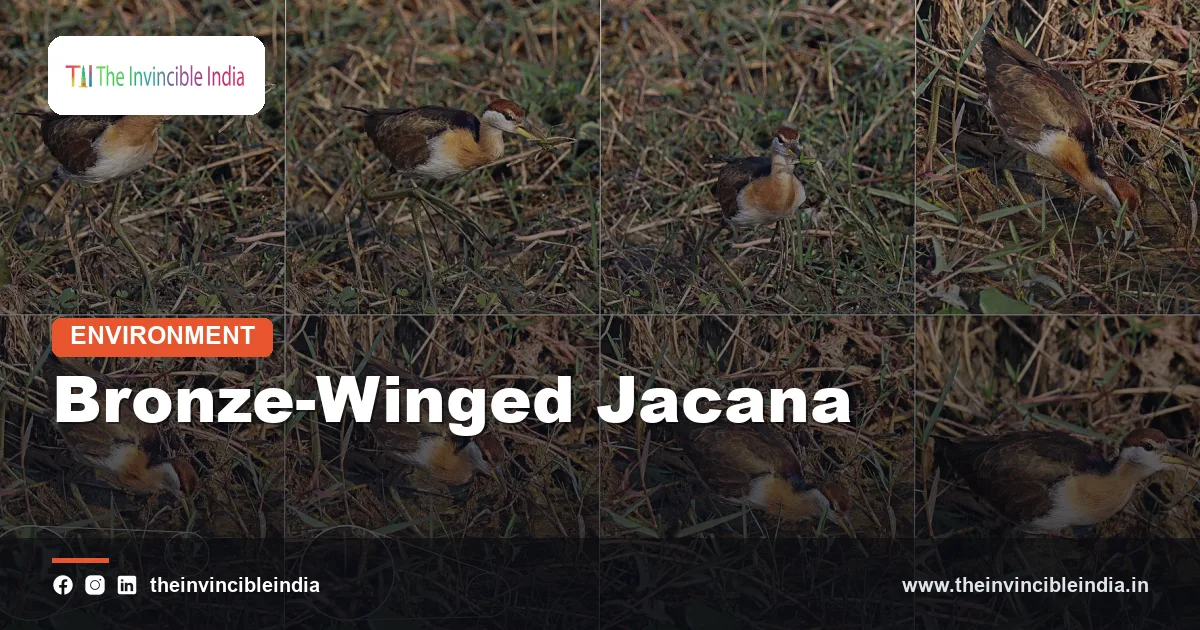
The bronze-winged jacana (Metopidius indicus) is a glossy black-and-bronze wetland bird of South and Southeast Asia, nicknamed the “lily-trotter” because its enormously long toes let it walk across floating lily and lotus leaves without sinking. Across India it is a familiar resident of ponds, tanks, marshes and flooded paddy, and it is best known for its role-reversed breeding system, in which the larger female defends territory and mates with several males while each male incubates the eggs and raises the chicks.
Few Indian birds show an adaptation as visible as the bronze-winged jacana’s feet, or a family life as unusual. This explainer covers how to identify the bird, how it walks on water plants, what it eats, where it lives in India, how its polyandrous breeding works, how it differs from the pheasant-tailed jacana, and what threatens the wetlands it depends on. Information was last reviewed on 23 October 2026.
| Attribute | Detail |
|---|---|
| Common name | Bronze-winged jacana (“lily-trotter”) |
| Scientific name | Metopidius indicus |
| Family | Jacanidae (the jacanas) |
| Body length | Roughly 28 to 31 cm, with females somewhat larger than males |
| Habitat | Freshwater ponds, tanks, marshes and lakes with floating vegetation |
| Range | The Indian subcontinent east to Southeast Asia |
| Breeding system | Polyandry: one female mates with several males; males incubate and rear the young |
| Main breeding season | Mostly the monsoon months, with regional variation |
| Conservation status | Least Concern on the IUCN Red List (global assessment) |
Key Takeaways
- The bronze-winged jacana is a wetland bird whose very long toes and claws spread its weight so it can walk on floating leaves.
- Adult bronze-winged jacanas are glossy black with a bronze-green sheen on the wings and back, a bold white stripe above the eye and a yellow bill with a reddish forehead shield.
- Bronze-winged jacanas are polyandrous: a female defends a territory and mates with several males, and each male then incubates the eggs and cares for the chicks.
- The bronze-winged jacana feeds mainly on aquatic insects, small invertebrates and some plant matter picked from floating vegetation and shallow water.
- In India the bronze-winged jacana is widely distributed in freshwater wetlands, and it generally breeds during or around the monsoon when floating plants are abundant.
- The IUCN lists the bronze-winged jacana as Least Concern globally, but local numbers depend on the health of vegetated freshwater wetlands.
What is the bronze-winged jacana?
The bronze-winged jacana is a medium-sized wading bird in the family Jacanidae that lives on freshwater wetlands with floating plants and walks across them on elongated toes. It is the only member of the genus Metopidius, so it has no close relatives within its own genus, although it shares its family with other jacanas around the tropics.
Jacanas are a small and distinctive family of about eight species found in the warm regions of Asia, Africa, Australasia and the Americas. They are not closely related to herons, storks or ducks in everyday terms, and are placed among the waders (shorebirds) in the order Charadriiformes. The scientific name Metopidius refers to the frontal shield on the forehead, a feature that gives the species a slightly “helmeted” look.
The bird is a resident across much of India. It does not undertake long migrations like many ducks or waders, although individuals move locally when ponds dry up or fill with the rains. Because it is easy to watch from the edge of a pond, it is a popular bird for beginners in Indian birdwatching.
How can you identify a bronze-winged jacana?
An adult bronze-winged jacana is identified by its glossy black head, neck and underparts, olive-bronze back and wings, a broad white stripe above the eye, a yellow bill and very long greenish legs and toes. The contrast between the dark body and the white eyebrow is the quickest way to recognise it.
Adult plumage
- Head and neck: glossy black, often with a faint purple or green gloss in good light.
- Eyebrow: a bold white stripe running back from the eye over the head, which is visible even at a distance.
- Back and wings: olive-green to bronze, giving the bird its common name.
- Bill and shield: a yellow bill with a reddish frontal shield at the base.
- Legs and toes: long, pale greenish-grey, with toes and claws that look almost out of proportion to the body.
Juveniles
Young bronze-winged jacanas look quite different from adults. They are browner and paler, with a rufous or buff tone on the upperparts, whitish underparts and a less distinct dark cap, and they gain the glossy black adult plumage gradually as they mature.
Voice and behaviour
The bronze-winged jacana is a fairly vocal bird that gives sharp, harsh, mewing or chattering notes, especially when alarmed or when chasing intruders from its territory. In flight it shows dark flight feathers and trailing long legs, and it generally flies low over the water for short distances before dropping back onto the vegetation.
How does the bronze-winged jacana walk on floating leaves?
The bronze-winged jacana walks on floating leaves by spreading its weight over a very large area using extremely long toes and straight claws, much as a snowshoe prevents sinking in snow. This is the adaptation that earned jacanas the name “lily-trotters”.
The toes of a jacana can be several times longer than those of a similar-sized wader, and each toe ends in a long, thin claw. When the bird steps on a lotus leaf or a mat of water hyacinth, the load is shared across the entire foot instead of pressing on a small point. The leaf bends slightly but does not tip or tear, and the bird moves with a deliberate, high-stepping gait.
Several body features support this lifestyle:
- Light build: a relatively small, light body lowers the pressure on each leaf.
- Balance: the bird lifts its feet clear of the water and places them carefully, adjusting its wings and body to stay level.
- Swimming ability: when needed, the bronze-winged jacana can swim, and it can dive or hide with only its bill above the surface when frightened.
- Foraging reach: by walking on vegetation, the bird gets to insects and snails on leaf surfaces that wading birds cannot reach.
Where is the bronze-winged jacana found in India?
The bronze-winged jacana is found across most of peninsular and northern India wherever there are freshwater wetlands with floating or emergent vegetation, from the plains to low-lying hill regions. Its wider range runs through Sri Lanka, Bangladesh, Nepal and Myanmar to parts of Southeast Asia.
Within India the bird occurs in a wide range of habitats, and it does not need a protected area to survive. Typical places include:
- Village ponds and temple tanks with lotus or water lilies.
- Large lakes, reservoirs and marshes, including many wetlands within sanctuaries and national parks.
- Flooded paddy fields and shallow seasonal pools during the monsoon.
- Slow-moving canals and oxbow lakes with a fringe of floating plants.
Birdwatchers regularly record the species in states from Kerala and Tamil Nadu in the south to West Bengal, Assam and the north-east, and in many central and western regions. Its numbers are generally described as stable and locally common, but exact population estimates for India are not reliable and should be treated with caution.
What does the bronze-winged jacana eat?
The bronze-winged jacana eats mainly small aquatic animals such as insects, beetles, bugs, snails and other invertebrates, supplemented by seeds and parts of aquatic plants. It is an omnivore that picks food from leaf surfaces, from the water’s film and from shallow mud.
The bird forages by walking slowly over lily pads and floating weed, glancing down and picking prey with its bill. It will sometimes lift or flip a leaf to expose insects hiding underneath. Because the vegetation is also used by many aquatic insects for laying eggs and by their larvae to feed, a healthy pond with floating plants offers a steady supply of food.
Typical food items include:
- Aquatic and flying insects, including beetles, water bugs and dragonfly or damselfly larvae.
- Small molluscs such as snails, and other small invertebrates.
- Seeds and shoots of aquatic plants.
- Occasionally, very small fish or tadpoles, although this is a minor part of the diet.
How does the bronze-winged jacana breed?
The bronze-winged jacana breeds on a floating pad of vegetation, usually during or soon after the monsoon, with a female pairing with several males and each male raising his own clutch. The exact timing varies by region and local water levels, so egg-laying may be earlier or later in different parts of India.
The nest is a flimsy platform, often just a few stems and leaves, placed on floating vegetation such as lotus or water lily leaves. It may look barely sufficient, and the eggs can sit in a shallow depression above or at the water’s surface. The clutch is usually around four eggs, which are glossy and heavily marked with dark scribbles on a brown ground colour, a pattern that helps them blend with the nest material.
The key stages of the breeding cycle are:
- Territory: the female defends a territory containing the nests of several males.
- Mating: she mates with the males in her territory, one after another.
- Egg-laying: she lays a clutch for each male, who becomes responsible for it.
- Incubation: the male sits on the eggs for roughly two to three weeks.
- Chick care: the male guards and broods the young, which leave the nest soon after hatching.
Why do male jacanas raise the chicks?
Male bronze-winged jacanas raise the chicks because jacanas have a reversed breeding system, known as polyandry, in which females compete for territory and males provide almost all parental care. Biologists often cite this as an example of sex-role reversal in birds.
In this system the female is larger than the male, which helps her win territorial contests. She spends her time defending the pond or patch of wetland and laying eggs for more than one male, rather than sitting on a nest. Each male builds or accepts a nest on his portion of the territory, incubates the clutch and then takes sole charge of the chicks.
Several features of the chick care are especially striking:
- The chicks are precocial, meaning they can walk and feed themselves within hours of hatching.
- When danger threatens, the male can tuck the chicks under his wings and walk away with their legs dangling beneath his body.
- The chicks freeze or hide among the floating plants, using their cryptic colouring for camouflage.
- The male leads the brood to areas rich in insects and keeps watch for predators such as snakes, crows, kites and other birds.
A likely reason for this system is that jacana nests on floating vegetation are very vulnerable to predators and flooding. By laying several clutches with different males, a female can replace lost nests quickly and spread the risk across more than one attempt.
How does the bronze-winged jacana differ from the pheasant-tailed jacana?
The bronze-winged jacana differs from the pheasant-tailed jacana mainly in its dark glossy plumage, the white eyebrow stripe and the lack of a long breeding tail, whereas the pheasant-tailed jacana turns white-headed with a long drooping tail in the breeding season. Both are lily-trotters that share many of the same wetlands in India.
| Feature | Bronze-winged jacana | Pheasant-tailed jacana |
|---|---|---|
| Scientific name | Metopidius indicus | Hydrophasianus chirurgus |
| Head and neck | Glossy black with a white eyebrow | White head with a golden nape in breeding plumage |
| Tail | Short, with no long plumes | Long, curved, black tail in the breeding season |
| Wings in flight | Dark, with bronze-green coverts | Largely white in breeding plumage |
| Frontal shield | Reddish shield above a yellow bill | No prominent shield |
| Seasonal change | Little visible change between seasons | Marked change between breeding and non-breeding plumage |
| Breeding system | Polyandrous | Polyandrous |
The two species often occur together on lotus-covered ponds, which makes the comparison useful for field identification. In the non-breeding season the pheasant-tailed jacana loses its tail and white wings, but its pale face, dark neck band and white underparts still set it apart from the all-dark bronze-winged jacana.
What threats does the bronze-winged jacana face?
The bronze-winged jacana is not currently considered globally threatened, but it depends on freshwater wetlands with floating vegetation, which are shrinking or degrading in many parts of India. Drainage, pollution, encroachment and overgrowth of invasive weeds can all reduce suitable habitat.
The main pressures on the species and its habitat include:
- Wetland loss: ponds and marshes are filled in or drained for construction and agriculture.
- Pollution: sewage, pesticide runoff and industrial effluent degrade water quality and reduce insect prey.
- Invasive plants: dense mats of weeds can choke open water, although floating plants in moderation actually help the bird.
- Disturbance: collection of lotus, egg collection and heavy disturbance during the nesting season can cause nest failure.
- Water-level changes: sudden flooding or drying of ponds can destroy floating nests.
Because the bronze-winged jacana is easy to see and sensitive to water quality, it is sometimes treated as a useful indicator of the health of small freshwater wetlands. Protecting village ponds, temple tanks and seasonal marshes, rather than only large sanctuaries, supports this bird and many other wetland species.
How can you watch the bronze-winged jacana responsibly?
The best way to watch a bronze-winged jacana is to approach a lotus pond quietly in the early morning or late afternoon, stay at the edge and use binoculars rather than moving closer. The bird is usually confiding and easy to see, but nesting males and chicks are sensitive to disturbance.
A few simple practices help both the observer and the birds:
- Visit during the monsoon and just after, when floating vegetation is dense and breeding activity is highest.
- Look for the white eyebrow and the high-stepping walk on lily pads, and scan carefully for a male with chicks.
- Avoid wading into the water or disturbing floating nests, since eggs are hard to see and easily damaged.
- Do not use playback of calls to attract birds during the breeding season.
- Record sightings on citizen-science platforms so that distribution data stay current.
Bottom Line
The bronze-winged jacana is a lily-trotter whose long toes, bronze sheen and white eyebrow make it easy to recognise, and whose reversed family roles make it one of the most interesting birds on Indian ponds. Its future depends less on legal protection of the species than on keeping small freshwater wetlands clean, vegetated and undrained.
Frequently Asked Questions
What is a bronze-winged jacana?
A bronze-winged jacana is a glossy black wading bird with bronze-green wings and a white eyebrow that lives on freshwater ponds and marshes in South and Southeast Asia. It is called a lily-trotter because its very long toes let it walk across floating leaves. It is a common resident in many parts of India.
Why is the bronze-winged jacana called a lily-trotter?
The bronze-winged jacana is called a lily-trotter because it walks on lily and lotus leaves without sinking. Its extremely long toes and claws spread the bird’s weight over a wide area. This lets it forage on floating vegetation where other waders cannot go.
Do male jacanas really incubate the eggs?
Yes, male bronze-winged jacanas incubate the eggs and raise the chicks on their own. The larger female defends a territory and lays clutches for several males. This reversed breeding system is called polyandry.
What does a bronze-winged jacana eat?
A bronze-winged jacana eats mainly aquatic insects, snails and other small invertebrates, along with some seeds and plant material. It picks food from floating leaves and shallow water as it walks over the vegetation. Insects make up the bulk of its diet.
When does the bronze-winged jacana breed in India?
The bronze-winged jacana mostly breeds during the monsoon and the weeks that follow, when floating vegetation is abundant. The exact timing varies by region and by local water conditions. The usual clutch is about four glossy, scribbled eggs on a floating leaf pad.
Is the bronze-winged jacana an endangered bird?
No, the bronze-winged jacana is not considered endangered, and the IUCN lists it as Least Concern at the global level. However, it relies on freshwater wetlands with floating plants, and loss or pollution of these habitats can reduce local numbers. Protecting ponds and marshes helps keep the species common.
{“@context”:”https://schema.org”,”@graph”:[{“@type”:”FAQPage”,”mainEntity”:[{“@type”:”Question”,”name”:”What is a bronze-winged jacana?”,”acceptedAnswer”:{“@type”:”Answer”,”text”:”A bronze-winged jacana is a glossy black wading bird with bronze-green wings and a white eyebrow that lives on freshwater ponds and marshes in South and Southeast Asia. It is called a lily-trotter because its very long toes let it walk across floating leaves. It is a common resident in many parts of India.”}},{“@type”:”Question”,”name”:”Why is the bronze-winged jacana called a lily-trotter?”,”acceptedAnswer”:{“@type”:”Answer”,”text”:”The bronze-winged jacana is called a lily-trotter because it walks on lily and lotus leaves without sinking. Its extremely long toes and claws spread the bird’s weight over a wide area. This lets it forage on floating vegetation where other waders cannot go.”}},{“@type”:”Question”,”name”:”Do male jacanas really incubate the eggs?”,”acceptedAnswer”:{“@type”:”Answer”,”text”:”Yes, male bronze-winged jacanas incubate the eggs and raise the chicks on their own. The larger female defends a territory and lays clutches for several males. This reversed breeding system is called polyandry.”}},{“@type”:”Question”,”name”:”What does a bronze-winged jacana eat?”,”acceptedAnswer”:{“@type”:”Answer”,”text”:”A bronze-winged jacana eats mainly aquatic insects, snails and other small invertebrates, along with some seeds and plant material. It picks food from floating leaves and shallow water as it walks over the vegetation. Insects make up the bulk of its diet.”}},{“@type”:”Question”,”name”:”When does the bronze-winged jacana breed in India?”,”acceptedAnswer”:{“@type”:”Answer”,”text”:”The bronze-winged jacana mostly breeds during the monsoon and the weeks that follow, when floating vegetation is abundant. The exact timing varies by region and by local water conditions. The usual clutch is about four glossy, scribbled eggs on a floating leaf pad.”}},{“@type”:”Question”,”name”:”Is the bronze-winged jacana an endangered bird?”,”acceptedAnswer”:{“@type”:”Answer”,”text”:”No, the bronze-winged jacana is not considered endangered, and the IUCN lists it as Least Concern at the global level. However, it relies on freshwater wetlands with floating plants, and loss or pollution of these habitats can reduce local numbers. Protecting ponds and marshes helps keep the species common.”}}]}]}


