

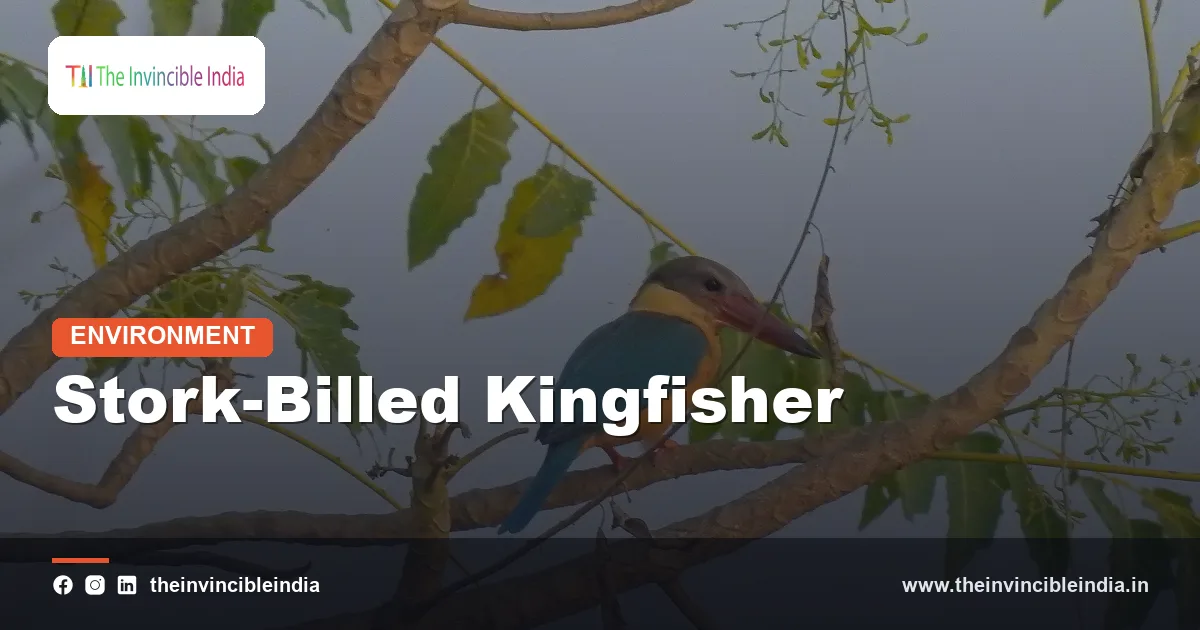
The stork-billed kingfisher (Pelargopsis capensis) is a large kingfisher of South and Southeast Asia with a huge, heavy red bill, a brown cap, a turquoise-green back and warm buff-orange underparts, found along wooded rivers, forest streams, mangroves and coastal creeks. In India it is one of the biggest and most striking kingfishers, a shy but loud bird that perches quietly in shade, dives for fish, frogs and crabs, and announces itself with a harsh, laughing call.
Although its size and bill make it easy to identify once seen, the stork-billed kingfisher is often hidden in dense vegetation over water, so many people hear it before they see it. This explainer covers how to identify the bird, where it lives in India, what it eats, how it hunts, how and where it nests, how it differs from similar kingfishers, and what threatens the wooded waterways it depends on. Information was last reviewed on 23 October 2026.
| Attribute | Detail |
|---|---|
| Common name | Stork-billed kingfisher |
| Scientific name | Pelargopsis capensis |
| Family | Alcedinidae (kingfishers), in the tree-kingfisher group |
| Body length | Roughly 35 to 38 cm, among the largest kingfishers in India |
| Distinctive feature | Very large, heavy, bright red bill |
| Habitat | Wooded rivers and streams, mangroves, coastal creeks, forest pools and tanks |
| Range | Peninsular and north-eastern India, Sri Lanka, the Andaman and Nicobar Islands and Southeast Asia |
| Nesting | Cavity in an earth bank, termite mound or tree hole near water |
| Conservation status | Least Concern on the IUCN Red List (global assessment) |
Key Takeaways
- The stork-billed kingfisher is one of the largest kingfishers in India, recognised by its huge red bill, brown cap and blue-green back.
- Stork-billed kingfishers hunt from shaded perches over water and also take frogs, crabs, lizards and large insects in addition to fish.
- The stork-billed kingfisher is known for a loud, harsh, laughing call that often reveals the bird before it is seen.
- Stork-billed kingfishers nest in cavities, including holes in earth banks, termite mounds and tree hollows near water.
- In India the stork-billed kingfisher lives mainly in wooded riverine and coastal habitats such as forest streams, tanks and mangroves, and is less common in open, treeless country.
- The IUCN lists the stork-billed kingfisher as Least Concern globally, but it depends on tree-lined waterways and intact mangroves.
What is the stork-billed kingfisher?
The stork-billed kingfisher is a large, heavily built kingfisher with an oversized red bill that lives around wooded waterways in South and Southeast Asia and eats fish, amphibians and crustaceans. It belongs to the genus Pelargopsis, whose name comes from Greek words relating to storks, a reference to the bird’s massive bill.
It is a member of the “tree kingfishers” in the broad sense, meaning it does not specialise in hovering, like the pied kingfisher, but instead sits on a perch and watches the water or ground below. Unlike the small common kingfisher, which is about the size of a sparrow, the stork-billed kingfisher is nearly as large as a pigeon.
Taxonomists have revised how Pelargopsis kingfishers are grouped over time, and the stork-billed kingfisher was once treated as a group of closely related forms. Regional populations differ slightly in colour, and several forms are recognised in the Indian region, including island forms in the Andaman and Nicobar archipelago.
How can you identify a stork-billed kingfisher?
A stork-billed kingfisher is identified by its enormous, bright red bill, a dull brown or ochre cap, a turquoise-blue to green back and tail, a buff-orange collar and underparts and short reddish legs. The bill alone is distinctive and much larger than that of any other Indian kingfisher of similar colour.
Key identification marks
- Bill: very large, heavy and red, with a slightly darker tip in some birds.
- Head: brown or greyish-brown crown and face, contrasting with the neck.
- Neck and underparts: a pale buff collar and orange-buff underparts.
- Back and tail: glossy blue-green to turquoise, bright in flight.
- Legs: short and red.
Similar species
In some wooded and coastal parts of eastern India, the brown-winged kingfisher (Pelargopsis amauroptera) also has a red bill, but it has brown wings and back rather than blue-green ones and is mostly confined to mangroves and tidal creeks. In flight the bright turquoise back and rump of the stork-billed kingfisher are a clear mark.
Voice
The stork-billed kingfisher gives a loud, raucous, laughing call, often a repeated series of harsh “ke-ke-ke” notes that carries a long way through forest. The call is given from a perch and in flight, and is one of the best ways to detect the bird.
Where is the stork-billed kingfisher found in India?
The stork-billed kingfisher is found mainly in wooded parts of peninsular India, the Western Ghats, eastern and north-eastern India and the Andaman and Nicobar Islands, wherever tree-lined rivers, streams, tanks, backwaters or mangroves provide perches over water. It is a bird of cover and is rarely seen far from trees.
Outside India, it ranges through Sri Lanka, Nepal, Bangladesh, Myanmar and much of Southeast Asia, with different regional forms. Indian populations are generally resident, although birds may make small local movements with seasonal changes in water level.
Typical Indian habitats include:
- Forest-fringed rivers and streams, particularly in the Western Ghats and the north-east.
- Coastal mangroves, tidal creeks and backwaters.
- Village tanks, ponds and canals with overhanging trees.
- Wooded wetlands within national parks and sanctuaries.
Detailed national population estimates are not reliable, but the bird is described as locally fairly common and is considered much less abundant than the white-throated kingfisher in open country.
What does the stork-billed kingfisher eat?
The stork-billed kingfisher eats a varied diet of fish, frogs, crabs and other crustaceans, large insects and sometimes lizards and small birds. Its powerful bill allows it to take larger prey than most other kingfishers can handle.
The diet includes:
- Fish: small to medium-sized fish caught in rivers, tanks and tidal creeks.
- Amphibians: frogs and tadpoles caught at the water’s edge.
- Crustaceans: crabs and prawns, especially in mangroves and estuaries.
- Reptiles and insects: small lizards, and large insects such as dragonflies or beetles.
- Small vertebrates: occasionally small birds or rodents near the water.
This flexible diet is one reason the bird can live both on freshwater streams and along tidal coasts. It often beats larger prey against a branch before swallowing it.
How does the stork-billed kingfisher hunt?
The stork-billed kingfisher hunts by sitting motionless on a shaded perch over water, watching for movement, and then diving or swooping onto prey before returning to the perch. It is a patient ambush predator rather than an active searcher.
The hunting sequence is typically:
- Watching: the bird perches quietly on an overhanging branch, rock or post, often in deep shade.
- Strike: it dives or swoops, seizing a fish, frog or crab in the large bill.
- Return: it flies back to a perch and often hits the prey against a branch to subdue it.
- Swallowing: prey is generally swallowed whole, usually headfirst.
Because it hunts from shaded perches, the bird depends on trees, mangroves or other structures along the water. Removing riverbank vegetation reduces the places it can sit and hunt.
How does the stork-billed kingfisher breed and nest?
The stork-billed kingfisher breeds in a nest chamber at the end of a tunnel or cavity, usually in an earth bank beside water, and may also use termite mounds or tree hollows. Both parents typically take part in digging or preparing the cavity and in feeding the young.
The key points of its breeding are:
- Nest site: a hole in a steep bank, a termite mound or a hollow in a tree, usually near water.
- Eggs: a small clutch of round, glossy white eggs laid in the chamber with little or no lining.
- Season: the breeding season varies by region, and commonly overlaps with the rains or the period after them.
- Care: both parents incubate and bring fish and other prey to the nestlings.
Because the species needs undisturbed banks or trees for nesting, it is sensitive to clearance of riverside vegetation and heavy human disturbance during the breeding season. Exact breeding details differ between populations and are better documented in some regions than others.
How does the stork-billed kingfisher differ from other Indian kingfishers?
The stork-billed kingfisher differs from other Indian kingfishers mainly in its much larger size, its huge red bill and its brown head with a turquoise back. It is also quieter at rest but louder in voice than the small blue kingfishers.
| Species | Approximate size | Bill | Main colours |
|---|---|---|---|
| Stork-billed kingfisher | Large, about 35 to 38 cm | Huge, red | Brown cap, blue-green back, buff-orange below |
| White-throated kingfisher | Medium, about 28 cm | Red, smaller | Brown head, blue back, white throat |
| Common kingfisher | Small, about 16 cm | Black, short | Bright blue above, orange below |
| Pied kingfisher | Medium, about 25 to 31 cm | Black, long | Black and white |
| Brown-winged kingfisher | Large | Red, heavy | Brown wings, orange-buff below |
The most common confusion is with the white-throated kingfisher, which is smaller, has a white throat and breast and often sits on wires in open country. The stork-billed kingfisher stays closer to wooded water and has a conspicuously larger bill.
What threats does the stork-billed kingfisher face?
The stork-billed kingfisher is not considered threatened at the global level, but it depends on wooded waterways and mangroves that are being cleared or degraded in many places. Loss of riverside trees, mangroves and nesting banks can reduce local populations.
The main pressures include:
- Deforestation and mangrove loss: clearance for aquaculture, farming and construction removes perches and nest sites.
- River modification: embankments, sand mining and channelisation remove natural banks.
- Pollution: contaminated water lowers prey populations of fish, frogs and crabs.
- Disturbance and hunting: noise, boat traffic and occasional hunting or trapping can disturb birds.
Protection of forest streams and coastal mangroves, such as those in the Sundarbans and other protected wetlands, benefits the species along with many other riverine birds and animals.
Why does the stork-billed kingfisher matter to river and coastal ecosystems?
The stork-billed kingfisher matters because, as a large predator of fish, frogs and crabs, it helps regulate prey populations and acts as a visible sign that a wooded waterway still has both clean water and standing trees. Kingfishers are often used by naturalists as indicator species for river health.
Several ecological roles are linked to the bird:
- Predator in the food web: the stork-billed kingfisher feeds on animals at the middle of the aquatic food chain, linking fish, amphibians and crustaceans to the top of the riverside community.
- Indicator of habitat quality: because the bird needs both fish-bearing water and shaded perches, its presence suggests that the banks, trees and water are in reasonable condition.
- Cavity creator: burrows and holes made or used by the bird may later be reused by other small animals.
- Cultural and tourism value: its bright colours and loud call make it a favourite of birdwatchers visiting forest rivers, backwaters and mangroves, which supports local nature-based livelihoods.
Because the bird is large and conspicuous once found, it is also useful for community-based bird monitoring. Regular sightings in a stretch of river or mangrove creek, recorded over several years, can help naturalists notice if the bird is disappearing from an area, which may signal problems such as pollution, clearing of bankside trees or heavy disturbance.
How can you watch the stork-billed kingfisher?
The best way to watch a stork-billed kingfisher is to visit a tree-lined river, mangrove creek or forest tank in the early morning, listen for the loud laughing call, and scan overhanging branches with binoculars. Boat safaris in mangrove and backwater areas are often the most productive way to see it.
- Look in shaded perches over water, where the large red bill stands out.
- Listen for the harsh, repeated call, which helps locate the bird.
- Keep a quiet, steady approach, since the bird is wary.
- Avoid disturbing banks and tree holes during the breeding season.
- Record sightings in citizen-science databases to support monitoring.
Bottom Line
The stork-billed kingfisher is a large, loud and impressive bird whose oversized red bill, blue-green back and shaded ambush hunting set it apart from other Indian kingfishers. Its future in India depends on keeping rivers lined with trees, mangroves intact and waterways clean enough to support fish, frogs and crabs.
Frequently Asked Questions
What is a stork-billed kingfisher?
A stork-billed kingfisher is a large kingfisher with a huge red bill, a brown cap and a blue-green back. It lives along wooded rivers, mangroves and forest tanks in South and Southeast Asia. It eats fish, frogs, crabs and other prey.
Why is it called the stork-billed kingfisher?
It is called the stork-billed kingfisher because its large, heavy bill resembles that of a stork. The bill is bright red and much bigger than that of other Indian kingfishers. The genus name Pelargopsis also refers to its stork-like appearance.
Where can I see a stork-billed kingfisher in India?
You can see a stork-billed kingfisher along wooded rivers, backwaters and mangroves in peninsular India, the Western Ghats, eastern and north-eastern India and the Andaman and Nicobar Islands. Early morning visits and boat trips are often productive. The loud call helps locate it.
What does a stork-billed kingfisher eat?
A stork-billed kingfisher eats fish, frogs, crabs, large insects and sometimes lizards and small birds. It hunts from a shaded perch and dives onto its prey. Its strong bill allows it to take larger prey than most kingfishers.
How does the stork-billed kingfisher nest?
The stork-billed kingfisher nests in a cavity, usually a tunnel in an earth bank, though termite mounds and tree holes near water can also be used. The female lays glossy white eggs in a chamber at the end. Both parents feed the young.
Is the stork-billed kingfisher endangered?
No, the stork-billed kingfisher is not considered endangered, and the IUCN lists it as Least Concern globally. However, it depends on wooded waterways and mangroves that are being lost in places. Local declines can occur where tree cover and clean water disappear.
{“@context”:”https://schema.org”,”@graph”:[{“@type”:”FAQPage”,”mainEntity”:[{“@type”:”Question”,”name”:”What is a stork-billed kingfisher?”,”acceptedAnswer”:{“@type”:”Answer”,”text”:”A stork-billed kingfisher is a large kingfisher with a huge red bill, a brown cap and a blue-green back. It lives along wooded rivers, mangroves and forest tanks in South and Southeast Asia. It eats fish, frogs, crabs and other prey.”}},{“@type”:”Question”,”name”:”Why is it called the stork-billed kingfisher?”,”acceptedAnswer”:{“@type”:”Answer”,”text”:”It is called the stork-billed kingfisher because its large, heavy bill resembles that of a stork. The bill is bright red and much bigger than that of other Indian kingfishers. The genus name Pelargopsis also refers to its stork-like appearance.”}},{“@type”:”Question”,”name”:”Where can I see a stork-billed kingfisher in India?”,”acceptedAnswer”:{“@type”:”Answer”,”text”:”You can see a stork-billed kingfisher along wooded rivers, backwaters and mangroves in peninsular India, the Western Ghats, eastern and north-eastern India and the Andaman and Nicobar Islands. Early morning visits and boat trips are often productive. The loud call helps locate it.”}},{“@type”:”Question”,”name”:”What does a stork-billed kingfisher eat?”,”acceptedAnswer”:{“@type”:”Answer”,”text”:”A stork-billed kingfisher eats fish, frogs, crabs, large insects and sometimes lizards and small birds. It hunts from a shaded perch and dives onto its prey. Its strong bill allows it to take larger prey than most kingfishers.”}},{“@type”:”Question”,”name”:”How does the stork-billed kingfisher nest?”,”acceptedAnswer”:{“@type”:”Answer”,”text”:”The stork-billed kingfisher nests in a cavity, usually a tunnel in an earth bank, though termite mounds and tree holes near water can also be used. The female lays glossy white eggs in a chamber at the end. Both parents feed the young.”}},{“@type”:”Question”,”name”:”Is the stork-billed kingfisher endangered?”,”acceptedAnswer”:{“@type”:”Answer”,”text”:”No, the stork-billed kingfisher is not considered endangered, and the IUCN lists it as Least Concern globally. However, it depends on wooded waterways and mangroves that are being lost in places. Local declines can occur where tree cover and clean water disappear.”}}]}]}


