

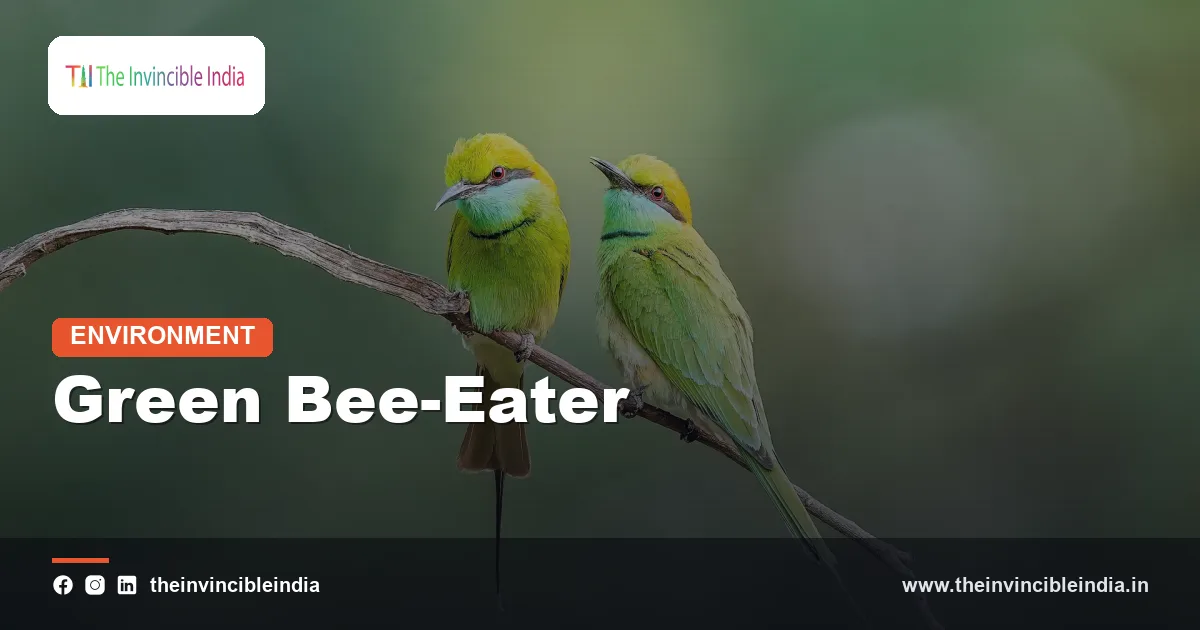
The green bee-eater (Merops orientalis) is a slim, emerald-green bird of open country in the family Meropidae, easily recognised by its curved black bill, black eye-stripe and two needle-like central tail feathers, and it is one of the most widespread and approachable birds across India. It perches on wires, fence posts and bare twigs, then darts out to snatch bees, wasps, dragonflies and other flying insects in mid-air before returning to the same spot.
Because the green bee-eater lives happily in farmland, scrub, village edges, parks and even the outskirts of cities, many Indians know it as the small green bird sitting on the electricity line. This explainer covers how the green bee-eater looks, what it eats, how it handles stinging prey, where it nests, how it differs from similar birds and why it matters as a natural pest controller.
| Quick Facts: Green Bee-Eater | |
|---|---|
| Common name | Green bee-eater (also called little green bee-eater) |
| Scientific name | Merops orientalis |
| Family and order | Meropidae (bee-eaters), order Coraciiformes |
| Size | Roughly 16-18 cm, with the central tail streamers adding extra length |
| Key field marks | Green body, black eye-stripe, thin black necklace, curved bill, elongated central tail feathers |
| Diet | Flying insects, especially bees, wasps, flies, beetles and dragonflies |
| Nesting | A burrow dug in sandy ground, a bank or flat soil |
| Habitat | Open country, farmland, scrub, grassland, village edges and gardens |
| Conservation status | Least Concern on the IUCN Red List |
Key Takeaways
- The green bee-eater is a small, bright green bird of the family Meropidae that catches flying insects in mid-air from an open perch.
- Two thin central tail feathers, a black eye-stripe, a fine black necklace and a slightly down-curved bill separate the green bee-eater from most other Indian birds.
- The green bee-eater removes the sting of bees and wasps by beating and rubbing the insect on its perch before swallowing it.
- The green bee-eater nests in a tunnel dug into sandy soil or a low bank, and both parents, sometimes with helpers, feed the chicks.
- The IUCN lists the green bee-eater as Least Concern, and the species is widespread across the Indian plains and much of South Asia.
- The green bee-eater is a natural controller of flying insect pests and a good starter bird for new birdwatchers because it is common and tolerant of people.
What is the green bee-eater?
The green bee-eater is a small insect-eating bird, scientifically named Merops orientalis, that belongs to the bee-eater family Meropidae and is found from parts of Africa through the Indian subcontinent to Southeast Asia. In India the species is resident across most of the plains, and its bright colour and habit of sitting in the open make it one of the first birds that beginners learn to identify.
The bee-eaters are an old and distinctive group of birds, related to kingfishers, rollers and hoopoes in the order Coraciiformes. The word “bee-eater” is slightly misleading, because the green bee-eater eats many kinds of flying insect, but bees and wasps are a favourite and give the family its name. Several forms of the green bee-eater are recognised across its large range, and they differ in small details such as the shade on the head, throat and cheeks.
How can you identify a green bee-eater?
A green bee-eater is identified by its overall grass-green plumage, a bold black stripe running through the eye, a narrow black line across the lower throat, a slim down-curved black bill and a pair of long pin-like central tail feathers. The crown and nape often show a wash of rusty or coppery colour, and the throat has a blue or turquoise tinge in good light.
- Size: The bird is only about as long as a sparrow’s body plus its slender tail, so it looks light and elegant on the perch.
- Tail pins: The two elongated central tail feathers are thin and straight, and they are the quickest way to tell the species apart from other small green birds. Birds that have just moulted or are young may show shorter pins.
- Eye: The eye is usually reddish, set in a black mask that stands out against the green face.
- Sexes: Males and females look almost the same, which is common among bee-eaters, and the sexes are very hard to separate in the field.
- Young birds: Juveniles are duller, with little of the coppery wash and without long tail pins.
What does the green bee-eater eat?
The green bee-eater eats flying insects, taking bees, wasps, hornets, flies, grasshoppers, beetles, butterflies, moths and dragonflies on the wing. It does not usually dig, probe or glean from leaves, so almost all of its food is caught in the air.
A bee-eater scans from a perch, often a wire or a dry twig that gives a clear view, and then makes a short, swooping flight to snatch an insect before gliding back. This method is called sallying or hawking, and the same bird will often use the same perch many times in a day. The bird may also hunt low over grass, water edges and crop fields, particularly when insects are abundant after rain or when the day warms up.
Prey is mostly small to medium in size. Larger insects are handled more carefully, and a bird may spend a few moments beating or rubbing its catch on a branch before it swallows it. Bee-eaters also cough up pellets of indigestible insect parts, such as wing cases, as many insect-eating birds do.
How does a green bee-eater eat bees without being stung?
A green bee-eater avoids stings by catching the insect in its bill, then repeatedly striking or rubbing it against a hard perch to squeeze out the venom and remove the stinger before swallowing. The bird holds the insect by the tip of its body and works along it, so the sting end is dealt with first.
This behaviour is learned and refined with practice, and young birds are seen practising on small insects before they take on a wasp. The bird is not completely immune to venom, but the sting is largely neutralised by the rubbing action, and the thick, narrow bill and quick handling reduce the chance of injury. Observers sometimes report that birds near beehives and wasp nests do well because the insects are concentrated there.
Where does the green bee-eater live in India?
The green bee-eater lives across most of peninsular and northern India’s lowlands, in open habitats such as scrub, farmland, grassland, dry deciduous forest edges, roadsides, orchards and gardens. It tends to avoid dense, closed forest and very high mountain areas, though it occurs in the foothills.
The species is largely resident, meaning it stays in the same region through the year, though local movements follow food and weather. In dry regions it may gather near water and flowering trees. Because it adapts well to cultivated land and human settlements, it is often one of the commonest birds seen from train windows and highways in the plains. Its wider range extends into Pakistan, Sri Lanka, Nepal and Bangladesh, and the bird also occurs across parts of Africa and Southeast Asia.
How does the green bee-eater breed and nest?
The green bee-eater breeds by digging a tunnel nest into sandy or loose soil, usually in a flat patch, a low bank, a track edge or a dry stream cut, where the pair lays a small clutch of white eggs at the end of the burrow. Breeding in much of India is concentrated in the hotter, drier months of roughly March to June, though timing varies by region.
Both adults dig the burrow, using the bill to loosen soil and the feet to push it out. The tunnel can run for around a metre or more and ends in a rounded chamber that has no real nest lining. A clutch commonly has several round white eggs, and both parents incubate and feed the nestlings with insects. Young adults from earlier broods can sometimes act as helpers, which is seen in several bee-eater species.
Because nests are at ground level or in low banks, they are vulnerable to trampling, predators and digging. A quiet, undisturbed patch of sandy soil can support a nesting pair year after year.
How is the green bee-eater different from other Indian bee-eaters?
The green bee-eater is the smallest and most widespread of the common Indian bee-eaters, and it differs from larger relatives by its size, its overall green colour and a rusty crown, whereas the blue-tailed and blue-cheeked species have blue tails, and the chestnut-headed species has a rich chestnut crown and breast.
| Species | Relative size | Distinguishing feature | Typical habitat |
|---|---|---|---|
| Green bee-eater | Smallest of the group | All-green body, black eye-stripe, thin black necklace, tail pins | Open country, farmland, scrub |
| Blue-tailed bee-eater | Larger | Blue rump and tail, chestnut throat | Water edges, rivers, paddy fields |
| Blue-cheeked bee-eater | Larger | Green tail, blue cheek patch, bright throat | Open dry country and water, mostly seasonal |
| Chestnut-headed bee-eater | Medium | Chestnut crown and upper breast, yellow throat | Wooded country near water |
What sounds does the green bee-eater make?
The green bee-eater makes a soft, trilling, rippling call, often written as a repeated “tree-tree” or “trit-trit”, that it gives from the perch and in flight, and the sound is a reliable way to locate flocks even before they are seen. The call is pleasant and unhurried, not a loud screech.
Birds that perch together keep up a low chatter, particularly when they move off together at dusk or gather at a roost. Alarm notes are sharper and may be given when a hawk or a shrike passes. The calls help birds stay in contact while they feed over open ground.
Why does the green bee-eater matter to people and farms?
The green bee-eater matters because it consumes large numbers of flying insects, including some crop pests, grasshoppers and flies, and it indicates a healthy open-country habitat. The bird is generally considered beneficial to farming and is not known to cause damage to crops.
Beekeepers sometimes note that bee-eaters take honey bees from hives. The impact varies from place to place, but the bird feeds on many other insects too, and observers usually find that nearby natural food sources reduce attacks on managed hives. Where a problem does occur, simple measures such as moving hives or providing perches away from the apiary are suggested, rather than harming the birds.
Is the green bee-eater threatened, and is it protected in India?
The green bee-eater is not threatened globally, as the IUCN Red List classes it as Least Concern because of its very large range and stable numbers, and no precise population figure is widely accepted for India. In India, wild birds are broadly covered by the Wildlife (Protection) Act, 1972, which prohibits hunting, capture and trade in native species.
Local pressures include loss of open scrub and bare ground for nesting, heavy pesticide use that reduces insect prey, and disturbance at nest sites in places where soil is dug for construction or farming. Even so, the bird continues to do well in many human-modified landscapes. Citizen-science platforms record it frequently, which helps track any change in distribution over time.
How can you watch and photograph the green bee-eater responsibly?
The best way to watch a green bee-eater is to look along wires and fences in open country during the early morning or late afternoon, stay at a respectful distance, and let the bird return to its perch rather than chasing it. A pair of binoculars is enough to see the colours and tail pins well.
- Keep a safe distance from nest burrows, because repeated disturbance can make adults abandon eggs or chicks.
- Do not use playback of calls to attract birds in the breeding season.
- Avoid flushing birds from roosts at dawn or dusk, when they are conserving energy.
- Record sightings on a citizen-science platform so that the data supports local bird records.
Bottom Line
The green bee-eater is a small, bright, insect-hunting bird that suits India’s open farmland, scrub and village edges, and it is easy to identify by its green colour, black eye-stripe and thin tail pins. It is common, harmless and helpful, and it is best protected by leaving patches of open soil, avoiding unnecessary pesticide use and keeping nest sites undisturbed.
Frequently Asked Questions
What does a green bee-eater look like?
A green bee-eater is a slim, grass-green bird with a black eye-stripe, a thin black necklace and a curved black bill. It also has two long, needle-like central tail feathers. The crown often has a rusty or coppery wash, and the throat may look bluish in good light.
What does the green bee-eater eat?
The green bee-eater eats flying insects such as bees, wasps, flies, dragonflies, beetles and grasshoppers. It catches them in mid-air from a perch and returns to the same spot. Larger prey is beaten against the perch before it is swallowed.
How does the green bee-eater avoid bee stings?
The green bee-eater avoids stings by rubbing and striking bees and wasps on a branch to remove the stinger and squeeze out venom before swallowing. It holds the insect by the tail end and works along its body. This skill improves with practice, and young birds learn it by trying small prey first.
Where does the green bee-eater nest?
The green bee-eater nests in a tunnel that it digs into sandy or loose soil, often in flat ground or a low bank. The burrow ends in a rounded chamber where white eggs are laid. In much of India breeding happens mainly in the warmer months, roughly from March to June.
Is the green bee-eater a migratory bird?
The green bee-eater is mostly a resident bird in India, so it stays in the same general region through the year. Some local movements happen in response to food, water and weather. This differs from the blue-tailed and blue-cheeked bee-eaters, which show more seasonal movement.
Is the green bee-eater protected in India?
The green bee-eater is not globally threatened, as the IUCN lists it as Least Concern, but it is a wild bird and falls under India’s general protection for native wildlife in the Wildlife (Protection) Act, 1972. Capturing, trapping or trading wild birds is not allowed. Keeping nesting areas undisturbed and reducing pesticide use help local populations.
{“@context”:”https://schema.org”,”@graph”:[{“@type”:”FAQPage”,”mainEntity”:[{“@type”:”Question”,”name”:”What does a green bee-eater look like?”,”acceptedAnswer”:{“@type”:”Answer”,”text”:”A green bee-eater is a slim, grass-green bird with a black eye-stripe, a thin black necklace and a curved black bill. It also has two long, needle-like central tail feathers. The crown often has a rusty or coppery wash, and the throat may look bluish in good light.”}},{“@type”:”Question”,”name”:”What does the green bee-eater eat?”,”acceptedAnswer”:{“@type”:”Answer”,”text”:”The green bee-eater eats flying insects such as bees, wasps, flies, dragonflies, beetles and grasshoppers. It catches them in mid-air from a perch and returns to the same spot. Larger prey is beaten against the perch before it is swallowed.”}},{“@type”:”Question”,”name”:”How does the green bee-eater avoid bee stings?”,”acceptedAnswer”:{“@type”:”Answer”,”text”:”The green bee-eater avoids stings by rubbing and striking bees and wasps on a branch to remove the stinger and squeeze out venom before swallowing. It holds the insect by the tail end and works along its body. This skill improves with practice, and young birds learn it by trying small prey first.”}},{“@type”:”Question”,”name”:”Where does the green bee-eater nest?”,”acceptedAnswer”:{“@type”:”Answer”,”text”:”The green bee-eater nests in a tunnel that it digs into sandy or loose soil, often in flat ground or a low bank. The burrow ends in a rounded chamber where white eggs are laid. In much of India breeding happens mainly in the warmer months, roughly from March to June.”}},{“@type”:”Question”,”name”:”Is the green bee-eater a migratory bird?”,”acceptedAnswer”:{“@type”:”Answer”,”text”:”The green bee-eater is mostly a resident bird in India, so it stays in the same general region through the year. Some local movements happen in response to food, water and weather. This differs from the blue-tailed and blue-cheeked bee-eaters, which show more seasonal movement.”}},{“@type”:”Question”,”name”:”Is the green bee-eater protected in India?”,”acceptedAnswer”:{“@type”:”Answer”,”text”:”The green bee-eater is not globally threatened, as the IUCN lists it as Least Concern, but it is a wild bird and falls under India’s general protection for native wildlife in the Wildlife (Protection) Act, 1972. Capturing, trapping or trading wild birds is not allowed. Keeping nesting areas undisturbed and reducing pesticide use help local populations.”}}]}]}


