

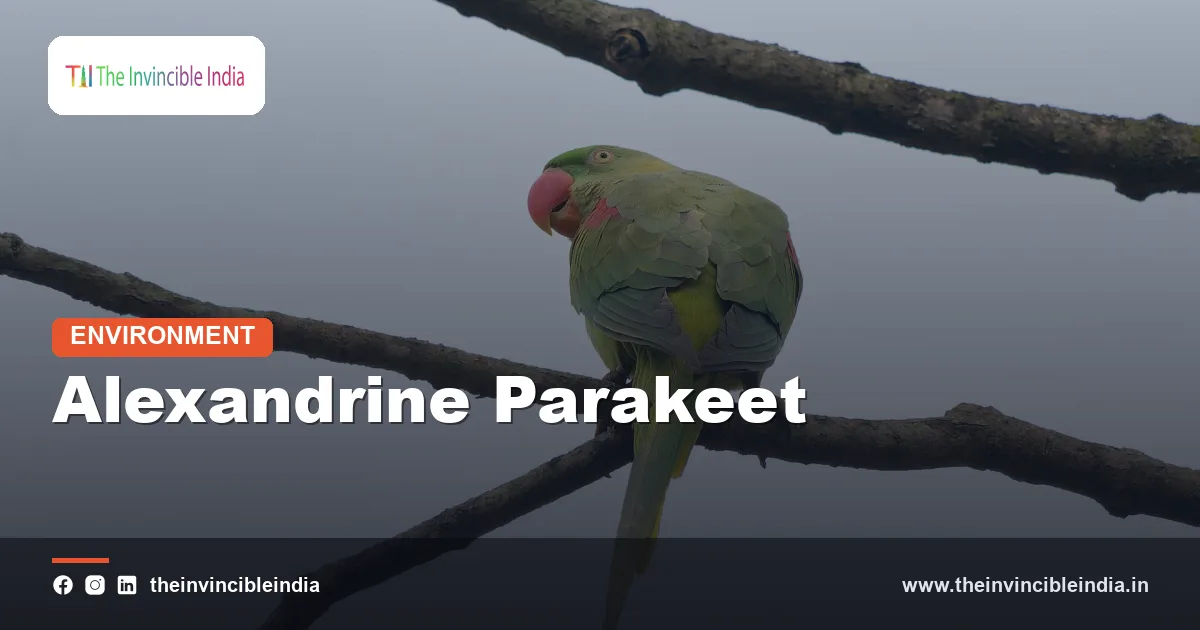
The Alexandrine parakeet (Psittacula eupatria) is a large, long-tailed green parakeet of South and Southeast Asia, recognised by its heavy red bill, a maroon-red patch on each shoulder and, in the adult male, a black chin stripe and a pinkish collar around the neck. It is the biggest of the common parakeets in India, noticeably larger than the familiar rose-ringed parakeet, and it is named after Alexander the Great, who is said to have introduced the birds to Europe after his campaigns.
The Alexandrine parakeet lives in forests, groves, farmland and city parks across the Indian subcontinent. The IUCN classifies it as Near Threatened because of trapping for the pet trade and habitat loss, and wild native parakeets cannot be legally caught, traded or kept as pets in India. This explainer covers its identification, diet, range, nesting, behaviour, the legend behind its name and conservation.
| Quick Facts: Alexandrine Parakeet | |
|---|---|
| Common name | Alexandrine parakeet (also called the large Indian parakeet) |
| Scientific name | Psittacula eupatria |
| Family and order | Psittaculidae (Old World parrots), order Psittaciformes |
| Size | Roughly 50-58 cm including a long tail; the largest of the common Indian parakeets |
| Key field marks | Large red bill, maroon shoulder patch, long green tail; male has a black chin stripe and a pink-and-black collar |
| Diet | Fruits, seeds, nuts, grains, buds and flowers |
| Nesting | Tree holes, usually in tall old trees; a few white eggs |
| Range | Indian subcontinent and parts of Southeast Asia; also feral in some cities elsewhere |
| Conservation status | Near Threatened on the IUCN Red List; capture and trade of wild birds are prohibited in India |
Key Takeaways
- The Alexandrine parakeet is a large green parakeet, up to roughly 58 cm including its tail, with a heavy red bill and a maroon shoulder patch.
- The Alexandrine parakeet is named after Alexander the Great, and its scientific name Psittacula eupatria is usually taken to mean “of noble lineage”.
- The adult male Alexandrine parakeet develops a black chin stripe and a pink-and-black neck collar, while the female and young birds are plain green-necked.
- The IUCN lists the Alexandrine parakeet as Near Threatened, mainly because of trapping for the pet trade and the loss of old nesting trees.
- The Alexandrine parakeet nests in cavities in tall old trees, and chicks are often taken illegally from these holes for sale.
- Capturing, selling or keeping wild Alexandrine parakeets is prohibited in India under the Wildlife (Protection) Act, 1972, and offenders can face penalties.
What is the Alexandrine parakeet?
The Alexandrine parakeet is a large, strong-billed parrot of the genus Psittacula, native to the Indian subcontinent and parts of Southeast Asia, where it lives in woodland, plantations, farmland and sometimes cities. It is a member of the Old World parrot family Psittaculidae, which also includes the rose-ringed, plum-headed, blossom-headed and Himalayan parakeets.
The Alexandrine parakeet is easy to distinguish from smaller relatives by its size, its heavier build, its large red beak and its slow, powerful wingbeats. It is a social bird, and it usually lives in pairs or flocks that gather at fruiting trees and roosts. A loud, raucous call often announces its arrival long before it is seen.
Why is it called the Alexandrine parakeet?
The Alexandrine parakeet is called so because it is traditionally linked to Alexander the Great, who is said to have taken these parakeets from the Indian region to Greece and the Mediterranean after his campaign in the fourth century BCE. The birds were kept as prized ornamental pets in the ancient world, and the name stuck.
The Latin species name eupatria is generally interpreted as “of noble birth” or “of good lineage”, which fits the bird’s long history as a status animal. Records from ancient Greece and Rome suggest that parakeets from India were well known as luxury cage birds, and the Alexandrine parakeet was among them. The exact details of the story are partly traditional, but the association with Alexander is firmly established in the bird’s common name.
How can you identify an Alexandrine parakeet?
An Alexandrine parakeet is identified by its large size, bright green plumage, a thick red bill with a paler tip, a deep red or maroon patch on the shoulder of each wing, and a long tapering tail. Adult males also show a black stripe from the bill to the throat and a rosy-pink band across the nape.
- Bill: The heavy red bill looks large against the head, which is a good mark to separate the species from the rose-ringed parakeet.
- Shoulder patch: The maroon wing patch is visible on perched birds and in flight, and both sexes have it.
- Tail: The long tail can be as much as half of the bird’s total length, with a bluish-green tinge on the upper surface and yellowish underside.
- Size: At roughly 50-58 cm including the tail, it looks noticeably larger than the rose-ringed parakeet.
- Flight: The flight is slower and heavier than the dashing flight of smaller parakeets, with deeper wingbeats.
How do male and female Alexandrine parakeets differ?
Male and female Alexandrine parakeets differ mainly in the neck: the adult male has a black chin stripe and a pink-and-black collar, whereas the female and the young have a plain green neck and lack the collar. Males acquire the full collar only after a few years, usually at about three years of age, so younger males can look like females.
The female is often slightly smaller, with a shorter tail, and her bill may be duller. Because many captive-bred birds are sold without clear information on age, the male’s collar is often used as a rough sign of maturity. In the wild, a pair is usually easy to detect by the pair’s close perching and mutual calling, especially around nest holes.
What does the Alexandrine parakeet eat?
The Alexandrine parakeet eats fruits, seeds, nuts, grains, flower buds, blossoms and nectar, and its strong bill allows it to crack hard seeds and open tough fruits that smaller parakeets cannot manage. Typical foods include figs and other wild fruits, mango, guava, ripening cereals, sunflower heads and various tree seeds.
Flocks fly out from roosts at dawn to feeding areas and return in the evening, sometimes covering many kilometres. In farmland, the species can feed on maize, sorghum, millet, sunflower, rice and ripening fruit, and local damage to crops and orchards is sometimes reported. The bird also feeds in gardens on flowering and fruiting trees, and it will visit bird feeders in some urban areas.
Where does the Alexandrine parakeet live?
The Alexandrine parakeet lives across much of the Indian subcontinent, in Sri Lanka, Nepal, Bangladesh, Bhutan and Myanmar, and through to parts of mainland Southeast Asia, and it favours open woodland, riverine forest, orchards, farmland and large trees in towns. It is generally found in the plains and lower hills, and it is less common in dense, high-altitude forest.
Several subspecies are recognised across the range, and they vary somewhat in size and bill. One form is found in the Andaman Islands and is noted for a particularly large bill. Feral populations have also appeared in cities outside the native range, including parts of Europe, the Middle East and North America, where escaped or released pets have established small groups. These feral birds show the species’ adaptability but do not count towards its native-range status.
How does the Alexandrine parakeet nest and breed?
The Alexandrine parakeet nests in cavities in large, old trees, laying a small clutch of white eggs, usually two to four, on a bed of wood dust at the bottom of the hole. Breeding in much of India occurs in the cooler months and into early spring, roughly from winter to March or April, though timing varies by region.
The female incubates the eggs and the male feeds her. After hatching, both parents feed the chicks until they are ready to fledge. Birds often reuse the same nest hole year after year and compete fiercely with other hole-nesters, such as mynas, owls and other parakeets. This dependence on old trees with suitable cavities makes the species sensitive to the felling of large, mature trees.
Can the Alexandrine parakeet talk, and why is it popular as a pet?
The Alexandrine parakeet can mimic human speech and other sounds in captivity, and this ability, combined with its attractive colours and long history as a cage bird, has made it a target of the pet trade. Wild birds do not speak, and the mimicry is learned by captive individuals through repeated exposure.
The demand for talking parakeets drives the illegal removal of chicks from nest holes, a practice that damages wild populations. Captive-bred birds in some countries are sold legally under regulated conditions, but in India keeping native wild-caught parakeets is prohibited, and sellers who offer them are breaking the law. Parakeets are long-lived, loud and demanding birds, and many are neglected or released when owners cannot cope.
| Feature | Alexandrine parakeet | Rose-ringed parakeet |
|---|---|---|
| Scientific name | Psittacula eupatria | Psittacula krameri |
| Size | Large, roughly 50-58 cm with tail | Medium, roughly 40 cm with tail |
| Bill | Heavy and red | Smaller and red |
| Shoulder patch | Maroon patch present | No maroon patch |
| Male neck | Black chin stripe and pink-and-black collar | Black chin stripe and pink-and-black ring |
| IUCN status | Near Threatened | Least Concern |
Intelligence and social complexity are part of the bird’s appeal. Wild Alexandrine parakeets learn the locations of food trees, recognise their roost sites and respond to alarm calls from other species. These abilities are common in parrots, which have large brains for their body size, and they explain why captive birds can become bored, noisy or destructive when kept in small cages without stimulation.
What sounds does the Alexandrine parakeet make?
The Alexandrine parakeet makes a loud, deep, raucous “kee-ak” or “krraa” call, which is lower-pitched and more resonant than the shriller call of the rose-ringed parakeet. Flocks are noisy in flight and at roosts, and the sound can be heard at a distance.
Birds call to maintain contact in flight, during courtship and when a predator or intruder approaches. The deeper voice helps observers separate the species from smaller parakeets even when the birds are hidden in foliage. At dusk, large roosts can be very noisy as birds arrive in groups and settle for the night.
Is the Alexandrine parakeet threatened, and is the pet trade illegal in India?
The Alexandrine parakeet is classified as Near Threatened by the IUCN, meaning it is close to qualifying for a threatened category, mainly because of trapping for the pet trade and loss of old trees with nest cavities. Capturing, trading or keeping wild native parakeets in India is prohibited under the Wildlife (Protection) Act, 1972.
The status was raised to Near Threatened in recent assessments because parts of the range have seen declines, even though the bird is still found over a huge area. Exact numbers are uncertain. The international trade in parrots is also regulated by the Convention on International Trade in Endangered Species of Wild Fauna and Flora (CITES), which lists the Alexandrine parakeet in its appendices so that cross-border trade is controlled.
- Trapping: Chicks and adults are taken from nests and roosts for sale as pets.
- Habitat loss: The felling of old trees removes nest holes, which are scarce.
- Crop conflict: Birds feeding on farms are sometimes harassed or killed.
- Competition: Hole-nesting competitors can reduce breeding success where cavities are limited.
Because the bird feeds in crop fields, conservation also depends on practical ways of reducing conflict, such as scaring devices, early harvest, netting over small orchards and the retention of wild fruiting trees that provide an alternative food source. Compensation and awareness measures help farmers tolerate flocks, and a tolerant attitude is a major factor in whether the species survives alongside agriculture.
How can people help the Alexandrine parakeet?
People can help the Alexandrine parakeet by protecting old nesting trees, refusing to buy wild-caught parakeets, reporting illegal sellers to the forest department and planting native fruiting trees that feed wild birds. Each of these actions is simple and effective when practised at a local level.
Citizen records of sightings and roost counts help scientists understand where the species is declining or doing well. Conservation groups also run awareness programmes at bird markets and in schools. Where tree felling is unavoidable, retaining trees with visible cavities, or installing suitable nest boxes, can help hole-nesting birds continue to breed.
Bottom Line
The Alexandrine parakeet is a large, strikingly coloured Indian parrot with a long history as a prized cage bird, and its Near Threatened status reflects the cost of that popularity. Keeping old trees standing and leaving wild birds in the wild are the two most important steps to protect it.
Frequently Asked Questions
Why is it called the Alexandrine parakeet?
The Alexandrine parakeet is named after Alexander the Great, who is traditionally said to have taken these birds from India to the Mediterranean world. The Latin name eupatria is usually read as “of noble lineage”. The details of the story are partly traditional, but the name is well established.
How big is the Alexandrine parakeet?
The Alexandrine parakeet is about 50 to 58 cm long including its tail, which makes it the largest of the common Indian parakeets. It is clearly bigger than the rose-ringed parakeet. The long tail accounts for a large part of the length.
How can you tell a male Alexandrine parakeet from a female?
The adult male Alexandrine parakeet has a black chin stripe and a pink-and-black collar around the neck, while the female has a plain green neck. Males usually gain the full collar at about three years of age. Both sexes have a maroon shoulder patch and a large red bill.
Is the Alexandrine parakeet endangered?
The Alexandrine parakeet is not classed as endangered, but the IUCN lists it as Near Threatened. The main causes are trapping for the pet trade and the loss of old trees with nest holes. Exact population figures are uncertain, and trends differ by region.
Can you keep an Alexandrine parakeet as a pet in India?
No, keeping a wild-caught Alexandrine parakeet as a pet is illegal in India. Native wild birds are protected under the Wildlife (Protection) Act, 1972, which prohibits capture, trade and possession. Anyone offered a parakeet for sale should report it to the forest department.
What does the Alexandrine parakeet eat?
The Alexandrine parakeet eats fruits, seeds, nuts, grains, buds and nectar. Its strong bill can open hard fruits and crack tough seeds. Flocks feed in forests, orchards and farmland, and they sometimes damage crops such as maize, sunflower and ripening fruit.
{“@context”:”https://schema.org”,”@graph”:[{“@type”:”FAQPage”,”mainEntity”:[{“@type”:”Question”,”name”:”Why is it called the Alexandrine parakeet?”,”acceptedAnswer”:{“@type”:”Answer”,”text”:”The Alexandrine parakeet is named after Alexander the Great, who is traditionally said to have taken these birds from India to the Mediterranean world. The Latin name eupatria is usually read as “of noble lineage”. The details of the story are partly traditional, but the name is well established.”}},{“@type”:”Question”,”name”:”How big is the Alexandrine parakeet?”,”acceptedAnswer”:{“@type”:”Answer”,”text”:”The Alexandrine parakeet is about 50 to 58 cm long including its tail, which makes it the largest of the common Indian parakeets. It is clearly bigger than the rose-ringed parakeet. The long tail accounts for a large part of the length.”}},{“@type”:”Question”,”name”:”How can you tell a male Alexandrine parakeet from a female?”,”acceptedAnswer”:{“@type”:”Answer”,”text”:”The adult male Alexandrine parakeet has a black chin stripe and a pink-and-black collar around the neck, while the female has a plain green neck. Males usually gain the full collar at about three years of age. Both sexes have a maroon shoulder patch and a large red bill.”}},{“@type”:”Question”,”name”:”Is the Alexandrine parakeet endangered?”,”acceptedAnswer”:{“@type”:”Answer”,”text”:”The Alexandrine parakeet is not classed as endangered, but the IUCN lists it as Near Threatened. The main causes are trapping for the pet trade and the loss of old trees with nest holes. Exact population figures are uncertain, and trends differ by region.”}},{“@type”:”Question”,”name”:”Can you keep an Alexandrine parakeet as a pet in India?”,”acceptedAnswer”:{“@type”:”Answer”,”text”:”No, keeping a wild-caught Alexandrine parakeet as a pet is illegal in India. Native wild birds are protected under the Wildlife (Protection) Act, 1972, which prohibits capture, trade and possession. Anyone offered a parakeet for sale should report it to the forest department.”}},{“@type”:”Question”,”name”:”What does the Alexandrine parakeet eat?”,”acceptedAnswer”:{“@type”:”Answer”,”text”:”The Alexandrine parakeet eats fruits, seeds, nuts, grains, buds and nectar. Its strong bill can open hard fruits and crack tough seeds. Flocks feed in forests, orchards and farmland, and they sometimes damage crops such as maize, sunflower and ripening fruit.”}}]}]}


