

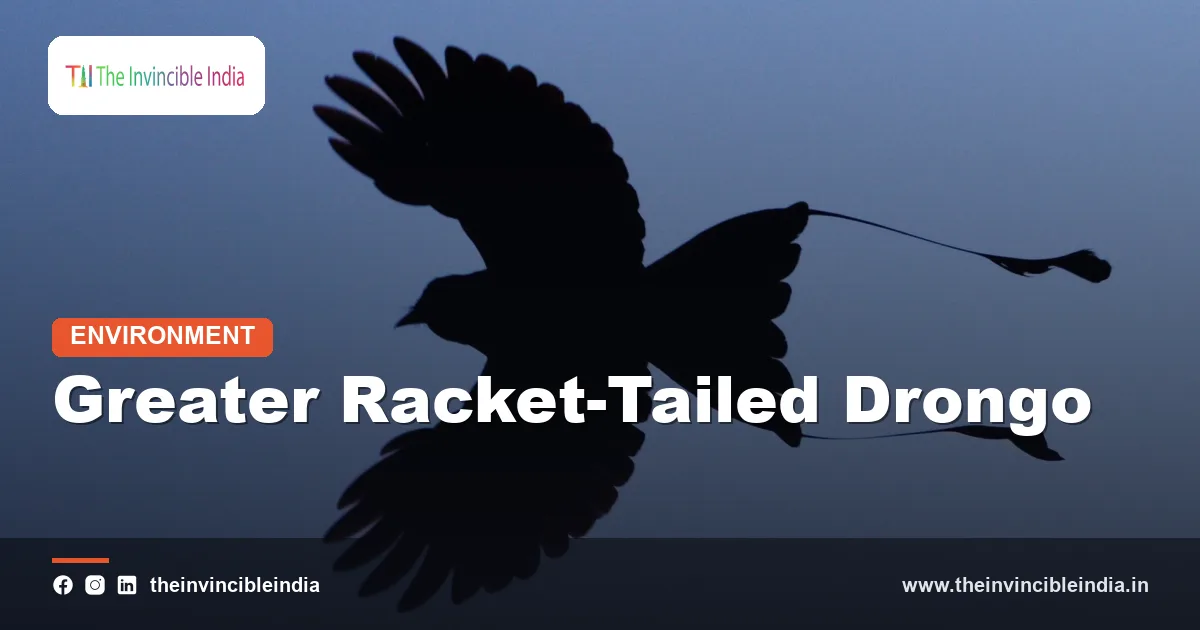
The greater racket-tailed drongo (Dicrurus paradiseus), known in Hindi as the bhimraj, is a glossy blue-black forest bird of India and Southeast Asia, famous for two extremely long, wire-like tail streamers that end in small twisted “rackets”, and for its remarkable ability to mimic other birds. In the forests of the Western Ghats, the Himalayan foothills and the north-east, it is a conspicuous, noisy bird that often leads mixed-species feeding flocks.
The greater racket-tailed drongo is an insect-eating songbird that hunts on the wing and is bold enough to chase away much larger birds from its territory. This explainer covers how to recognise the bird, what its racket tail is for, how it mimics other species, how it leads flocks, how it breeds, where it lives in India, and how the species is faring. 23 October 2026.
Quick Facts
| Attribute | Detail |
|---|---|
| Common names | Greater racket-tailed drongo, bhimraj (Hindi) |
| Scientific name | Dicrurus paradiseus |
| Family | Dicruridae (drongos), order Passeriformes (perching birds) |
| Body length | About 30 to 35 cm without the streamers; total length with streamers can exceed 50 cm |
| Distinctive feature | Two elongated outer tail feathers with bare shafts and racket-shaped tips; a tuft of feathers on the forehead |
| Habitat in India | Moist deciduous and evergreen forest, forest edges and plantations |
| Diet | Mainly flying insects, plus some nectar and small prey |
| Conservation status (IUCN) | Least Concern |
Key Takeaways
- The greater racket-tailed drongo is a glossy black songbird whose two elongated outer tail feathers carry bare shafts and small racket-shaped tips.
- The greater racket-tailed drongo is a skilled mimic that copies the calls of many other birds and sometimes of birds of prey.
- The greater racket-tailed drongo often acts as a sentinel for mixed-species flocks, giving alarm calls that other forest birds heed.
- The greater racket-tailed drongo catches most of its food as flying insects, snatching them in short aerial sallies from a perch.
- The greater racket-tailed drongo belongs to the family Dicruridae, whose Greek-derived family name refers to a forked tail.
- The International Union for Conservation of Nature (IUCN) lists the greater racket-tailed drongo as Least Concern, though forest loss can reduce local numbers.
What is the greater racket-tailed drongo?
The greater racket-tailed drongo is a large, glossy black drongo that lives in the forests of the Indian subcontinent and Southeast Asia, and is the largest of the drongos commonly seen in India. It is placed in the genus Dicrurus, a name that combines Greek words for “forked” and “tail”.
The bird is bold and active, sitting upright on an open branch and watching for insects. A crest of curled feathers rises from the base of the bill on the forehead, and the glossy plumage shines with a blue or green sheen in good light. The species is common in many forested areas, from the Western Ghats to the north-east.
The drongo family, Dicruridae, is a group of mostly black, forked-tailed insect-eaters found across Africa, Asia and Australasia. India has several members of the family, including the black drongo, the ashy drongo, the bronzed drongo, the spangled drongo and the lesser racket-tailed drongo.
How can you identify the greater racket-tailed drongo?
The greater racket-tailed drongo can be identified by its glossy blue-black plumage, a tuft of feathers curving forward over the base of the bill, a deeply forked tail and, in adults, two very long outer tail feathers that end in twisted rackets. Without the long streamers, the bird can be confused with other large drongos.
The crest and plumage
- The feathers are black with a blue-green gloss, most visible in sunlight.
- A crest of upturned feathers sits above the bill and can be raised or lowered.
- The eyes are dark red-brown and the bill is black and strong.
- The legs are short, and the bird perches upright.
Juveniles and moulting adults
Young birds and adults in moult lack the full racket-tipped streamers. They have a forked tail without the long extensions and can be hard to identify. In such cases the crest, the larger size and the loud, varied calls are the best clues.
Greater versus lesser
The lesser racket-tailed drongo (Dicrurus remifer) is a smaller relative of hill forests in the Himalayan foothills and north-east India. Its body is smaller and its forehead crest is less prominent. Distinguishing the two is easiest by size and by habitat, since the greater racket-tailed drongo has a wider range.
What is the racket tail of the greater racket-tailed drongo for?
The racket tail of the greater racket-tailed drongo is most likely a signal of fitness and a feature that has been shaped by mate choice, though its exact function is still debated. The two outer tail feathers are bare along most of their length and carry a small, twisted web of vane at the tip on the inner side.
The long streamers look like two small insects dangling behind the bird in flight. They flutter and spin as the bird moves, and this has led some observers to suggest a role in distracting predators or confusing them. Others note that long tails are costly to carry and so may advertise a healthy bird. Studies on related species and similar birds support the idea of a signalling role, but the evidence for this particular drongo remains limited.
Whatever the purpose, the tail does not seem to slow the bird much. The greater racket-tailed drongo flies swiftly through the forest, with the streamers trailing behind, and can twist and turn to catch insects in the air.
How does the greater racket-tailed drongo mimic other birds?
The greater racket-tailed drongo mimics other birds by copying their songs and calls in its own varied repertoire, and it can reproduce the calls of many forest species with surprising accuracy. The drongo mixes these imitations with its own loud, metallic whistles and harsh notes.
Mimicry is documented across the drongo family. Observers have reported the greater racket-tailed drongo imitating the calls of birds of prey as well as of small songbirds. Some drongos in other parts of the world are known to give false alarm calls to make other animals flee, so that they can steal the food that is left behind. Whether the greater racket-tailed drongo uses mimicry in this way is less clear, and the question is still being studied.
Whatever its function, the mimicry gives the bird its fame among birdwatchers and cage-bird keepers. A loud, rich and varied song can make a single bird sound like a whole flock hidden in the trees.
Why does the greater racket-tailed drongo lead mixed-species flocks?
The greater racket-tailed drongo leads mixed-species flocks because its vigilance and loud alarm calls help other forest birds feed more safely, and in return the drongo benefits from insects disturbed by the moving flock. Such flocks are a common feature of tropical forests.
A typical flock in a south Indian or north-eastern forest may include babblers, warblers, flycatchers, woodpeckers and nuthatches. The drongo sits on a high perch, scans for hawks and other threats, and gives alarm calls when a predator appears. Other birds learn to respond to these calls and can spend more time feeding.
The drongo itself catches insects flushed out by the movement of the flock. This arrangement is a kind of mutualism, although the drongo is also known to chase and rob smaller birds of their catches, so the relationship is not purely friendly. Researchers often cite the drongo as an example of a nuclear or sentinel species in tropical forest flocks.
What does the greater racket-tailed drongo eat?
The greater racket-tailed drongo eats mainly insects, which it catches in the air by darting out from a perch, and it also feeds on nectar and takes the occasional small lizard or other small animal. Beetles, moths, dragonflies, wasps, bees and cicadas are all recorded as prey.
The bird returns to the same perch after each sortie, a technique called hawking. In the flowering season it visits trees such as silk-cotton and coral trees to drink nectar, and in doing so it can carry pollen from flower to flower. The diet shifts with the season and with the habitat.
How does the greater racket-tailed drongo breed?
The greater racket-tailed drongo breeds by building a shallow cup nest of fine twigs, grass and fibres, bound with cobwebs, in a fork of a tree, usually at a moderate height, and laying a small clutch of spotted eggs. Both parents take part in incubation and in feeding the young.
In India the breeding season runs through the spring and early summer in many regions, though timing varies with local climate. The pair defends the nest area fiercely and will dive at crows, raptors and even larger animals that approach. This aggressive defence also gives some protection to the nests of smaller birds nearby, which are sometimes built close to drongo nests.
The eggs are usually white or pinkish with reddish-brown spots, and the clutch is typically three or four. The chicks fledge after about two to three weeks, and the parents feed them for a time afterwards.
Where is the greater racket-tailed drongo found in India?
The greater racket-tailed drongo is found in the forests of the Western Ghats, the Eastern Ghats, central India, the Himalayan foothills and the north-east, and it also occurs in Sri Lanka and much of Southeast Asia. It prefers moist deciduous and evergreen forest, forest edges and well-wooded plantations such as coffee and tea estates.
Several subspecies are recognised across its range, and they differ in size, in the shape of the crest and in the length of the streamers. The bird is largely resident, though it may move locally in response to food. It is absent from dry desert regions and from open farmland with few trees, and in the hills it ranges to moderate elevations.
Birdwatchers often find the bird in national parks and tiger reserves such as those of the Western Ghats and the north-east, where the species’ loud calls make it easy to locate.
Is the greater racket-tailed drongo threatened?
The greater racket-tailed drongo is not considered threatened globally; the IUCN rates it as Least Concern because it has a wide range and is common in suitable habitat. Local populations can decline where forests are cleared or fragmented.
The bird has been caught in some regions for the cage-bird trade because of its mimicry and its impressive tail, which is illegal in India. Under the Wild Life (Protection) Act, 1972, capturing wild birds is prohibited. Habitat loss, the clearing of old trees and the spread of intensive monoculture plantations are the more general pressures. Protecting forest patches and keeping native trees in plantations help the species.
How does the greater racket-tailed drongo compare with other Indian drongos?
The greater racket-tailed drongo differs from other Indian drongos in its size, its racket-tipped tail and its forest habitat. The table below compares it with four other drongos found in India.
| Drongo | Appearance | Typical habitat | Notable trait |
|---|---|---|---|
| Greater racket-tailed drongo | Large, glossy black, forehead crest, long racket streamers | Moist forest and plantations | Mimicry; leads mixed flocks |
| Lesser racket-tailed drongo | Smaller, less prominent crest | Hill forests of the Himalayan foothills and north-east | Similar racket tail on a smaller bird |
| Black drongo | Glossy black, forked tail, white spot at mouth corner | Open farmland and grassland | Perches on wires and cattle |
| Ashy drongo | Slaty grey, deeply forked tail, red eye | Hill forests; winter visitor in the plains | Hawks insects from perches |
| Spangled drongo | Glossy black with spangled sheen, curled tail tips | Evergreen and moist forest | Upturned fish-tail ends |
The comparison shows that drongos share a hunting style but differ in setting. The black drongo keeps to open fields, while the greater racket-tailed drongo prefers the canopy and middle layer of forest.
How can you watch the greater racket-tailed drongo?
You can watch the greater racket-tailed drongo by visiting a forest or a well-wooded plantation in the early morning and listening for its loud, varied calls. The bird often perches on a prominent dead branch and is easy to spot against the sky.
- Follow mixed flocks, since the drongo usually moves with them.
- Look for the long, twisting streamers trailing behind in flight.
- Note the forehead crest and the strong, upright posture.
- Avoid playback of calls, which can disturb nesting pairs.
- Keep a safe distance from nests, because the parents may be aggressive.
- Record sightings on a citizen-science platform such as eBird.
Bottom Line
The greater racket-tailed drongo is a glossy forest songbird with two racket-tipped tail streamers, a mimic’s voice and a habit of leading mixed flocks. It is common and not threatened worldwide, but it needs mature forest and nesting trees to thrive.
Frequently Asked Questions
What is the greater racket-tailed drongo known as in Hindi?
The greater racket-tailed drongo is known as the bhimraj in Hindi. The name is widely used in north and eastern India. Other regional languages have their own names for the bird.
Why does the greater racket-tailed drongo have a racket tail?
The greater racket-tailed drongo has a racket tail most likely as a signal of fitness shaped by mate choice, although its exact role is debated. The two long outer feathers have bare shafts with small twisted tips. Some researchers also suggest the fluttering tips may distract predators.
Can the greater racket-tailed drongo mimic other birds?
Yes, the greater racket-tailed drongo can mimic the calls of many other birds. Its repertoire includes imitations of small songbirds and sometimes of birds of prey. The reasons for this mimicry are still being studied.
What does the greater racket-tailed drongo eat?
The greater racket-tailed drongo eats mainly flying insects, which it catches in short aerial sorties from a perch. It also drinks nectar and sometimes takes small prey such as lizards. Beetles, moths, wasps and dragonflies are among the recorded insects.
Where does the greater racket-tailed drongo live?
The greater racket-tailed drongo lives in moist deciduous and evergreen forest, forest edges and wooded plantations. In India it occurs in the Western Ghats, the Eastern Ghats, central India, the Himalayan foothills and the north-east. It also lives in Sri Lanka and Southeast Asia.
Is the greater racket-tailed drongo endangered?
No, the greater racket-tailed drongo is not endangered; the IUCN lists it as Least Concern. It is common in suitable habitat across a wide range. Forest loss and illegal capture for the cage-bird trade can reduce local numbers.
{“@context”:”https://schema.org”,”@graph”:[{“@type”:”FAQPage”,”mainEntity”:[{“@type”:”Question”,”name”:”What is the greater racket-tailed drongo known as in Hindi?”,”acceptedAnswer”:{“@type”:”Answer”,”text”:”The greater racket-tailed drongo is known as the bhimraj in Hindi. The name is widely used in north and eastern India. Other regional languages have their own names for the bird.”}},{“@type”:”Question”,”name”:”Why does the greater racket-tailed drongo have a racket tail?”,”acceptedAnswer”:{“@type”:”Answer”,”text”:”The greater racket-tailed drongo has a racket tail most likely as a signal of fitness shaped by mate choice, although its exact role is debated. The two long outer feathers have bare shafts with small twisted tips. Some researchers also suggest the fluttering tips may distract predators.”}},{“@type”:”Question”,”name”:”Can the greater racket-tailed drongo mimic other birds?”,”acceptedAnswer”:{“@type”:”Answer”,”text”:”Yes, the greater racket-tailed drongo can mimic the calls of many other birds. Its repertoire includes imitations of small songbirds and sometimes of birds of prey. The reasons for this mimicry are still being studied.”}},{“@type”:”Question”,”name”:”What does the greater racket-tailed drongo eat?”,”acceptedAnswer”:{“@type”:”Answer”,”text”:”The greater racket-tailed drongo eats mainly flying insects, which it catches in short aerial sorties from a perch. It also drinks nectar and sometimes takes small prey such as lizards. Beetles, moths, wasps and dragonflies are among the recorded insects.”}},{“@type”:”Question”,”name”:”Where does the greater racket-tailed drongo live?”,”acceptedAnswer”:{“@type”:”Answer”,”text”:”The greater racket-tailed drongo lives in moist deciduous and evergreen forest, forest edges and wooded plantations. In India it occurs in the Western Ghats, the Eastern Ghats, central India, the Himalayan foothills and the north-east. It also lives in Sri Lanka and Southeast Asia.”}},{“@type”:”Question”,”name”:”Is the greater racket-tailed drongo endangered?”,”acceptedAnswer”:{“@type”:”Answer”,”text”:”No, the greater racket-tailed drongo is not endangered; the IUCN lists it as Least Concern. It is common in suitable habitat across a wide range. Forest loss and illegal capture for the cage-bird trade can reduce local numbers.”}}]}]}


