

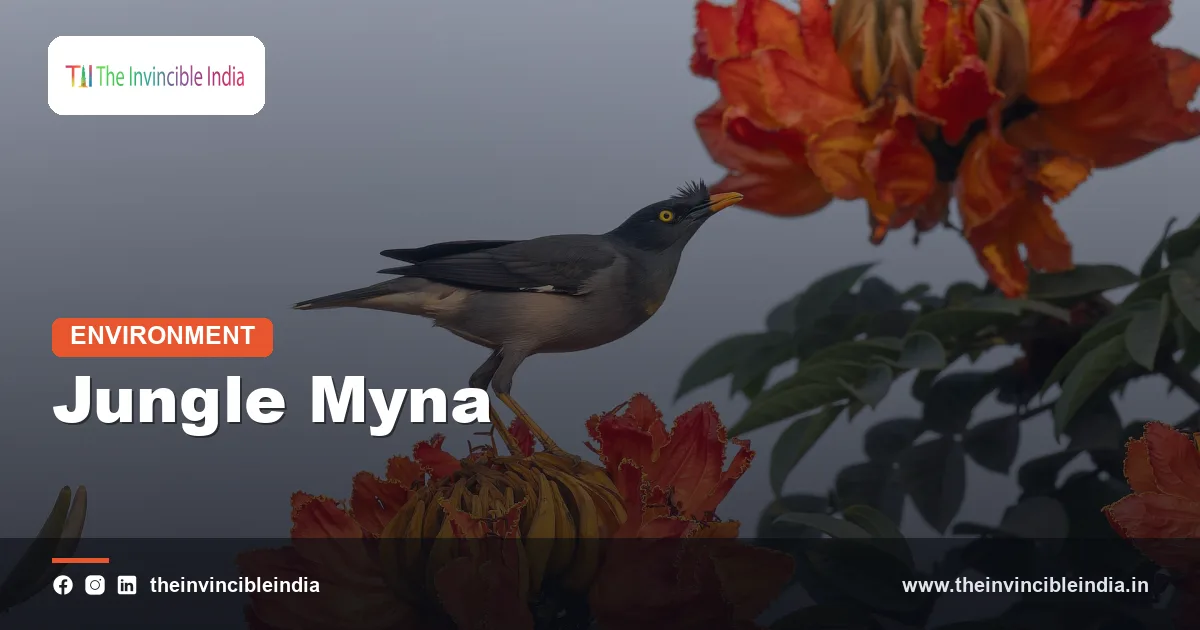
The jungle myna (Acridotheres fuscus) is a dark grey-brown myna of the Indian subcontinent, recognised by the small tuft of feathers on its forehead, its pale whitish-blue eyes and a white flash in the wing, and it is common in groves, fields and forest edges where it often rides on cattle. It is closely related to the common myna and is frequently mistaken for it, but the jungle myna has no bare yellow skin behind the eye and a more subdued, sooty look.
Despite its name, the jungle myna does not live deep in dense forest; it prefers open woodland, orchards, cultivation and village outskirts. This explainer covers how to identify the jungle myna, how it differs from the common myna, where it lives in India, what it eats, how it flocks and breeds, and how it fares as habitats change. Numbers and local abundance are given qualitatively because they differ by region and season.
| Quick Facts: Jungle Myna | |
|---|---|
| Scientific name | Acridotheres fuscus |
| Family | Sturnidae (starlings and mynas) |
| Common names | Jungle myna, jungle mynah |
| Typical length | About 22 to 24 cm |
| Plumage | Dark slaty grey-brown, paler below, with a white wing patch and white-tipped tail in flight |
| Distinctive marks | Upright tuft of feathers on the forehead; pale whitish or bluish-white eyes; yellow-orange bill |
| Range | Widespread across the Indian subcontinent, including India, Nepal, Bangladesh and Sri Lanka |
| Habitat | Groves, orchards, farmland, forest edges and village outskirts |
| Conservation status | Least Concern on the IUCN Red List |
Key Takeaways
- The jungle myna is a dark grey-brown myna with a small upright tuft of feathers above the bill and pale, whitish eyes.
- The jungle myna lacks the bare yellow patch of skin behind the eye that marks the common myna.
- The jungle myna is common across India in groves, farmland and forest edges and frequently perches on cattle and buffaloes to catch insects.
- The jungle myna eats insects, fruit, grain and nectar, and it forms flocks that roost together at night.
- The jungle myna nests in holes in trees and walls and usually lays three to five pale blue eggs.
- The jungle myna is rated Least Concern by the IUCN because it is widespread and adaptable.
What is the jungle myna?
The jungle myna is a medium-sized songbird in the starling family Sturnidae, native to the Indian subcontinent, and one of the common mynas that share Indian fields and towns with the more familiar common myna and bank myna. It belongs to the genus Acridotheres, whose name means “locust hunter” and reflects the group’s taste for insects.
The jungle myna is a resident bird, staying in the same region year round, though flocks wander locally in search of fruiting trees and fresh pasture. Several subspecies are recognised, and they differ mainly in the depth of the grey tone, with some forms paler than others. The name “jungle myna” can be misleading because the bird is most often seen in open, semi-wild or cultivated country rather than in interior forest.
In India, mynas have long been part of village life and have been kept as cage birds for their ability to mimic sounds. Capturing wild mynas is restricted under modern wildlife law, and the jungle myna is best enjoyed in its natural setting.
How do you identify a jungle myna?
A jungle myna can be identified by its dark, sooty grey-brown plumage, a short, upright tuft of feathers on the forehead, pale whitish-blue eyes, an orange-yellow bill and a clear white patch at the base of the primary feathers that shows in flight. The overall appearance is darker and plainer than the common myna.
Key field marks include:
- Forehead tuft: a small, stiff crest of feathers rising over the base of the bill; it gives the face a distinctive, slightly puffed profile.
- Eyes: pale, whitish or bluish-white, noticeable even at a distance.
- Face: no bare skin patch behind the eye, unlike the common myna and the bank myna.
- Body: dark grey-brown above, a slightly paler grey on the belly and white on the undertail.
- Bill and legs: yellow to orange, sometimes with a darker base.
- Wings and tail: a white wing patch and white tail tips become visible when the bird flies.
Young jungle mynas are duller, with a less obvious tuft. The calls include chirps, whistles and gurgling notes that are often mixed with the sounds of other flock members.
How is the jungle myna different from the common myna?
The jungle myna differs from the common myna mainly in colour, eye colour, forehead tuft and bare skin: it is darker and greyer, has pale eyes and a forehead tuft, and lacks the bright yellow patch behind the eye that the common myna has. Both are similar in size and share many habits, so they are regularly mixed up.
The comparison below highlights how to tell the two apart.
| Feature | Jungle myna | Common myna |
|---|---|---|
| Scientific name | Acridotheres fuscus | Acridotheres tristis |
| Body colour | Dark slaty grey-brown | Warm brown with black head |
| Forehead | Small upright tuft | Smooth, no tuft |
| Eye | Pale whitish or bluish-white | Dark |
| Bare skin behind eye | Absent | Bright yellow patch |
| Wing flash | White patch | White patch |
| Habitat | Groves, fields, forest edges | Towns, villages, cultivation |
A useful shortcut is to look at the face: a jungle myna has a pale, staring eye and a tuft above the bill, whereas the common myna has a bold yellow patch of skin behind its eye.
Where does the jungle myna live in India?
The jungle myna lives across most of peninsular India and the Himalayan foothills, and it extends into the eastern and southern regions, favouring open woodland, groves, orchards and cultivation rather than dense interior forest or arid desert. It also occurs in neighbouring Nepal, Bangladesh and Sri Lanka, and has been introduced to some islands elsewhere.
Typical habitats include:
- Mango groves, banyan and peepal trees, and other tall trees in villages.
- Cultivated fields with scattered trees, especially where cattle graze.
- Forest edges, clearings and light deciduous woodland.
- Plantations such as tea, coffee and areca nut, where trees provide cover.
- Town outskirts, parks and campuses with older trees.
The species is less abundant than the common myna in dense city centres, but it can be numerous in the green belts around towns. In the Himalaya it ranges up through the foothills but is rarely found at high elevations.
What does the jungle myna eat?
The jungle myna is an omnivore that eats insects, fruit, grain, flower nectar and household scraps, with insects forming a large share of its diet during the breeding season. This varied diet enables the jungle myna to thrive in a mosaic of cultivated and semi-wild habitats.
Typical foods and methods are:
- Insects: grasshoppers, crickets, beetles, caterpillars and termites, picked from the ground or from the backs of livestock.
- Fruit: figs, berries, ripe mangoes, bananas and other soft fruit from trees and orchards.
- Grain and seeds: spilled cereals and pulses around fields and threshing floors.
- Nectar: flowers of silk cotton, coral tree and other blossoming trees.
- Scraps: bread, rice and cooked food discarded near villages and roadside stalls.
A well-known feeding habit is riding on the backs of cattle, buffaloes and other livestock, from where the jungle myna snaps up flies and insects disturbed by the animal’s movement. In doing so it may also remove ticks and other parasites.
Why does the jungle myna ride on cattle?
The jungle myna rides on cattle and buffaloes because the grazing animals stir up insects and attract flies, giving the myna an easy, steady supply of food while it enjoys a raised, safe vantage point. This behaviour is common in India and is shared by egrets, crows, drongos and other mynas.
The benefits and costs of the relationship are as follows:
| Party | Likely benefit | Possible cost |
|---|---|---|
| Jungle myna | Easy insects, ticks and flies; better view of predators | Risk from being trampled or kicked |
| Cattle or buffalo | Fewer flies and ticks on the skin | Minor irritation if the bird pecks at wounds |
| Farmer | Fewer insects around livestock | None significant |
The size of the benefit to livestock has been debated, and the relationship is best described as mutualistic or commensal depending on the situation. What is clear is that the jungle myna reliably follows grazing animals.
How does the jungle myna flock and communicate?
The jungle myna is a gregarious bird that forages in small flocks, often with other mynas, and gathers in large noisy roosts at dusk. Flocking helps the birds find food, spot predators early and keep warm at night.
Notable social behaviour includes:
- Moving across fields in loose parties of five to twenty birds, with individuals calling constantly.
- Assembling at communal roosts in trees, bamboo clumps or reed beds, sometimes with common mynas and starlings.
- Mobbing snakes, cats and hawks with loud alarm calls.
- Using a repertoire of whistles, chirps and chuckles, and mimicking some sounds from its surroundings.
Pairs often stay together over a long time, and the birds engage in displays such as bowing, wing-flicking and head-bobbing, particularly near nest holes in the breeding season.
How does the jungle myna breed?
The jungle myna breeds in holes in trees, walls and buildings, and the pair usually lays three to five pale blue eggs in a nest of grass, rags and feathers, with the main breeding season in the warmer part of the year. The exact timing varies from region to region and sometimes allows a second brood.
Key breeding features:
- Nest site: natural tree hollows, holes in masonry or old buildings, and sometimes nest boxes.
- Nest material: grass, straw, roots, feathers, paper and cloth pieces.
- Eggs: plain pale blue, usually three to five.
- Incubation: by both parents, for roughly two weeks.
- Chicks: fed insects by both parents and leave the nest after around three weeks.
Jungle mynas can compete with other hole-nesting birds, such as parakeets and sparrows, for nest sites, especially where old trees are scarce. Preserving mature trees and wall holes therefore benefits many species at once.
Is the jungle myna threatened?
The jungle myna is not threatened and is listed as Least Concern by the IUCN, because its range is large, it eats many foods and it tolerates human-altered landscapes. Even so, local populations depend on mature trees for nesting and roosting, and the loss of groves, orchards and old trees can reduce numbers at a site.
Some points about its conservation outlook:
- The species has been introduced to a few islands outside its native range, where mynas can become invasive and compete with native birds.
- In India, it is a native species and is generally considered beneficial because of its appetite for insects.
- Wild mynas are protected from trapping under Indian wildlife law, and readers should check the current provisions of the Wildlife (Protection) Act, 1972.
- Pesticide-heavy farming may reduce insect prey, though effects on the jungle myna are not well quantified.
How can you tell the three common Indian mynas apart?
The three mynas most often seen together in India are the common myna, the bank myna and the jungle myna, and they can be told apart by body colour, eye and facial skin, and forehead shape. The common myna is brown with a yellow eye patch, the bank myna is bluish-grey with an orange-red eye patch, and the jungle myna is dark grey with pale eyes and a forehead tuft.
Watching their behaviour also helps. Common mynas dominate dense towns and gardens, bank mynas gather near river banks and railway lines in the north, and jungle mynas favour groves and fields with cattle. All three are valuable insect-eaters and may share roosts, so scanning a flock carefully often reveals more than one species.
Bottom Line
The jungle myna is a dark, tufted, pale-eyed myna that thrives in groves, fields and forest edges across India. It is a resilient insect-eater and cattle companion, and protecting old trees and hedgerows is the simplest way to keep it and other hole-nesting birds in the landscape.
Frequently Asked Questions
What does a jungle myna look like?
A jungle myna is a dark grey-brown bird with a small upright tuft of feathers over its bill, pale whitish eyes and an orange-yellow bill. It has a white patch in the wing and white tail tips visible in flight. It lacks the bare yellow patch behind the eye seen on the common myna.
How is the jungle myna different from the common myna?
The jungle myna is darker and greyer than the common myna, has pale eyes and a forehead tuft, and lacks the bare yellow eye patch. The common myna is warm brown with a black head and a bold yellow patch behind the eye. Both are similar in size and often mix in the same flocks.
Why does the jungle myna sit on cattle?
The jungle myna sits on cattle because grazing animals disturb insects and attract flies, giving the bird an easy meal. The perch also gives a good view of predators. The behaviour may also help the livestock by removing some ticks and flies.
Where does the jungle myna live?
The jungle myna lives in groves, orchards, farmland, forest edges and village outskirts across much of India, as well as in Nepal, Bangladesh and Sri Lanka. It prefers open or semi-open country with trees rather than dense interior forest. It is less common in dry deserts and at high Himalayan altitudes.
What does the jungle myna eat?
The jungle myna eats insects, fruit, grain, flower nectar and household scraps. Insects such as grasshoppers, beetles and caterpillars are especially important in the breeding season. It often picks food from the ground or from the backs of grazing livestock.
How many eggs does a jungle myna lay?
A jungle myna usually lays three to five pale blue eggs in a nest in a tree hole or wall cavity. Both parents incubate the eggs and feed the chicks, which leave the nest after about three weeks. Breeding peaks in the warmer months, and some pairs raise a second brood.
{“@context”:”https://schema.org”,”@graph”:[{“@type”:”FAQPage”,”mainEntity”:[{“@type”:”Question”,”name”:”What does a jungle myna look like?”,”acceptedAnswer”:{“@type”:”Answer”,”text”:”A jungle myna is a dark grey-brown bird with a small upright tuft of feathers over its bill, pale whitish eyes and an orange-yellow bill. It has a white patch in the wing and white tail tips visible in flight. It lacks the bare yellow patch behind the eye seen on the common myna.”}},{“@type”:”Question”,”name”:”How is the jungle myna different from the common myna?”,”acceptedAnswer”:{“@type”:”Answer”,”text”:”The jungle myna is darker and greyer than the common myna, has pale eyes and a forehead tuft, and lacks the bare yellow eye patch. The common myna is warm brown with a black head and a bold yellow patch behind the eye. Both are similar in size and often mix in the same flocks.”}},{“@type”:”Question”,”name”:”Why does the jungle myna sit on cattle?”,”acceptedAnswer”:{“@type”:”Answer”,”text”:”The jungle myna sits on cattle because grazing animals disturb insects and attract flies, giving the bird an easy meal. The perch also gives a good view of predators. The behaviour may also help the livestock by removing some ticks and flies.”}},{“@type”:”Question”,”name”:”Where does the jungle myna live?”,”acceptedAnswer”:{“@type”:”Answer”,”text”:”The jungle myna lives in groves, orchards, farmland, forest edges and village outskirts across much of India, as well as in Nepal, Bangladesh and Sri Lanka. It prefers open or semi-open country with trees rather than dense interior forest. It is less common in dry deserts and at high Himalayan altitudes.”}},{“@type”:”Question”,”name”:”What does the jungle myna eat?”,”acceptedAnswer”:{“@type”:”Answer”,”text”:”The jungle myna eats insects, fruit, grain, flower nectar and household scraps. Insects such as grasshoppers, beetles and caterpillars are especially important in the breeding season. It often picks food from the ground or from the backs of grazing livestock.”}},{“@type”:”Question”,”name”:”How many eggs does a jungle myna lay?”,”acceptedAnswer”:{“@type”:”Answer”,”text”:”A jungle myna usually lays three to five pale blue eggs in a nest in a tree hole or wall cavity. Both parents incubate the eggs and feed the chicks, which leave the nest after about three weeks. Breeding peaks in the warmer months, and some pairs raise a second brood.”}}]}]}


