

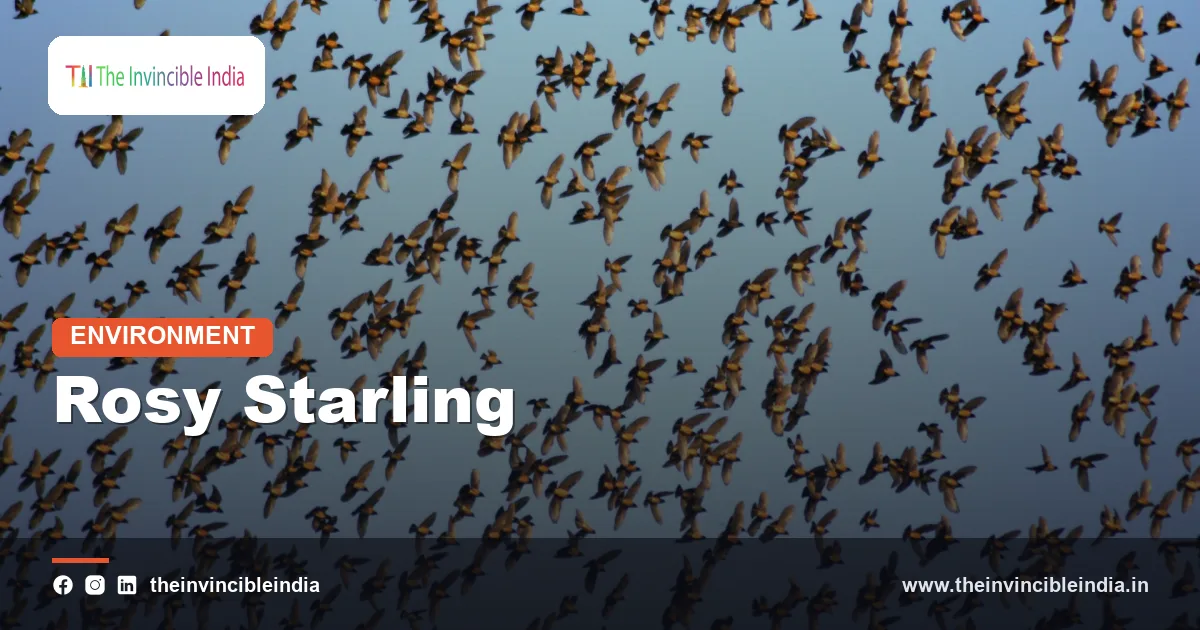
The rosy starling (Pastor roseus) is a pink-and-black starling that breeds on the steppes of Central Asia and south-eastern Europe and spends the winter in India, arriving in large, noisy flocks from late summer and leaving again in spring. It belongs to the starling and myna family, Sturnidae, and is one of the most striking winter visitors to the Indian peninsula, especially in the dry, grain-growing country of Gujarat, Maharashtra, Karnataka, Andhra Pradesh and Tamil Nadu.
The rosy starling is also called the rose-coloured starling or rosy pastor, and in Hindi-speaking regions it is often called gulabi myna. This guide explains how to identify the rosy starling, where and when it appears in India, what it eats, why it gathers in such dense swirling flocks, how it affects farmers, and what its journey tells us about the health of grasslands across two continents. Details were last checked on 23 October 2026.
| Quick Fact | Detail |
|---|---|
| Common names | Rosy starling, rose-coloured starling, rosy pastor; gulabi myna in Hindi |
| Scientific name | Pastor roseus (earlier placed in the genus Sturnus) |
| Family | Sturnidae (starlings and mynas) |
| Size | About 21-22 cm, slightly smaller than a pigeon |
| Breeding grounds | Steppes and semi-deserts of Central Asia and parts of south-eastern Europe |
| Status in India | Winter visitor (non-breeding), mainly in the central, western and southern peninsula |
| Typical stay in India | Roughly July-August to March-April, varying by region and year |
| Conservation status | Least Concern on the IUCN Red List |
Key Takeaways
- The rosy starling (Pastor roseus) is a migratory starling that breeds in Central Asia and south-eastern Europe and winters in the Indian subcontinent.
- Adult rosy starlings in breeding plumage have a pink body and mantle with a glossy black head, wings and tail, and a shaggy crest.
- In India, the rosy starling is a non-breeding winter visitor and does not nest anywhere in the country.
- Rosy starlings eat insects such as grasshoppers and locusts on their breeding grounds and switch to grains, ripe fruits and flower nectar in India.
- The rosy starling roosts and forages in dense flocks that can number in the thousands, and its flocks sometimes damage ripening sorghum (jowar) crops.
- The IUCN lists the rosy starling as Least Concern, but its numbers fluctuate sharply from year to year with locust outbreaks and weather.
What is a rosy starling?
A rosy starling is a medium-small songbird of the starling family that is easy to recognise in adult plumage by its pale-pink body set against a black hood, wings and tail. The scientific name Pastor roseus translates roughly as “rosy shepherd”, a nod to the way flocks follow grazing herds and locust swarms across open country.
The bird is roughly the size of a myna, with a short, stout, slightly curved bill, a rounded head and a quick, direct flight. Males and females look similar, though females tend to be a little duller. The species is not rare, but it is seasonal in India, which is why many people notice it only when a flock suddenly appears on a roadside wire or a harvested field.
How can you identify a rosy starling in India?
You can identify an adult rosy starling by the combination of a glossy black head with a loose crest, a pink back and belly, and black wings and tail. The bill is pink with a dark base in breeding birds and the legs are pinkish.
Plumage changes through the season, which causes confusion. Birds arriving in India in autumn are often in worn, scruffier plumage, and the pink is pale or washed with grey, while the black hood has pale scaly fringes. By late winter, many adults look cleaner and pinker as they approach the northward journey. Young birds are sandy-brown above and paler below, with a pale yellowish bill, and they resemble a washed-out myna.
Useful field marks
- A pink body and black hood in adults, with the crest more visible when the bird is excited.
- A pale, sandy juvenile plumage with no black hood.
- Dense, vocal flocks that move together between roosts and fields.
- A harsh, chattering call, often described as a rapid rasping “krr-krr”, mixed with whistles in song.
Where does the rosy starling come from?
The rosy starling breeds across the steppes and arid grasslands of Central Asia, extending west to parts of south-eastern Europe, and its numbers there depend heavily on the availability of locusts and grasshoppers. Breeding is colonial, with birds nesting in crevices among rocks, stone heaps, cliffs and sometimes in burrows or old walls.
The species is nomadic as a breeder, meaning colonies may form in one area in a good locust year and move elsewhere in a poor one. This explains why local numbers can swing widely. After breeding, adults and young leave and head south towards Iran, Pakistan and the Indian subcontinent, where they spend the non-breeding season. Smaller numbers also winter in Sri Lanka and other parts of South Asia.
When does the rosy starling arrive in India?
The rosy starling usually begins arriving in India in the second half of the monsoon season, around July and August in the north-west, and numbers build through the autumn. Arrival dates vary by region, because the birds move in stages and tend to reach Gujarat and Maharashtra before the far south.
Flocks generally remain through winter and begin leaving in March and April for the return journey north. Some birds linger later in warm years. Because exact dates shift with weather, bird watchers usually treat these dates as approximate and rely on local eBird or club records for a given district.
Where in India can you see rosy starlings?
Rosy starlings are most regularly reported from the dry, open, grain-growing belts of western and peninsular India, including Gujarat, Maharashtra, Madhya Pradesh, Karnataka, Telangana, Andhra Pradesh and Tamil Nadu. Smaller numbers reach other states, and sightings in the north and east are less regular.
The favoured habitat is open farmland, scrub, harvested fields, orchards, village edges and flowering trees. Birds often rest in large trees and reedbeds at dusk. In many places, a rosy starling roost can be traced by following the evening flight of flocks along familiar lines every day for weeks.
What does the rosy starling eat?
The rosy starling is an omnivore that eats mostly insects in summer and mostly grain, fruit and nectar in winter. On the breeding grounds, grasshoppers and locusts are the staple, and a pair raising chicks can consume a large number of them each day.
In India, the diet shifts. Birds feed on ripening sorghum and other millets, mulberries, figs and other soft fruits, and nectar from flowering trees such as coral tree (Erythrina) and silk-cotton (Bombax). While probing blossoms, they pick up pollen and may play a minor role in pollination, though this is less studied than their grain feeding. They also take beetles and other insects from fields.
Why do rosy starlings form huge flocks?
Rosy starlings form huge flocks because grouping reduces the risk from predators, helps birds find food, and allows warm, safe communal roosting. A large flock is harder for a hawk or falcon to target, since the moving mass confuses an attacking bird.
At dusk, flocks sometimes perform swirling, shape-shifting aerial displays before dropping into a roost, which are loosely called murmurations. These are most famously linked to the common starling in Europe, but rosy starlings also fly in tight, coordinated groups. Researchers explain such movement through local rules, where each bird adjusts its speed and direction to a handful of nearby neighbours, so the whole flock appears to move as one without any leader.
Roosting habits
- Roosts are often in dense trees, reedbeds, sugarcane or thickets, which offer cover from predators.
- The same roost may be used night after night during winter.
- Birds often fly 10 km or more between roosts and feeding areas, though distances vary.
Is the rosy starling a pest or a friend of farmers?
The rosy starling is both: it helps farmers by eating pest insects, and it can harm them by feeding on ripening grain. In India, the damage is mostly confined to sorghum (jowar) and similar crops at the milky and hard-grain stages, when large flocks descend on fields.
Farmers in some regions use scarecrows, noise, nets or watchers to protect fields, and the practice of guarding crops at dawn and dusk is still common. Losses are usually local and short-lived rather than widespread. In Central Asia, the same bird is valued because it eats locusts that would otherwise destroy crops and pasture, so the same species can be an ally in one season and a nuisance in another.
How does the rosy starling differ from similar birds?
The rosy starling differs from other Indian starlings and mynas mainly by its pink-and-black colouring in adult plumage, its crested black hood and its strongly flocking habits. Several resident birds share the same family but look quite different.
| Bird | Key difference from the rosy starling | Status in India |
|---|---|---|
| Rosy starling | Pink body, black hood and crest, black wings and tail | Winter visitor |
| Common myna | Brown body, black head, bare yellow eye-patch, yellow bill | Resident |
| Brahminy starling | Black cap, orange-buff underparts, pale streaked head | Resident and local migrant |
| Asian pied starling | Black and white, with orange bill base and orange eye-skin | Resident |
| Common starling | Dark, glossy and speckled in winter, with no pink | Winter visitor mainly in the north-west |
| Chestnut-tailed starling | Grey body, chestnut belly and tail sides, no crest | Resident and winter visitor in the north and east |
Juvenile rosy starlings are the hardest to separate, since young birds of several starling species are brownish. Size, flock behaviour, and the pale yellowish bill help, and photographing the bird is useful for later checking.
Is the rosy starling threatened?
The rosy starling is not threatened globally, and the IUCN lists it as Least Concern because its breeding range is very large and its total population is considered substantial. However, numbers at any given place fluctuate sharply.
Several pressures may affect it over time. Heavy use of pesticides against locusts can reduce its food supply on breeding grounds, and changes to grassland and steppe habitats may affect nesting. In India, loss of roost trees, conversion of farmland, and local persecution as a crop pest are concerns. Citizen-science records are the best way to track whether winter numbers are changing, as formal counts are limited.
How can you watch rosy starlings responsibly?
You can watch rosy starlings responsibly by keeping a respectful distance, avoiding disturbance of roosts at dusk, and recording your sightings on a citizen-science platform such as eBird. Binoculars and a camera with a long lens make it possible to enjoy the birds without flushing them.
- Visit open fields and flowering trees in the early morning, when flocks leave the roost.
- Watch from the roadside or a vehicle, since birds are often wary of people on foot.
- Avoid playing recorded calls, which can disturb feeding and roosting birds.
- Do not trample standing crops, and ask the landowner’s permission before entering a field.
- Note date, place, flock size and plumage, since these details help researchers.
Bottom Line
The rosy starling is a pink-and-black winter visitor that links the steppes of Central Asia to the farmland of peninsular India. It benefits people by eating insects but can damage ripening grain, and its numbers rise and fall with locust cycles. Watching and recording it gives a simple window into long-distance bird migration.
Frequently Asked Questions
Is the rosy starling found in India all year?
No, the rosy starling is found in India only as a winter visitor. It breeds in Central Asia and south-eastern Europe and arrives in India from roughly July or August, leaving again around March or April.
Why is the rosy starling pink?
The rosy starling is pink because of pigments in its body feathers, which show most clearly in breeding plumage. In India, many birds look paler or greyer in autumn because of worn feather tips, and they become pinker by late winter.
Does the rosy starling breed in India?
No, the rosy starling does not breed in India. It nests in colonies in rock crevices and similar sites on the steppes of Central Asia and parts of south-eastern Europe, then travels south for the non-breeding season.
What is the difference between a rosy starling and a common myna?
A rosy starling has a pink body and a black crested hood, while a common myna is brown with a black head, yellow bill and a bare yellow patch behind the eye. The common myna is a resident across India, whereas the rosy starling visits only in winter.
Do rosy starlings damage crops in India?
Yes, rosy starlings can damage ripening sorghum and some other grain crops when large flocks feed in fields. The damage is usually local and short-lived, and the same species also eats insect pests, so its overall effect on farming is mixed.
Is the rosy starling an endangered bird?
No, the rosy starling is listed as Least Concern by the IUCN. Its global range is very large and its population is considered substantial, though local numbers can vary greatly from one year to the next.
{“@context”:”https://schema.org”,”@graph”:[{“@type”:”FAQPage”,”mainEntity”:[{“@type”:”Question”,”name”:”Is the rosy starling found in India all year?”,”acceptedAnswer”:{“@type”:”Answer”,”text”:”No, the rosy starling is found in India only as a winter visitor. It breeds in Central Asia and south-eastern Europe and arrives in India from roughly July or August, leaving again around March or April.”}},{“@type”:”Question”,”name”:”Why is the rosy starling pink?”,”acceptedAnswer”:{“@type”:”Answer”,”text”:”The rosy starling is pink because of pigments in its body feathers, which show most clearly in breeding plumage. In India, many birds look paler or greyer in autumn because of worn feather tips, and they become pinker by late winter.”}},{“@type”:”Question”,”name”:”Does the rosy starling breed in India?”,”acceptedAnswer”:{“@type”:”Answer”,”text”:”No, the rosy starling does not breed in India. It nests in colonies in rock crevices and similar sites on the steppes of Central Asia and parts of south-eastern Europe, then travels south for the non-breeding season.”}},{“@type”:”Question”,”name”:”What is the difference between a rosy starling and a common myna?”,”acceptedAnswer”:{“@type”:”Answer”,”text”:”A rosy starling has a pink body and a black crested hood, while a common myna is brown with a black head, yellow bill and a bare yellow patch behind the eye. The common myna is a resident across India, whereas the rosy starling visits only in winter.”}},{“@type”:”Question”,”name”:”Do rosy starlings damage crops in India?”,”acceptedAnswer”:{“@type”:”Answer”,”text”:”Yes, rosy starlings can damage ripening sorghum and some other grain crops when large flocks feed in fields. The damage is usually local and short-lived, and the same species also eats insect pests, so its overall effect on farming is mixed.”}},{“@type”:”Question”,”name”:”Is the rosy starling an endangered bird?”,”acceptedAnswer”:{“@type”:”Answer”,”text”:”No, the rosy starling is listed as Least Concern by the IUCN. Its global range is very large and its population is considered substantial, though local numbers can vary greatly from one year to the next.”}}]}]}


