

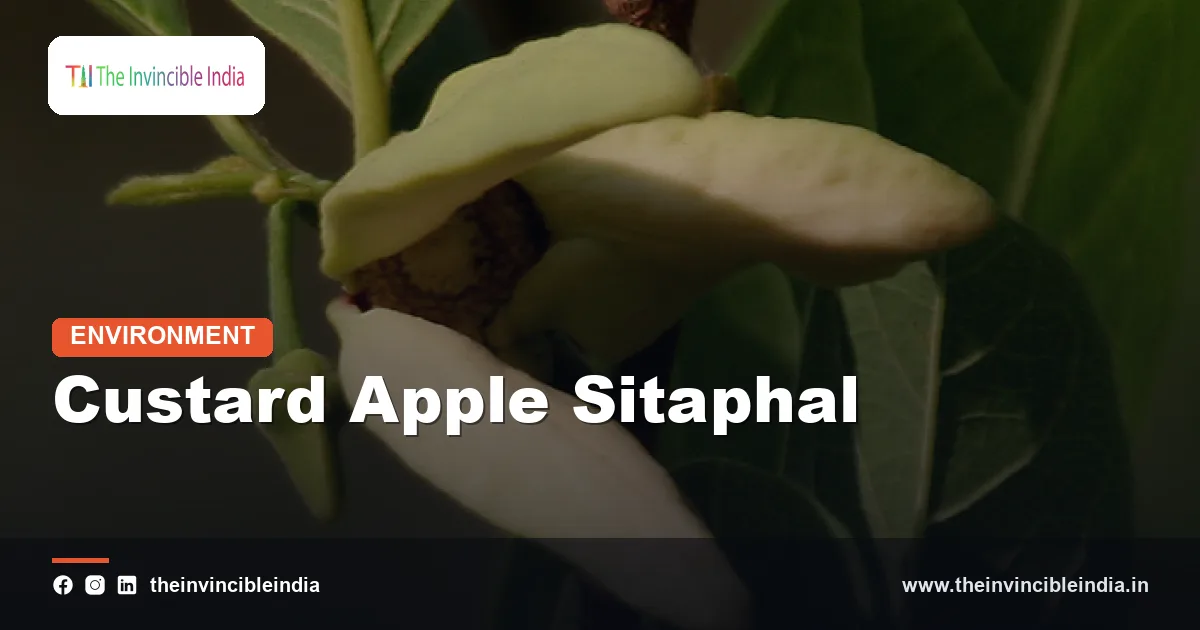
The custard apple (Annona squamosa), known in Hindi and Marathi as sitaphal and in English as the sugar apple, is a small, hardy, fruit-bearing tree that thrives in the dry and semi-arid parts of India and ripens its sweet, creamy, seed-filled fruit after the monsoon. Although the tree is a native of the tropical Americas, it has been grown in India for several centuries and is now one of the country’s best-known dryland fruit crops.
The custard apple tree in India is valued for three reasons: it needs little water, it grows on poor and stony soils where few other fruit trees succeed, and it produces a fruit that sells at a good price in the autumn season. This explainer covers what the tree is, where it grows, how it is cultivated, how the fruit is eaten and what cautions apply.
Quick Facts
| Attribute | Details |
|---|---|
| Common names | Custard apple, sugar apple, sweetsop; sitaphal (Hindi, Marathi, Gujarati), seetha pazham (Tamil), sitaphalam (Telugu), ata (Bengali) |
| Scientific name | Annona squamosa |
| Plant family | Annonaceae (the soursop and cherimoya family) |
| Origin | Tropical Americas and the West Indies; introduced to India by European traders, generally dated to the 16th century |
| Tree type | Small, semi-deciduous tree, usually 3 to 6 metres tall |
| Fruiting season in India | Mainly August to October, after the south-west monsoon |
| Leading growing regions | Maharashtra, Gujarat, Andhra Pradesh, Telangana, Karnataka, Madhya Pradesh, Odisha and Rajasthan |
| Popular varieties | Balanagar, Mammoth, Red Sitaphal, Arka Sahan, NMK-1 (Golden) |
Key Takeaways
- The custard apple (Annona squamosa) is a small drought-hardy tree native to tropical America that was brought to India roughly 500 years ago and is now grown widely on dry, stony land.
- Custard apple fruit in India ripens mostly between August and October, soon after the monsoon, and the fruit is picked hard and softens within a few days.
- Custard apple flowers are usually pollinated poorly by insects, so growers often improve fruit set by hand pollination in the morning hours.
- The black seeds of the custard apple are not meant to be eaten, because crushed seeds contain toxic compounds and have traditionally been used as a natural insecticide.
- Maharashtra, especially districts around Beed, Solapur and Pune, is widely regarded as the heartland of commercial sitaphal production in India.
- Custard apple pulp is sweet and energy-dense, and it offers vitamin C, dietary fibre and potassium, but people watching their blood sugar should eat it in modest portions.
What is the custard apple tree?
The custard apple tree is a small, bushy, semi-deciduous tree of the Annona genus that bears rounded, knobbly, green fruits filled with sweet white pulp and black seeds. The scientific name Annona squamosa refers to the scale-like (squamose) pattern on the fruit rind, which is actually a set of fused carpels.
The tree is usually between 3 and 6 metres tall, with an open, irregular crown and slender, drooping branches. The leaves are oblong, pale green and slightly aromatic when crushed. In the dry season, the tree sheds most of its leaves, and it then flushes again with new growth just before flowering. This leaf-shedding habit is part of why the tree copes so well with the long dry months of peninsular India.
Several related species are also grown, including the cherimoya, the soursop and the atemoya, which is a hybrid between the custard apple and the cherimoya. Within India, however, the term sitaphal almost always refers to Annona squamosa.
Where does the custard apple come from and how did it reach India?
The custard apple originated in the tropical regions of the Americas and the Caribbean, and it reached India through European maritime trade, most commonly attributed to the Portuguese in the 16th century. From the Indian coast, the tree spread inland because its seeds germinate easily and the plant tolerates neglect.
Over time, the custard apple escaped from gardens and established itself on rocky hillsides, wasteland and field boundaries across the Deccan plateau and central India. In several districts, naturalised wild stands of the tree are harvested for fruit, a pattern that gave early rise to the commercial industry in areas such as Purandar near Pune and parts of Marathwada.
The Hindi and Marathi name sitaphal is popularly linked in folk tradition to Sita from the Ramayana, and a number of sitaphal-related place names and stories exist in regional lore. These are traditional associations rather than botanical records, and they reflect how fully the fruit has been absorbed into Indian culture.
Where is the custard apple grown in India?
The custard apple is grown mainly across the dry and semi-arid belts of Maharashtra, Gujarat, Andhra Pradesh, Telangana, Karnataka, Madhya Pradesh, Odisha and Rajasthan, with Maharashtra generally regarded as the leading state. The tree prefers a warm, dry climate with a distinct hot season and moderate rainfall.
Within Maharashtra, the districts of Beed, Solapur, Osmanabad (Dharashiv), Aurangabad (Chhatrapati Sambhajinagar), Jalna and Pune are especially associated with sitaphal. Much of the commercial planting is on light, murrum or gravelly soils that are unsuitable for water-hungry fruit crops. In Gujarat, the Saurashtra and central regions grow it, while in the south, Andhra Pradesh and Karnataka contribute significant volumes.
Statistics on area and production change from year to year, and they are reported through the National Horticulture Board and state horticulture departments. For that reason, current rankings are best checked against the latest official horticulture statistics rather than a fixed figure.
What climate and soil does the custard apple tree need?
The custard apple tree needs a warm tropical or subtropical climate, well-drained soil and a dry spell before flowering, and it dislikes waterlogging and hard frost. It grows best where annual rainfall is moderate and where temperatures during the growing season stay warm.
- Soil: Light, gravelly or sandy loam soils with good drainage are ideal. The tree can establish on shallow, stony ground, but heavy clay that holds water leads to root rot.
- Water: The tree is deeply drought-tolerant once established. Light irrigation during fruit development can improve fruit size, but excess water is more harmful than too little.
- Temperature: Warm days are required for good flowering and fruit set. Very cold weather and frost damage young shoots and flowers.
- Humidity: A dry period before flowering helps fruit set, whereas very humid weather during flowering can reduce pollination success.
Because of these needs, the custard apple has become a recommended crop for watershed development and rainfed horticulture programmes. It offers farmers on marginal land a fruit crop without the heavy irrigation demand of crops such as banana or grapes.
How is the custard apple cultivated?
Custard apple is cultivated by planting seedlings or grafted plants in pits at wide spacing, feeding them with farmyard manure, training the canopy and, in commercial orchards, pollinating the flowers by hand to improve fruit set. Orchards typically begin bearing in the third or fourth year after planting.
Propagation and planting
Traditionally, the tree has been raised from seed, which produces variable fruit quality. Improved orchards use grafted or budded plants of selected varieties so that fruit size, sweetness and seed count are more uniform. Planting is generally done at the start of the monsoon in pits filled with topsoil and organic manure, with spacing commonly about 5 to 6 metres between trees in rainfed conditions, and closer in intensively managed orchards.
Pruning and training
Light pruning after harvest removes dry and crowded branches and encourages fresh shoots. Because flowers appear on new growth, a pruned and managed tree tends to produce a more uniform crop. Many growers withhold water briefly in the hot season to induce flowering at the right time.
Hand pollination
Custard apple flowers are protogynous, meaning the female part becomes receptive before the pollen of the same flower is released. Natural pollination by small beetles is often inadequate, so growers collect pollen from freshly opened flowers and gently apply it to receptive flowers in the early morning. This labour-intensive step is one of the reasons commercial yields are higher in managed orchards than in wild stands.
Harvest
The fruit is harvested when it is mature but still firm, which is usually indicated by the spaces between the scale-like segments widening and the skin turning from deep green to a lighter, creamy-green shade. Fruits picked too early do not ripen well. After harvest, they soften within two to four days at room temperature, which makes handling and transport the main commercial challenge.
What are the main varieties of custard apple in India?
The main varieties of custard apple in India include Balanagar, Mammoth, Red Sitaphal, Arka Sahan and NMK-1 (Golden), and they differ mainly in fruit size, pulp quantity and seed count. Many orchards still contain unnamed local seedling types, which are smaller and more seedy than selected varieties.
| Variety | Notable features |
|---|---|
| Balanagar | Selected in Telangana; large, relatively regular fruit with good pulp, widely planted in the south |
| Mammoth | Known for large fruit size and comparatively fewer seeds |
| Red Sitaphal | A type with reddish-purple fruit skin; less common but valued for its colour |
| Arka Sahan | A hybrid developed by the Indian Institute of Horticultural Research (IIHR), Bengaluru, noted for large, sweet fruits |
| NMK-1 (Golden) | A selection from Maharashtra popular with commercial growers for its large, attractive fruit |
| Local seedling types | Variable in quality; common in wild and traditional plantings |
Variety names and their characteristics are described by research institutions and state agricultural universities, and farmers usually choose based on local advice, market demand and the availability of planting material.
What pests and diseases affect the custard apple?
The most important pest of the custard apple is the mealybug, followed by fruit borers and fungal problems such as anthracnose and wilt, which can reduce yield if orchards are poorly managed. The tree is generally regarded as a low-input crop, but pest pressure rises in humid or crowded conditions.
- Mealybugs: These sap-sucking insects cluster on shoots and fruit, coat them with a white waxy layer and encourage sooty mould. Orchard sanitation and biological control are commonly recommended.
- Fruit borers: Larvae can tunnel into developing fruit and make it unmarketable.
- Anthracnose and fruit rots: Fungal infections can cause dark lesions on leaves and fruit, especially in humid weather.
- Root and collar problems: Waterlogging favours root rot, which is why drainage is stressed in orchard planning.
Integrated pest management, which combines clean orchards, pruning, natural predators and careful spraying only when needed, is the approach advised by agricultural extension services.
How is sitaphal eaten and used?
Sitaphal is eaten fresh by breaking the ripe fruit open and scooping out the soft, sweet pulp while spitting out the hard black seeds, and the pulp is also used in desserts, milkshakes and ice cream. A ripe fruit yields a custard-like, slightly granular pulp with a flavour often compared to vanilla and pear.
- Fresh eating: The most common use; the fruit is simply split by hand.
- Rabri and basundi: In Maharashtra and Gujarat, sitaphal pulp is folded into sweetened thickened milk to make sitaphal basundi, a seasonal dessert.
- Ice cream and shakes: Seedless pulp is a popular flavour for ice cream and chilled beverages, and a processing industry for frozen pulp exists to supply these year-round.
- Other uses: The pulp can be blended into smoothies and puddings.
Processing units freeze the pulp so that sitaphal desserts remain available outside the short natural season. Seed removal is the main labour step, since the pulp is mixed closely with seeds.
Is custard apple healthy, and what precautions apply?
Custard apple is a nutritious, energy-dense fruit that provides vitamin C, dietary fibre, potassium and some B-vitamins, but it is also high in natural sugars, so portions should be moderate. Nutrient values vary by variety and ripeness, and published food composition tables should be consulted for exact figures.
Traditional systems of medicine have used various parts of the tree, including the leaves and bark, for home remedies. Such uses are traditional, and scientific evidence for specific medical benefits is limited, so the fruit is best viewed as a food rather than a treatment.
Safety notes
- The seeds should not be chewed or swallowed. Crushed seeds contain compounds that are toxic, and the powder can irritate the eyes badly.
- Seed powder has traditionally been used against head lice and as a crop insecticide, but this use is not a safe home remedy for people.
- People with diabetes should ask a doctor or dietitian about portion size because of the fruit’s sugar content.
- People with a known allergy to related fruits should be cautious when trying it for the first time.
Why does the custard apple matter for Indian farmers and the environment?
The custard apple matters because it offers a drought-tolerant, low-input fruit crop for degraded and rainfed land, which supports rural incomes while keeping marginal land productive. The tree needs far less irrigation than many commercial fruits, and its early-autumn harvest fits a seasonal market with strong demand.
Environmentally, perennial orchards on hill slopes and wasteland help hold soil, add leaf litter and provide some shade and habitat. Dryland horticulture programmes in states such as Maharashtra and Andhra Pradesh have promoted the crop as part of livelihood and watershed development.
The main challenges are the fruit’s short shelf life, uneven ripening, pollination difficulties and the effort needed to market a soft, easily bruised product. Better cold chains, pulp processing and improved varieties are the main routes for addressing them.
How does the custard apple compare with other dryland fruit trees?
The custard apple is one of several hardy fruit trees suited to dry India, and it is distinguished by its post-monsoon fruiting, soft creamy pulp and its high seed content. The comparison below summarises how it differs from other commonly planted dryland fruits.
| Tree | Typical fruiting season | Key strength | Main challenge |
|---|---|---|---|
| Custard apple (sitaphal) | August to October | Creamy sweet pulp; thrives on poor land | Short shelf life; seedy pulp |
| Pomegranate (anar) | Varies with flowering season (bahar) | Good storage and export demand | Bacterial blight; needs careful management |
| Ber (Indian jujube) | Winter to early spring | Extremely hardy; low input | Pruning and fruit fly |
| Guava (amrud) | Two main crops a year | Adaptable and high-yielding | Fruit fly and market gluts |
Bottom Line
The custard apple is a hardy, post-monsoon fruit tree that has become a dependable crop for dry regions of India, particularly Maharashtra. It rewards good pollination and orchard care, but its soft fruit and toxic seeds call for careful handling and sensible eating.
Frequently Asked Questions
What is a custard apple called in Hindi?
The custard apple is called sitaphal in Hindi and Marathi. It is also known as the sugar apple or sweetsop in English. The scientific name of the common species is Annona squamosa.
When is custard apple in season in India?
Custard apple is in season in India mainly from August to October, soon after the monsoon. Exact timing varies by region and variety. Frozen pulp is used to supply desserts and ice cream outside this window.
Can you eat the seeds of a custard apple?
No, the seeds of a custard apple should not be eaten. They are hard and contain toxic compounds, and crushed seed powder can seriously irritate the eyes. Only the soft white pulp is meant to be eaten.
How long does a custard apple tree take to bear fruit?
A custard apple tree usually starts bearing fruit three to four years after planting, especially when grafted plants are used. Seedling trees can take somewhat longer and give more variable fruit. Yield rises as the tree matures and is well managed.
How do you know when a custard apple is ripe?
A custard apple is ripe when the fruit yields to gentle pressure and the gaps between its scale-like segments have widened. The skin turns from deep green to a lighter, creamy shade. Fruits picked mature but firm soften at room temperature within a few days.
Is custard apple good for people with diabetes?
Custard apple contains a fair amount of natural sugar, so people with diabetes should eat it only in small portions and after consulting a doctor or dietitian. The fruit does offer fibre, but it should not be treated as a remedy for any condition. Individual blood sugar responses differ.
{“@context”:”https://schema.org”,”@graph”:[{“@type”:”FAQPage”,”mainEntity”:[{“@type”:”Question”,”name”:”What is a custard apple called in Hindi?”,”acceptedAnswer”:{“@type”:”Answer”,”text”:”The custard apple is called sitaphal in Hindi and Marathi. It is also known as the sugar apple or sweetsop in English. The scientific name of the common species is Annona squamosa.”}},{“@type”:”Question”,”name”:”When is custard apple in season in India?”,”acceptedAnswer”:{“@type”:”Answer”,”text”:”Custard apple is in season in India mainly from August to October, soon after the monsoon. Exact timing varies by region and variety. Frozen pulp is used to supply desserts and ice cream outside this window.”}},{“@type”:”Question”,”name”:”Can you eat the seeds of a custard apple?”,”acceptedAnswer”:{“@type”:”Answer”,”text”:”No, the seeds of a custard apple should not be eaten. They are hard and contain toxic compounds, and crushed seed powder can seriously irritate the eyes. Only the soft white pulp is meant to be eaten.”}},{“@type”:”Question”,”name”:”How long does a custard apple tree take to bear fruit?”,”acceptedAnswer”:{“@type”:”Answer”,”text”:”A custard apple tree usually starts bearing fruit three to four years after planting, especially when grafted plants are used. Seedling trees can take somewhat longer and give more variable fruit. Yield rises as the tree matures and is well managed.”}},{“@type”:”Question”,”name”:”How do you know when a custard apple is ripe?”,”acceptedAnswer”:{“@type”:”Answer”,”text”:”A custard apple is ripe when the fruit yields to gentle pressure and the gaps between its scale-like segments have widened. The skin turns from deep green to a lighter, creamy shade. Fruits picked mature but firm soften at room temperature within a few days.”}},{“@type”:”Question”,”name”:”Is custard apple good for people with diabetes?”,”acceptedAnswer”:{“@type”:”Answer”,”text”:”Custard apple contains a fair amount of natural sugar, so people with diabetes should eat it only in small portions and after consulting a doctor or dietitian. The fruit does offer fibre, but it should not be treated as a remedy for any condition. Individual blood sugar responses differ.”}}]}]}


