

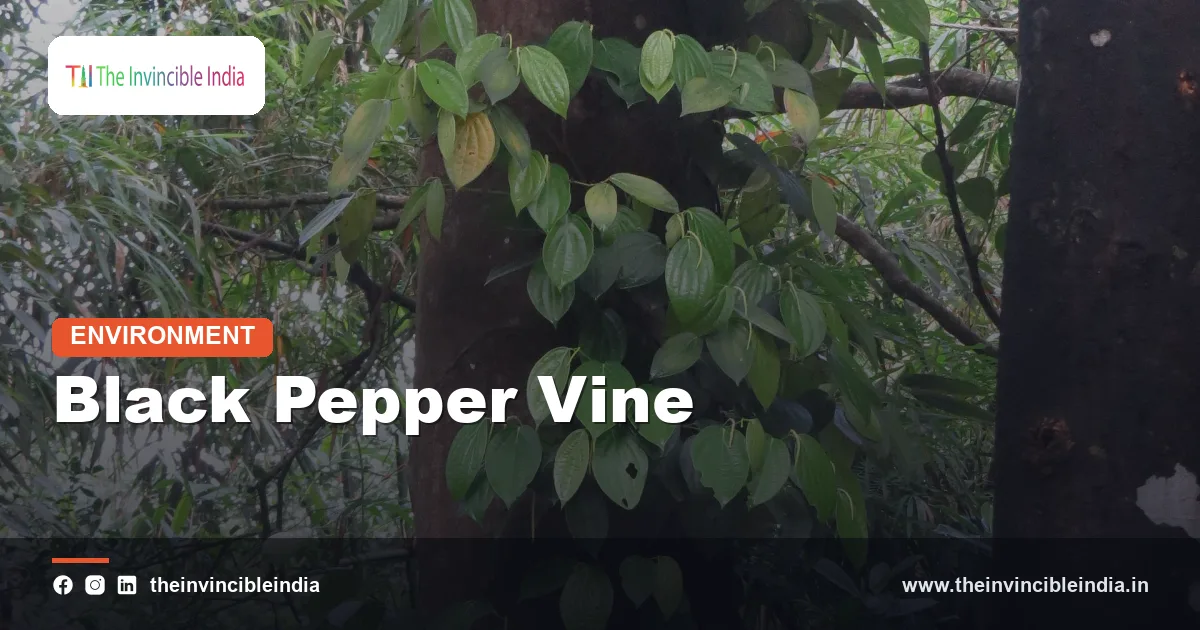
Black pepper (Piper nigrum) is the dried, unripe fruit of a perennial climbing vine native to the Western Ghats of southern India, and it is known worldwide as the “king of spices” for its sharp heat and its long role in global trade. The vine grows mainly in Kerala, Karnataka and Tamil Nadu, where it climbs on shade trees in plantations and home gardens, and it was the spice that drew traders from Rome, Arabia and later Portugal to the Malabar Coast.
The black pepper vine is called kali mirch in Hindi, kurumulaku in Malayalam and milagu in Tamil. This explainer, last updated 23 October 2026, covers the botany, cultivation, processing, history and uses of the black pepper vine in India.
| Quick Fact | Detail |
|---|---|
| Scientific name | Piper nigrum |
| Plant family | Piperaceae (the pepper family) |
| Common names | Black pepper, kali mirch, kurumulaku, milagu, miriyalu, menasu, king of spices, black gold |
| Plant type | Perennial woody climbing vine, often 4 to 10 metres on supports |
| Native range | Western Ghats of southern India (Malabar region) |
| Main Indian producers | Kerala (largest share), Karnataka, Tamil Nadu |
| Pungent compound | Piperine, with aroma from essential oils |
| Harvest season | Roughly November to March, depending on the region and altitude |
| Governing bodies | Spices Board India (Kochi) and ICAR-Indian Institute of Spices Research (Kozhikode) |
Key Takeaways
- Black pepper is the dried fruit of Piper nigrum, a climbing vine that is native to the Western Ghats of southern India.
- Black, green, white and red peppercorns all come from the same Piper nigrum vine and differ only in ripeness and processing.
- Kerala is India’s main black pepper producing state, and Malabar and Tellicherry are the best-known Indian pepper names in world trade.
- The search for black pepper and other spices on the Malabar Coast was a major motive for Vasco da Gama’s 1498 voyage from Portugal to Calicut.
- The heat of black pepper comes mostly from piperine, a compound that is also studied for its effect on the absorption of some nutrients and drugs.
- India is one of the world’s leading producers and consumers of black pepper, but Vietnam is generally recognised as the largest producer by volume.
What is the black pepper vine?
The black pepper vine is a perennial, evergreen climber of the pepper family, Piperaceae, grown for its small round fruits called peppercorns. The vine clings to a support tree with short aerial roots, and its heart-shaped, glossy, dark-green leaves are borne alternately along woody stems.
The flowers of the black pepper vine are tiny and borne on hanging spikes, and each spike develops into a string of berries that turn from green to red when ripe. A well-grown vine carries many spikes, each holding dozens of berries.
Black pepper is related to long pepper (Piper longum, pippali) and betel (Piper betle), which are also valued in Indian medicine and everyday life. Black pepper should not be confused with chilli, a New World plant from a different family that reached India only after the sixteenth century. Until chilli arrived, black pepper provided most of the heat in Indian cooking.
Where does black pepper grow in India?
Black pepper grows in India mainly along the Western Ghats and the Malabar Coast in Kerala, Karnataka and Tamil Nadu, with Kerala accounting for the largest share of the country’s production. Districts such as Idukki, Wayanad and Kozhikode in Kerala and Kodagu and Uttara Kannada in Karnataka are well known for pepper.
The vine needs a warm, humid climate with well-distributed rain, and it is happiest from sea level up to about 1,500 metres. It does best in deep, well-drained, fertile soils rich in organic matter, and it cannot tolerate waterlogging. Smaller plantings exist in the Northeast and in parts of the Andaman and Nicobar Islands, where the climate is also suitable.
Black pepper is mostly a smallholder crop in India. Many farmers grow a few hundred vines in mixed gardens with coconut, arecanut, coffee or rubber, which is one of the reasons the crop is spread across thousands of small farms rather than a few large estates.
How is black pepper grown?
Black pepper is grown by planting rooted cuttings next to a living support tree, called a standard, which the vine climbs for light. The standards are often trees such as Erythrina (the “mandharam”), Garuga, silver oak (Grevillea robusta) or jackfruit, and in coffee estates the vine climbs on the shade trees themselves.
Planting and care
- Planting material: Rooted runner shoots or cuttings from healthy mother vines, planted at the start of the monsoon.
- Shade: Light to moderate shade early on, with the vine trained up the standard.
- Nutrition: Organic manure and balanced fertilisers, with attention to soil acidity, since many pepper soils are acidic.
- Drainage: Mounds or trenches help avoid water collecting around the roots.
- Time to bearing: Vines usually begin to yield in the third year and reach full production after about six to eight years.
- Productive life: Well-managed vines can continue to bear for decades.
Common varieties
Karimunda is the most widely grown traditional cultivar in Kerala, valued for its hardiness and adaptability. Panniyur 1, released from the Pepper Research Station at Panniyur in Kerala, was India’s first hybrid pepper variety and is known for its high yield. Improved selections from the ICAR-Indian Institute of Spices Research, such as Subhakara, Sreekara and Panchami, were released to give better yield and quality.
How is black pepper made from the vine?
Black pepper is made by harvesting the berries when they are fully grown but still green or just starting to turn red, then drying them in the sun until the skin shrivels and blackens. The dark colour develops as enzymes in the outer layer oxidise during drying.
- Spikes are picked by hand once a few berries on the spike begin to turn yellow or red.
- The berries are separated from the spikes by hand or by simple threshers.
- Many farmers briefly dip the berries in hot water to speed up browning and clean the surface.
- The berries are spread in the sun for several days until they are dry and about one-third of their fresh weight.
- The dried pepper is cleaned, sorted and graded by size and density before sale.
Cleaned black pepper is graded by bulk density, with heavier, bigger berries fetching higher prices. Moisture control is important to prevent mould and to meet food safety limits in export markets.
What is the difference between black, white, green and red pepper?
Black, white, green and red peppercorns all come from the same Piper nigrum vine and differ only in the stage of ripeness at harvest and in how they are processed. The colour and flavour change with the treatment given to the berry.
| Type | Harvest stage | Processing | Flavour |
|---|---|---|---|
| Black pepper | Mature but unripe, green to just turning red | Sun-dried with the skin on | Hot, sharp and aromatic |
| White pepper | Fully ripe, red | Soaked to remove the outer skin, then dried | Milder, earthy and slightly fermented |
| Green pepper | Unripe, green | Brined, freeze-dried or pickled; not sun-dried | Fresh, fruity and gentler |
| Red pepper (ripe) | Fully ripe, red | Preserved in brine or vinegar or carefully dried | Sweet and fruity, less pungent |
Pink peppercorns sold in shops are usually a different plant (Schinus), and they are not a form of black pepper.
Why is Indian black pepper called Malabar and Tellicherry pepper?
Indian black pepper is called Malabar pepper because it is traditionally produced and exported from the Malabar Coast of Kerala, and the Tellicherry name refers to larger, bolder berries originally graded at the port of Tellicherry, now Thalassery. Both are trade names that carry a reputation for aroma and size.
Malabar pepper has been given a Geographical Indication (GI) registration in India, which protects the name for pepper grown in the defined region. Tellicherry Garbled Extra Bold, often shortened to TGEB, is a premium grade for the largest berries from selected lots.
Buyers often judge Indian pepper on berry size, bulk density, piperine content and the amount of volatile oil. The Spices Board India sets quality grades for export, and international buyers also test for moisture, extraneous matter and pesticide residue.
How did black pepper shape history and trade?
Black pepper shaped history because it was among the first and most valuable Indian goods traded across the Indian Ocean and to Europe, and its trade helped build ports, empires and sea routes. Pepper from the Malabar Coast was reaching Egypt, Greece and Rome more than two thousand years ago.
| Period | Event |
|---|---|
| Ancient period | Pepper from Malabar travels to Egypt, Arabia and the Mediterranean; ports such as Muziris become important trading centres. |
| Roman era | Rome imports pepper in large quantity from southern India, and pepper warehouses are recorded in the city. |
| Early fifth century CE | Pepper is among the goods demanded in the ransom of Rome by Alaric the Visigoth, according to ancient accounts. |
| Medieval period | Arab, Venetian and Genoese merchants control the overland and Red Sea trade, keeping prices high in Europe. |
| 1498 | Vasco da Gama’s fleet reaches Calicut, opening the direct sea route from Europe to India. |
| Colonial period | The Portuguese, Dutch and later the British compete for control of the pepper trade on the Malabar Coast. |
| Modern era | Production spreads to Vietnam, Indonesia, Brazil and other countries, and India becomes one of several major producers. |
Pepper was so valuable that it was once counted and sold peppercorn by peppercorn, and the expression “peppercorn rent” survives today for a nominal payment.
What is black pepper used for?
Black pepper is used mainly as a seasoning that adds heat and aroma to food, and it is also used in Ayurveda and folk medicine, in food preservation and in the extraction of oleoresin and essential oil. It is one of the most widely used spices in the world.
- Cooking: Ground into curries, masalas, rasam, soups, marinades and spice blends such as garam masala; pepper is also used whole in tempering and in pepper-based dishes of Kerala and Chettinad.
- Home remedies: Pepper with honey, ginger or tulsi is a traditional home preparation for coughs and colds, and it is one of the three pungent ingredients in the Ayurvedic mix trikatu.
- Industry: Oleoresin and essential oil are extracted for flavouring, fragrance and food processing.
- Preservation: Pepper’s pungency and antimicrobial properties made it a useful meat and pickle ingredient before refrigeration.
What does science say about piperine?
Piperine is the main pungent compound in black pepper, and laboratory and some human studies suggest it can increase the absorption of certain nutrients and drugs, such as curcumin from turmeric. This is why pepper is often combined with turmeric in modern supplements and in traditional recipes. Claims that pepper treats disease, however, are not firmly established, and large amounts can irritate the stomach. People on medication should ask a doctor before taking concentrated piperine supplements.
What problems do black pepper farmers face?
Black pepper farmers face fungal diseases, price swings, ageing plantations and competition from imports. The best-known disease is quick wilt or foot rot, caused by a Phytophthora fungus that thrives in heavy monsoon rain and can kill a vine in a short time.
- Diseases: Quick wilt (foot rot), slow decline, and viral problems such as stunt disease.
- Pests: Pollu beetle, which hollows the berries, and scale insects and mealybugs.
- Climate stress: Erratic rainfall and rising temperatures affect flowering and berry set.
- Prices: Global supply and imports cause price swings that squeeze small farmers.
- Replanting: Old, low-yielding vines need replacing, but replanting takes years to pay back.
Research bodies such as ICAR-Indian Institute of Spices Research and the Kerala Agricultural University work on disease-resistant varieties, nursery hygiene, and better drainage practices to protect pepper vines.
Bottom Line
Black pepper is a southern Indian vine that became one of the most important spices in world history, and it remains a core crop of Kerala and the Western Ghats. The same Piper nigrum vine gives black, white, green and red pepper, and its value rests on a long record of use in food, trade and traditional medicine.
Frequently Asked Questions
Is black pepper native to India?
Yes, black pepper is native to the Western Ghats of southern India, particularly the Malabar region. The wild ancestors of Piper nigrum still grow in the evergreen forests of the Ghats. Cultivation then spread to Southeast Asia and other tropical regions.
Are black and white pepper from the same plant?
Yes, black and white pepper both come from the Piper nigrum vine. Black pepper is made from berries picked before full ripeness and dried with the skin on, while white pepper comes from fully ripe berries whose outer skin is removed after soaking. White pepper is usually milder and has a different aroma.
Which Indian state produces the most black pepper?
Kerala produces the largest share of India’s black pepper, followed by Karnataka and Tamil Nadu. Wayanad and Idukki in Kerala are major pepper districts, and Kodagu is important in Karnataka. Production in each state varies with weather and disease from year to year.
How long does a black pepper vine take to bear fruit?
A black pepper vine usually begins to bear fruit in about three years and reaches full yield after six to eight years. Vines raised from cuttings of healthy mother plants bear earlier than seedlings. A well-cared vine can remain productive for many years.
What is Tellicherry pepper?
Tellicherry pepper is a premium grade of Indian black pepper made up of larger, bolder berries, named after the port of Tellicherry, now Thalassery, in Kerala. The best-known grade is Tellicherry Garbled Extra Bold (TGEB). The name describes a size and quality grade rather than a different plant.
Does black pepper have health benefits?
Black pepper contains piperine, which may improve the absorption of some nutrients, and it is used in traditional remedies for coughs and digestion. These uses are traditional, and strong claims of curing disease are not proven. Pepper is safe as a seasoning for most people, but large medicinal doses may upset the stomach.
{“@context”:”https://schema.org”,”@graph”:[{“@type”:”FAQPage”,”mainEntity”:[{“@type”:”Question”,”name”:”Is black pepper native to India?”,”acceptedAnswer”:{“@type”:”Answer”,”text”:”Yes, black pepper is native to the Western Ghats of southern India, particularly the Malabar region. The wild ancestors of Piper nigrum still grow in the evergreen forests of the Ghats. Cultivation then spread to Southeast Asia and other tropical regions.”}},{“@type”:”Question”,”name”:”Are black and white pepper from the same plant?”,”acceptedAnswer”:{“@type”:”Answer”,”text”:”Yes, black and white pepper both come from the Piper nigrum vine. Black pepper is made from berries picked before full ripeness and dried with the skin on, while white pepper comes from fully ripe berries whose outer skin is removed after soaking. White pepper is usually milder and has a different aroma.”}},{“@type”:”Question”,”name”:”Which Indian state produces the most black pepper?”,”acceptedAnswer”:{“@type”:”Answer”,”text”:”Kerala produces the largest share of India’s black pepper, followed by Karnataka and Tamil Nadu. Wayanad and Idukki in Kerala are major pepper districts, and Kodagu is important in Karnataka. Production in each state varies with weather and disease from year to year.”}},{“@type”:”Question”,”name”:”How long does a black pepper vine take to bear fruit?”,”acceptedAnswer”:{“@type”:”Answer”,”text”:”A black pepper vine usually begins to bear fruit in about three years and reaches full yield after six to eight years. Vines raised from cuttings of healthy mother plants bear earlier than seedlings. A well-cared vine can remain productive for many years.”}},{“@type”:”Question”,”name”:”What is Tellicherry pepper?”,”acceptedAnswer”:{“@type”:”Answer”,”text”:”Tellicherry pepper is a premium grade of Indian black pepper made up of larger, bolder berries, named after the port of Tellicherry, now Thalassery, in Kerala. The best-known grade is Tellicherry Garbled Extra Bold (TGEB). The name describes a size and quality grade rather than a different plant.”}},{“@type”:”Question”,”name”:”Does black pepper have health benefits?”,”acceptedAnswer”:{“@type”:”Answer”,”text”:”Black pepper contains piperine, which may improve the absorption of some nutrients, and it is used in traditional remedies for coughs and digestion. These uses are traditional, and strong claims of curing disease are not proven. Pepper is safe as a seasoning for most people, but large medicinal doses may upset the stomach.”}}]}]}


