

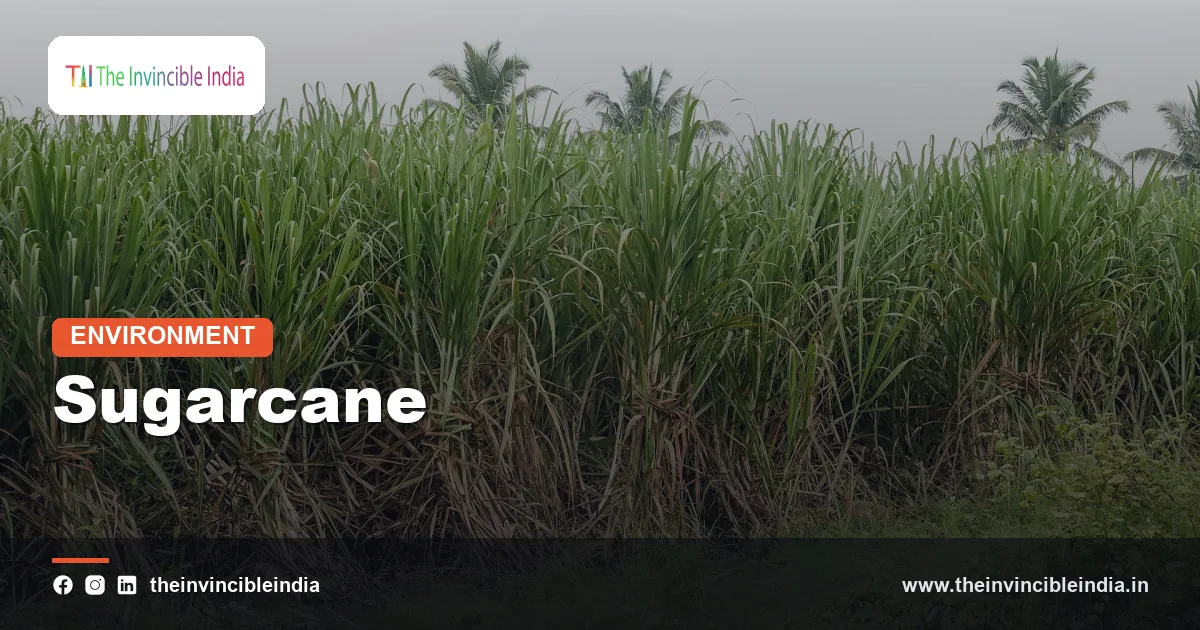
Sugarcane in India is a tall, perennial giant grass (Saccharum officinarum and its hybrids) grown for the sucrose-rich juice in its stalks, which is turned into sugar, jaggery, khandsari, molasses and, increasingly, fuel ethanol. India is the world’s second-largest sugarcane and sugar producer after Brazil and is also the largest consumer of sugar, with Uttar Pradesh, Maharashtra and Karnataka forming the core of the industry.
The sugarcane crop supports tens of millions of farming families and a network of several hundred sugar mills, and it shapes rural politics, groundwater use and energy policy in the states where it dominates. This explainer covers what the crop is, how it is grown, where it thrives, how prices are set, and why its water demand and ethanol role matter. It was last reviewed on 23 October 2026.
| Attribute | Detail |
|---|---|
| Scientific name | Saccharum officinarum (noble cane) and modern Saccharum hybrids; family Poaceae (grasses) |
| Crop type | Perennial grass grown as a commercial crop, usually harvested as a plant crop followed by one or more ratoon crops |
| Typical duration | About ten to eighteen months from planting to harvest, depending on region and planting season |
| India’s global rank | Second-largest producer after Brazil; among the very largest consumers of sugar |
| Leading states | Uttar Pradesh, Maharashtra and Karnataka, followed by Tamil Nadu, Gujarat, Bihar, Haryana and Punjab |
| Main products | Sugar, jaggery (gur), khandsari, molasses, ethanol, bagasse-based power |
| Price mechanism | Fair and Remunerative Price (FRP) set by the Centre; some states announce a higher State Advised Price (SAP) |
| Key research body | ICAR-Sugarcane Breeding Institute, Coimbatore (founded in 1912) |
| Sugar season | October to September, with crushing running roughly from October-November to March-April |
Key Takeaways
- Sugarcane is a perennial grass whose stalks store sucrose, and India grows it as a commercial crop for sugar, jaggery, ethanol and power.
- India is the second-largest producer of sugarcane and sugar in the world after Brazil, and it is also among the biggest consumers of sugar.
- Uttar Pradesh, Maharashtra and Karnataka together account for the bulk of India’s sugarcane and sugar output.
- Sugarcane is a water-intensive crop, and its heavy irrigation use in water-stressed regions such as Maharashtra and Karnataka is a long-running policy concern.
- The Central government fixes a Fair and Remunerative Price (FRP) for cane each season, and mills are legally expected to pay farmers within a short statutory period after delivery.
- India’s ethanol blending programme uses cane juice, syrup and molasses to blend ethanol into petrol, and the country reached its 10 per cent blending milestone in 2022.
What Is Sugarcane and How Does It Grow?
Sugarcane is a thick-stemmed tropical grass that stores sugar in its jointed stalks, which can grow three to five metres tall. The plant is propagated not by seed but by planting stalk cuttings called setts, each carrying at least two or three buds, and these sprout into new shoots called tillers.
A healthy cane clump may carry many stalks, and each stalk is divided into nodes and internodes. As the crop matures, the stalks accumulate sucrose, and the sugar content, called the recovery rate, peaks in the cooler, drier months before harvest. The leaves and the dried tops are removed as trash, and the stalks are cut at ground level.
After harvest, the stubble left in the field regrows without replanting, and this second crop is called the ratoon. A farmer may take one or two ratoon crops from a single planting, which lowers the cost of cultivation but often brings lower yields and more pest build-up.
What Is the History of Sugarcane in India?
Sugarcane has been cultivated in the Indian subcontinent for well over two thousand years, and India is widely recognised as one of the earliest places where cane juice was crystallised into solid sugar. The English word “sugar” is traced through Arabic and Persian to the Sanskrit sharkara, which meant grit or granulated sugar.
Early Indian texts describe jaggery and cane products, and Indian sugar-making techniques spread along trade routes to Persia, the Arab world and later Europe. During the colonial period the crop was expanded in several parts of India, including the Gangetic plain. After independence, the cooperative sugar mill movement, especially in Maharashtra, helped link farmers directly to processing.
The Sugarcane Breeding Institute, set up at Coimbatore in 1912, played a central role in developing high-yielding, high-sugar cane varieties. Its Co series of varieties, named after Coimbatore, remains the basis of much of the cane grown across the country.
Where Is Sugarcane Grown in India?
Sugarcane is grown in two broad zones in India: the sub-tropical belt of the north, led by Uttar Pradesh, and the tropical belt of the peninsula, led by Maharashtra, Karnataka and Tamil Nadu. The two zones differ in climate, which affects crop duration, sugar recovery and the length of the crushing season.
| Zone | Main states | Features |
|---|---|---|
| Sub-tropical (north) | Uttar Pradesh, Bihar, Haryana, Punjab, Uttarakhand | Cold winters and hot summers; usually a roughly twelve-month crop; larger area but generally lower sugar recovery |
| Tropical (peninsular) | Maharashtra, Karnataka, Tamil Nadu, Andhra Pradesh, Telangana, Gujarat | Warm all year; longer crop cycles; higher sugar recovery and a long crushing season |
Uttar Pradesh has the largest area under cane, and its western and central districts are heavily cane-dependent. Maharashtra produces a large share of the country’s sugar, especially from the Pune, Kolhapur, Solapur and Marathwada regions, while Karnataka’s Belagavi and Mandya belts are other major clusters.
How Is Sugarcane Planted and Harvested?
Sugarcane in India is planted in three main seasons, namely spring (February to March), autumn (October) and, in Maharashtra, the longer adsali crop planted in July to August, which stays in the field for roughly sixteen to eighteen months. The right season depends on the climate zone and on irrigation availability.
Planting
Farmers plant setts in furrows after deep ploughing and manuring. Many now use the trench method or sett treatment with fungicides, and some use bud-chip or tissue-culture seedlings to improve seed quality. Spacing, soil fertility and early weed control strongly influence the final yield.
Irrigation and nutrients
Cane needs plentiful water during its grand growth phase, together with nitrogen, phosphorus and potassium. Traditional flood irrigation is still widespread, though drip irrigation and fertigation are being promoted to save water and raise yields.
Harvest
Harvesting is mostly done by hand with sharp knives, and the cut cane must reach the mill quickly because sucrose declines after cutting. Mechanical harvesters are spreading in larger holdings and in labour-short regions, but manual harvesting by migrant gangs of workers remains common in many areas.
What Products Are Made from Sugarcane?
Sugarcane yields white sugar, jaggery, khandsari, molasses, ethanol, bagasse and press mud, and each product forms a separate stream of the industry. Because almost every part of the plant is used, sugarcane is often described as a crop with very little waste.
- Sugar: produced in mills through crushing, juice clarification, evaporation and crystallisation; sold as raw, plantation white or refined sugar.
- Jaggery (gur): made by boiling cane juice in open pans, often in small units, and widely eaten in rural India and used in sweets.
- Khandsari: a traditional, less refined crystalline sugar made by small-scale units.
- Molasses: a dark syrup left after crystallisation, used to make ethanol, alcohol and animal feed.
- Bagasse: the fibrous residue left after crushing, burned in mills to produce steam and electricity, and also used in paper and board making.
- Press mud: a nutrient-rich by-product used as manure and in biogas or compost production.
- Cane juice: sold fresh as a roadside drink across India, especially in summer.
How Is the Price of Sugarcane Decided in India?
The price of sugarcane in India is set by the Central government as a Fair and Remunerative Price (FRP), which is announced each season on the recommendation of the Commission for Agricultural Costs and Prices (CACP) after consulting states. The FRP is the minimum price that sugar mills must pay farmers for cane.
The legal framework rests on the Sugarcane (Control) Order, 1966, issued under the Essential Commodities Act, 1955. Some states, including Uttar Pradesh, Haryana and Punjab, announce a State Advised Price (SAP) that is higher than the FRP, which can strain mill finances when sugar prices are low.
Under the order, mills are expected to pay cane price within fourteen days of delivery, and delayed payment attracts interest. In practice, arrears to farmers have been a recurring political issue in several seasons, which is why the government has used tools such as minimum selling prices for sugar, export policy and ethanol procurement to improve mill cash flow.
Why Is Sugarcane Called a Water-Intensive Crop?
Sugarcane is called water-intensive because it stays in the field for a year or more and needs far more irrigation per hectare than most other crops, such as pulses or millets. Producing a kilogram of sugar is often estimated to need thousands of litres of water when rainfall and irrigation are counted together.
This matters because a large share of Indian cane is grown in regions that are already dry, notably parts of Maharashtra and Karnataka, where groundwater is overdrawn. Policymakers and agricultural scientists have promoted drip irrigation, trash mulching, alternate-furrow irrigation and shifts to less thirsty crops in drought-prone districts.
The issue is delicate because sugarcane gives farmers a relatively assured price and market through the mill, which makes it hard for many of them to switch. Reducing the water footprint is therefore a question of incentives as much as technology.
How Does Sugarcane Power India’s Ethanol Programme?
Sugarcane feeds India’s ethanol blending programme by supplying cane juice, sugar syrup and B-heavy or C-heavy molasses that distilleries convert into ethanol for mixing with petrol. The Ethanol Blended Petrol (EBP) programme was expanded under the National Policy on Biofuels, 2018.
India reached about 10 per cent ethanol blending in petrol in 2022, ahead of the original schedule, and then advanced its target of 20 per cent blending, known as E20, to 2025-26. The government says the programme helps cut crude oil imports, reduce emissions and give mills and farmers an additional revenue stream, particularly in years of surplus sugar.
The policy also raises trade-offs. Diverting more cane to ethanol can tighten sugar supplies and prompt export curbs, and the water used by cane remains a concern. For this reason, policy now encourages ethanol from other feedstocks such as grain as well.
What Are the Main Problems Facing Sugarcane Farmers?
The main problems facing Indian sugarcane farmers are delayed payments, rising input costs, water scarcity, pests and disease, and weak diversification options. Climate variability has added to the risk, with droughts and floods in different seasons affecting both cane yield and sugar recovery.
| Issue | What it means |
|---|---|
| Payment arrears | Mills sometimes pay cane price late, leaving farmers short of working capital |
| Red rot disease | A fungal disease that has destroyed popular varieties and forces regular varietal replacement |
| Varietal ageing | Overreliance on a few popular varieties leaves the crop exposed to pests and disease |
| Groundwater depletion | Heavy irrigation draws down aquifers in cane-growing districts |
| Trash burning | Burning leaf residue after harvest adds to air pollution and soil loss of organic matter |
| Labour shortage | Manual harvest depends on seasonal migrant workers, and gaps raise costs |
Who Regulates the Sugar Industry?
The sugar industry in India is regulated mainly by the Department of Food and Public Distribution under the Ministry of Consumer Affairs, Food and Public Distribution, working with state governments. The department handles sugar policy, mill licensing questions, monthly release quotas, export and import policy, and the sugar buffer stock.
The Sugar Development Fund provides soft loans to mills for modernisation and ethanol capacity. Cooperative mills, which are especially prominent in Maharashtra and Gujarat, are owned by farmer members, while private mills dominate Uttar Pradesh. The Indian Sugar and Bio-Energy Manufacturers Association (ISMA) and the National Federation of Cooperative Sugar Factories are leading industry bodies.
Bottom Line
Sugarcane is one of India’s most economically and politically significant crops, linking farmers, mills, energy policy and water resources. Its future depends on balancing steady farm incomes with water efficiency, better varieties and a sensible use of cane for sugar versus ethanol.
Frequently Asked Questions
Which state is the largest producer of sugarcane in India?
Uttar Pradesh is the largest producer of sugarcane in India by area and by cane output. Maharashtra and Karnataka follow, and Maharashtra often rivals or exceeds Uttar Pradesh in sugar production because of higher sugar recovery.
How long does sugarcane take to grow?
Sugarcane usually takes about ten to eighteen months to grow, depending on the planting season and region. In north India a spring-planted crop is typically ready in around twelve months, while the adsali crop of Maharashtra can stay in the field for sixteen to eighteen months.
Which country produces the most sugarcane?
Brazil is the world’s largest producer of sugarcane, with India in second place. Both countries have grown their sugar and ethanol industries, though Brazil uses a larger share of its cane for ethanol.
What is the FRP of sugarcane?
The FRP, or Fair and Remunerative Price, is the minimum price that sugar mills must pay farmers for sugarcane in India. The Central government announces it each sugar season on the recommendation of the Commission for Agricultural Costs and Prices, and some states add a higher State Advised Price.
Why is sugarcane considered bad for groundwater?
Sugarcane is considered hard on groundwater because it needs large amounts of irrigation over a long growing period. In dry regions where it is grown with flood irrigation, aquifers can fall quickly, which is why drip irrigation and crop diversification are encouraged.
How is sugarcane used to make ethanol?
Sugarcane is used to make ethanol by fermenting its juice, syrup or molasses with yeast and then distilling the result. The ethanol is blended with petrol under India’s Ethanol Blended Petrol programme, which has moved towards a 20 per cent blending target.
{“@context”:”https://schema.org”,”@graph”:[{“@type”:”FAQPage”,”mainEntity”:[{“@type”:”Question”,”name”:”Which state is the largest producer of sugarcane in India?”,”acceptedAnswer”:{“@type”:”Answer”,”text”:”Uttar Pradesh is the largest producer of sugarcane in India by area and by cane output. Maharashtra and Karnataka follow, and Maharashtra often rivals or exceeds Uttar Pradesh in sugar production because of higher sugar recovery.”}},{“@type”:”Question”,”name”:”How long does sugarcane take to grow?”,”acceptedAnswer”:{“@type”:”Answer”,”text”:”Sugarcane usually takes about ten to eighteen months to grow, depending on the planting season and region. In north India a spring-planted crop is typically ready in around twelve months, while the adsali crop of Maharashtra can stay in the field for sixteen to eighteen months.”}},{“@type”:”Question”,”name”:”Which country produces the most sugarcane?”,”acceptedAnswer”:{“@type”:”Answer”,”text”:”Brazil is the world’s largest producer of sugarcane, with India in second place. Both countries have grown their sugar and ethanol industries, though Brazil uses a larger share of its cane for ethanol.”}},{“@type”:”Question”,”name”:”What is the FRP of sugarcane?”,”acceptedAnswer”:{“@type”:”Answer”,”text”:”The FRP, or Fair and Remunerative Price, is the minimum price that sugar mills must pay farmers for sugarcane in India. The Central government announces it each sugar season on the recommendation of the Commission for Agricultural Costs and Prices, and some states add a higher State Advised Price.”}},{“@type”:”Question”,”name”:”Why is sugarcane considered bad for groundwater?”,”acceptedAnswer”:{“@type”:”Answer”,”text”:”Sugarcane is considered hard on groundwater because it needs large amounts of irrigation over a long growing period. In dry regions where it is grown with flood irrigation, aquifers can fall quickly, which is why drip irrigation and crop diversification are encouraged.”}},{“@type”:”Question”,”name”:”How is sugarcane used to make ethanol?”,”acceptedAnswer”:{“@type”:”Answer”,”text”:”Sugarcane is used to make ethanol by fermenting its juice, syrup or molasses with yeast and then distilling the result. The ethanol is blended with petrol under India’s Ethanol Blended Petrol programme, which has moved towards a 20 per cent blending target.”}}]}]}


