

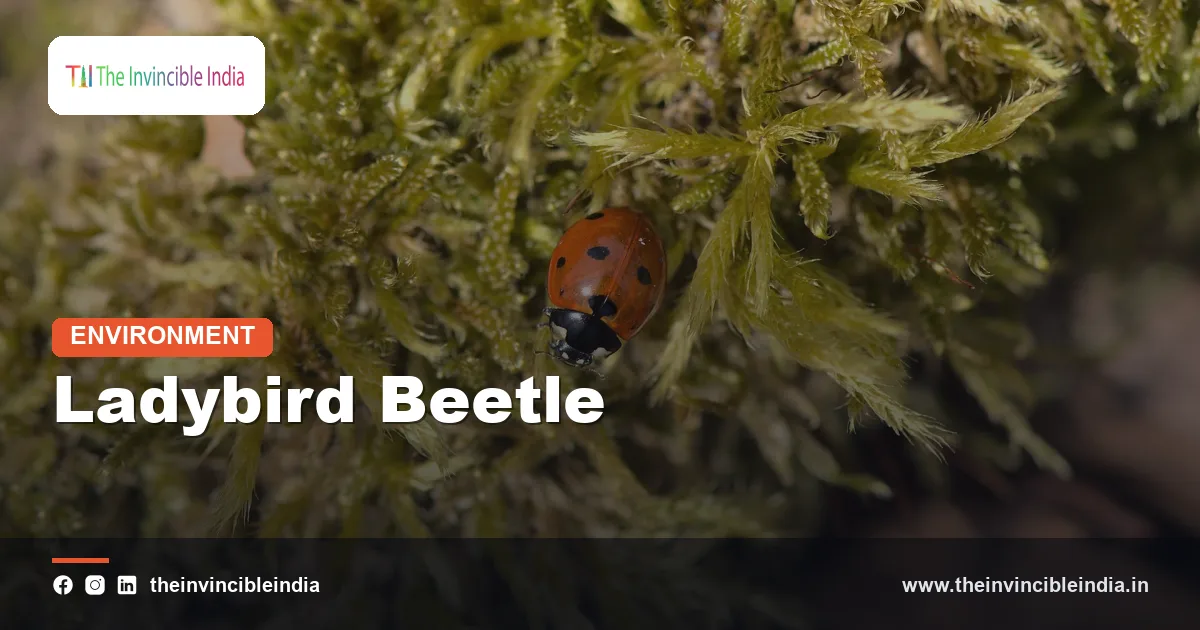
The ladybird beetle is a small, round, usually spotted beetle of the family Coccinellidae, and it is one of the most useful insects in an Indian garden or farm because both its larvae and adults eat aphids, mealybugs, scale insects and mites. Known as the ladybug in American English, the ladybird beetle advertises its bad taste with bright red, orange or yellow colours broken by black spots.
Ladybird beetles are harmless to people and are valued around the world as natural pest controllers. This explainer covers what a ladybird beetle is, how many species live in India, what it eats, how its life cycle works, why the colours matter, and how gardeners and farmers can encourage these beneficial beetles.
| Quick Facts | Details |
|---|---|
| Common names | Ladybird beetle, ladybird, ladybug, lady beetle |
| Scientific group | Family Coccinellidae (order Coleoptera) |
| Species worldwide | About 6,000 described species |
| Size | Typically 1 to 10 mm long, depending on the species |
| Common Indian species | Seven-spot (Coccinella septempunctata), six-spotted zigzag (Cheilomenes sexmaculata), transverse ladybird (Coccinella transversalis), mealybug destroyer (Cryptolaemus montrouzieri) |
| Diet | Mostly soft-bodied insects such as aphids, scale insects, mealybugs and mites; a few species eat plants or fungi |
| Life cycle | Egg, larva (four instars), pupa and adult; often completed in about four to six weeks in warm weather |
| Defence | Warning colouration and a bitter yellow fluid released from the leg joints |
| Danger to humans | None; harmless and not venomous |
Key Takeaways
- The ladybird beetle belongs to the family Coccinellidae, which has about 6,000 species worldwide and a large number recorded across India.
- A single ladybird beetle larva can eat hundreds of aphids before it pupates, and an adult can consume dozens of aphids in a day, which makes the beetle a natural pest controller.
- The red, orange and yellow colours of a ladybird beetle are warning colours, because the beetle releases a foul-tasting fluid that deters birds and other predators.
- The number of spots on a ladybird beetle is set by its species and does not show its age.
- Most ladybird beetles are harmless to humans and crops, but a few Indian species, such as the 28-spotted hadda beetle (Henosepilachna vigintioctopunctata), feed on plants and damage brinjal and potato.
- Avoiding broad-spectrum pesticides and growing flowering plants such as marigold, coriander and fennel are the simplest ways to keep ladybird beetles in a garden.
What is a ladybird beetle?
A ladybird beetle is a small beetle in the family Coccinellidae, characterised by a domed, rounded body, short legs, short club-ended antennae and hard, glossy forewings called elytra that are often marked with black spots. The word coccinellid comes from the Latin coccineus, meaning scarlet.
The group is placed in the order Coleoptera, which makes up roughly one in every four known animal species. Most ladybird beetles are predators, and that is why they appear in agriculture, horticulture and biological control around the world. Despite the name, there is nothing female about the beetle: the name is said to honour the Virgin Mary, the Lady of the old European tradition, whose red cloak was linked with the seven-spot ladybird.
In India, ladybird beetles are common in gardens, grasslands, cultivated fields, orchards and forest edges, from the plains to the Himalayan foothills.
How many ladybird beetle species are found in India?
India is home to several hundred species of ladybird beetle, spread over dozens of genera, with the highest diversity in the Western Ghats, the Himalayan region and the north-east. Exact counts differ among checklists because new species are still being described and some names are revised.
A handful of species are seen again and again in Indian fields and gardens:
- Seven-spot ladybird (Coccinella septempunctata): a red beetle with seven black spots, common in northern and central India and widely used as an aphid predator.
- Six-spotted zigzag ladybird (Cheilomenes sexmaculata): orange-red with a zigzag black band, one of the most abundant beetles in Indian crops.
- Transverse ladybird (Coccinella transversalis): marked by a broad black band across the elytra, common across the plains.
- Mealybug destroyer (Cryptolaemus montrouzieri): a dark beetle with an orange head, mass-reared for mealybug control.
- Black-and-yellow scale-eaters (Chilocorus species): small, shiny beetles that feed on scale insects.
- Mite-eating Stethorus: tiny, almost black beetles that eat spider mites.
Not every ladybird beetle is red and spotted. Some are yellow, orange, black, striped or even nearly uniform, and many of the smallest species are easily mistaken for other beetles.
What does a ladybird beetle eat?
A ladybird beetle mostly eats soft-bodied insects, especially aphids, but the exact diet depends on the species. Many species also eat scale insects, mealybugs, whiteflies, mites, thrips and the eggs of other insects.
The larvae are particularly hungry. A larva of the seven-spot ladybird can consume several hundred aphids during its development, and adults of many species eat dozens of aphids per day. When prey is scarce, ladybird beetles may also feed on pollen, nectar and honeydew, which keeps them alive between pest outbreaks. This is a major reason why flowering plants near crops help to retain the beetles.
Plant-eating and fungus-eating species
Not all coccinellids are predators. The subfamily Epilachninae feeds on leaves, and several species are pests. The best known in India is the hadda beetle (Henosepilachna vigintioctopunctata), which skeletonises the leaves of brinjal, potato, bitter gourd and other crops. Its dull, hairy body with 28 black spots on a dull orange background helps tell it from a shiny predatory ladybird. A few small coccinellids feed on powdery mildew fungus on leaves.
How does the ladybird beetle life cycle work?
The ladybird beetle goes through complete metamorphosis, with four stages: egg, larva, pupa and adult. In warm Indian conditions, the cycle from egg to adult often takes about four to six weeks, so several generations can occur in a single season.
- Egg: The female lays small, yellow or orange, spindle-shaped eggs in clusters, usually near aphid colonies so that the newly hatched larvae have food at once. Eggs hatch in a few days.
- Larva: The larva looks nothing like the adult. It is dark, elongated and often spiny or spotted with orange, which has led people to compare it with a tiny alligator. It grows through four instars over roughly two to three weeks.
- Pupa: The larva attaches itself to a leaf or stem and becomes a stationary pupa, which is not feeding. The adult forms inside over about a week.
- Adult: The beetle emerges with soft, pale elytra that harden and gain their full colour and spots within a day or two.
Adults of many species live for several months. In cooler regions, adults gather in sheltered places to pass the cold season. In the plains of India, many species slow down or rest during the hottest part of summer or during other unfavourable periods.
Why do ladybird beetles have spots and bright colours?
Ladybird beetles have bright colours and spots as a warning to predators that they taste bad, a strategy known as aposematism. Birds, lizards and other predators learn quickly to associate the striking red and black pattern with an unpleasant meal.
The warning is backed by chemistry. When a ladybird beetle is disturbed, it can release a yellow, smelly fluid from its leg joints, a behaviour called reflex bleeding. The fluid contains bitter alkaloids that make the beetle distasteful and, for small predators, mildly toxic. The beetle may also play dead and fall to the ground.
The number of spots is a species characteristic, not a sign of age. A seven-spot ladybird will have seven spots from the day it hardens, and a two-spot ladybird will have two. Some species, though, show a great deal of colour variation within a single population, which can confuse beginners.
Why is the ladybird beetle called a gardener’s friend?
The ladybird beetle is called a gardener’s friend because it eats the sap-sucking insects that damage garden plants, often keeping their numbers low without any chemical spray. A healthy population of ladybird beetles and their larvae can clear an aphid-infested rose, mustard or vegetable bed within days.
Gardeners benefit in several ways. The beetles reduce the need for pesticides, which saves money and protects pollinators. They also work continuously, because adults and larvae both feed, and they actively search plants for new colonies. A garden that supports a range of predators, including hoverflies, lacewings and spiders as well as ladybird beetles, is more stable than one that depends on repeated spraying.
How is the ladybird beetle used in biological pest control?
The ladybird beetle is used in biological pest control by releasing or conserving predatory species to suppress pests such as aphids, mealybugs and scale insects. Biological control is a core part of Integrated Pest Management (IPM), the approach promoted by Indian agricultural research institutions.
| Species | Target pest | Where it is used |
|---|---|---|
| Cryptolaemus montrouzieri (mealybug destroyer) | Mealybugs | Grapes, citrus, guava, coffee, ornamentals; mass-reared in biocontrol laboratories |
| Rodolia cardinalis (vedalia beetle) | Cottony cushion scale | Famous worldwide for its success in citrus groves |
| Coccinella septempunctata | Aphids | Cereals, mustard, vegetables |
| Cheilomenes sexmaculata | Aphids and small soft-bodied pests | Vegetables, pulses, field crops |
| Stethorus species | Spider mites | Cotton, vegetables, orchards |
The vedalia beetle is the textbook case. Its introduction to California in the late 1880s rescued the citrus industry from cottony cushion scale, and the episode helped to launch modern classical biological control. In India, agencies such as the National Bureau of Agricultural Insect Resources (NBAIR) in Bengaluru conduct research on natural enemies and support the mass rearing of predators, including ladybird beetles.
Conservation biocontrol, in which farmers simply protect the beetles already present, often works as well as releases, and it is cheaper. Released beetles may fly away, so a food supply and shelter are needed to hold them.
Are ladybird beetles harmful to humans or pets?
No, ladybird beetles are harmless to humans and do not sting or spread disease. They are not venomous. A few species can give a mild nip, which feels like a pinch, and some people with allergies may react to the yellow defensive fluid.
Pets that eat a small number of ladybird beetles are usually fine, although a large number can irritate the mouth or stomach of a dog. The introduced Asian harlequin ladybird (Harmonia axyridis) is known elsewhere in the world for entering homes in autumn, but that behaviour is not a common problem in India.
The simplest rule is to leave ladybird beetles alone. They are among the few insects that almost everyone is happy to see.
How can you attract ladybird beetles to your garden?
You can attract ladybird beetles to a garden by growing nectar-rich flowers, avoiding broad-spectrum pesticides and tolerating a small number of aphids, which act as bait. A little pest presence is useful because it keeps the predators in the area.
- Plant flowers: Marigold, coriander, dill, fennel, cosmos, sunflower and yarrow provide pollen and nectar for adults.
- Skip the spray: Insecticides kill beetles as readily as pests. If spraying is necessary, a soap or neem-based spray used in the evening is gentler.
- Provide shelter: Leave some leaf litter, a few unmown grassy patches or mulch, so beetles can rest and overwinter or over-summer.
- Offer water: A shallow dish with pebbles gives a safe drinking place.
- Be patient: The beetles usually arrive after aphids appear, and the larvae are the most effective predators, so avoid removing the odd-looking dark larvae.
How can you tell a ladybird beetle larva from a pest?
A ladybird beetle larva can be told from a pest by its elongated, alligator-like shape, six legs, and dark, often spiny or orange-marked body, as well as by its presence among aphids or scale insects. Many gardeners mistake it for a harmful caterpillar and remove it.
Ladybird larvae move quickly over leaves in search of prey and are most often seen on plants with aphids, mealybugs or mites. They do not chew holes in leaves. The yellow egg clusters on the underside of leaves are also a good sign. In contrast, the pest hadda beetle larva is yellowish and covered with branching spines, and it leaves a lace-like pattern of damage on leaves.
Bottom Line
The ladybird beetle is a harmless, colourful predator that gives Indian gardens and farms free pest control, from the hungry larva to the spotted adult. Protecting it by avoiding unnecessary sprays and planting flowers is among the easiest and cheapest steps toward healthy crops.
Frequently Asked Questions
What does a ladybird beetle eat?
Most ladybird beetles eat soft-bodied insects such as aphids, mealybugs, scale insects, whiteflies and mites. Their larvae are especially hungry and can eat hundreds of aphids before pupating. When prey is scarce, adults may feed on pollen, nectar and honeydew.
Are ladybird beetles harmful to humans?
No, ladybird beetles are harmless to humans. They have no venom and do not carry diseases, and they only occasionally give a gentle pinch. Some people may react to the yellow fluid that the beetle releases when it is disturbed.
Why does a ladybird beetle have spots?
A ladybird beetle has spots and bright colours as a warning to predators that it tastes bad. When threatened, the beetle can release a bitter, smelly fluid from its leg joints. The number of spots depends on the species and does not show the beetle’s age.
How many ladybird beetle species are there in India?
India has several hundred species of ladybird beetle, out of about 6,000 described species worldwide. Diversity is highest in the Western Ghats, the Himalayan region and the north-east. Exact numbers vary between checklists because taxonomists still describe and revise species.
Is every ladybird beetle a beneficial insect?
No, most ladybird beetles are beneficial predators, but a few are plant-eating pests. The 28-spotted hadda beetle, Henosepilachna vigintioctopunctata, damages brinjal, potato and other crops. Predatory species are shiny, while plant-eating ones are usually dull and slightly hairy.
How can I attract ladybird beetles to my garden?
Plant flowers such as marigold, coriander, dill and fennel, avoid broad-spectrum pesticides, and leave some leaf litter for shelter. Tolerating a few aphids keeps the predators nearby. Ladybird larvae are very effective, so avoid removing the dark, spiny larvae from your plants.
{“@context”:”https://schema.org”,”@graph”:[{“@type”:”FAQPage”,”mainEntity”:[{“@type”:”Question”,”name”:”What does a ladybird beetle eat?”,”acceptedAnswer”:{“@type”:”Answer”,”text”:”Most ladybird beetles eat soft-bodied insects such as aphids, mealybugs, scale insects, whiteflies and mites. Their larvae are especially hungry and can eat hundreds of aphids before pupating. When prey is scarce, adults may feed on pollen, nectar and honeydew.”}},{“@type”:”Question”,”name”:”Are ladybird beetles harmful to humans?”,”acceptedAnswer”:{“@type”:”Answer”,”text”:”No, ladybird beetles are harmless to humans. They have no venom and do not carry diseases, and they only occasionally give a gentle pinch. Some people may react to the yellow fluid that the beetle releases when it is disturbed.”}},{“@type”:”Question”,”name”:”Why does a ladybird beetle have spots?”,”acceptedAnswer”:{“@type”:”Answer”,”text”:”A ladybird beetle has spots and bright colours as a warning to predators that it tastes bad. When threatened, the beetle can release a bitter, smelly fluid from its leg joints. The number of spots depends on the species and does not show the beetle’s age.”}},{“@type”:”Question”,”name”:”How many ladybird beetle species are there in India?”,”acceptedAnswer”:{“@type”:”Answer”,”text”:”India has several hundred species of ladybird beetle, out of about 6,000 described species worldwide. Diversity is highest in the Western Ghats, the Himalayan region and the north-east. Exact numbers vary between checklists because taxonomists still describe and revise species.”}},{“@type”:”Question”,”name”:”Is every ladybird beetle a beneficial insect?”,”acceptedAnswer”:{“@type”:”Answer”,”text”:”No, most ladybird beetles are beneficial predators, but a few are plant-eating pests. The 28-spotted hadda beetle, Henosepilachna vigintioctopunctata, damages brinjal, potato and other crops. Predatory species are shiny, while plant-eating ones are usually dull and slightly hairy.”}},{“@type”:”Question”,”name”:”How can I attract ladybird beetles to my garden?”,”acceptedAnswer”:{“@type”:”Answer”,”text”:”Plant flowers such as marigold, coriander, dill and fennel, avoid broad-spectrum pesticides, and leave some leaf litter for shelter. Tolerating a few aphids keeps the predators nearby. Ladybird larvae are very effective, so avoid removing the dark, spiny larvae from your plants.”}}]}]}


