

In India, cicadas are large, stout-bodied, winged insects of the order Hemiptera whose males produce the loud, shrill, buzzing chorus that fills forests, gardens and avenues during the hot months and the monsoon. The sound is made not by the voice but by the tymbals, a pair of ribbed membranes on the male’s abdomen that are buckled rapidly by muscles and amplified by a hollow body cavity.
Cicadas are harmless to people, they do not bite or sting, and they are an important part of the forest ecosystem. This explainer covers what cicadas are, how and why they sing, what the long underground nymph stage involves, where they are found in India, and what they mean for forests, birds and people.
| Quick Facts | Details |
|---|---|
| Scientific group | Family Cicadidae, superfamily Cicadoidea, order Hemiptera (true bugs) |
| Species worldwide | More than 3,000 described species |
| Indian genera | Include Platypleura, Cryptotympana, Pomponia, Dundubia and Huechys |
| Adult size | Typically about 2 to 6 cm long, with a wingspan that can exceed 10 cm in the largest species |
| Sound organ | A pair of tymbals on the abdomen, found only in males of most species |
| Life cycle | Egg, underground nymph (several years in many species), adult that lives for only a few weeks |
| Diet | Xylem sap from tree roots (nymphs) and from twigs and branches (adults) |
| Peak season in India | Hot pre-monsoon and monsoon months in many regions |
| Danger to humans | None; no bite, no sting, no venom |
Key Takeaways
- Cicadas are sap-feeding insects in the family Cicadidae, and only the males of most species make the loud calling song.
- Male cicadas produce sound by buckling tymbals, ribbed membranes on the abdomen, and the hollow abdomen acts as a resonating chamber that can make some songs louder than 100 decibels at close range.
- Cicada nymphs live underground for years, feeding on xylem sap from tree roots, before climbing a tree, shedding the nymphal skin and emerging as winged adults.
- In India, the cicada chorus is strongly linked with the hot season and the monsoon, and many species are found in the Western Ghats, the Himalayan foothills and the north-east.
- Cicadas are harmless to humans, and they feed birds, bats, reptiles, mantises and wasps, while their burrowing nymphs help aerate soil.
- The most famous periodical cicadas, which emerge every 13 or 17 years, live in North America and are not found in India.
What are cicadas?
Cicadas are large, winged insects in the family Cicadidae, known for their loud songs and their long life underground as nymphs. They belong to the order Hemiptera, the true bugs, which also contains aphids, leafhoppers, shield bugs and planthoppers.
All Hemiptera feed with a piercing and sucking beak, called a rostrum, and cicadas use theirs to drink plant sap. The adult has a broad head with two prominent, widely spaced compound eyes and three small simple eyes, short bristle-like antennae, and two pairs of clear or patterned membranous wings held roof-like over the body. The body is usually stout and green, brown, black or greyish, patterned in a way that blends with bark.
Worldwide, more than 3,000 species have been described. In India, cicadas are widespread in forests, plantations, gardens and roadside trees, although most people hear them far more often than they see them.
How do cicadas make their loud sound?
Cicadas make their loud sound with tymbals, paired ribbed membranes on the sides of the male’s first abdominal segment that are rapidly buckled inward by strong muscles. Each buckling produces a click, and thousands of clicks per minute fuse into the continuous buzz.
The process works like pressing and releasing the lid of a tin. A muscle pulls the tymbal inward, making it pop, and relaxing the muscle allows it to spring back. Most of the male abdomen is hollow and filled with air sacs, which amplify the sound like the body of a guitar. The male can tune the sound by changing the position of his abdomen and by opening or closing the folds that cover the tymbals.
The loudest cicada songs can exceed 100 decibels at close range, which is comparable to a loud motorcycle. Cicadas protect their own hearing by partly disabling their ears while they sing.
Do female cicadas sing?
In most species, females do not sing. They respond to males with wing flicks, clicks or other signals, and they hear the call with a pair of ear-like organs called tympana on the abdomen.
Why do cicadas sing during the monsoon?
Cicadas sing during the monsoon and the hot months because males call to attract females, and the warm, humid weather favours activity and emergence from the soil. The chorus is a reproductive display, not a weather forecast.
Several factors line up in India. Temperature strongly affects cicada activity, so calling is loudest during the hottest hours of the day in many species, while some species sing at dawn or dusk. Rain softens the soil and makes it easier for mature nymphs to come up, and the lush growth of the season provides fresh sap for adults. In many parts of India, people therefore associate the sound with the hot pre-monsoon and monsoon, and with long afternoons in the forest.
The chorus also helps in another way. When many males call together, the sound is more attractive to females and the combined noise makes it harder for a predator to find any one singer. Some species call from high in the canopy, which also makes them harder to reach.
What is the life cycle of cicadas?
The life cycle of cicadas has three stages, egg, nymph and adult, and unlike butterflies, cicadas show incomplete metamorphosis with no pupal stage. The nymph stage lasts years in many species, while the adult lives for only weeks.
- Egg: The female uses a saw-like egg-laying organ, the ovipositor, to cut slits in twigs and lays dozens of eggs in each slit. The eggs hatch in a few weeks to a few months.
- Nymph: The tiny nymph drops to the ground, burrows into the soil and attaches to a root, feeding on xylem sap. It moults several times and grows slowly underground. Front legs are broad and strong, adapted for digging.
- Emergence: When mature, the nymph digs out of the soil, often at dusk or at night after rain, and climbs a tree trunk, a wall or a plant stem.
- Final moult: The nymph’s skin splits down the back and the winged adult pulls itself out. The wings are soft and crumpled at first, and they expand and harden over a few hours.
- Adult: The adult feeds, sings, mates and lays eggs, and then dies within a few weeks.
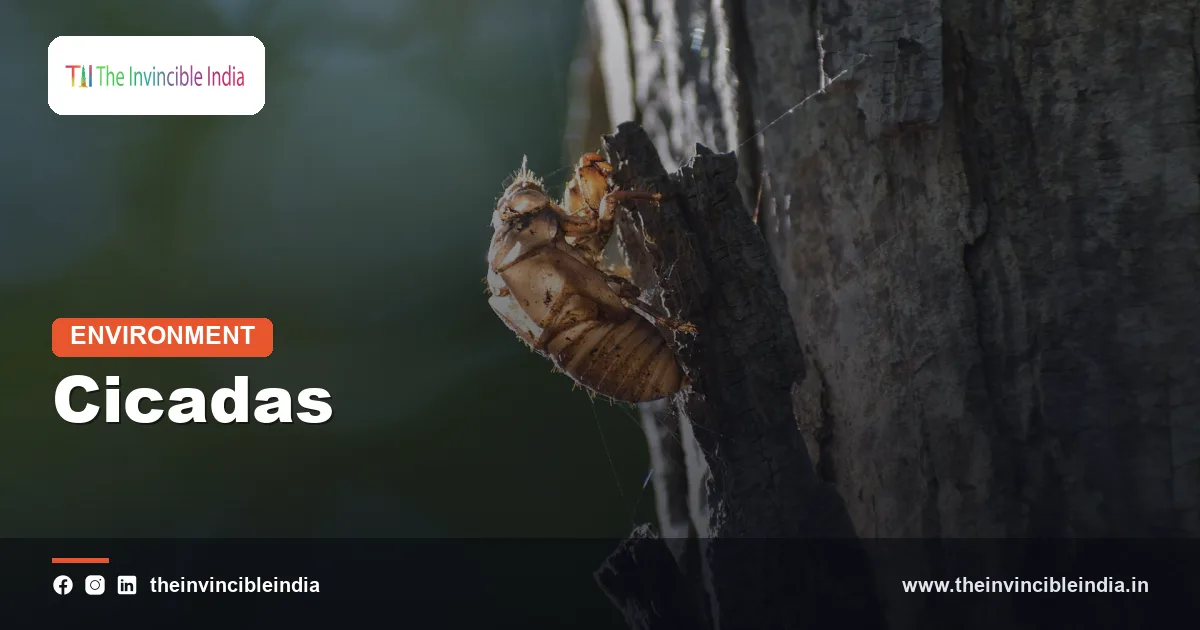
The empty brown shell left clinging to the bark is called an exuvia. These husks are often the only sign of cicadas that many people notice, and they can be found in large numbers beneath trees after emergence.
How long do cicadas live underground?
Cicadas live underground for several years as nymphs in many species, although the exact period differs and is poorly known for most Indian species. Annual cicadas, which are the main type in the tropics, typically spend a few years underground, but their adults emerge every year because different broods overlap.
The cicadas that spend 13 or 17 years underground are the periodical cicadas of the genus Magicicada, found only in eastern North America. These emerge in huge synchronised broods and are not part of the Indian fauna. A common error is to describe all cicadas as 17-year insects.
| Type | Years underground | Where found |
|---|---|---|
| Annual cicadas | Often about 2 to 5 years, with some species longer; adults appear every year | Worldwide, including India |
| 13-year periodical cicadas | 13 | Southern and central United States |
| 17-year periodical cicadas | 17 | Northern and eastern United States |
Life in the soil is quiet and protected. The nymph is hidden from most predators, and its slow growth is linked to its low-nutrient diet of xylem sap.
Where are cicadas found in India?
Cicadas are found throughout India wherever there are trees, with high diversity in the Western Ghats, the Himalayan foothills and the north-east. Forests with rich tree cover and undisturbed soil support the most species.
Genera recorded in the Indian subcontinent include Platypleura, Cryptotympana, Pomponia, Dundubia, Huechys, Meimuna and Tosena. Some are pale and mottled, blending into bark, while others have bright markings. Large species with wide, patterned wings are often noticed on garden and roadside trees in the monsoon.
Because the nymphs live in the soil for years, cicadas need undisturbed ground. They are therefore more common in forests, old orchards and tree-lined avenues than in paved areas. Cicadas are often more easily heard than seen: a person standing under a tree may hear a deafening chorus while spotting nothing, because the insects are camouflaged on the bark and high in the canopy.
What do cicadas eat?
Cicadas eat xylem sap, the watery fluid that carries water and minerals up through trees, and both nymphs and adults feed this way. They pierce the plant with a sharp beak and suck up the sap.
Xylem sap is low in nutrition, which is one reason why nymphs take so long to grow. Cicadas must drink large amounts, and they expel the excess as a fine spray or droplets, which is why a person standing under a cicada-filled tree may feel a light mist or see wet patches on the ground. Because the insects feed on many species of trees but take only a little from each, they seldom harm healthy trees. Occasionally, heavy egg-laying in young twigs can cause a few small branches to wither, a problem that is mainly cosmetic.
Are cicadas harmful or dangerous?
No, cicadas are not harmful or dangerous to humans. They do not bite, sting, carry diseases or damage buildings, and they are largely harmless to crops and gardens. The loud sound is the only real nuisance.
People are sometimes startled when a large cicada flies clumsily into them, since the insects are poor fliers, but the contact is harmless. A cicada may grip clothing with its claws, and its beak may rarely probe the skin if it mistakes a person for a tree, but this is accidental and mild. Cicadas are sometimes confused with locusts, which are grasshoppers that damage crops; the two groups are unrelated. They are also mistaken for crickets, which sing at night and make sound by rubbing their wings together.
What is the ecological role of cicadas?
The ecological role of cicadas is to cycle nutrients, aerate soil and serve as an abundant food source for predators. Their numbers make them an important link in the forest food web.
- Soil aeration: Nymph tunnels improve air and water movement in the soil.
- Food source: Birds such as drongos, bee-eaters and shrikes eat adults, as do bats, lizards, mantises, spiders and wasps. Some wasps hunt cicadas to feed their young.
- Nutrient cycling: Dead adults, which fall to the ground in large numbers, decompose and release nitrogen and other nutrients into the soil.
- Indicators of health: A rich cicada community often indicates old trees and undisturbed soil.
Cicadas are therefore both prey and indicator, and their decline in an area can signal forest loss or soil disturbance. Because adults emerge in large numbers, predators can feed on them without wiping them out.
How can you tell cicadas from crickets and grasshoppers?
You can tell cicadas from crickets and grasshoppers by their wide head with bulging eyes, short bristle-like antennae, piercing beak and roof-like clear wings, whereas crickets and grasshoppers have long antennae and chewing mouthparts. Their sounds also differ in how they are made.
| Feature | Cicadas | Crickets and grasshoppers |
|---|---|---|
| Order | Hemiptera (true bugs) | Orthoptera |
| Antennae | Short, bristle-like | Long and thread-like (crickets) or shorter (grasshoppers) |
| Mouthparts | Piercing beak that sucks sap | Chewing jaws |
| Sound organ | Tymbals on the male abdomen | Rubbing of wings or legs (stridulation) |
| Usual singing time | Mostly daytime, some at dusk | Mostly evening and night |
| Young stage | Burrowing underground nymph | Nymph living above ground |
Bottom Line
Cicadas are the voice of the Indian monsoon forest, harmless sap-feeding insects with a long hidden life underground and a brief, noisy life in the trees. Protecting tree cover and undisturbed soil keeps their chorus, and the food web it supports, intact.
Frequently Asked Questions
How do cicadas make their loud noise?
Male cicadas make the sound with tymbals, ribbed membranes on the abdomen that are buckled rapidly by strong muscles. The hollow abdomen then amplifies the clicks into a continuous buzz. Close up, some songs exceed 100 decibels.
Why are cicadas so loud during the monsoon?
Cicadas are loud during the monsoon because males call to attract females, and warm, humid weather favours activity and emergence from the soil. Heat strongly drives calling in many species. A chorus of many males is also harder for a predator to pin down.
Are cicadas harmful to humans or crops?
No, cicadas are harmless to humans, as they do not bite, sting or spread disease. They are also largely harmless to crops, since they feed on sap without usually harming healthy trees. Heavy egg-laying can occasionally wither a few young twigs.
How long do cicadas live?
Cicada nymphs live underground for years, and the winged adult lives for only a few weeks. Annual cicadas, the main type in India, often spend a few years as nymphs, while the 13 and 17-year periodical cicadas live in North America. The adult stage is for singing, mating and egg laying.
What is the empty shell on tree trunks?
The empty shell on a tree trunk is the exuvia, the cast-off skin of a cicada nymph. The nymph climbs the tree, its skin splits along the back, and the winged adult emerges. The shell stays attached to the bark for weeks.
Are cicadas the same as crickets?
No, cicadas are not crickets. Cicadas are true bugs of the order Hemiptera, with short antennae and a sap-sucking beak, while crickets belong to Orthoptera and have long antennae and chewing mouthparts. Cicadas sing with tymbals during the day, and crickets rub their wings together, mostly at night.
{“@context”:”https://schema.org”,”@graph”:[{“@type”:”FAQPage”,”mainEntity”:[{“@type”:”Question”,”name”:”How do cicadas make their loud noise?”,”acceptedAnswer”:{“@type”:”Answer”,”text”:”Male cicadas make the sound with tymbals, ribbed membranes on the abdomen that are buckled rapidly by strong muscles. The hollow abdomen then amplifies the clicks into a continuous buzz. Close up, some songs exceed 100 decibels.”}},{“@type”:”Question”,”name”:”Why are cicadas so loud during the monsoon?”,”acceptedAnswer”:{“@type”:”Answer”,”text”:”Cicadas are loud during the monsoon because males call to attract females, and warm, humid weather favours activity and emergence from the soil. Heat strongly drives calling in many species. A chorus of many males is also harder for a predator to pin down.”}},{“@type”:”Question”,”name”:”Are cicadas harmful to humans or crops?”,”acceptedAnswer”:{“@type”:”Answer”,”text”:”No, cicadas are harmless to humans, as they do not bite, sting or spread disease. They are also largely harmless to crops, since they feed on sap without usually harming healthy trees. Heavy egg-laying can occasionally wither a few young twigs.”}},{“@type”:”Question”,”name”:”How long do cicadas live?”,”acceptedAnswer”:{“@type”:”Answer”,”text”:”Cicada nymphs live underground for years, and the winged adult lives for only a few weeks. Annual cicadas, the main type in India, often spend a few years as nymphs, while the 13 and 17-year periodical cicadas live in North America. The adult stage is for singing, mating and egg laying.”}},{“@type”:”Question”,”name”:”What is the empty shell on tree trunks?”,”acceptedAnswer”:{“@type”:”Answer”,”text”:”The empty shell on a tree trunk is the exuvia, the cast-off skin of a cicada nymph. The nymph climbs the tree, its skin splits along the back, and the winged adult emerges. The shell stays attached to the bark for weeks.”}},{“@type”:”Question”,”name”:”Are cicadas the same as crickets?”,”acceptedAnswer”:{“@type”:”Answer”,”text”:”No, cicadas are not crickets. Cicadas are true bugs of the order Hemiptera, with short antennae and a sap-sucking beak, while crickets belong to Orthoptera and have long antennae and chewing mouthparts. Cicadas sing with tymbals during the day, and crickets rub their wings together, mostly at night.”}}]}]}


