

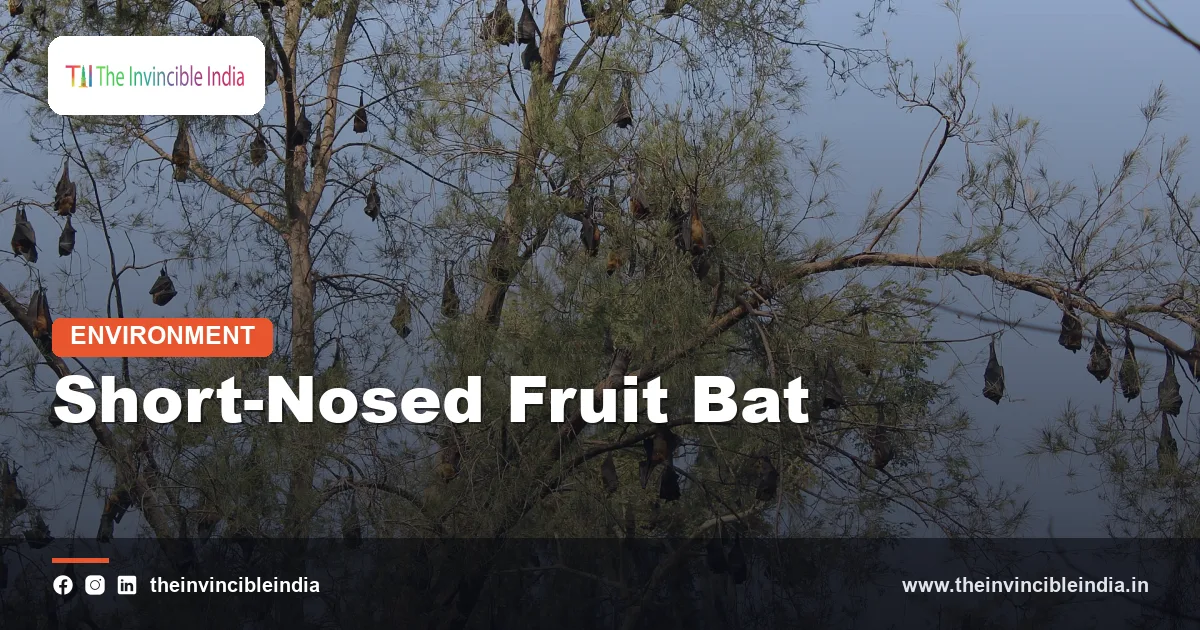
The short-nosed fruit bat (Cynopterus sphinx) is a small, fruit-eating bat of the family Pteropodidae that is among the most common and widespread bats in India, roosting in tree foliage, palm crowns and buildings, and acting as an important pollinator and seed disperser. Also called the greater short-nosed fruit bat or the Indian fruit bat, the short-nosed fruit bat is best known for modifying leaves into small shelters, often described as “tents”, under which males gather groups of females.
Because the short-nosed fruit bat lives close to orchards, gardens and homes, it is often confused with the much larger Indian flying fox or blamed for fruit losses. This explainer sets out what the short-nosed fruit bat is, how it lives, what it eats, why it matters to Indian ecosystems and how it is treated in law and conservation, using stable and widely documented facts.
| Attribute | Detail |
|---|---|
| Common names | Short-nosed fruit bat, greater short-nosed fruit bat, Indian fruit bat |
| Scientific name | Cynopterus sphinx |
| Family | Pteropodidae (Old World fruit bats), order Chiroptera |
| Size | Small; body weight roughly 40 to 70 grams, forearm roughly 6 to 7.5 centimetres |
| Diet | Fruit, nectar, pollen and some flower parts |
| Roosts | Foliage, leaf “tents”, palm crowns, eaves, roofs and old buildings |
| Range | South Asia and parts of Southeast Asia, including most of India |
| Conservation status | Generally rated Least Concern on the IUCN Red List |
| Main ecological roles | Pollination and seed dispersal |
Key Takeaways
- The short-nosed fruit bat (Cynopterus sphinx) is one of the commonest fruit bats of the Indian subcontinent and weighs only a few dozen grams.
- The short-nosed fruit bat feeds on fruit, nectar and pollen, which makes it both a seed disperser and a pollinator of many tropical plants.
- Male short-nosed fruit bats are known for biting leaf veins and ribs to create tent-like shelters in which they attract and hold groups of females.
- The short-nosed fruit bat is far smaller than the Indian flying fox (Pteropus medius), and the two species are frequently confused by the public.
- The short-nosed fruit bat generally breeds twice a year in many Indian populations, usually producing a single pup at a time.
- The short-nosed fruit bat is not currently considered globally threatened, although roost loss, pruning of old trees and persecution as an orchard pest affect local populations.
What is the short-nosed fruit bat?
The short-nosed fruit bat is a small megabat (a member of the Old World fruit bat family Pteropodidae) whose scientific name is Cynopterus sphinx and which is widely distributed across the Indian subcontinent and neighbouring Southeast Asia. It was formally described in the late eighteenth century and has been studied extensively in India because it is abundant, easy to observe and ecologically useful.
The genus name Cynopterus refers to the dog-like face typical of fruit bats. Unlike the small insect-eating bats that most people associate with caves and attics, the short-nosed fruit bat has large eyes, a simple pointed muzzle and a keen sense of smell, all adapted to finding ripe fruit in the dark. Most fruit bats, including this species, do not use the sophisticated echolocation of insect-eating bats and rely instead on sight and scent.
Several close relatives share the name “short-nosed”, including the lesser short-nosed fruit bat (Cynopterus brachyotis) of Southeast Asia. In India, however, the name almost always refers to Cynopterus sphinx, which is the most commonly encountered small fruit bat across the plains, coasts and foothills.
What does the short-nosed fruit bat look like?
The short-nosed fruit bat is a stocky, brownish bat with a short, broad muzzle, large dark eyes, simple rounded ears with pale edges and fur that ranges from olive-brown to greyish-brown above and paler below. Adults are small by fruit-bat standards, typically weighing around 40 to 70 grams, with a wingspan of well under half a metre.
The short muzzle gives the species its common name and distinguishes it from longer-faced fruit bats such as the Indian flying fox. Males often have a darker, more orange or reddish collar of fur around the neck and shoulders, and males carry scent-producing glandular tissue on the shoulders that is used in signalling. The wings are dark and leathery, and the ear rims are pale or whitish in many individuals, a feature that helps observers recognise the species when it is roosting.
Key features that help identification include:
- A short, broad, dog-like muzzle with a prominent nostril tube typical of many fruit bats
- Large, dark eyes suited to dim light
- Pale or whitish margins on the ears
- A body small enough to sit in a person’s palm, unlike the large flying foxes
- Males with a thicker, more colourful ruff of neck fur and shoulder glands
Where does the short-nosed fruit bat live in India?
The short-nosed fruit bat lives across most of peninsular and northern India, from coastal Kerala and Tamil Nadu to the Gangetic plains, the Himalayan foothills, the north-east and the islands, wherever there are fruiting trees and suitable roosting foliage. It also occurs in neighbouring Sri Lanka, Nepal, Pakistan, Bangladesh and parts of Southeast Asia.
The species is highly adaptable. It occupies tropical forests, orchards, village groves, temple gardens, campuses and city avenues, and it tolerates human presence better than many wildlife species. Because it is a generalist, populations can persist in towns as long as there are fruit-bearing trees such as fig, mango, guava, sapota and banana, and trees with large leaves or dense palm crowns that can shelter a roosting group.
Local abundance varies by season, because fruit availability changes and bats move between feeding areas and roosts. Researchers generally treat the species as common, but no reliable national population figure exists, so any specific count should be treated cautiously.
How does the short-nosed fruit bat make leaf tents?
The short-nosed fruit bat makes leaf tents by biting through the veins and ribs of large leaves, causing the leaf blade to fold and droop into a sheltered, tent-like shape under which the bats hang. This behaviour is relatively rare among mammals and is one of the most distinctive features of the species.
The bats favour trees with sturdy, broad or compound leaves, including the ashoka tree (Polyalthia longifolia) and various palms such as coconut, where the crown or the fronds can be cut along the midrib so that the leaf collapses into a canopy. The tent offers shade, partial protection from rain and wind and some concealment from predators such as birds of prey and snakes.
Tent building is mostly the work of males. A male prepares or occupies a tent, and groups of females may roost with him, which makes the tent a focal point for mating. This pattern, in which one male defends a small group of females, is often described as a harem structure, although group composition changes over time as females move between roosts.
Not all short-nosed fruit bats use tents. Many roost in dense foliage, in the dark corners of old buildings, under eaves, in the roofs of temples and in other human structures, and roost choice depends on what is available locally.
What does the short-nosed fruit bat eat?
The short-nosed fruit bat eats mainly ripe or ripening fruit, together with nectar, pollen and sometimes flower parts, and it feeds at night after leaving its roost at dusk. Its diet in India includes figs, guavas, mangoes, bananas, sapota (chikoo), papaya, jamun and many wild fruits.
The bat has a distinctive way of eating. It often carries a fruit away from the tree to a feeding perch, bites off and chews it to extract the juice and soft pulp, and then spits out the fibrous pulp and many seeds, instead of swallowing everything. This habit means that seeds can be dropped some distance from the parent tree, and small seeds that are swallowed can pass through the gut and be deposited further away.
The species also visits flowers, especially those that open at night, to lap nectar. During these visits the bats collect pollen on their fur and carry it from flower to flower. The short-nosed fruit bat therefore combines two services, seed dispersal and pollination, in a single feeding routine.
Common foods in an Indian setting
- Fig and other wild forest fruits, which are especially important in lean seasons
- Cultivated fruits such as guava, mango, banana, papaya and sapota
- Nectar and pollen from night-blooming or bat-adapted flowers
- Occasional leaves and flower buds that supply protein and minerals
Why does the short-nosed fruit bat matter for the environment?
The short-nosed fruit bat matters because it disperses seeds and pollinates flowers, helping forests, orchards and village groves regenerate and keeping genetic exchange moving between plants that cannot move themselves. Fruit bats are sometimes called “farmers of the forest” because the seeds they drop far from parent trees can grow into new trees in cleared or degraded land.
Seed dispersal by bats is especially important after disturbance. Bats fly widely at night and cross open ground that many forest birds avoid, so they deposit seeds in areas where regrowth is needed. Pollination by bats supports plants whose flowers open at night, including some species of economic and cultural importance. In Southeast Asia, related fruit bats are well known as pollinators of durian, and in India bat-visited flowers include several forest and village trees.
These ecological services have a direct link to human livelihoods, because many fruit trees and timber species benefit from animal-mediated dispersal and pollination. Declines in bat numbers can therefore weaken forest recovery, although the exact economic value of the short-nosed fruit bat in India has not been precisely quantified.
How does the short-nosed fruit bat breed and live?
The short-nosed fruit bat typically breeds twice a year in many Indian populations, with females usually giving birth to a single pup after a gestation of a few months. The twin breeding seasons are timed so that pups are born when fruit is available, although the exact months differ by region and climate.
Mothers nurse the pup and carry it for the first few weeks, then leave it in the roost while foraging. Young bats begin to fly after a few weeks and reach sexual maturity within their first year or soon after. Individuals can live for several years in the wild, and some captive fruit bats of related species have lived much longer, but reliable lifespan figures for wild short-nosed fruit bats are limited.
Social life centres on the roost. Males compete to hold good tent sites, advertise with scent and calls and sometimes guard small groups of females. Bachelor males roost separately. Females may switch groups between breeding cycles, which helps maintain genetic mixing.
| Feature | Short-nosed fruit bat | Indian flying fox |
|---|---|---|
| Scientific name | Cynopterus sphinx | Pteropus medius |
| Size | Small, tens of grams | Large, around a kilogram or more |
| Roosting style | Small groups in foliage, tents, buildings | Large, visible colonies in tall trees |
| Wingspan | Well under half a metre | Over a metre in large individuals |
| Typical diet | Fruit, nectar and pollen | Fruit, nectar and flowers |
| Public perception | Often overlooked or confused | Often noticed and disliked as a fruit pest |
Is the short-nosed fruit bat a pest or a danger to people?
The short-nosed fruit bat is not a major danger to people, but it can damage some orchard fruit, and like all wild mammals it can carry pathogens, so it should never be handled with bare hands. Farmers sometimes report fruit loss to bats, though birds, monkeys and insects often cause equal or greater damage, and the visible half-eaten fruit is commonly blamed on bats.
Public concern about bats in India increased after outbreaks of Nipah virus in Kerala and West Bengal, where the main natural host identified in research is the larger Indian flying fox rather than the short-nosed fruit bat. Health authorities advise people not to eat fruit that is partly eaten or fallen, to avoid raw date-palm sap collected where bats have access, and not to touch sick or dead bats. These precautions apply generally to fruit bats and do not mean that bats should be culled, which would not remove the risk and would remove the ecological benefits.
Protective netting, bagging of high-value fruit and harvesting at the correct time are the practical ways to limit orchard losses without harming bats.
What is the legal status of the short-nosed fruit bat in India?
The short-nosed fruit bat is a wild animal covered by India’s Wildlife (Protection) Act, 1972, but its exact schedule placement has changed over time and should be checked against the current text of the Act and its amendments. Historically, fruit bats were listed among species treated as “vermin” in the Act, a category that allowed restricted control in particular circumstances, and the 2022 amendment restructured the schedules.
Because legal listings can change, anyone dealing with bats should rely on the official gazette text and on state forest department guidance. Whatever the schedule, the species is rated as Least Concern on the global IUCN Red List, which reflects its wide range and adaptability, even though local populations may decline where old trees are felled, roosts are disturbed or bats are hunted.
Good practice for coexisting with the short-nosed fruit bat includes retaining mature roost trees, avoiding the removal of large palms during the breeding season, using netting instead of poison or fire, and consulting local wildlife authorities before disturbing a roost.
How can people live alongside the short-nosed fruit bat?
People can live alongside the short-nosed fruit bat by keeping mature fruit and shade trees, protecting roosts from disturbance, covering high-value fruit with nets and avoiding harming bats, which in turn keeps the pollination and seed dispersal they provide. Simple steps work better than eradication, because the bats return wherever food and shelter are available.
- Retain old trees and palms that offer foliage for tents and roosts
- Use bird and bat netting or fruit bagging on orchard trees instead of poison
- Avoid cutting down active roost trees during the pupping season
- Do not handle bats; call forest or wildlife rescue services for injured animals
- Cover raw sap collection pots to reduce contamination by bats and other animals
- Teach children to distinguish the harmless small fruit bats from large flying foxes, and both from insect-eating bats
Bottom Line
The short-nosed fruit bat is a small, adaptable, fruit-eating bat that builds leaf tents, breeds twice a year in many populations and quietly performs pollination and seed dispersal across Indian gardens, orchards and forests. It is common and not globally threatened, but it depends on mature trees and undisturbed roosts, and it is best protected by understanding it rather than fearing it.
Frequently Asked Questions
What is the scientific name of the short-nosed fruit bat?
The scientific name of the short-nosed fruit bat is Cynopterus sphinx. It belongs to the family Pteropodidae, the Old World fruit bats, and is also called the greater short-nosed fruit bat or Indian fruit bat. The name distinguishes it from close relatives such as Cynopterus brachyotis of Southeast Asia.
Is the short-nosed fruit bat the same as a flying fox?
No, the short-nosed fruit bat is not the same as a flying fox, although both are fruit bats. The short-nosed fruit bat (Cynopterus sphinx) weighs only a few dozen grams, while the Indian flying fox (Pteropus medius) weighs around a kilogram and roosts in large visible colonies. The two species differ in size, face shape and roosting habits.
What does the short-nosed fruit bat eat?
The short-nosed fruit bat eats mainly fruit, nectar and pollen. In India it feeds on figs, guavas, mangoes, bananas, sapota and wild forest fruits, and it often chews the fruit to swallow the juice and spits out the fibrous pulp. This feeding style helps it disperse seeds and pollinate flowers.
Why does the short-nosed fruit bat make leaf tents?
The short-nosed fruit bat makes leaf tents to create a shaded, sheltered roost, and males use these tents to attract and hold groups of females. The bat bites the veins of large leaves or palm fronds so that the leaf folds into a canopy. The tent offers protection from sun, rain and some predators.
Is the short-nosed fruit bat dangerous to humans?
The short-nosed fruit bat is not aggressive and poses little direct danger, but it should not be handled because wild bats can carry diseases and may bite when frightened. The Nipah virus host identified in Indian research is mainly the larger Indian flying fox. Health authorities advise avoiding partly eaten fruit and raw sap contaminated by bats.
Is the short-nosed fruit bat endangered?
No, the short-nosed fruit bat is generally rated Least Concern on the IUCN Red List because it is widespread and adaptable. Local populations can still decline when roost trees are felled, colonies are disturbed or bats are persecuted as orchard pests. Its legal listing under Indian wildlife law has changed over time and should be checked against the current Act.
{“@context”:”https://schema.org”,”@graph”:[{“@type”:”FAQPage”,”mainEntity”:[{“@type”:”Question”,”name”:”What is the scientific name of the short-nosed fruit bat?”,”acceptedAnswer”:{“@type”:”Answer”,”text”:”The scientific name of the short-nosed fruit bat is Cynopterus sphinx. It belongs to the family Pteropodidae, the Old World fruit bats, and is also called the greater short-nosed fruit bat or Indian fruit bat. The name distinguishes it from close relatives such as Cynopterus brachyotis of Southeast Asia.”}},{“@type”:”Question”,”name”:”Is the short-nosed fruit bat the same as a flying fox?”,”acceptedAnswer”:{“@type”:”Answer”,”text”:”No, the short-nosed fruit bat is not the same as a flying fox, although both are fruit bats. The short-nosed fruit bat (Cynopterus sphinx) weighs only a few dozen grams, while the Indian flying fox (Pteropus medius) weighs around a kilogram and roosts in large visible colonies. The two species differ in size, face shape and roosting habits.”}},{“@type”:”Question”,”name”:”What does the short-nosed fruit bat eat?”,”acceptedAnswer”:{“@type”:”Answer”,”text”:”The short-nosed fruit bat eats mainly fruit, nectar and pollen. In India it feeds on figs, guavas, mangoes, bananas, sapota and wild forest fruits, and it often chews the fruit to swallow the juice and spits out the fibrous pulp. This feeding style helps it disperse seeds and pollinate flowers.”}},{“@type”:”Question”,”name”:”Why does the short-nosed fruit bat make leaf tents?”,”acceptedAnswer”:{“@type”:”Answer”,”text”:”The short-nosed fruit bat makes leaf tents to create a shaded, sheltered roost, and males use these tents to attract and hold groups of females. The bat bites the veins of large leaves or palm fronds so that the leaf folds into a canopy. The tent offers protection from sun, rain and some predators.”}},{“@type”:”Question”,”name”:”Is the short-nosed fruit bat dangerous to humans?”,”acceptedAnswer”:{“@type”:”Answer”,”text”:”The short-nosed fruit bat is not aggressive and poses little direct danger, but it should not be handled because wild bats can carry diseases and may bite when frightened. The Nipah virus host identified in Indian research is mainly the larger Indian flying fox. Health authorities advise avoiding partly eaten fruit and raw sap contaminated by bats.”}},{“@type”:”Question”,”name”:”Is the short-nosed fruit bat endangered?”,”acceptedAnswer”:{“@type”:”Answer”,”text”:”No, the short-nosed fruit bat is generally rated Least Concern on the IUCN Red List because it is widespread and adaptable. Local populations can still decline when roost trees are felled, colonies are disturbed or bats are persecuted as orchard pests. Its legal listing under Indian wildlife law has changed over time and should be checked against the current Act.”}}]}]}


