

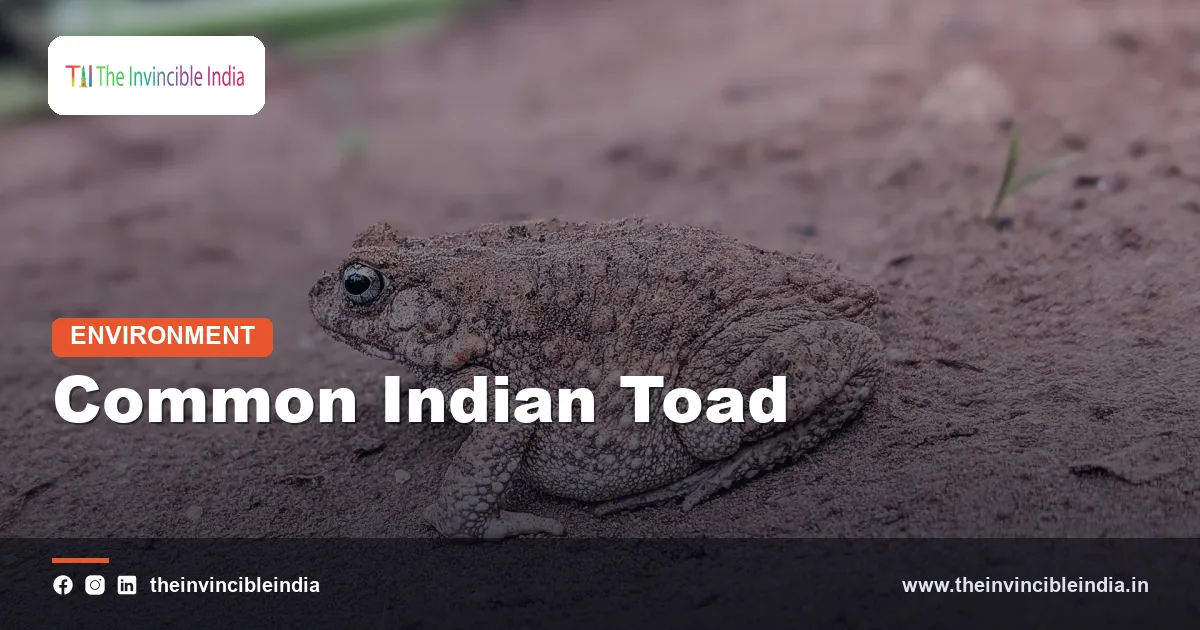
The common Indian toad (Duttaphrynus melanostictus) is the warty, brown-to-grey garden toad of South and Southeast Asia that hides by day, emerges at night to eat insects around lights and breeds in monsoon pools. Also known as the Asian common toad, black-spined toad or Himalayan toad, the common Indian toad is one of the most familiar amphibians in Indian homes, gardens and fields.
The common Indian toad is harmless to people who do not handle it roughly, but its skin carries glands that release a bitter, irritating secretion, which protects it from predators. This explainer covers what the common Indian toad is, how to recognise it, what it eats, how it breeds in the monsoon, why it is useful for natural pest control and how people should behave around it, using stable and well-documented facts.
| Attribute | Detail |
|---|---|
| Common names | Common Indian toad, Asian common toad, black-spined toad, Himalayan toad |
| Scientific name | Duttaphrynus melanostictus (formerly Bufo melanostictus) |
| Family | Bufonidae (true toads), order Anura |
| Size | Medium to large for a toad; adults commonly several centimetres to around 10 centimetres or more, with females larger than males |
| Habitat | Gardens, farmland, forest edges, roadsides, homes and wet or dry open ground |
| Activity | Mainly nocturnal; hides in burrows, crevices and under objects by day |
| Breeding | Explosive breeding in temporary pools, mostly during the monsoon |
| Range | South Asia, parts of East and Southeast Asia, with an invasive population reported in Madagascar |
| Conservation status | Generally rated Least Concern on the IUCN Red List |
Key Takeaways
- The common Indian toad (Duttaphrynus melanostictus) is a widespread, warty amphibian that is one of the most commonly seen toads in Indian gardens and villages.
- The common Indian toad has dark ridges on its head and black-tipped warts, and it carries large poison glands behind its eyes that deter predators.
- The common Indian toad eats large numbers of insects such as ants, beetles, termites, moths and cockroaches, and it often hunts near outdoor lights where insects gather.
- The common Indian toad lays its eggs in long double strings of jelly in temporary pools, usually after heavy rain, and its tadpoles are small and dark.
- The common Indian toad is harmless to humans when left alone, but its skin secretion can irritate eyes and mouths and can poison dogs and other pets that bite it.
- The common Indian toad is not globally threatened, although road traffic, pesticides, habitat loss and disease affect amphibians in general.
What is the common Indian toad?
The common Indian toad is a medium-sized to large true toad of the family Bufonidae, scientifically named Duttaphrynus melanostictus, that lives across the Indian subcontinent and much of Southeast Asia in close association with people. It was previously placed in the genus Bufo, and older books and field guides still use the name Bufo melanostictus.
The genus name Duttaphrynus honours the Indian herpetologist Sushil Kumar Dutta, and it was created when Asian toads formerly classified as Bufo were reorganised into several genera. The species name melanostictus refers to the black spots or spines that mark its warts.
The common Indian toad is a member of the order Anura, which includes all frogs and toads. It is a true toad, with dry, warty skin and a short, stocky body, and it is an amphibian that depends on water for breeding but spends much of its adult life on land.
How can you recognise the common Indian toad?
The common Indian toad can be recognised by its stout body, dry warty skin, prominent bony ridges on top of the head and black-tipped warts, together with large oval parotoid glands behind each eye. Its colour ranges from yellowish-brown to dark grey or reddish-brown, and the underside is cream or dirty white.
The ridges on the head are an important identification feature. They run from the snout and above the eyes toward the glands, forming a raised, bony pattern, and the tips of many warts are dark or black, giving the species its common name of black-spined toad. The legs are short and the hind feet are only partly webbed, which fits a land-dwelling animal that swims only when breeding.
Females are larger than males and may be considerably bulkier. Males are smaller and develop dark nuptial pads on their fingers during the breeding season, which help them grip females. Young toads are smaller and often more clearly marked.
Where does the common Indian toad live?
The common Indian toad lives across most of India, Nepal, Bangladesh, Sri Lanka, Pakistan and Myanmar and extends to southern China, Thailand and the Malay region, occupying gardens, farmland, villages, towns and forest edges from the plains to moderate elevations. It is one of the amphibians least dependent on pristine habitat.
The species is highly adaptable. By day it shelters under stones, logs, flowerpots, drain covers and in burrows or crevices, and at night it emerges to feed in open ground. It tolerates a wide range of conditions, including drier regions, because it can retreat into burrows during dry weather and wait for rain.
An invasive population of the species has been reported in Madagascar, where there are concerns that its toxins could harm native predators that have not evolved to deal with toad poison. This illustrates how a common and adaptable species at home can become a problem when introduced elsewhere.
What does the common Indian toad eat?
The common Indian toad eats mainly insects and other small invertebrates, including ants, termites, beetles, moths, crickets, cockroaches, spiders and earthworms, and it catches prey by flicking out a sticky tongue. It is an opportunistic hunter that eats whatever moves and fits in its mouth.
A familiar sight in Indian homes is a toad sitting under a porch light or street lamp, snapping up insects attracted by the light. This behaviour makes the common Indian toad a useful form of natural pest control around houses and in gardens and crop fields, where it eats many insects that damage plants or bother people.
Toads do not chew prey but swallow it whole, using their eyes to help push food down the throat. They eat large numbers of ants and termites, and their diet is typically broader than that of many frogs. The tadpoles, by contrast, graze on algae and organic matter in the water.
Typical prey
- Ants and termites, often the most numerous items
- Beetles, crickets and cockroaches
- Moths and other insects attracted to lights
- Spiders, millipedes and earthworms
- Occasionally small snails and other small animals
How does the common Indian toad breed in the monsoon?
The common Indian toad breeds mainly during the monsoon, when males gather in temporary pools, ponds and flooded ditches after heavy rain and call to attract females in short, intense bursts of activity known as explosive breeding. Females lay long double strings of eggs in the water, and the eggs hatch into small black tadpoles within days.
The male call is a steady, rattling trill that carries over a considerable distance at night. Males clasp females in a position called amplexus and fertilise the eggs as they are laid. A single female can lay thousands of eggs, though the exact number varies with her size, and most eggs and tadpoles are eaten by fish, insects, birds and other predators.
The tadpoles develop for a few weeks, depending on temperature and food, before turning into tiny toadlets that leave the water. After metamorphosis, thousands of toadlets can emerge at once and spread into nearby land. Breeding can occur at other times of year if heavy rain falls, particularly in southern and eastern India where rainfall patterns differ.
| Stage | What happens | Approximate timing |
|---|---|---|
| Calling and pairing | Males call at temporary pools; pairs clasp in amplexus | Nights following heavy rain |
| Egg laying | Eggs laid in long double strings of jelly | Same nights |
| Tadpole stage | Small dark tadpoles graze on algae | A few weeks |
| Metamorphosis | Limbs develop, tail is absorbed, young leave water | Around one to two months from laying |
| Adulthood | Land-based hunting; return to water to breed | Mature within a year or two |
Is the common Indian toad poisonous?
The common Indian toad is poisonous to predators, not to people who simply see or touch it gently, because its skin and parotoid glands release a bitter, irritating secretion called bufotoxin that can sicken animals that bite or swallow it. The poison is a defence, not a weapon that the toad uses actively.
For humans, the secretion can irritate the eyes, nose and mouth and may cause a stinging sensation if it gets into cuts or mucous membranes. It is therefore sensible to avoid handling toads, to wash hands with soap after any contact and to keep fingers away from the face. Children should be taught not to put toads in their mouths or rub their eyes after touching them.
Pets, especially dogs, are at risk if they bite or mouth a toad. Signs include heavy drooling, pawing at the mouth, vomiting and, in severe cases, trembling or collapse. Rinsing the dog’s mouth with plenty of water and seeking veterinary help quickly is the recommended response. Many local myths hold that toads spit poison or cause warts; neither is true.
How is a toad different from a frog?
A toad differs from a frog mainly in its drier, warty skin, shorter legs and more land-based lifestyle, but scientifically “toad” usually refers to members of the family Bufonidae while “frog” is a general term for many other families. The distinction is informal, because both belong to the same order, Anura.
| Feature | Common Indian toad | Typical Indian frog |
|---|---|---|
| Skin | Dry, thick and warty | Smooth and moist |
| Legs | Short; walks or crawls and makes short hops | Long; leaps and swims strongly |
| Habitat | Mostly on land, near people | Often in or near water |
| Poison glands | Large parotoid glands behind the eyes | Usually absent or small |
| Eggs | Laid in long double strings | Often laid in clumps or foam |
Why does the common Indian toad matter for the environment?
The common Indian toad matters because it controls insect populations as a predator and serves as food for snakes, birds and mammals, linking small invertebrates to larger animals in the food web. A single toad can eat a great many insects over a season, and its tadpoles help recycle nutrients in temporary pools.
Amphibians are also widely used as indicators of environmental health because their thin, permeable skin and double life on land and in water make them sensitive to pollution, pesticides and habitat change. The common Indian toad is relatively tough, so it persists where more sensitive species disappear, but heavy use of pesticides and the loss of breeding pools still reduce local populations.
Biological pest control by toads is useful but unquantified: studies show that toads eat large numbers of crop pests, yet exact economic benefits vary by habitat and are not summarised in a single reliable figure.
What threats does the common Indian toad face?
The common Indian toad faces threats from road traffic, pesticide and fertiliser runoff, habitat conversion, drainage of breeding pools and disease, although it remains common and is rated Least Concern globally. Road deaths are particularly visible on wet monsoon nights, when toads cross roads in large numbers to reach breeding pools.
- Vehicle collisions during monsoon breeding migrations
- Pesticides and fertilisers that poison eggs, tadpoles and adults
- Filling in or draining of temporary pools and ponds
- Persecution through fear and superstition
- Amphibian disease, including chytrid fungus, which has affected amphibians worldwide
Amphibians in India are generally covered by wildlife law, but the specific schedule placement of the common Indian toad should be checked against the current text of the Wildlife (Protection) Act, 1972, as amended. Ordinary good practice is simple: do not harm toads, keep pesticide use low and protect small ponds and pools.
How can people live safely with the common Indian toad?
People can live safely with the common Indian toad by leaving it undisturbed, washing hands after any contact, keeping pets away from it and avoiding pesticides that kill the insects and toads in a garden. The toad is a free pest-control service and rarely causes any trouble.
- Do not pick up toads with bare hands; if one must be moved, use gloves or a container
- Wash hands thoroughly and avoid touching eyes, nose or mouth afterwards
- Keep dogs and cats away from toads, especially at night during the monsoon
- Leave small damp, shaded corners and shallow water in gardens for toads to use
- Reduce outdoor lighting if toads and insects gather in unwanted numbers
- Drive carefully on wet nights when toads cross roads
Bottom Line
The common Indian toad is a hardy, warty amphibian that eats insects, breeds explosively in monsoon pools and defends itself with skin toxins that matter to predators but not to people who leave it alone. It is common and not globally threatened, and it is best treated as a helpful neighbour that needs clean water, small pools and a pesticide-light garden.
Frequently Asked Questions
What is the scientific name of the common Indian toad?
The scientific name of the common Indian toad is Duttaphrynus melanostictus. Older books call it Bufo melanostictus. It is also known as the Asian common toad, black-spined toad or Himalayan toad, and it belongs to the family Bufonidae.
Is the common Indian toad poisonous to humans?
The common Indian toad is not dangerous to humans who leave it alone, but its skin secretion can irritate the eyes and mouth. Wash hands after any contact and avoid touching your face. The poison is a defence against predators and can seriously affect dogs and other pets that bite the toad.
What does the common Indian toad eat?
The common Indian toad eats mostly insects such as ants, termites, beetles, moths and cockroaches, along with spiders and earthworms. It often waits near lights at night to catch insects that gather there. This makes it a useful natural pest controller in gardens and fields.
When does the common Indian toad breed?
The common Indian toad breeds mainly during the monsoon, after heavy rain fills temporary pools. Males gather at the water and call, and females lay eggs in long double strings of jelly. The black tadpoles develop over a few weeks before leaving the water as small toadlets.
What is the difference between a toad and a frog?
A toad generally has dry, warty skin, shorter legs and a more land-based life than a frog, which usually has smooth, moist skin and long legs for leaping and swimming. Scientifically, both are members of the order Anura. The common Indian toad is a true toad of the family Bufonidae.
Is the common Indian toad endangered?
No, the common Indian toad is generally rated Least Concern on the IUCN Red List because it is widespread and adaptable. It still faces local threats such as road deaths, pesticides and loss of breeding pools. Its exact legal schedule under Indian wildlife law should be checked in the current Act.
{“@context”:”https://schema.org”,”@graph”:[{“@type”:”FAQPage”,”mainEntity”:[{“@type”:”Question”,”name”:”What is the scientific name of the common Indian toad?”,”acceptedAnswer”:{“@type”:”Answer”,”text”:”The scientific name of the common Indian toad is Duttaphrynus melanostictus. Older books call it Bufo melanostictus. It is also known as the Asian common toad, black-spined toad or Himalayan toad, and it belongs to the family Bufonidae.”}},{“@type”:”Question”,”name”:”Is the common Indian toad poisonous to humans?”,”acceptedAnswer”:{“@type”:”Answer”,”text”:”The common Indian toad is not dangerous to humans who leave it alone, but its skin secretion can irritate the eyes and mouth. Wash hands after any contact and avoid touching your face. The poison is a defence against predators and can seriously affect dogs and other pets that bite the toad.”}},{“@type”:”Question”,”name”:”What does the common Indian toad eat?”,”acceptedAnswer”:{“@type”:”Answer”,”text”:”The common Indian toad eats mostly insects such as ants, termites, beetles, moths and cockroaches, along with spiders and earthworms. It often waits near lights at night to catch insects that gather there. This makes it a useful natural pest controller in gardens and fields.”}},{“@type”:”Question”,”name”:”When does the common Indian toad breed?”,”acceptedAnswer”:{“@type”:”Answer”,”text”:”The common Indian toad breeds mainly during the monsoon, after heavy rain fills temporary pools. Males gather at the water and call, and females lay eggs in long double strings of jelly. The black tadpoles develop over a few weeks before leaving the water as small toadlets.”}},{“@type”:”Question”,”name”:”What is the difference between a toad and a frog?”,”acceptedAnswer”:{“@type”:”Answer”,”text”:”A toad generally has dry, warty skin, shorter legs and a more land-based life than a frog, which usually has smooth, moist skin and long legs for leaping and swimming. Scientifically, both are members of the order Anura. The common Indian toad is a true toad of the family Bufonidae.”}},{“@type”:”Question”,”name”:”Is the common Indian toad endangered?”,”acceptedAnswer”:{“@type”:”Answer”,”text”:”No, the common Indian toad is generally rated Least Concern on the IUCN Red List because it is widespread and adaptable. It still faces local threats such as road deaths, pesticides and loss of breeding pools. Its exact legal schedule under Indian wildlife law should be checked in the current Act.”}}]}]}


