

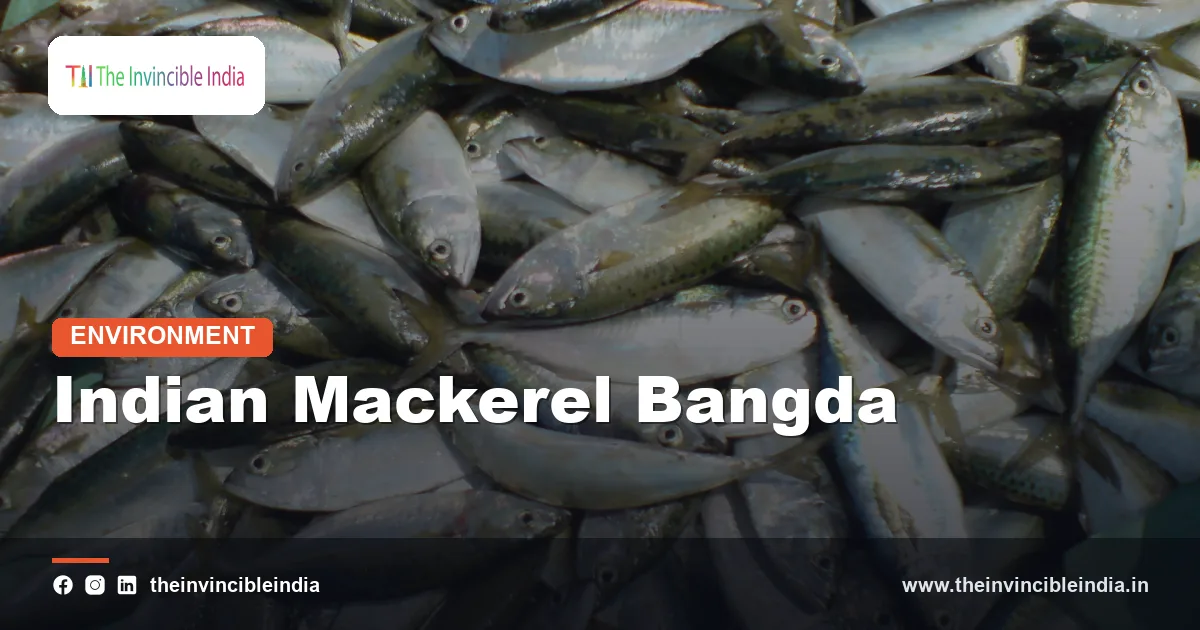
The Indian mackerel (Rastrelliger kanagurta), known as bangda in Marathi, Konkani and Hindi, is a small, silvery, schooling marine fish of the Indo-Pacific that forms one of the most important and abundant catches along the Indian coast. It is a staple of everyday coastal cooking from Maharashtra and Goa down through Karnataka and Kerala, and it ranks among the top species in India’s marine fish landings.
The Indian mackerel is an oily, protein-rich fish that feeds on plankton and travels in large shoals close to the coast, which makes it relatively easy to catch in quantity and inexpensive to buy. This explainer covers how to recognise the fish, where and when it is caught, how it lives and breeds, how it differs from the seer fish, and why its catch is closely watched by fisheries scientists.
| Attribute | Detail |
|---|---|
| Scientific name | Rastrelliger kanagurta (also called the Indian mackerel or striped mackerel) |
| Family | Scombridae (mackerels, tunas and bonitos) |
| Local names | Bangda (Marathi, Konkani, Hindi); bangude (Kannada and Tulu); ayala or ayila (Malayalam) |
| Typical size | Commonly around 15 to 25 cm in catches, reaching about 35 cm at most |
| Habitat | Coastal, surface-dwelling (pelagic) waters of the Indian and western Pacific oceans |
| Diet | Plankton, both zooplankton and phytoplankton, filtered through long gill rakers |
| Behaviour | Forms large shoals and migrates along the coast |
| Key research body | Central Marine Fisheries Research Institute (CMFRI), Kochi, established 1947 |
| Main fishing gear | Purse seines, ring seines, gillnets and trawls |
Key Takeaways
- The Indian mackerel (bangda) is a small, schooling, plankton-feeding marine fish that is among the most abundant species in India’s marine catch.
- The Indian mackerel is an oily fish rich in protein and omega-3 fatty acids, and it is typically cheaper than seer fish, pomfret and other premium sea fish.
- The Indian mackerel is caught mainly along the west coast, in Kerala, Karnataka, Goa and Maharashtra, and is central to coastal cuisines in those states.
- The Indian mackerel is not the same as the seer fish (surmai or king mackerel), which is a larger, predatory fish of a different genus.
- The Indian mackerel catch varies sharply from year to year, and scientists link these changes to ocean conditions, the monsoon, fishing pressure and a warming sea.
- The Indian mackerel is protected during breeding periods through the uniform monsoon fishing ban of 61 days and minimum legal size rules in some states.
What is the Indian mackerel?
The Indian mackerel is a small marine fish of the family Scombridae, scientifically named Rastrelliger kanagurta, that lives in warm coastal waters and forms dense shoals near the surface. It is a close relative of tuna but is far smaller, and it is sometimes also called the striped mackerel or long-jawed mackerel in English.
In India the fish is known by many regional names, bangda in the Konkan and Goa, bangude in coastal Karnataka and ayala or ayila in Kerala. The names differ from coast to coast, but all refer to the same widespread species, which supplies a vast amount of animal protein to coastal communities.
It belongs to the genus Rastrelliger, which has a few other members, including the short mackerel (Rastrelliger brachysoma) found farther east. The Indian mackerel is the commonly landed species along the Indian coast.
What does the Indian mackerel look like?
The Indian mackerel has a slender, spindle-shaped body, a bluish-green back marked with dark wavy lines or spots, a silvery belly and a large mouth with a slightly pointed snout. Two separate dorsal fins and a row of small finlets behind the dorsal and anal fins are typical of the mackerel family.
- Body: streamlined and rounded in cross-section, built for fast swimming.
- Colour: metallic blue-green above, silver below, with several dark stripes or bands along the upper body and a dark spot near the pectoral fin in some individuals.
- Gill rakers: very long and comb-like, visible when the gill cover is lifted; they strain plankton out of the water.
- Size: market fish are commonly about 15 to 25 cm, with a maximum around 35 cm.
The long gill rakers distinguish the Indian mackerel from many other fish and are a clear sign of its plankton-feeding life. They also explain why it can be fished in such large numbers, because it stays near the surface where plankton is richest.
Where is the Indian mackerel found?
The Indian mackerel is found throughout the tropical Indo-West Pacific, from East Africa and the Red Sea region across the Indian Ocean to Southeast Asia and the western Pacific, and it is common in coastal waters around India. Within India, the main fishing grounds lie off the south-west and west coasts, with significant landings also on the east coast.
Kerala, Karnataka, Goa and Maharashtra have long been the most important mackerel states, and Tamil Nadu, Andhra Pradesh and other east-coast states also record sizeable catches. The fish prefers the sea within the continental shelf, usually in water that is not very deep, and follows plankton-rich currents.
The fish also enters estuaries and bays at times, particularly the juveniles, which often occur close to the shore. This closeness to the coast makes it accessible to small boats and traditional fishing communities as well as to larger mechanised vessels.
How does the Indian mackerel live and breed?
The Indian mackerel lives in fast-moving schools that feed on plankton near the surface, spawns over an extended season in coastal waters and grows rapidly, reaching a catchable size within a year or so. Males and females both mature at a young age, which helps the species recover quickly from heavy fishing, though this resilience has limits.
Spawning occurs over several months, with a peak around the monsoon period in many parts of its Indian range, although timing varies by region and by year. The eggs and larvae float in the plankton, and the young stay in nearshore waters before joining the main adult shoals. Estimates of lifespan vary, but the fish is generally considered short-lived, with most individuals living no more than a few years.
Because the species depends so strongly on plankton, its abundance responds to changes in ocean productivity. Variations in sea temperature, upwelling off the south-west coast and the strength and timing of the monsoon all appear to influence plankton and, in turn, mackerel catches.
Is Indian mackerel the same as seer fish?
No, the Indian mackerel is not the same as seer fish, because the Indian mackerel (bangda) is a small, plankton-feeding fish of the genus Rastrelliger, whereas seer fish (surmai or king mackerel) belongs to the genus Scomberomorus and is a larger, predatory fish. The two are related members of the same family but differ greatly in size, diet, price and taste.
| Feature | Indian mackerel (bangda) | Seer fish (surmai, king mackerel) |
|---|---|---|
| Genus | Rastrelliger | Scomberomorus |
| Typical size | About 15 to 25 cm | Often 50 cm to over a metre |
| Diet | Filters plankton | Hunts smaller fish and squid |
| Behaviour | Dense surface shoals | Faster, more solitary or in small groups |
| Market price | Generally affordable | Generally premium |
| Culinary use | Whole fry, curry, stuffed preparations | Steaks and fillets |
The confusion arises because English uses “mackerel” for several different fish. In Indian markets, traders and cooks use separate names for the two, and consumers can tell them apart easily by size and shape.
How is the Indian mackerel caught?
The Indian mackerel is caught mainly with purse seines, ring seines, gillnets and trawl nets operated from mechanised boats, motorised country craft and traditional vessels. Because the fish moves in dense surface shoals, nets that encircle a school can take large quantities in a single haul.
- Purse seines and ring seines: encircling nets used by larger boats on the west coast.
- Gillnets: used by smaller boats and country craft.
- Trawls: bottom and mid-water trawling takes mackerel along with other species.
The fishing season depends on region and weather. A uniform ban of 61 days is imposed on fishing in India’s exclusive economic zone each year during the monsoon, typically from 1 June to 31 July on the west coast and from 15 April to 14 June on the east coast. The ban protects the breeding season of many fish and the safety of fishermen at sea.
How is the Indian mackerel used in Indian cooking?
The Indian mackerel is used in Indian cooking mainly as a whole fish, fried, grilled, or simmered in coconut-based and tamarind-based curries, especially along the west coast. Its oily, strongly flavoured flesh holds up well to bold masalas.
- Goa and Konkan: bangda fry coated in rava, and recheado, a red masala stuffing, are widely served.
- Karnataka coast: bangude is cooked in tangy, spicy gravies, often with coconut and tamarind.
- Kerala: ayala curry, made with kudampuli (Malabar tamarind) and chilli, is a household favourite.
- Preservation: the fish is also salted and sun-dried, and in some areas it is canned.
The fish is a good source of protein, vitamin B12, vitamin D and the long-chain omega-3 fatty acids that are associated with heart and brain health. As with all oily fish, it is best eaten fresh, since the fats spoil quickly in heat. Mackerel also has a small number of bones that are easily removed, and the fish is generally considered safe for regular consumption.
Why is the Indian mackerel catch so variable?
The Indian mackerel catch varies strongly from year to year because the fish is short-lived, depends on plankton and responds quickly to changes in sea temperature, upwelling, the monsoon and fishing effort. Scientists at the Central Marine Fisheries Research Institute (CMFRI) have documented large swings in landings over the decades.
Studies by CMFRI and other bodies have also suggested that the distribution of the Indian mackerel is shifting, with the fish appearing in increasing numbers in northern and eastern waters in some years, a movement associated with ocean warming. These findings are still being refined, and they are best understood as trends under study rather than settled facts.
Another concern is the heavy catch of juvenile mackerel before they reach breeding size. Kerala has introduced a minimum legal size for mackerel, widely reported at around 14 cm, to encourage fishers to let young fish grow. Such rules depend on enforcement and cooperation by fishing communities.
What is the future of the Indian mackerel fishery?
The future of the Indian mackerel fishery depends on keeping catches within sustainable limits, protecting juvenile fish and spawning periods, and adapting to changes in ocean conditions linked to climate. India’s marine catch, estimated at several million tonnes a year, includes mackerel among its leading species, so any decline affects both food supply and the livelihoods of fishing families.
Management measures include the seasonal ban, minimum legal sizes, regulation of fishing gear and mesh size, and stock assessment by research institutions. Fisheries authorities and the Ministry of Fisheries, Animal Husbandry and Dairying also promote sustainable practices through schemes such as the Pradhan Mantri Matsya Sampada Yojana. For consumers, choosing fresh, locally caught fish in season and avoiding undersized fish supports these efforts.
How can you tell whether Indian mackerel is fresh?
Fresh Indian mackerel can be recognised by bright, clear eyes, firm flesh that springs back when pressed, red or pink gills and a clean smell of the sea rather than a sour or ammonia-like odour. Because the fish is oily and the fats turn rancid quickly in warm weather, freshness matters more for mackerel than for many leaner fish.
- Eyes: clear and slightly bulging, not sunken or cloudy.
- Skin: shiny, with the bluish-green and silver colours still vivid.
- Gills: bright red or pink, not brown or grey.
- Flesh: firm, with no deep dents left by a finger press.
- Smell: mild and briny.
Along the coast, fresh bangda is often sold within hours of landing at fish markets and landing centres, while inland markets receive iced fish after a longer journey. Storing the fish on ice and cooking it the same day keeps both flavour and nutrition at their best.
How is Indian mackerel preserved and traded?
Indian mackerel is preserved by icing, freezing, salting and sun-drying, and by canning in some units, and it is traded mainly in domestic markets, with a smaller share exported in frozen or processed form. Because shoals are landed in large numbers over short periods, preservation is essential to prevent waste during peak seasons.
Traditional curing, in which the fish is split or left whole, salted and dried in the sun, is practised in several coastal districts. The dried product keeps for months and supplies protein to inland and hill communities, and it also gives fishing families an income when fresh fish prices fall in glut periods. Modern ice plants, cold storage and better transport have reduced losses, although small-scale fishers still face challenges in handling and price fluctuation.
The wide availability of mackerel also makes it a useful fish for animal and poultry feed industries in some regions, where surplus and low-value catch is processed into fishmeal. Researchers and policymakers continue to debate how much of the food-grade fish should be diverted to such uses, because the same fish is valuable as direct human food.
Bottom Line
The Indian mackerel, or bangda, is a small, silvery, plankton-feeding shoaling fish that sits at the centre of India’s coastal fishing and food culture. Its abundance makes it affordable and nutritious, but its fluctuating catch, juvenile fishing and warming seas make careful management essential.
Frequently Asked Questions
What is Indian mackerel called in Hindi and Marathi?
Indian mackerel is called bangda in Hindi, Marathi and Konkani. In Karnataka and the Tulu-speaking region it is called bangude, and in Kerala it is known as ayala or ayila. The scientific name is Rastrelliger kanagurta.
Is Indian mackerel the same as seer fish?
No, Indian mackerel and seer fish are different fish of the same family. Indian mackerel (bangda) is a small plankton-feeding fish, while seer fish (surmai or king mackerel) is a larger predatory fish of a different genus. Seer fish is usually more expensive.
Is Indian mackerel healthy to eat?
Yes, Indian mackerel is a nutritious oily fish that provides protein, vitamin B12, vitamin D and omega-3 fatty acids. It is best eaten fresh and cooked well. People with specific medical conditions or fish allergies should consult a doctor.
What does Indian mackerel eat?
Indian mackerel eats plankton, mostly zooplankton along with some phytoplankton, which it filters from the water with long gill rakers. It feeds near the surface in coastal waters. Its diet explains why it forms large shoals in plankton-rich areas.
Where is Indian mackerel mainly caught in India?
Indian mackerel is mainly caught along the west coast of India, in Kerala, Karnataka, Goa and Maharashtra, with notable landings on the east coast as well. It is taken with purse seines, ring seines, gillnets and trawls. Catches vary a great deal from year to year.
Why is there a fishing ban during the monsoon?
India imposes a uniform 61-day monsoon fishing ban in its exclusive economic zone to protect the breeding season of fish, including mackerel, and to keep fishermen safe during rough seas. On the west coast it typically runs from 1 June to 31 July. On the east coast it typically runs from 15 April to 14 June.
{“@context”:”https://schema.org”,”@graph”:[{“@type”:”FAQPage”,”mainEntity”:[{“@type”:”Question”,”name”:”What is Indian mackerel called in Hindi and Marathi?”,”acceptedAnswer”:{“@type”:”Answer”,”text”:”Indian mackerel is called bangda in Hindi, Marathi and Konkani. In Karnataka and the Tulu-speaking region it is called bangude, and in Kerala it is known as ayala or ayila. The scientific name is Rastrelliger kanagurta.”}},{“@type”:”Question”,”name”:”Is Indian mackerel the same as seer fish?”,”acceptedAnswer”:{“@type”:”Answer”,”text”:”No, Indian mackerel and seer fish are different fish of the same family. Indian mackerel (bangda) is a small plankton-feeding fish, while seer fish (surmai or king mackerel) is a larger predatory fish of a different genus. Seer fish is usually more expensive.”}},{“@type”:”Question”,”name”:”Is Indian mackerel healthy to eat?”,”acceptedAnswer”:{“@type”:”Answer”,”text”:”Yes, Indian mackerel is a nutritious oily fish that provides protein, vitamin B12, vitamin D and omega-3 fatty acids. It is best eaten fresh and cooked well. People with specific medical conditions or fish allergies should consult a doctor.”}},{“@type”:”Question”,”name”:”What does Indian mackerel eat?”,”acceptedAnswer”:{“@type”:”Answer”,”text”:”Indian mackerel eats plankton, mostly zooplankton along with some phytoplankton, which it filters from the water with long gill rakers. It feeds near the surface in coastal waters. Its diet explains why it forms large shoals in plankton-rich areas.”}},{“@type”:”Question”,”name”:”Where is Indian mackerel mainly caught in India?”,”acceptedAnswer”:{“@type”:”Answer”,”text”:”Indian mackerel is mainly caught along the west coast of India, in Kerala, Karnataka, Goa and Maharashtra, with notable landings on the east coast as well. It is taken with purse seines, ring seines, gillnets and trawls. Catches vary a great deal from year to year.”}},{“@type”:”Question”,”name”:”Why is there a fishing ban during the monsoon?”,”acceptedAnswer”:{“@type”:”Answer”,”text”:”India imposes a uniform 61-day monsoon fishing ban in its exclusive economic zone to protect the breeding season of fish, including mackerel, and to keep fishermen safe during rough seas. On the west coast it typically runs from 1 June to 31 July. On the east coast it typically runs from 15 April to 14 June.”}}]}]}


