

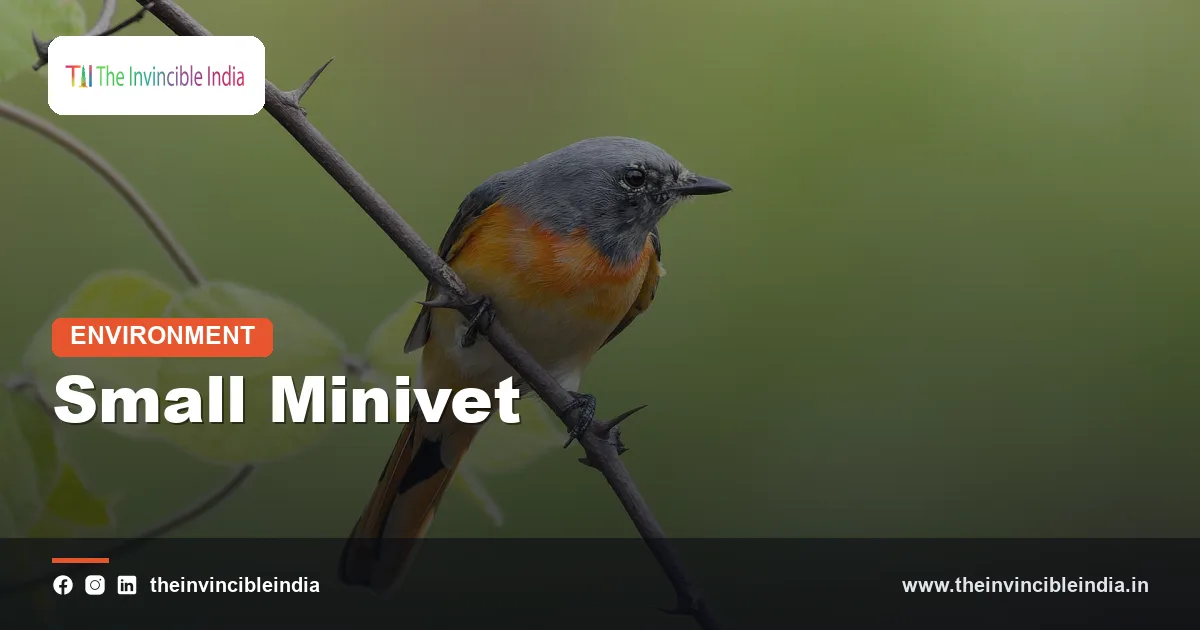
The small minivet (Pericrocotus cinnamomeus) is a tiny, flycatcher-like songbird of the Indian subcontinent, in which the male has a grey head and back with an orange-red breast and rump, while the female is paler grey with soft yellow underparts. It is the commonest and most widespread of India’s minivets, found in gardens, avenues, scrub and open woodland across much of the country.
The small minivet is a lively, social bird that moves through treetops in loose flocks, flitting from branch to branch and flashing its coloured rump. It is easy to overlook because of its size, but a flock is very noticeable once its thin, twittering calls are known. This article covers identification, range, diet, behaviour, nesting and conservation, and compares the species with the larger scarlet minivet.
| Quick Facts: Small Minivet | |
|---|---|
| Scientific name | Pericrocotus cinnamomeus |
| Family | Campephagidae (cuckoo-shrikes, trillers and minivets) |
| Size | Roughly 15 to 16 cm, the smallest of the Indian minivets, with a fairly long tail |
| Male plumage | Grey head and back, blackish wings with an orange patch, orange-red rump and underparts shading to paler orange |
| Female plumage | Paler grey above, whitish to pale yellow below with a yellowish-orange rump |
| Range in India | Most of the Indian subcontinent below the high mountains, including plains, peninsular India and lower hills |
| Habitat | Open deciduous woodland, scrub, gardens, orchards, avenues and mango groves |
| Diet | Small insects, such as caterpillars, bugs, beetles and flies, taken among leaves |
| Breeding season | Mostly in spring and the summer months; builds a small cup nest on a thin tree fork |
| Conservation status | IUCN Least Concern; protected under the Wildlife (Protection) Act, 1972 |
Key Takeaways
- The small minivet (Pericrocotus cinnamomeus) is the smallest and most widespread minivet in India, measuring only about 15 to 16 cm in length.
- Male small minivets have a grey head and back with orange-red underparts and rump, while females are paler grey with yellowish underparts.
- Small minivets forage in active flocks in the treetops of gardens, avenues and open woodland, feeding mainly on small insects gleaned from leaves.
- The small minivet builds a tiny cup nest of fine fibres, bound with spider silk and decorated with lichen, on a thin fork of a tree.
- The small minivet is classified as Least Concern by the IUCN, and it is far more tolerant of human-modified habitat than the forest-dependent scarlet minivet.
- The small minivet belongs to the family Campephagidae, whose name refers to caterpillar-eating habits, and it is a useful natural controller of leaf-eating insects.
What is the small minivet?
The small minivet is a small passerine bird in the genus Pericrocotus, a group of brightly coloured insectivorous birds of South and South-East Asia, and it is the minivet most likely to be seen in everyday settings in India. Its common name reflects its size, as it is the smallest of the minivets found in the country.
Minivets are named for their general resemblance to the cuckoo-shrikes, a related and larger group, together forming the family Campephagidae. The small minivet is sexually dimorphic: the male and female differ in colour, with the male showing orange or reddish tones and the female showing more subdued yellow-grey tones. Several regional subspecies are recognised, with minor differences in the shade of the male’s underparts and the greyness of the back.
The scientific name cinnamomeus means “cinnamon-coloured” and refers to the warm, orange-brown tint of the male’s lower parts in some forms. Some regional forms of the bird are quite pale, while others are deeper in colour.
How can you identify a small minivet?
A small minivet can be identified by its tiny size, slender body, long tail and the pattern of grey upperparts with orange-red or yellow patches, together with its habit of moving in flocks through treetops. The long graduated tail, edged with white, and the flash of colour on the rump in flight are good clues.
The male
The adult male has a slate-grey to blackish head and back, a darker crown, and black wings with a bold orange-red patch that forms a wing bar. The throat and breast are orange, and the belly is lighter. The rump is orange-red, and the tail is black with orange or white outer feathers. In sunlight, the colours look warm and glowing.
The female
The female is less colourful, with grey upperparts, a white or pale yellow throat and underparts, and a yellowish-orange rump. The wings show a pale yellow bar. Young birds look similar to females, and young males gain orange feathers gradually.
Flight and posture
The bird often sits with its tail slightly fanned or flicked, and it frequently flutters at the end of branches while feeding. In flight, it appears to flutter and glide in short bursts, showing the colourful rump and tail patches.
Similar species
- Scarlet minivet: a larger bird with a glossy black male and scarlet-red underparts, living in tall forest canopy.
- White-bellied minivet: a bird of dry peninsular scrub with a black head, white underparts and a rusty-orange rump.
- Ashy minivet: a migratory grey-and-white species seen on passage, lacking orange or red.
- Flycatchers and flowerpeckers: may look similar from a distance but lack the long, graduated tail and flock behaviour.
Where does the small minivet live in India?
The small minivet lives across most of India below the high mountains, from the dry plains and peninsular plateau to the lower slopes of the Himalayas, in open woodland, scrub, gardens and cultivated areas with trees. It is much more common in lowlands than in dense forest.
The bird favours open deciduous woodland and dry forest with scattered trees, but it also lives in the middle of towns, on tree-lined roads, in orchards and mango groves, and in large gardens. It is rare or absent in thick evergreen forest, where other minivets replace it, and it avoids treeless open land.
The species is mainly resident, but it shows local movements in response to food and weather. Flocks may appear in an area in some seasons and move on in others, so the bird can seem to come and go. Related species occur across South Asia and parts of South-East Asia, and the Indian birds form the core of the species’ range.
Typical places to look
- Large avenue trees, such as neem, tamarind, rain tree and peepal.
- Orchards, mango groves and teak or mixed plantations.
- Scrubby woodland on rocky hills and the edges of deciduous forests.
- Large campus and park gardens in cities.
What does the small minivet eat?
The small minivet eats mainly small insects, such as caterpillars, small beetles, bugs, flies and aphids, which it gleans from leaves, twigs and the bark of trees. It sometimes catches flying insects in short fluttering sallies from a perch.
Flocks feed by moving steadily through the foliage, hovering briefly at leaf tips to pick off prey. Each bird covers a small patch of branches before flying on, and the group works through a tree in a few minutes. The slender bill and light body allow the bird to cling to thin twigs and flutter at the tips of branches.
Because the small minivet eats large numbers of leaf-eating caterpillars and sap-sucking bugs, it contributes to the natural control of insect pests in gardens and orchards. Along with warblers, tailorbirds and white-eyes, it forms part of the community of small insect-eaters that keep tree foliage healthy.
Why does the small minivet move in flocks?
The small minivet moves in flocks because feeding in a group helps individual birds find insects and spot predators more quickly. Flocks usually consist of a handful to a dozen or so birds, though larger groups gather in good conditions or at roosts.
The flocks move continuously through the canopy, and the birds keep contact with thin, high-pitched, tinkling or twittering notes. These calls are often the first clue to the presence of a flock, since the birds themselves are small and high in the foliage. The sound has been described as a series of fine whistles or “swee-swee” notes.
Flock composition can be fluid. Mixed groups of males and females travel together outside the breeding season, and birds may also join mixed-species hunting parties with tits, white-eyes and leaf warblers. During breeding, pairs separate from the flock to defend a small area around the nest, while neighbours may still feed together at the edge of their territories.
How does the small minivet breed and nest?
The small minivet breeds by building a tiny, neat cup nest on a thin, horizontal fork of a tree, usually well above the ground, and lays a small clutch of spotted eggs. The nest is very small and so well camouflaged with lichen and spider silk that it can look like a lump on the branch.
Both parents help build the nest, using fine grass, bark fibre, rootlets and cobweb, and then cover the outside with bits of lichen or bark. The clutch usually numbers about three eggs, which are pale with brown or reddish markings. Both parents incubate and feed the nestlings with small insects.
The breeding season varies with region and rainfall but generally falls in spring and summer, ahead of or during the early monsoon, when insect numbers are rising. Because the nest is placed on a thin fork, it may be exposed to wind, rain and predators such as crows and squirrels, and nesting failure is common. Pairs often attempt a second nest if the first fails.
| Stage | What happens |
|---|---|
| Flock breaks up | Pairs form and leave the flock to claim a small breeding area |
| Nest building | Both birds construct a small cup of fibre, bound with spider silk and covered with lichen |
| Egg laying | About three pale, spotted eggs are laid |
| Incubation and feeding | Both parents share incubation and feed insects to the chicks |
| After fledging | Families rejoin flocks and wander through nearby trees |
How is the small minivet different from the scarlet minivet?
The small minivet differs from the scarlet minivet mainly in size, colour and habitat: it is smaller, the male is grey and orange rather than black and scarlet, and it lives in open woodland and gardens instead of tall forest canopy. The two species belong to the same genus and are often confused by beginners.
| Feature | Small minivet | Scarlet minivet |
|---|---|---|
| Approximate length | 15 to 16 cm | 19 to 20 cm |
| Male upperparts | Grey to slate with a darker crown | Glossy black |
| Male underparts | Orange-red shading to paler orange | Bright scarlet-red |
| Female colouring | Grey above, pale yellow below | Grey-olive above, yellow below |
| Typical habitat | Open woodland, gardens, avenues, scrub | Tall forest canopy |
| Tolerance of towns | High | Low |
The simplest tip for field identification is habitat. A minivet in a city park or roadside tree is almost always the small minivet, while one high in the canopy of a tall hill forest is more likely to be a scarlet minivet or another forest species.
Is the small minivet threatened?
The small minivet is not threatened and is classified as Least Concern by the IUCN because it is widespread, abundant in suitable habitat and tolerant of altered landscapes. It remains a familiar bird in many Indian towns and rural areas.
In India, the species is protected as a wild bird under the Wildlife (Protection) Act, 1972. The main risks are the loss of mature trees, heavy use of pesticides in orchards and farmland, and the clearing of scrub and woodland for development. These pressures are local and rarely threaten the survival of the species as a whole, but they can remove birds from specific places.
How people can help
- Plant and retain native trees along roads, in gardens and on campuses.
- Avoid cutting or heavy pruning of trees from spring to early monsoon, the main nesting period.
- Reduce pesticide use in orchards and gardens, to protect insect food.
- Record sightings on citizen-science platforms to track local changes in numbers.
How can you spot a small minivet?
A small minivet is best spotted by listening for the thin twittering calls of a flock and then scanning the outer branches of nearby trees, where birds flit and flutter in search of insects. Early morning is the best time, when the flocks are most active.
- Visit tree-lined roads, orchards, parks and open woodland, especially on mornings after rain.
- Look for small birds with long tails fluttering at leaf tips, and note the flash of orange or yellow on the rump.
- Use binoculars to confirm the male’s orange and grey pattern and the female’s yellow tones.
- Keep a respectful distance from any nest, and avoid playing recorded calls at breeding birds.
Because the small minivet is common and accessible, it is a good starting point for learning about the Campephagidae family. Watching a flock through the seasons helps reveal how group size, behaviour and calls change with food and breeding.
Bottom Line
The small minivet is the smallest, commonest and most adaptable minivet in India, easy to recognise by the orange-and-grey male and its habit of flocking through treetops. Retaining native trees and limiting pesticide use in towns and farmland helps keep it a familiar sight.
Frequently Asked Questions
What is a small minivet?
The small minivet is a tiny songbird, Pericrocotus cinnamomeus, found across the Indian subcontinent. The male has a grey head and back with an orange-red breast and rump, and the female is paler with yellowish underparts. It lives in flocks and feeds on small insects.
How can you tell a male small minivet from a female?
The male small minivet has a grey head and back with orange-red underparts and rump, while the female is paler grey above with whitish to yellow underparts. Both have a long tail and a coloured wing bar. The male is brighter, especially in sunlight.
Where does the small minivet live in India?
The small minivet lives across most of India below the high mountains, in open woodland, scrub, gardens, avenues and orchards. It is common in lowland and peninsular regions. It is rare in thick evergreen forest.
What does the small minivet eat?
The small minivet eats mainly small insects, including caterpillars, bugs, beetles and flies. It picks them from leaves and twigs while fluttering through the canopy. It sometimes catches flying insects in short flights.
Is the small minivet the same as the scarlet minivet?
The small minivet is not the same as the scarlet minivet; they are separate species in the same genus. The small minivet is smaller, with an orange-and-grey male, while the scarlet minivet is larger, with a black-and-scarlet male. The small minivet lives in open woodland and gardens, and the scarlet minivet prefers tall forest.
Is the small minivet protected in India?
The small minivet is protected in India under the Wildlife (Protection) Act, 1972, which prohibits hunting and capture of wild birds. The IUCN classifies it as Least Concern because it is common and adaptable. Retaining mature trees helps maintain local populations.
{“@context”:”https://schema.org”,”@graph”:[{“@type”:”FAQPage”,”mainEntity”:[{“@type”:”Question”,”name”:”What is a small minivet?”,”acceptedAnswer”:{“@type”:”Answer”,”text”:”The small minivet is a tiny songbird, Pericrocotus cinnamomeus, found across the Indian subcontinent. The male has a grey head and back with an orange-red breast and rump, and the female is paler with yellowish underparts. It lives in flocks and feeds on small insects.”}},{“@type”:”Question”,”name”:”How can you tell a male small minivet from a female?”,”acceptedAnswer”:{“@type”:”Answer”,”text”:”The male small minivet has a grey head and back with orange-red underparts and rump, while the female is paler grey above with whitish to yellow underparts. Both have a long tail and a coloured wing bar. The male is brighter, especially in sunlight.”}},{“@type”:”Question”,”name”:”Where does the small minivet live in India?”,”acceptedAnswer”:{“@type”:”Answer”,”text”:”The small minivet lives across most of India below the high mountains, in open woodland, scrub, gardens, avenues and orchards. It is common in lowland and peninsular regions. It is rare in thick evergreen forest.”}},{“@type”:”Question”,”name”:”What does the small minivet eat?”,”acceptedAnswer”:{“@type”:”Answer”,”text”:”The small minivet eats mainly small insects, including caterpillars, bugs, beetles and flies. It picks them from leaves and twigs while fluttering through the canopy. It sometimes catches flying insects in short flights.”}},{“@type”:”Question”,”name”:”Is the small minivet the same as the scarlet minivet?”,”acceptedAnswer”:{“@type”:”Answer”,”text”:”The small minivet is not the same as the scarlet minivet; they are separate species in the same genus. The small minivet is smaller, with an orange-and-grey male, while the scarlet minivet is larger, with a black-and-scarlet male. The small minivet lives in open woodland and gardens, and the scarlet minivet prefers tall forest.”}},{“@type”:”Question”,”name”:”Is the small minivet protected in India?”,”acceptedAnswer”:{“@type”:”Answer”,”text”:”The small minivet is protected in India under the Wildlife (Protection) Act, 1972, which prohibits hunting and capture of wild birds. The IUCN classifies it as Least Concern because it is common and adaptable. Retaining mature trees helps maintain local populations.”}}]}]}


