

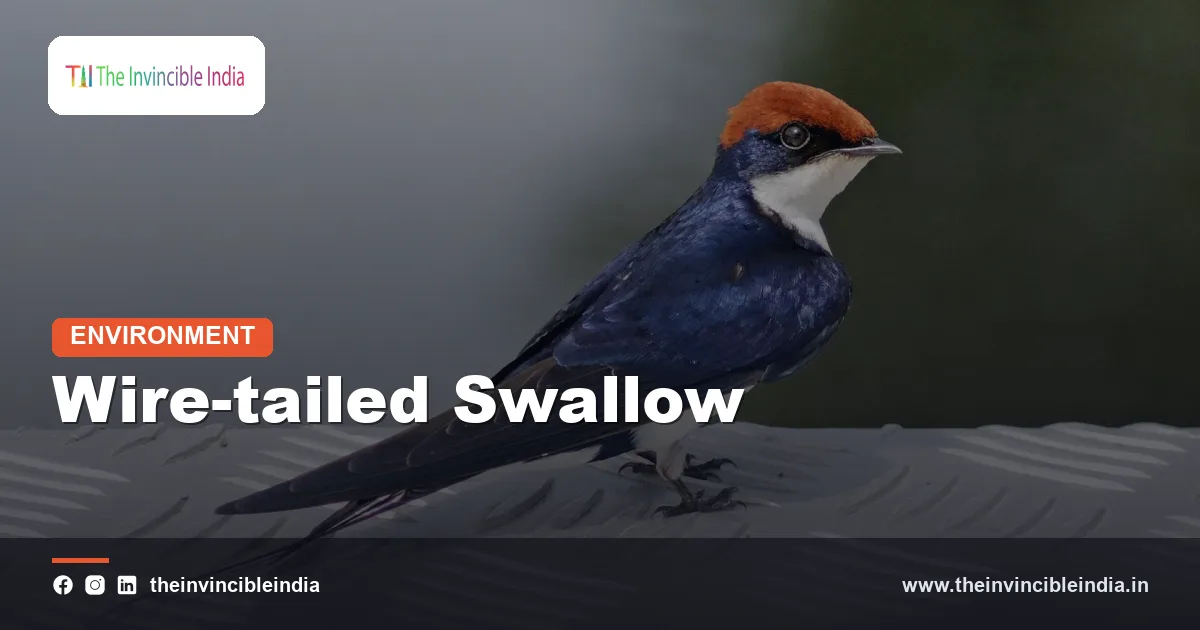
The wire-tailed swallow (Hirundo smithii) is a small, glossy blue and white swallow of the family Hirundinidae, named for the two hair-thin tail feathers that trail behind it like fine wires. In India it is a resident bird of rivers, lakes, canals and bridges, usually seen skimming low over water or perched on a wire above it.
The wire-tailed swallow is one of the most elegant members of its family, with a bright chestnut cap and spotless white underparts. This explainer describes how to recognise the wire-tailed swallow, where it lives, what it eats, how it builds its mud nest, and how it differs from the barn swallow and the red-rumped swallow.
| Fact | Detail |
|---|---|
| Common name | Wire-tailed swallow |
| Scientific name | Hirundo smithii |
| Family | Hirundinidae (swallows and martins) |
| Size | Body about 14 cm long, with the wire-like tail streamers adding several centimetres |
| Status in India | Resident, with some local movements, across most of the plains and low hills |
| Habitat | Rivers, lakes, reservoirs, canals, ponds, bridges and waterside villages |
| Diet | Small flying insects such as midges, flies and small bugs, caught over water and open ground |
| Breeding | Open cup of mud under bridges, culverts or eaves, usually over or near water, roughly March to August |
| Conservation status | Least Concern on the IUCN Red List |
Key Takeaways
- The wire-tailed swallow (Hirundo smithii) is a glossy steel-blue swallow with a chestnut cap, white underparts and two very thin, wire-like tail feathers.
- The wire-tailed swallow is closely tied to water in India, and it is most often seen along rivers, lakes, canals and under bridges.
- The wire-tailed swallow builds an open cup nest of mud pellets lined with grass and feathers, usually under a bridge, culvert or eave close to water.
- The wire-tailed swallow feeds in flight on small insects, flying low over the surface of water and open ground.
- The wire-tailed swallow is a resident of the Indian subcontinent and also occurs in Africa and South-East Asia.
- The wire-tailed swallow is classified as Least Concern, with a wide range and a stable population.
What is the wire-tailed swallow?
The wire-tailed swallow is a small aerial insect-eating bird in the swallow and martin family, with the scientific name Hirundo smithii. It belongs to the same genus as the barn swallow, and its name comes from the extremely thin outer tail feathers, which extend well beyond the rest of the tail.
The species lives in two main parts of the world. One population occupies parts of sub-Saharan Africa, and another occupies the Indian subcontinent and parts of South-East Asia. Birds in India are largely resident, though individuals shift locally with water levels and the seasons.
Like other swallows, the wire-tailed swallow has long, pointed wings, a short bill with a wide gape and tiny feet. It spends most of the day in flight and settles mainly to rest, preen and attend the nest.
What does the wire-tailed swallow look like?
The wire-tailed swallow has glossy dark steel-blue upperparts, a bright chestnut crown and forehead, and clean white underparts. The outer tail feathers are shaped into fine, thread-like wires that can extend several centimetres beyond the rest of the tail.
These are the features that identify the species in the field.
- The chestnut cap contrasts sharply with the blue back and white face, and gives the bird a neat, capped look.
- The underparts are pure white, without the streaking of the red-rumped swallow or the broad chest band of the barn swallow.
- The wire tail streamers are very narrow, almost invisible at a distance, and are longer in adult birds than in juveniles.
- The rump is blue like the back and not chestnut, which also separates it from the red-rumped swallow.
Males and females are similar. Young birds lack the long wires and have duller, browner caps, but still show the clean white underparts that mark the species.
Where does the wire-tailed swallow live in India?
The wire-tailed swallow lives across much of India’s plains and low hills, wherever rivers, lakes and other open water are found. It is common in the peninsula, the Gangetic plains and the east, and it is less frequent in very dry desert areas and in the high mountains.
The bird depends on water in two ways. It hunts insects that hatch near the surface, and it finds the wet mud it needs for building its nest. For this reason, the species is closely associated with bridges over rivers and canals, reservoirs, village tanks and irrigation channels.
The wire-tailed swallow also visits paddy fields, riverside towns and sandy shores. Where suitable bridges and culverts are available, it can live close to busy human settlements, and it is often seen sitting on overhead wires beside the water.
How do bridges and canals help the wire-tailed swallow?
Bridges and canals help the wire-tailed swallow by supplying both nest sites and feeding areas in one place. A bridge over a river offers a sheltered underside for the mud cup, while the water below produces the midges and flies that the birds catch.
The spread of irrigation canals, reservoirs and concrete bridges across India has probably given the species more places to nest than it had in the past, when it relied on cliffs, caves and well walls. This is a good example of a wild bird adapting to human-made structures without needing to give up its natural diet.
What does the wire-tailed swallow eat?
The wire-tailed swallow eats small flying insects, including midges, flies, mosquitoes and tiny bugs, which it catches in flight with its wide bill. Because many of these insects breed in or near water, the bird is most active just above the surface of rivers, lakes and ponds.
The hunting flight is swift and low. The wire-tailed swallow makes repeated passes over the water in sweeping circles, sometimes touching the surface to drink or to bathe in flight. It may also follow the edges of reed beds or hunt above wet grassland.
Insects are plentiful over water after rain. At such times, wire-tailed swallows may gather in small groups with other swallows, martins and swifts, taking advantage of the same swarms.
How does the wire-tailed swallow build its nest?
The wire-tailed swallow builds an open, cup-shaped nest from small pellets of mud, attached under a bridge, culvert, eave or rock ledge, usually over or near water. Both sexes collect wet mud from the bank and add it in layers to form a half-bowl, which they then line with soft grass and feathers.
The nest is simpler than the closed, tunnel-shaped nest of the red-rumped swallow. It is a shallow bowl open at the top, and it is usually built by a single pair rather than in a dense colony, though several pairs may use one large bridge.
Typical nest sites include these.
- The underside of road and railway bridges over rivers and canals.
- Concrete culverts, sluice gates and irrigation structures.
- Eaves, verandahs and beams of buildings near water.
- Well walls, rock overhangs and cave mouths in rocky river valleys.
How does the wire-tailed swallow breed?
The wire-tailed swallow breeds mainly from about March to August in India, with timing varying by region and the local rains. The female lays about three or four white eggs marked with reddish-brown spots, and both parents share the incubation and feeding.
The eggs hatch after about two weeks, and the chicks are fed small insects until they fledge at roughly three weeks of age. After they leave the nest, the young often return to perch on nearby wires or branches while the adults continue to feed them.
Pairs frequently reuse the same nest, adding fresh mud and lining each year. A pair may raise two broods when food is plentiful, and the nest is defended with sharp, twittering calls.
How is the wire-tailed swallow different from other Indian swallows?
The wire-tailed swallow is different from other Indian swallows chiefly in its chestnut cap, pure white underparts and hair-thin tail wires. The table below sets out the main contrasts with the barn swallow and the red-rumped swallow.
| Feature | Wire-tailed swallow | Barn swallow | Red-rumped swallow |
|---|---|---|---|
| Head | Chestnut cap only | Chestnut forehead and throat | Dark cap, rufous nape |
| Underparts | Clean white | White to buff, dark chest band | Buff, finely streaked |
| Tail | Wire-thin streamers | Broader long streamers | Deeply forked, no wires |
| Rump | Blue | Blue | Chestnut |
| Habit | Resident, stays by water | Mostly winter visitor | Resident and visitor |
When a small, bright-capped swallow with white underparts sits on a wire above a river, it is very likely a wire-tailed swallow.
What does the wire-tailed swallow sound like?
The wire-tailed swallow has a soft, musical twitter and a short, sweet song. Its calls include liquid “chit” or “tsit” notes given in flight and a gentle warbling song delivered from a perch or while flying near the nest.
Compared with a house sparrow or a bulbul, the wire-tailed swallow is a quiet bird, and its calls are easily missed against traffic or the sound of running water. Pairs call most often when they are close together at the nest.
Is the wire-tailed swallow in danger?
The wire-tailed swallow is not in danger. The IUCN Red List lists it as Least Concern because it has a very large range in Africa and Asia and a population that is considered stable.
The main local threats are the loss or pollution of wetlands, the disturbance or removal of nests from bridges and culverts, and the decline of insects after heavy pesticide use. Rivers that are drained, dammed without suitable edges, or heavily polluted can offer fewer insects and less nest mud.
Healthy rivers, reservoirs and village ponds help this species. Because it uses human structures, the wire-tailed swallow can live beside people comfortably, as long as nests are not knocked down and the water nearby stays clean.
Why does the wire-tailed swallow have wire-like tail feathers?
The wire-tailed swallow has wire-like tail feathers mainly because long tail streamers appear to be a sexual signal and a flight aid. In swallows, males generally have the longest streamers, and females tend to favour mates with well-developed tails, so the feature is thought to be shaped by mate choice.
Long streamers can also improve manoeuvrability during turns and sudden changes of direction, although very long wires carry an aerodynamic cost. The wire-tailed swallow shows an extreme version of this trade-off, since its outer tail feathers are almost bare shafts. Birds that lose the wires during the nesting season may still breed, but their tails are noticeably shorter.
How can you watch wire-tailed swallows in India?
You can watch wire-tailed swallows by visiting rivers, lakes, canals and reservoirs and looking at bridges, wires and low perches near the water. Early morning and late afternoon are the best times, when insects are active and the birds are feeding.
- Scan overhead wires and bridge rails for small, white-bellied swallows with a chestnut cap.
- Watch the water surface, where the birds dip, drink and bathe in flight.
- Look under bridges for open mud cups lined with grass and feathers.
- Keep a polite distance from nests, especially when chicks are being fed.
Bottom Line
The wire-tailed swallow (Hirundo smithii) is a small, bright-capped waterside swallow that is easy to recognise once its chestnut cap, white underparts and trailing wire-like tail are noticed. It is secure in India, and its presence is a good sign of clean, insect-rich waterways.
Frequently Asked Questions
What is a wire-tailed swallow?
A wire-tailed swallow is a small swallow, scientifically Hirundo smithii, with a chestnut cap, glossy blue back, white underparts and two hair-thin tail feathers. It lives near rivers, lakes and bridges in India and feeds on flying insects.
Why is it called the wire-tailed swallow?
It is called the wire-tailed swallow because its outer tail feathers are extremely thin and extend behind the bird like fine wires. These streamers are narrower than those of the barn swallow and give the species its name.
Where does the wire-tailed swallow live in India?
The wire-tailed swallow lives across most of India’s plains and low hills, close to water. It is common along rivers, lakes, canals and reservoirs and is often seen under or on bridges.
What does the wire-tailed swallow eat?
The wire-tailed swallow eats small flying insects such as midges, flies and mosquitoes. It catches them in flight, mostly just above the surface of water or open ground.
How is a wire-tailed swallow different from a barn swallow?
A wire-tailed swallow has a chestnut cap, pure white underparts and hair-thin tail wires, while a barn swallow has a chestnut throat, a dark chest band and broader tail streamers. The wire-tailed swallow is also a resident of India, whereas the barn swallow is mostly a winter visitor.
Does the wire-tailed swallow nest in India?
Yes, the wire-tailed swallow nests in India, building an open mud cup under bridges, culverts or eaves close to water. Breeding usually runs from about March to August, and the nest is lined with grass and feathers.
{“@context”:”https://schema.org”,”@graph”:[{“@type”:”FAQPage”,”mainEntity”:[{“@type”:”Question”,”name”:”What is a wire-tailed swallow?”,”acceptedAnswer”:{“@type”:”Answer”,”text”:”A wire-tailed swallow is a small swallow, scientifically Hirundo smithii, with a chestnut cap, glossy blue back, white underparts and two hair-thin tail feathers. It lives near rivers, lakes and bridges in India and feeds on flying insects.”}},{“@type”:”Question”,”name”:”Why is it called the wire-tailed swallow?”,”acceptedAnswer”:{“@type”:”Answer”,”text”:”It is called the wire-tailed swallow because its outer tail feathers are extremely thin and extend behind the bird like fine wires. These streamers are narrower than those of the barn swallow and give the species its name.”}},{“@type”:”Question”,”name”:”Where does the wire-tailed swallow live in India?”,”acceptedAnswer”:{“@type”:”Answer”,”text”:”The wire-tailed swallow lives across most of India’s plains and low hills, close to water. It is common along rivers, lakes, canals and reservoirs and is often seen under or on bridges.”}},{“@type”:”Question”,”name”:”What does the wire-tailed swallow eat?”,”acceptedAnswer”:{“@type”:”Answer”,”text”:”The wire-tailed swallow eats small flying insects such as midges, flies and mosquitoes. It catches them in flight, mostly just above the surface of water or open ground.”}},{“@type”:”Question”,”name”:”How is a wire-tailed swallow different from a barn swallow?”,”acceptedAnswer”:{“@type”:”Answer”,”text”:”A wire-tailed swallow has a chestnut cap, pure white underparts and hair-thin tail wires, while a barn swallow has a chestnut throat, a dark chest band and broader tail streamers. The wire-tailed swallow is also a resident of India, whereas the barn swallow is mostly a winter visitor.”}},{“@type”:”Question”,”name”:”Does the wire-tailed swallow nest in India?”,”acceptedAnswer”:{“@type”:”Answer”,”text”:”Yes, the wire-tailed swallow nests in India, building an open mud cup under bridges, culverts or eaves close to water. Breeding usually runs from about March to August, and the nest is lined with grass and feathers.”}}]}]}


