

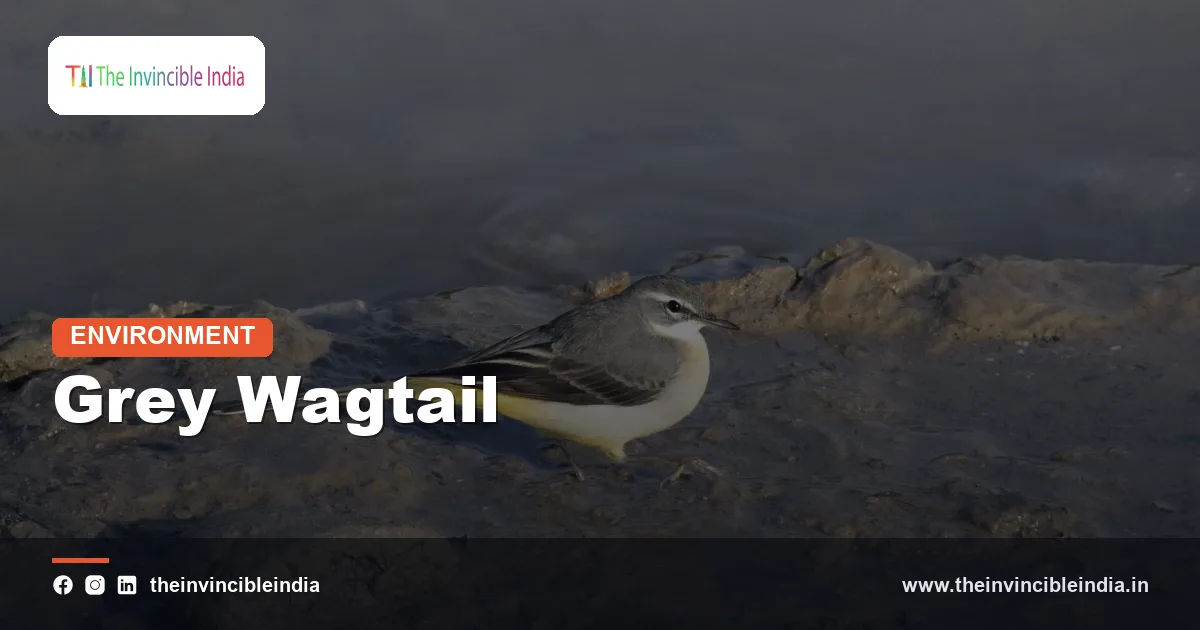
The grey wagtail (Motacilla cinerea) is a slender, long-tailed songbird of fast-flowing streams that breeds in the Himalaya and spreads across almost the whole of India as a winter visitor, recognised by its grey back, bright yellow underparts and constantly bobbing tail. Despite the name, the grey wagtail is the most yellow of the common Indian wagtails, and its habit of working the edges of streams, canals, ponds, drains and even wet rooftops makes it one of the easiest winter birds to watch in towns and cities.
This explainer covers what the grey wagtail is, how to identify it, where it lives through the year, what it eats, why it wags its tail, how it breeds in the mountains, and how it differs from other Indian wagtails.
| Quick Fact | Detail |
|---|---|
| Common name | Grey wagtail |
| Scientific name | Motacilla cinerea |
| Family | Motacillidae (pipits and wagtails) |
| Indian names | Wagtails are known by regional names such as khanjan and dhobin in Hindi-speaking areas |
| Size | About 18 to 19 cm, of which roughly half is tail |
| Range and habitat | Breeds along Himalayan streams; winters over most of peninsular India, the plains, the Western Ghats, Sri Lanka and the islands, near water |
| Diet | Flies, mayflies, small beetles, other insects and tiny aquatic invertebrates |
| Breeding season | Roughly April to July in the Himalaya, in rock crevices and stream banks |
| Conservation status | Least Concern (IUCN) |
Key Takeaways
- The grey wagtail (Motacilla cinerea) has the longest tail relative to body size among the wagtails found in India, and it wags that tail almost continuously.
- A grey wagtail is grey above and yellow below, with a yellow vent and undertail in every plumage, while the throat turns black only on breeding males.
- The grey wagtail breeds mainly along Himalayan mountain streams and moves to lower hills, plains and coasts across India in the cooler months.
- Grey wagtails feed on small insects and other invertebrates picked from wet rocks, shallow water, mud and even damp pavements and rooftops.
- In winter, an individual grey wagtail commonly defends its own stretch of stream or pond edge and often returns to the same spot year after year.
- The grey wagtail is classed as Least Concern, but it depends on clean, flowing water and rocky banks, so polluted or heavily modified streams reduce its numbers locally.
What is a grey wagtail?
A grey wagtail is a small insect-eating songbird in the family Motacillidae, the group that contains the wagtails and pipits. The scientific name Motacilla cinerea combines the Latin words for wagtail and ashen-grey. The species lives across a very large part of Europe, Asia and parts of Africa, and populations from the Himalaya are the ones that give India its winter birds.
Wagtails are slim, long-legged birds built for walking and running along the ground, rather than hopping. They have thin, pointed bills suited to picking up insects, and long tails that are constantly moved up and down. Among them the grey wagtail is the most strongly tied to flowing water, and it is far more at home on a rock in a stream than on an open field.
Taxonomists recognise more than one population of the species. The nominate form breeds in western Eurasia, while the form that visits India breeds from Central Asia and the Himalaya eastward. Differences between these forms are small and are mostly of interest to specialists rather than field observers.
How can you identify a grey wagtail?
The easiest way to identify a grey wagtail is to look for a small bird with a blue-grey back, yellow belly and an unusually long, dark tail that never stops moving. The back is a clean, soft grey, the wings are dark with a pale band, and the rump is a greenish-yellow that shows when the bird flies. The tail is black-brown with white outer feathers that flash in flight.
Plumage through the year
A winter grey wagtail has a white throat, a pale eyebrow stripe, and yellow only on the lower belly and undertail. A breeding male has a black throat and a stronger yellow underside, which makes it look like a different bird, though the black throat is usually seen only on the breeding grounds or in late winter as the bird moults toward breeding dress. Females and young birds are duller, with buff or whitish throats.
Voice
The grey wagtail gives a short, sharp, metallic call, often written as tzit or chizik, usually as it takes off or flies past. The call is high and clear, and it carries over the noise of running water. The song is a simple series of notes, rarely heard in India because the bird breeds in the hills.
Behaviour
The grey wagtail walks rapidly, pauses, bobs its rear half, and darts out to snatch a flying insect. It is usually seen alone or in pairs, though a few may gather at a good feeding or roosting site. It is generally confiding and will feed within a few metres of people.
Where is the grey wagtail found in India?
The grey wagtail is found in India as a breeding bird in the Himalaya and as a widespread winter visitor to the plains, peninsula, hills and many coastal and island areas. It is among the commoner wintering wagtails, and records exist from the foothills of the north to the southern tip of the country and to Sri Lanka.
Breeding takes place on rocky, fast-flowing streams, mostly in the Himalayan belt from Jammu and Kashmir through Himachal Pradesh, Uttarakhand, Nepal’s border regions and Sikkim to Arunachal Pradesh. Many birds breed at mid-elevations among conifer and oak forest, while some go higher. As the first heavy snow and cold arrive in autumn, the birds move down the valleys.
By October, grey wagtails begin to show up on the plains. They then spread across the peninsula, including the Western Ghats, Eastern Ghats and the hills of central and south India, where they favour forest streams and hill rivers. Birds are also reported from the Andaman and Nicobar Islands and from the Lakshadweep in winter, though numbers there are small.
Most birds leave the plains by March and April, heading back to the mountains. A few linger late, and the shifting timing of this return is one of the things bird watchers record in seasonal checklists.
What habitat does the grey wagtail prefer?
The grey wagtail prefers clear, shallow, flowing water with exposed rocks, gravel bars and overhanging vegetation. In winter the same bird will use almost any water edge, so it appears in a wide range of settings.
- Hill streams and rocky rivers, where stones give it perches and prey.
- Canals, irrigation channels and the spillways of dams.
- Garden ponds, lawns with sprinklers, and water tanks.
- Drains, culverts and puddles in towns and cities.
- Wet roofs, terraces and shaded courtyards after rain.
- Forest tracks beside small streams in the Western Ghats and other hill ranges.
The common thread is a source of small insects and a surface on which the bird can walk. It avoids dense vegetation and deep, still water, and it is usually missing from dry scrub and open arid land away from any water.
What does the grey wagtail eat?
The grey wagtail eats mainly small insects and other tiny invertebrates collected at or just above the water surface. It takes flies, mayflies, midges, small beetles, caddisflies and stoneflies, and it also eats small crustaceans, snails and the larvae of aquatic insects.
Several feeding methods are used. The bird walks along the water edge, picking insects from stones and mud. It flutters up to catch prey in the air, sometimes making a short leap or a sally of a metre or more. It may also wade into very shallow water and probe the gravel.
In winter, when insects are fewer, the grey wagtail may follow animals, forage under street lights for insects drawn at night, or pick at spiders and ants on paving. Its diet is not specialised, so the species copes well with urban conditions as long as some water and insect life remain.
Why does the grey wagtail wag its tail?
The grey wagtail wags its tail because the movement is a built-in part of its foraging and signalling behaviour, though the exact reason is still debated by researchers. Several explanations have been proposed, and more than one may apply.
- Flushing prey: the movement may startle small insects so that they jump or fly, making them easier to spot and catch.
- Signalling to predators: a constant wag may tell a hawk or cat that the bird is alert and not worth chasing.
- Balance: a long tail acts as a counterweight on slippery rocks and wet ground.
- Communication: wagging may help the bird signal to others of its kind, for example in defending a territory.
The tail is not wagged side to side, despite the name, but up and down in a steady, rhythmic bob. In the grey wagtail, the whole rear body often moves with it.
How does the grey wagtail breed?
The grey wagtail breeds in the Himalayan summer, building a cup nest in a crevice or on a ledge close to fast water. Pairs normally begin to form in spring, around the time the streams are swollen by melting snow, and egg laying typically takes place between about April and July depending on elevation.
The nest is a neat cup made of moss, grass, rootlets and small twigs, lined with hair, wool or feathers. It is placed in a hollow among rocks, under the lip of a bank, under a bridge, in a wall, or among tree roots, usually within a short distance of the stream. A clutch normally holds four to six eggs, which are pale with fine brownish speckles. Both parents take part in feeding the young, and they often carry beakfuls of insects to the nest.
A pair may raise a second brood if conditions allow. In harsh seasons, losses to floods, cold snaps and predators are common, and nest sites near flowing water can be washed away by a sudden rise in the stream.
How does the grey wagtail differ from other Indian wagtails?
The grey wagtail differs from other Indian wagtails mainly in its much longer tail, grey back and yellow undertail, which together set it apart from the yellow, white and citrine species. Several wagtails share India’s waters in winter, and they overlap in habitat, so comparing key features is the quickest way to separate them.
| Species | Typical features | Usual habitat in India |
|---|---|---|
| Grey wagtail (Motacilla cinerea) | Grey back, yellow vent and undertail, very long tail, white throat in winter | Streams, rocky banks, canals, wet rooftops |
| Western yellow wagtail (Motacilla flava) | Olive-brown back, yellow underparts, shorter tail | Grassy fields, marshes, grazing land |
| Citrine wagtail (Motacilla citreola) | Yellow head in breeding birds, grey back, white wing bars | Wet meadows, marsh edges, paddy |
| White wagtail (Motacilla alba) | Black, white and grey, no yellow | Open banks, roads, courtyards |
| White-browed wagtail (Motacilla maderaspatensis) | Black and white with a broad white eyebrow, large size, resident | Rivers, ponds, towns across the peninsula |
| Forest wagtail (Dendronanthus indicus) | Two black breast bands, sways its tail sideways | Shaded forest floors and tracks |
Beginners sometimes mistake the grey wagtail for a yellow wagtail because of the yellow underparts. The grey wagtail, however, has a grey rather than olive back, a much longer tail and a stronger link to rocks and running water. The white-browed wagtail, a resident of India, is far larger and is a black-and-white bird.
Is the grey wagtail a resident or a migrant?
The grey wagtail is mostly a short-distance migrant in India, because the same species breeds in the mountains and winters in the lower country, making it an altitudinal and regional migrant rather than a long-haul traveller. Birds from outside India also winter within it, so some individuals travel from Central Asia.
The movement is timed by season. Birds leave the high streams as ice forms, arrive on the plains from about September or October, and begin to return north in March. During migration, small numbers may pass over cities and coasts, and some travel at night.
A few birds stay in the lower hills through summer in some years, and there are scattered breeding records at lower elevations, but these are exceptions. For most observers in the plains and the south, the grey wagtail is a cold-season bird.
How does the grey wagtail behave in winter?
In winter the grey wagtail is largely a solitary and territorial bird that defends a small feeding patch and often returns to the same patch each year. Territoriality is surprisingly strong for a migrant, and a single wagtail may chase off others that enter its stretch of water.
The bird is active from early morning, and often feeds along puddles and gutters as soon as the light improves. At night, it may roost in small groups in trees, reed beds or on ledges of buildings, particularly in cities where it finds warmth and shelter. Roost sites are sometimes shared with other wagtails.
Because the species is so site faithful, ringing studies in other parts of its range have shown that the same bird can be found on the same stream in successive winters. This makes the grey wagtail a useful bird for tracking water quality in a small local area.
Is the grey wagtail threatened, and why does it matter?
The grey wagtail is not threatened and is listed as Least Concern by the International Union for Conservation of Nature (IUCN), thanks to its very large range and large global population. Even so, local declines occur where streams are polluted, dried up, dammed, or channelled into concrete.
The bird matters ecologically because it feeds on insects that live in or beside rivers, and its presence is often linked to reasonably clean water with healthy insect life. Streams choked with sewage, plastic or heavy silt support far fewer of the insects it needs. Sand mining and the loss of natural rocky banks also reduce nest sites and feeding areas.
Clearing of waterside vegetation, loss of small hill streams to road building, and the rapid growth of towns along rivers are all pressures that affect the species locally. Protecting stream corridors, keeping banks natural and controlling waste dumping help the grey wagtail along with many other waterside species.
How can you watch grey wagtails in India?
The best way to watch a grey wagtail in India is to visit a small clean stream, canal or garden pond in the cool season and wait quietly at the water edge. Early morning and late afternoon are the most rewarding hours, and a pair of binoculars helps with identification.
- Look for a flash of yellow under a long, bobbing tail on rocks and sandbars.
- Listen for the sharp, metallic call as the bird flies off.
- Check wet terraces, balconies and school grounds in towns for visiting birds.
- Visit hill streams in the Himalaya in spring and summer to see the black-throated breeding males.
- Record sightings on a citizen-science platform with the date, location and number of birds, which helps researchers follow migration patterns.
Keep a respectful distance, avoid disturbing nest sites in the mountains, and do not use playback of recorded calls in the breeding season, because this can distract birds from feeding and defending their nests.
Bottom Line
The grey wagtail is a small, graceful, yellow-bellied bird whose long tail and love of running water make it easy to recognise. It breeds in the Himalaya, winters across much of India, feeds on tiny insects and serves as a quiet indicator of healthy streams.
Frequently Asked Questions
What is a grey wagtail?
A grey wagtail is a small, long-tailed songbird of the family Motacillidae with a grey back and yellow underparts. It lives beside clear, flowing water and constantly bobs its tail. In India it breeds in the Himalaya and is a common winter visitor elsewhere.
Why is it called a grey wagtail when it is yellow?
It is called a grey wagtail because its back and head are grey, even though the belly and undertail are bright yellow. The name was given in Europe, where the grey upperparts were the main way to tell it from the yellow wagtail. In India the yellow underparts are often what people notice first.
Where do grey wagtails go in summer?
Grey wagtails go to the mountains in summer, mainly to Himalayan streams, where they breed. They leave the plains and peninsula between March and April. A small number of birds may stay on at lower hill streams.
What do grey wagtails eat?
Grey wagtails eat small insects and other invertebrates such as flies, mayflies, beetles, caddisflies and small crustaceans. They catch prey along the water edge, on wet stones and in short flights. They may also feed on roofs, lawns and pavements near water.
Why does the grey wagtail wag its tail?
The grey wagtail wags its tail for reasons that are still debated, though flushing insects, signalling alertness to predators and keeping balance on wet rocks are the leading ideas. The tail moves up and down rather than side to side. The behaviour is constant while the bird walks and feeds.
Is the grey wagtail endangered?
No, the grey wagtail is not endangered and is rated Least Concern by the IUCN. It has a very large range and a large global population. Local numbers can fall where streams are polluted, dried or heavily modified.
{“@context”:”https://schema.org”,”@graph”:[{“@type”:”FAQPage”,”mainEntity”:[{“@type”:”Question”,”name”:”What is a grey wagtail?”,”acceptedAnswer”:{“@type”:”Answer”,”text”:”A grey wagtail is a small, long-tailed songbird of the family Motacillidae with a grey back and yellow underparts. It lives beside clear, flowing water and constantly bobs its tail. In India it breeds in the Himalaya and is a common winter visitor elsewhere.”}},{“@type”:”Question”,”name”:”Why is it called a grey wagtail when it is yellow?”,”acceptedAnswer”:{“@type”:”Answer”,”text”:”It is called a grey wagtail because its back and head are grey, even though the belly and undertail are bright yellow. The name was given in Europe, where the grey upperparts were the main way to tell it from the yellow wagtail. In India the yellow underparts are often what people notice first.”}},{“@type”:”Question”,”name”:”Where do grey wagtails go in summer?”,”acceptedAnswer”:{“@type”:”Answer”,”text”:”Grey wagtails go to the mountains in summer, mainly to Himalayan streams, where they breed. They leave the plains and peninsula between March and April. A small number of birds may stay on at lower hill streams.”}},{“@type”:”Question”,”name”:”What do grey wagtails eat?”,”acceptedAnswer”:{“@type”:”Answer”,”text”:”Grey wagtails eat small insects and other invertebrates such as flies, mayflies, beetles, caddisflies and small crustaceans. They catch prey along the water edge, on wet stones and in short flights. They may also feed on roofs, lawns and pavements near water.”}},{“@type”:”Question”,”name”:”Why does the grey wagtail wag its tail?”,”acceptedAnswer”:{“@type”:”Answer”,”text”:”The grey wagtail wags its tail for reasons that are still debated, though flushing insects, signalling alertness to predators and keeping balance on wet rocks are the leading ideas. The tail moves up and down rather than side to side. The behaviour is constant while the bird walks and feeds.”}},{“@type”:”Question”,”name”:”Is the grey wagtail endangered?”,”acceptedAnswer”:{“@type”:”Answer”,”text”:”No, the grey wagtail is not endangered and is rated Least Concern by the IUCN. It has a very large range and a large global population. Local numbers can fall where streams are polluted, dried or heavily modified.”}}]}]}


