

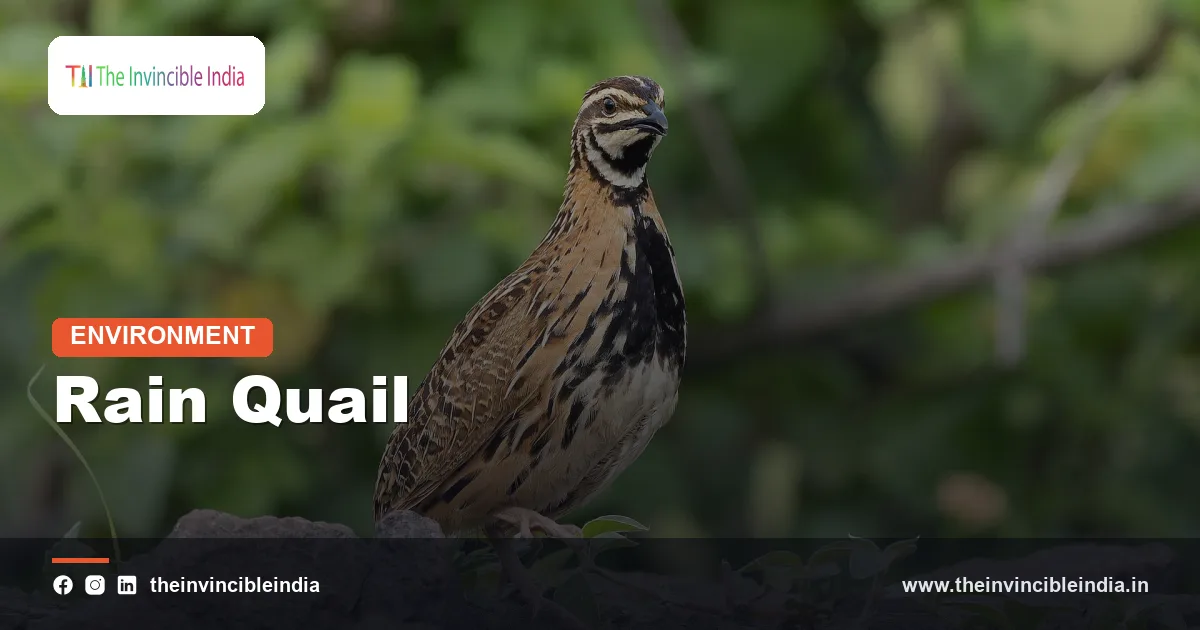
The rain quail (Coturnix coromandelica) is a small, plump, ground-dwelling quail of the Indian subcontinent that moves with the monsoon, breeding in grassland and crop fields during the rainy season and announcing itself with a clear, whistled call. Also known as the black-breasted quail, the species is one of the most widespread breeding quails of the Indian plains, though few people ever see it because it hides in dense grass and bursts into the air only at the last moment.
The rain quail belongs to the pheasant family and is a close cousin of the common quail and the domesticated Japanese quail. This explainer covers how to identify the rain quail, where it lives, why it is called a rain quail, what it eats, how it breeds, how it is separated from similar quails, and what threatens it.
Quick Facts
| Common name | Rain quail (also black-breasted quail) |
|---|---|
| Scientific name | Coturnix coromandelica |
| Family and order | Phasianidae, order Galliformes |
| Indian names | Known generically as lawa or bater (quail) in Hindi; many regional names |
| Size | About 17 to 18 cm long; male slightly larger and bolder than the female |
| Range and habitat | Indian subcontinent from Pakistan to Myanmar; grassland, scrub, stubble and crop fields |
| Diet | Seeds, grain, shoots and small insects |
| Breeding season | Mainly the monsoon months, roughly June to September |
| Conservation status | Least Concern (IUCN); wild birds are protected under Indian law |
Key Takeaways
- The rain quail is a small gamebird of the pheasant family that breeds mainly during the monsoon across the plains of India.
- The male rain quail is told by its black throat and breast markings and rufous underparts, while the female is a streaky buff-brown bird.
- The rain quail is a local migrant that moves in response to rainfall and the growth of grass and crops, rather than following a fixed seasonal route.
- The rain quail eats seeds, grain and small insects, and it feeds on the ground in dense grass, stubble and crop fields.
- The female rain quail lays a clutch of roughly six to eight eggs in a grass-lined scrape on the ground and raises the chicks without help from the male.
- The rain quail is listed as Least Concern by the IUCN, but trapping and netting for food and for quail fighting remain concerns in parts of India.
What is the rain quail?
The rain quail is a true quail in the genus Coturnix, a group of tiny, short-tailed, strong-flying ground birds in the pheasant family Phasianidae. Along with the common quail (Coturnix coturnix) and the Japanese quail (Coturnix japonica), it is one of several quails in the genus found in Asia, and the species name coromandelica refers to the Coromandel coast of south-eastern India, where early European naturalists collected it.
The bird is smaller than a partridge, about the size of a large sparrow with a heavy body. It has a very short tail, rounded wings and a compact build. It is not a bird of open ground but of cover, and it can crouch among stems so well that people walk past it without noticing. Its small size and rapid, whirring flight give it a character quite unlike the larger francolins and spurfowl.
How do you identify the male and female rain quail?
The rain quail is identified by the male’s black throat and breast markings against rufous underparts, and by the female’s streaked buff-brown plumage with a pale throat. The two are different enough that they can be told apart when seen well.
The male
- A black-and-white pattern on the throat and face, with a dark central line down the breast in breeding plumage.
- Rufous or chestnut underparts and flanks, with dark streaks on the sides.
- Upperparts of brown, buff and black, streaked and mottled for camouflage.
- A pale streak over the eye and a short, stout bill.
The female
The female rain quail is a more uniform sandy-brown bird, with dark spots and streaks on the breast and flanks and a pale buff throat. She lacks the male’s black breast markings, which makes her very similar to the female common quail. Both sexes have a lower, more rounded profile than a partridge and a very short tail.
Why is it called the rain quail?
The bird is called the rain quail because it appears in numbers and breeds in the monsoon, when rains stimulate the growth of grass and the sprouting of crops. In many parts of India, the arrival of the rain quail is noticed at the start of the rains, as birds that have been scattered or hidden in the dry season gather where grass and cover grow.
The rain quail is not a long-distance migrant in the way that many ducks and waders are. Instead, it makes local movements in response to rainfall and the availability of food and cover, and these shifts can be dramatic. Birds may be absent from a field in April and common in July. The movements often occur at night, and the species is rarely seen on the move.
Where does the rain quail live?
The rain quail lives in grassland, scrub, fallow land and crop fields across the Indian subcontinent, from Pakistan and Nepal through India and Bangladesh to Sri Lanka and Myanmar. In India it is widespread in the plains, particularly in dry and semi-arid regions that receive monsoon rain, and it is generally absent from dense forest and high mountains.
Its typical habitats include open grassland, millet and sorghum fields, stubble, fallow land with weeds, scrub with scattered bushes and the edges of wetlands. The bird avoids closely grazed or bare ground because it has nowhere to hide. After the monsoon, as crops are harvested and grass dries, rain quail may move on to areas with more cover. Because of this shifting pattern, field counts vary widely from one season to the next.
What does the rain quail eat?
The rain quail eats mostly small seeds, grain and green shoots, supplemented by small insects such as ants, termites, beetles and grasshoppers. It feeds on the ground, walking slowly through grass and picking items from the soil and the base of plants.
The balance of plant and animal food changes with the season. In the dry months the bird eats mostly seeds of wild grasses and weeds, and it may take spilled grain from harvested fields. During the monsoon, insects increase in number and become an important part of the diet, especially for the female laying eggs and for the chicks. The rain quail needs to drink, and it is usually found within reach of a pond, a stream, a canal or damp ground.
How does the rain quail breed?
The rain quail breeds mainly during the monsoon, from roughly June to September, when the female lays about six to eight eggs in a shallow scrape on the ground, lined with grass and hidden in thick cover. The timing matches the growth of grass and crops, which provide cover for the nest and food for the chicks.
The female alone incubates the eggs, for a little over two weeks, and then looks after the chicks. The male takes no part in raising the brood, and he may call from a clump of grass to attract several females over the season. The chicks are precocial and leave the nest within hours of hatching, feeding on tiny insects at first. They grow quickly and can fly within a few weeks, which suits a bird whose breeding window depends on the rains. Nests in crops are at risk from harvesting, grazing and predators such as snakes, crows and dogs.
What does the rain quail sound like?
The rain quail has a clear, repeated, whistled call given by the male, usually a series of three or four sharp notes that carries across fields. The call is most often heard at dawn and dusk and in the monsoon, and it is one of the best ways of finding the bird, since the quail itself is so hard to see.
A male will often call from a patch of grass or a low clod of earth, and several males may answer each other across a field. When a quail is flushed, it gives a thin, high call and flies off with a rapid whirr. The flight is fast, low and usually short, and the bird drops into cover again a few dozen metres away. Many observers find that the quail runs ahead through the grass after landing, and does not reappear in the same spot.
How is the rain quail different from other Indian quails?
The rain quail differs from other Indian quails in its small size, the male’s black breast, and its monsoon breeding pattern. Several quails share the plains and grasslands of India, and they can be confusing, so the table below sets out the main differences.
| Bird | Scientific name | Status in India | Distinguishing feature |
|---|---|---|---|
| Rain quail | Coturnix coromandelica | Resident and local migrant; breeds in the monsoon | Male with black throat and breast on rufous underparts |
| Common quail | Coturnix coturnix | Winter visitor and passage migrant | Slightly larger and paler, with less black on the breast |
| Japanese quail | Coturnix japonica | Not a regular wild bird of the plains; widely farmed in domestic form | Reddish face and throat in male |
| Jungle bush quail | Perdicula asiatica | Resident in scrub and dry forest | Smaller, round-bodied quail living in small coveys, with barred underparts |
The bush quails of the genus Perdicula live in small coveys year-round and breed in a different pattern, whereas the rain quail is more solitary or found in loose groups and is much more mobile.
What threatens the rain quail?
The main threats to the rain quail are trapping and netting, loss of grassland and weedy field margins, and the use of chemicals in farming. The IUCN lists the species as Least Concern because it has a wide range and a large population, but local numbers can fall quickly where pressure is intense.
- Trapping and netting: Quails are caught in large numbers using nets and traps, for sale as food and for use in traditional quail fights, even though capturing wild birds is prohibited under the Wildlife (Protection) Act, 1972.
- Habitat loss: Conversion of grassland and scrub to intensive crops, plantations and buildings removes cover and food.
- Pesticides: Insecticides reduce the insect food that chicks need, and herbicides remove weed seeds.
- Harvesting and grazing: Mowing and heavy grazing destroy nests and expose birds to predators.
Because the rain quail is nomadic, conservation depends on keeping a landscape-wide pattern of grassland, fallow and weedy field edges, not on protecting any one site.
Why does the rain quail matter?
The rain quail matters because it is a common indicator of healthy monsoon grassland and farmland, a controller of weed seeds and insects, and a link in the food chain that feeds hawks, harriers, owls, foxes and snakes. When rain quail are abundant, grass and weedy margins are usually intact.
The species also has a long human history. Quail have been caught and eaten across South Asia for centuries, and the sport of quail fighting remains a rural tradition in some northern regions. Today, wild catching is illegal, and the more sustainable relationship with the bird is to enjoy it as part of the monsoon landscape and to protect the grass and fields on which it depends.
Bottom Line
The rain quail is a small, well-camouflaged, nomadic quail that follows the monsoon across the plains of India, breeding where new grass and crops give it food and cover. It is not globally threatened, but it is heavily trapped and relies on grassland and farm margins that are shrinking.
Frequently Asked Questions
What is a rain quail?
A rain quail is a small gamebird of the pheasant family, Coturnix coromandelica, found across the Indian subcontinent. The male has a black throat and breast on rufous underparts, while the female is streaky buff-brown. It lives in grassland, scrub and crop fields and breeds mainly in the monsoon.
Why is the rain quail called the rain quail?
The bird is called the rain quail because it breeds and becomes most noticeable during the monsoon. Rain triggers the growth of grass and crops that give it food and nesting cover, so the species moves into new areas as the rains arrive.
Is the rain quail a migratory bird?
The rain quail is a local migrant rather than a long-distance one. It moves in response to rainfall, grass growth and food supply, so it may be absent from a field in the dry season and common there after the rains begin.
What does the rain quail eat?
The rain quail eats seeds, grain and green shoots, along with small insects such as ants, termites and beetles. It feeds on the ground in dense grass and stubble, and chicks depend mostly on tiny insects in their first weeks.
How many eggs does a rain quail lay?
A rain quail typically lays about six to eight eggs in a grass-lined scrape on the ground. The female incubates them for a little over two weeks, and the chicks leave the nest soon after hatching.
Is the rain quail protected in India?
Yes, wild rain quail are protected under the Wildlife (Protection) Act, 1972, which prohibits the capture and hunting of wild birds. The IUCN lists the species as Least Concern, but illegal netting and trapping for food and quail fighting still occur in some regions.
{“@context”:”https://schema.org”,”@graph”:[{“@type”:”FAQPage”,”mainEntity”:[{“@type”:”Question”,”name”:”What is a rain quail?”,”acceptedAnswer”:{“@type”:”Answer”,”text”:”A rain quail is a small gamebird of the pheasant family, Coturnix coromandelica, found across the Indian subcontinent. The male has a black throat and breast on rufous underparts, while the female is streaky buff-brown. It lives in grassland, scrub and crop fields and breeds mainly in the monsoon.”}},{“@type”:”Question”,”name”:”Why is the rain quail called the rain quail?”,”acceptedAnswer”:{“@type”:”Answer”,”text”:”The bird is called the rain quail because it breeds and becomes most noticeable during the monsoon. Rain triggers the growth of grass and crops that give it food and nesting cover, so the species moves into new areas as the rains arrive.”}},{“@type”:”Question”,”name”:”Is the rain quail a migratory bird?”,”acceptedAnswer”:{“@type”:”Answer”,”text”:”The rain quail is a local migrant rather than a long-distance one. It moves in response to rainfall, grass growth and food supply, so it may be absent from a field in the dry season and common there after the rains begin.”}},{“@type”:”Question”,”name”:”What does the rain quail eat?”,”acceptedAnswer”:{“@type”:”Answer”,”text”:”The rain quail eats seeds, grain and green shoots, along with small insects such as ants, termites and beetles. It feeds on the ground in dense grass and stubble, and chicks depend mostly on tiny insects in their first weeks.”}},{“@type”:”Question”,”name”:”How many eggs does a rain quail lay?”,”acceptedAnswer”:{“@type”:”Answer”,”text”:”A rain quail typically lays about six to eight eggs in a grass-lined scrape on the ground. The female incubates them for a little over two weeks, and the chicks leave the nest soon after hatching.”}},{“@type”:”Question”,”name”:”Is the rain quail protected in India?”,”acceptedAnswer”:{“@type”:”Answer”,”text”:”Yes, wild rain quail are protected under the Wildlife (Protection) Act, 1972, which prohibits the capture and hunting of wild birds. The IUCN lists the species as Least Concern, but illegal netting and trapping for food and quail fighting still occur in some regions.”}}]}]}


