

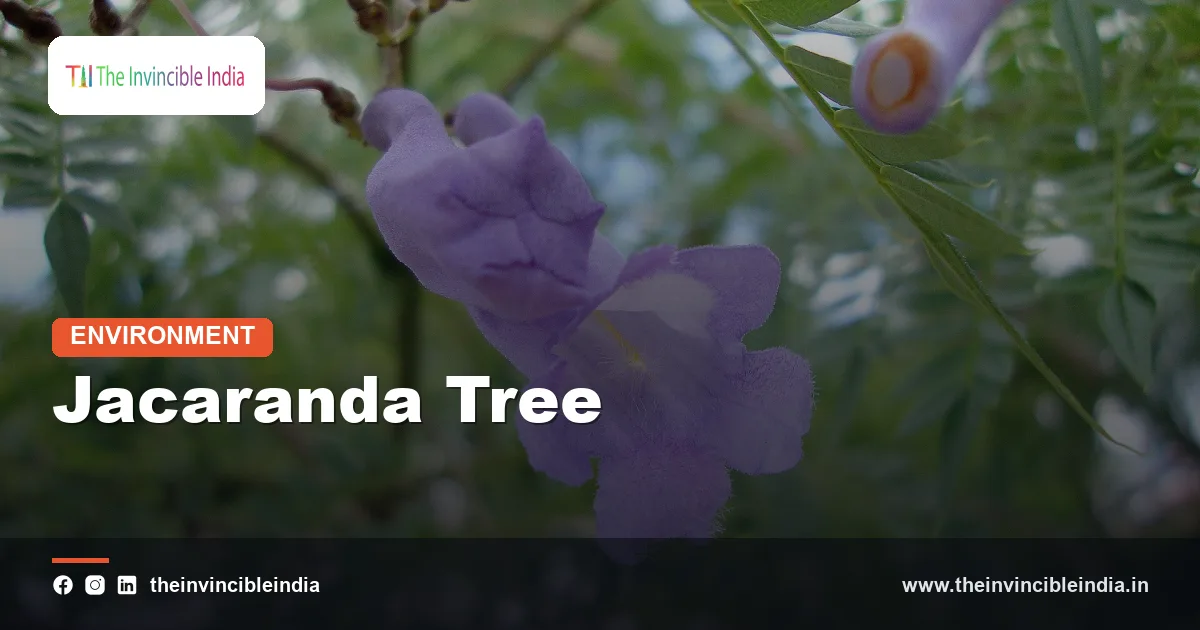
The jacaranda (Jacaranda mimosifolia) is a medium-to-large ornamental tree of the trumpet-vine family that is famous for covering itself in clusters of blue-purple flowers in spring, and it has become one of the most recognisable avenue trees in Indian cities. Native to South America and introduced to India during the colonial period, the jacaranda is now planted along roads, in parks and on campuses from the Himalayan foothills to the Deccan plateau.
This explainer covers what the jacaranda is, where it came from, when it blooms in India, how to tell it apart from similar trees such as the gulmohar, what it is used for and what its drawbacks are. The facts below are stable botanical and horticultural knowledge, so the article is meant as a lasting reference rather than a seasonal news item.
| Scientific name | Jacaranda mimosifolia |
|---|---|
| Family | Bignoniaceae (the trumpet-vine or bignonia family) |
| Common names in India | Jacaranda, neelmohar (also written nilmohur), blue gulmohar, blue trumpet tree |
| Typical height | About 10 to 20 metres at maturity, with a spreading, umbrella-like crown |
| Flowering season | Spring, broadly February to May depending on region; earlier in the south, later in the north |
| Leaves | Fern-like, bipinnate, semi-deciduous; often shed shortly before or during bloom |
| Native range | South America, mainly the Andean foothills and plains of northern Argentina and southern Bolivia |
| Main uses in India | Avenue, park and garden ornamental; shade; bee forage; light wood for small crafts |
| Notable features | Tubular blue-violet flowers in large panicles, flat round woody seed pods with papery winged seeds |
Key Takeaways
- The jacaranda (Jacaranda mimosifolia) is a South American tree that is not native to India but is now widely planted across Indian towns and cities as an ornamental.
- Jacaranda flowers are tubular and blue-violet, and they open in large clusters, often when the tree has few leaves, which produces its well-known purple-haze effect.
- In India, the jacaranda usually blooms in spring, with flowering beginning as early as February in warmer southern cities and continuing into May in the north.
- The jacaranda belongs to the Bignoniaceae family, not the pea family, so it is a different plant from the gulmohar (Delonix regia), even though the two are often confused.
- The jacaranda is valued mainly for its looks and shade, and it has little commercial timber value, so its role in India is ornamental rather than industrial.
- Fallen jacaranda flowers and woody pods make a seasonal litter, and the tree is listed as invasive in some countries, so planting decisions deserve some care.
What is a jacaranda tree?
A jacaranda tree is a deciduous to semi-deciduous flowering tree in the genus Jacaranda, and the species grown in India is almost always Jacaranda mimosifolia. The genus belongs to the family Bignoniaceae, a largely tropical group that also includes the Indian cork tree, the African tulip tree and the trumpet creeper. The species name mimosifolia means “with mimosa-like leaves”, a reference to the finely divided foliage that resembles that of the mimosa.
The common name “jacaranda” comes from a word of the Tupi-Guarani languages of South America. In Hindi and several other Indian languages the tree is called neelmohar, which literally pairs the colour blue with “mohar”, the same element found in gulmohar. That naming reflects how Indians first related the new tree to a flower they already knew.
The jacaranda grows quickly in its first years and then settles into a broad, rounded crown. The tree is not a fruit tree and is not grown for food. Its popularity rests on one thing: a spring display of colour that is unusual among Indian trees, most of which flower in shades of red, orange or yellow.
Where does the jacaranda come from, and how did it reach India?
The jacaranda comes from South America, with its natural range centred on northern Argentina and southern Bolivia, and it reached India as part of the wave of ornamental and avenue trees introduced under colonial-era botanical and civic planting. Botanical gardens, hill-station estates and municipal authorities were responsible for moving many such species around the tropics in the nineteenth and early twentieth centuries.
Once it proved adaptable, the jacaranda spread quickly. It tolerates a range of climates from warm subtropical to mild upland, grows easily from seed, and rewards planters with a dramatic bloom within a few years. These traits made it a favourite for avenues, cantonments, civil lines and institutional campuses.
The tree is now grown on every inhabited continent in warm-temperate and subtropical regions. Cities such as Pretoria in South Africa and several in Australia and Argentina are famous for their jacaranda blossom, which comes in October and November in the southern hemisphere. In India the same bloom arrives in spring, because the seasons are reversed.
When do jacaranda trees bloom in India?
Jacaranda trees bloom in India mostly in spring, usually between February and May, with the exact timing depending on local temperature and rainfall. In warmer southern cities flowering can begin early, while in north Indian cities the peak is generally later, in April and May, after the winter cold has passed and before the monsoon.
The flowering is closely tied to dry, warm weather. In many Indian cities the tree drops much of its old foliage in late winter or early spring and then flowers while the crown is still sparse, which makes the colour especially visible. New leaves follow as or after the flowers fade.
Individual trees vary. A tree in a sheltered courtyard may bloom a few weeks ahead of one on an exposed roadside, and a few trees produce a lighter second flush later in the season. Young trees, usually under about five years old from seed, often do not flower at all.
What does a jacaranda look like?
A jacaranda looks like a tall, spreading tree with ferny leaves, a grey-brown trunk and large clusters of bell-shaped violet-blue flowers. Its features are distinctive enough to identify the tree reliably in any season.
Leaves
The leaves are bipinnate, which means each leaf is divided into many pairs of primary branches, and each of those into numerous small leaflets. The result is a light, feathery foliage that casts dappled shade. The leaves are opposite on the twig, a useful feature that separates the jacaranda from many similar-looking pea-family trees.
Flowers
The flowers are tubular, about 3 to 5 centimetres long, and flare at the mouth into five lobes. They are blue-violet, sometimes closer to lavender, with a paler throat marked by faint lines. They grow in terminal panicles, so a flowering branch looks like a loose plume. The flowers have only a faint scent, and the colour rather than perfume is the main attraction.
Fruit and seeds
The fruit is a flat, round, woody capsule, roughly the size of a large coin or small plum in diameter, which splits open when dry. Inside are many thin seeds, each with a papery wing that lets the wind carry it a short distance. The capsules stay on the tree for months and are often collected by children and craft workers.
Bark and shape
The bark is thin, grey-brown and finely fissured on older trees. The crown is open and umbrella-shaped, and the branches tend to spread horizontally, which is why the tree is so popular for roadside shade.
Where can jacaranda trees be seen in India?
Jacaranda trees can be seen in many Indian towns and cities, especially those with a history of planned avenues, cantonments or hill-station gardens. The tree is a common street and park planting in the following kinds of places:
- Large metro and capital cities, where jacaranda avenues line some government and residential roads.
- Planned or colonial-era cities such as Chandigarh and Dehradun, which have extensive tree-lined road networks.
- Southern plateau cities, including Bengaluru and Pune, where the mild spring climate suits the tree well.
- Hill stations and upland towns in the Himalayan foothills and the Nilgiris, where cool nights favour healthy growth.
- University campuses, botanical gardens, golf courses and older bungalow compounds across the country.
The tree does less well in the hottest, driest parts of the country and in places with hard frost or heavy waterlogging. In coastal or very humid areas it can still grow, but flowering is often weaker.
How is the jacaranda different from the gulmohar?
The jacaranda differs from the gulmohar (Delonix regia) in family, flower colour, flower shape, flowering time and leaf arrangement. The two are frequently confused because both are broad, feathery-leaved ornamental trees that flower profusely in the hot season.
| Feature | Jacaranda | Gulmohar |
|---|---|---|
| Scientific name | Jacaranda mimosifolia | Delonix regia |
| Family | Bignoniaceae | Fabaceae (pea family) |
| Flower colour | Blue-violet | Bright red to orange-red |
| Flower shape | Tubular bell with five lobes | Five spreading petals, one streaked |
| Typical bloom | Spring, often Feb to May | Late spring to early summer, often May to June |
| Fruit | Round, flat woody capsule | Long, flat, sword-like pod |
| Native region | South America | Madagascar |
| Leaf arrangement | Opposite | Alternate |
The Hindi name neelmohar (“blue mohar”) is a reminder that the two trees are often mentioned together, and some Indian cities plant them side by side so that blue and red blooms overlap in late spring. Both are introduced rather than native trees, although the gulmohar has been grown in India for a longer time.
What is the jacaranda used for?
The jacaranda is used mainly as an ornamental and shade tree in India, and its other uses are minor. Understanding this helps explain why the tree is common in cities but rarely seen in forestry plantations.
- Ornamental planting: The tree’s blossom is the reason it is planted along streets, in parks and around institutions. A mature specimen is often treated as a landmark.
- Shade: The spreading crown gives light, dappled shade, which makes it pleasant for pavements and open lawns.
- Bee forage: The flowers produce nectar and pollen, so flowering trees support bees and other insects during the dry spring months.
- Wood: The timber is pale, light and fairly soft. It can be carved or turned for small items, but it is not a major commercial timber.
- Crafts: The round seed pods are sometimes used in decorative arrangements and handicrafts.
- Traditional medicine in its homeland: Parts of the tree have been used in folk medicine in South America, although there is no strong, standardised medicinal use in India.
The jacaranda is not a nitrogen-fixing tree, unlike many pea-family trees such as the karanja or the siris, so it does not improve soil fertility in the way those trees do. Its value to the city is aesthetic and ecological in the sense of shade and flower resources rather than agricultural.
How is a jacaranda grown and cared for?
A jacaranda is grown from seed or cuttings in full sun and well-drained soil, and it needs very little care once it has established. Gardeners and civic planters in India usually follow a few simple guidelines.
- Sun: Full sunlight gives the best flowering. Shaded trees grow tall but bloom sparsely.
- Soil: Light, sandy or loamy soils with good drainage suit the tree. Waterlogged ground often leads to root problems.
- Water: Young trees need regular watering for the first year or two. Mature trees are fairly drought tolerant.
- Propagation: Seeds germinate readily, but seedlings may take several years to flower. Grafted or cutting-raised plants often flower earlier.
- Pruning: Light pruning after flowering keeps the shape tidy. Heavy pruning can reduce the next season’s bloom.
- Cold: Mature trees tolerate a brief light frost, but young plants are more sensitive.
Because the jacaranda has fairly brittle wood and a wide crown, planting it with enough space from buildings, wires and drains is wise. Roots can lift light paving if the tree is planted too close to a pavement edge.
What are the drawbacks and concerns with the jacaranda?
The main drawbacks of the jacaranda are seasonal litter, brittle branches, a non-native status and, in some countries, a tendency to spread beyond gardens. These do not make the tree unsuitable for India, but they are reasons to plant thoughtfully.
Litter
When the flowers fall, they cover pavements, cars and lawns with a purple carpet. The blossom is slippery when wet. The woody pods also drop later in the year and can be a nuisance on paths.
Branch strength
The jacaranda’s branches can be brittle, and large limbs may break in strong winds or heavy rain. Careful siting and periodic inspection by civic arborists reduce the risk.
Non-native status
Because the jacaranda is not native to India, it supports fewer local insects, birds and other wildlife than native trees such as the neem, peepal or banyan. Many urban ecologists recommend mixing native species into avenues rather than relying on a single showy exotic.
Invasiveness
In parts of South Africa and Australia, the jacaranda is regulated as an invasive plant because its winged seeds can spread into natural areas. In India the tree is not generally regarded as a serious invasive, but gardeners are advised not to plant it close to forest edges.
Bottom Line
The jacaranda is a South American ornamental that has become a fixture of Indian spring, valued for its blue-violet blossom and gentle shade rather than for any commercial product. It is easy to grow and easy to recognise, but it is best planted alongside native trees and with enough space to cope with its litter and wide crown.
Frequently Asked Questions
Is the jacaranda native to India?
No, the jacaranda is not native to India; it comes from South America, mainly northern Argentina and southern Bolivia. It was introduced to India as an ornamental tree and has been widely planted since. It is now naturalised in gardens and roadsides but is not considered a core part of India’s native flora.
When do jacaranda flowers bloom in India?
Jacaranda flowers bloom in India mostly between February and May. Warmer southern cities often see flowering earlier, while north Indian cities peak in April and May. Exact timing varies with temperature, rainfall and the age of the tree.
What is the Hindi name of the jacaranda?
The Hindi name of the jacaranda is commonly given as neelmohar, sometimes written nilmohur, meaning “blue mohar”. The name links the tree to the red-flowered gulmohar, which it resembles in shape but not in colour. In many Indian cities people also simply say “jacaranda”.
Is the jacaranda the same as the gulmohar?
No, the jacaranda and the gulmohar are different trees from different families. The jacaranda (Jacaranda mimosifolia) has blue-violet tubular flowers, while the gulmohar (Delonix regia) has red-orange flowers and long sword-like pods. They are often confused because both have feathery leaves and spreading crowns.
Does the jacaranda have any practical uses?
The jacaranda has few practical uses beyond ornament and shade. Its flowers support bees, its light wood can be carved into small objects, and its pods are used in crafts. It is not a food crop, a major timber species or a nitrogen-fixing soil improver.
Why does the jacaranda drop so many flowers and pods?
The jacaranda drops many flowers and pods because it is a heavy bloomer that sets large clusters of tubular flowers and woody seed capsules. Flowers fall in a short period after the peak bloom, creating a purple carpet, while the pods ripen and fall later. Regular sweeping or planting the tree away from parked cars and narrow footpaths helps manage the mess.
{“@context”:”https://schema.org”,”@graph”:[{“@type”:”FAQPage”,”mainEntity”:[{“@type”:”Question”,”name”:”Is the jacaranda native to India?”,”acceptedAnswer”:{“@type”:”Answer”,”text”:”No, the jacaranda is not native to India; it comes from South America, mainly northern Argentina and southern Bolivia. It was introduced to India as an ornamental tree and has been widely planted since. It is now naturalised in gardens and roadsides but is not considered a core part of India’s native flora.”}},{“@type”:”Question”,”name”:”When do jacaranda flowers bloom in India?”,”acceptedAnswer”:{“@type”:”Answer”,”text”:”Jacaranda flowers bloom in India mostly between February and May. Warmer southern cities often see flowering earlier, while north Indian cities peak in April and May. Exact timing varies with temperature, rainfall and the age of the tree.”}},{“@type”:”Question”,”name”:”What is the Hindi name of the jacaranda?”,”acceptedAnswer”:{“@type”:”Answer”,”text”:”The Hindi name of the jacaranda is commonly given as neelmohar, sometimes written nilmohur, meaning “blue mohar”. The name links the tree to the red-flowered gulmohar, which it resembles in shape but not in colour. In many Indian cities people also simply say “jacaranda”.”}},{“@type”:”Question”,”name”:”Is the jacaranda the same as the gulmohar?”,”acceptedAnswer”:{“@type”:”Answer”,”text”:”No, the jacaranda and the gulmohar are different trees from different families. The jacaranda (Jacaranda mimosifolia) has blue-violet tubular flowers, while the gulmohar (Delonix regia) has red-orange flowers and long sword-like pods. They are often confused because both have feathery leaves and spreading crowns.”}},{“@type”:”Question”,”name”:”Does the jacaranda have any practical uses?”,”acceptedAnswer”:{“@type”:”Answer”,”text”:”The jacaranda has few practical uses beyond ornament and shade. Its flowers support bees, its light wood can be carved into small objects, and its pods are used in crafts. It is not a food crop, a major timber species or a nitrogen-fixing soil improver.”}},{“@type”:”Question”,”name”:”Why does the jacaranda drop so many flowers and pods?”,”acceptedAnswer”:{“@type”:”Answer”,”text”:”The jacaranda drops many flowers and pods because it is a heavy bloomer that sets large clusters of tubular flowers and woody seed capsules. Flowers fall in a short period after the peak bloom, creating a purple carpet, while the pods ripen and fall later. Regular sweeping or planting the tree away from parked cars and narrow footpaths helps manage the mess.”}}]}]}


