

The Indian cork tree (Millingtonia hortensis) is a tall, straight, semi-evergreen tree of the trumpet-vine family, best known for its clusters of fragrant white tubular flowers that open at night and perfume the air of Indian avenues in autumn and early winter. Also called akash neem or tree jasmine, the Indian cork tree is planted along streets, in gardens and around temples and campuses across India for its height, feathery leaves and sweet-smelling blossom.
This explainer describes what the Indian cork tree is, why it has so many names, how to identify it, when it flowers, how it is used and what care it needs. It also explains the tree’s folk medicinal reputation and its practical limitations, such as brittle branches. The facts are stable botanical and horticultural knowledge, so the article works as a long-term reference.
| Scientific name | Millingtonia hortensis |
|---|---|
| Family | Bignoniaceae (trumpet-vine family) |
| Common names in India | Akash neem (also akashneem, akash nimb), tree jasmine, Indian cork tree, maramalli (Tamil), akasha mallige (Kannada) |
| Typical height | Tall and slender, often about 15 to 25 metres, with a straight trunk |
| Leaves | Large, feathery, bipinnate to tripinnate; evergreen or briefly deciduous |
| Flowering season | Mainly late monsoon through early winter, commonly around October to December in much of India |
| Native range | South-East Asia, including Myanmar, Thailand and neighbouring regions; long cultivated in India |
| Main uses | Avenue, garden and temple tree; fragrance; light timber; cork-like bark; folk medicine |
| Notable features | Corky bark, long white night-scented flowers that drop at dawn, a genus with a single species |
Key Takeaways
- The Indian cork tree (Millingtonia hortensis) is a tall, straight tree of the Bignoniaceae family that is widely planted in India for its fragrant white flowers.
- Indian cork tree flowers are long, white, trumpet-shaped and open at night, and they fall in drifts at dawn, so the ground under the tree is often covered with blossom in the morning.
- The Indian cork tree is known in Hindi and several other languages as akash neem because its feathery foliage resembles the neem and its crown rises high into the sky.
- The common name “cork tree” comes from the thick, soft, corky layer in the bark, although the tree is not related to the true cork oak.
- Millingtonia is a genus with only one species, and Millingtonia hortensis is native to South-East Asia, not to India, though it has been grown in Indian gardens for a long time.
- The Indian cork tree grows fast and tall but has fairly brittle wood, so it is best planted in open spaces away from buildings and power lines.
What is the Indian cork tree?
The Indian cork tree is a tall, evergreen to semi-evergreen flowering tree whose scientific name is Millingtonia hortensis. It belongs to the family Bignoniaceae, which also includes the jacaranda, the African tulip tree and the trumpet creeper, and it is the only species in the genus Millingtonia.
The tree reaches a height of roughly fifteen to twenty-five metres, with a slender trunk and a narrow to oval crown. Its large, finely divided leaves give it a light, airy look, and its late-season flowers are the reason it is planted. The tree is common in towns and cities in many Indian states, and it also occurs in gardens in Sri Lanka, Bangladesh, Myanmar, Thailand and other parts of tropical Asia.
The English name “Indian cork tree” is slightly misleading, because the tree is native to South-East Asia rather than to India. It is called “Indian” because it has been widely grown and naturalised in the country for generations.
Why is it called akash neem and tree jasmine?
The Indian cork tree is called akash neem because its leaves look like those of the neem and the tree grows tall, reaching towards the akash, the Hindi word for sky. The name is used in Hindi, Bengali, Marathi and other languages, with small spelling variations such as akashneem and akash nimb.
The alternative name “tree jasmine” refers to the flowers, which are white, tubular and fragrant like jasmine blossom. In Tamil the tree is called maramalli, which means “tree jasmine” or “jasmine tree”, and in Kannada it is called akasha mallige. These names reflect the way Indian languages describe the plant by comparison with familiar trees and flowers.
Despite the comparison, the Indian cork tree is not related to the neem (Azadirachta indica, family Meliaceae) or to true jasmine (genus Jasminum, family Oleaceae). The resemblance is only in appearance and scent, and the tree has none of the neem’s medicinal or pesticidal reputation.
How do you identify an Indian cork tree?
An Indian cork tree is identified by its tall, straight trunk, its thick corky grey bark, its large feathery compound leaves and its long white tubular flowers in loose clusters. These features make the tree easy to recognise when it is in bloom and still distinctive when it is not.
Bark
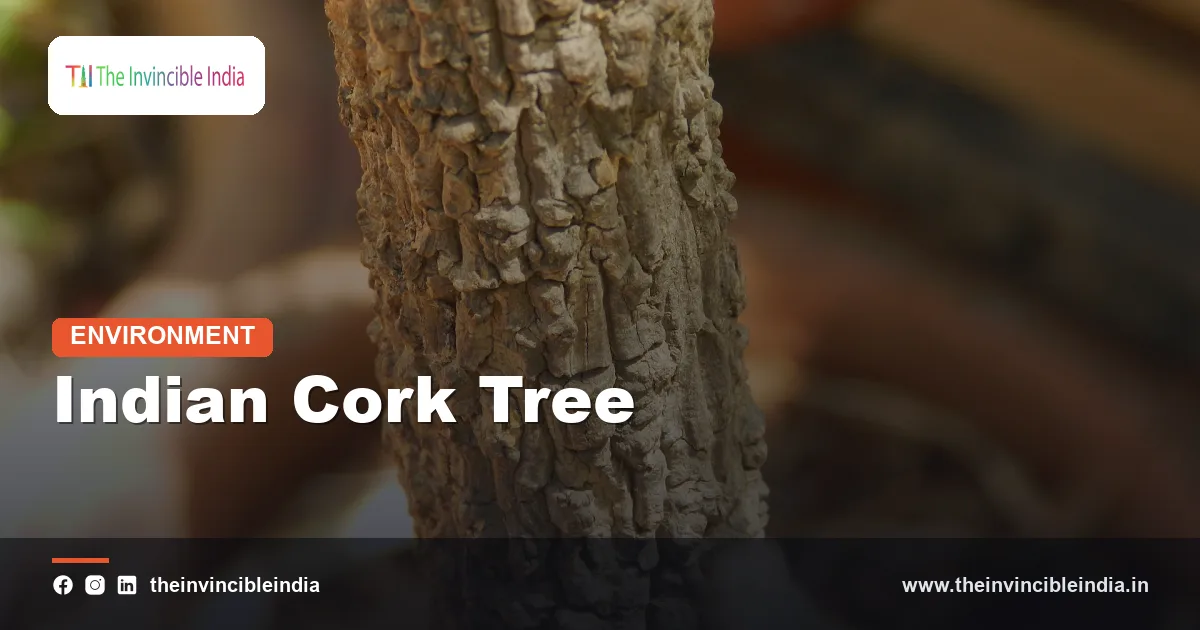
The bark is light grey-brown and quite thick, with a soft, spongy, corky texture that can be pressed with a fingernail. It is deeply fissured and flaky on older trees. This corky layer is the source of the tree’s English name.
Leaves
The leaves are large, opposite and divided two or three times into oval to lance-shaped leaflets with pointed tips. The overall effect is feathery and graceful. The crown is often rather narrow and sparse compared with spreading shade trees.
Flowers
The flowers are white, tubular and slender, about 6 to 8 centimetres long, flaring at the mouth into several lobes. They grow in terminal clusters, and the scent is sweet and strong, especially after dark. The flowers open in the evening and drop in the morning.
Fruit and seeds
The fruit is a long, narrow, flat capsule that splits to release thin, winged seeds. The seeds are carried a short distance by the wind. The tree is propagated in practice by seed, root suckers and cuttings.
When does the Indian cork tree flower?
The Indian cork tree flowers mainly from the end of the monsoon through early winter, typically around October to December in much of India, though local climate can shift the timing. In some regions a lighter flush may follow, and trees growing in warm, humid places can flower over a longer period.
The flowers open at night, and the scent is at its strongest in the late evening and early morning. By the next day many of the flowers have dropped, creating a white carpet on pavements and lawns. The effect is brief but repeated each night as new flowers open during the season.
This timing makes the Indian cork tree a useful complement to spring-flowering trees such as the jacaranda and the palash. Where it is planted together with such trees, an avenue can provide blossom at different times of the year.
Where does the Indian cork tree grow?
The Indian cork tree grows naturally in the tropical forests of South-East Asia and is cultivated across tropical and subtropical India, mainly in the plains and lower hills. It does well in warm, moist conditions with plenty of sunshine and well-drained soil.
- Climate: Warm tropical and subtropical regions suit it best. Young trees are sensitive to frost and prolonged cold.
- Soil: Deep, fertile, well-drained soil gives the strongest growth. Heavy clay or waterlogged ground can cause problems.
- Light: Full sun is preferred. Shaded trees become tall and thin and flower poorly.
- Water: Regular watering in the early years helps the tree establish. Mature trees tolerate dry spells fairly well.
In India the tree is a regular planting in city avenues, campuses, botanical gardens, temple grounds and older residential colonies. Because it grows tall and narrow, it is often used where space above ground is generous but the planting strip is limited.
What is the Indian cork tree used for?
The Indian cork tree is used mainly as an ornamental and fragrant garden tree, with minor uses for its light timber, its corky bark and its flowers in folk medicine. Its practical economic role is small compared with timber or fruit trees.
- Ornamental and avenue planting: The tall, straight form and scented flowers make it a popular choice for roads, parks and institutional grounds.
- Fragrance: The night-scented flowers are enjoyed in gardens, and they are sometimes collected for decoration and worship.
- Timber: The wood is pale yellowish, light and fairly soft. It is used locally for light construction, packing, boxes and small items, though it is not a major commercial timber.
- Cork substitute: The corky bark has been used in small quantities as an inferior substitute for cork, such as for bottle stoppers and floats.
- Bee and insect forage: The flowers offer nectar to night-flying insects and to bees during the day.
Its use as a plantation shade tree is limited, because its crown is narrow and its branches are brittle.
What are the folk medicinal uses of the Indian cork tree?
The Indian cork tree has a folk medicinal reputation in parts of Asia, especially for respiratory complaints, with its dried flowers and other parts used in traditional remedies. These uses come from folk practice and are not established medical treatments.
In some regions dried flowers were traditionally smoked or burnt as an inhalation for asthma, and different parts of the tree have been used in home remedies for coughs, fever and other ailments. Researchers have studied extracts from the tree for antioxidant and anti-inflammatory activity, but the evidence is preliminary and does not support self-treatment.
Smoking or inhaling any plant material can irritate the lungs, and the safety of these practices has not been established. Anyone with asthma or respiratory illness should consult a qualified doctor rather than rely on traditional preparations.
How do you grow and care for an Indian cork tree?
An Indian cork tree is grown from seed, root suckers or cuttings in a sunny, well-drained site, and it needs space, regular watering when young and occasional pruning. It is a fast-growing tree, which is part of its appeal for avenues.
- Planting time: Saplings are generally planted at the start of the rainy season so that roots establish with natural moisture.
- Spacing: Wide spacing from buildings, walls, drains and overhead wires is wise, because the tree grows tall and its roots spread.
- Watering and feeding: Regular water and some organic manure in the first few years support healthy growth.
- Pruning: Removal of dead and weak branches reduces the risk of breakage in storms.
- Time to flower: Seed-grown trees usually take several years before they begin to flower.
The tree is generally free of serious pests. Its main vulnerability is its wood, which is relatively soft and prone to snapping, and so it is best planted in sheltered or open locations rather than on exposed ridges.
How is the Indian cork tree different from similar trees?
The Indian cork tree differs from similar tall, flowering trees in its white night-scented trumpet flowers, corky bark and straight, narrow form. The table below compares it with trees that are often found nearby in Indian avenues.
| Tree | Family | Flower | Flowering time |
|---|---|---|---|
| Indian cork tree (Millingtonia hortensis) | Bignoniaceae | White, tubular, night-scented | Autumn to early winter |
| Jacaranda (Jacaranda mimosifolia) | Bignoniaceae | Blue-violet, tubular | Spring |
| Neem (Azadirachta indica) | Meliaceae | Small, white, honey-scented sprays | Spring |
| Frangipani (Plumeria) | Apocynaceae | White or yellow, five-petalled, fragrant | Much of the warm season |
The Indian cork tree and the jacaranda are close relatives within the same family, which explains why they share feathery leaves and tubular flowers. The neem is not related at all, even though the Hindi name suggests a link.
Bottom Line
The Indian cork tree is a tall, scented, fast-growing ornamental whose white night flowers perfume Indian streets in the cooler months. It is valued for beauty and fragrance rather than commerce, and it should be planted in open space where its height and brittle branches pose little risk.
Frequently Asked Questions
What is the Indian cork tree also called?
The Indian cork tree is also called akash neem, tree jasmine and Millingtonia hortensis. In Tamil it is known as maramalli and in Kannada as akasha mallige. The names refer to the neem-like leaves, the jasmine-like flowers and the corky bark.
Why is it called akash neem?
It is called akash neem because its feathery leaves resemble neem leaves and the tree grows tall towards the sky, which akash means in Hindi. The tree is not related to the true neem. The name describes appearance only.
When does the Indian cork tree bloom?
The Indian cork tree blooms mainly from late monsoon through early winter, commonly around October to December in much of India. The white flowers open at night and drop by morning. Exact timing can vary with local climate and the age of the tree.
Is the Indian cork tree native to India?
No, the Indian cork tree is generally regarded as native to South-East Asia, including Myanmar and neighbouring regions, rather than to India itself. It has been grown in Indian gardens and avenues for a long time and is widely naturalised in cultivation. The name “Indian” reflects its long presence in the country.
Does the Indian cork tree produce real cork?
No, the Indian cork tree does not produce true commercial cork; that comes from the cork oak. The tree has a thick, soft, corky bark layer, which has been used in small quantities as an inferior cork substitute. It is not a significant source of cork in trade.
Is the Indian cork tree good for planting near houses?
The Indian cork tree is not ideal for planting very close to houses because it grows tall and its branches are brittle. It is better suited to open compounds, wide roadsides and parks. If planted near buildings, it should be pruned regularly and kept clear of walls and overhead wires.
{“@context”:”https://schema.org”,”@graph”:[{“@type”:”FAQPage”,”mainEntity”:[{“@type”:”Question”,”name”:”What is the Indian cork tree also called?”,”acceptedAnswer”:{“@type”:”Answer”,”text”:”The Indian cork tree is also called akash neem, tree jasmine and Millingtonia hortensis. In Tamil it is known as maramalli and in Kannada as akasha mallige. The names refer to the neem-like leaves, the jasmine-like flowers and the corky bark.”}},{“@type”:”Question”,”name”:”Why is it called akash neem?”,”acceptedAnswer”:{“@type”:”Answer”,”text”:”It is called akash neem because its feathery leaves resemble neem leaves and the tree grows tall towards the sky, which akash means in Hindi. The tree is not related to the true neem. The name describes appearance only.”}},{“@type”:”Question”,”name”:”When does the Indian cork tree bloom?”,”acceptedAnswer”:{“@type”:”Answer”,”text”:”The Indian cork tree blooms mainly from late monsoon through early winter, commonly around October to December in much of India. The white flowers open at night and drop by morning. Exact timing can vary with local climate and the age of the tree.”}},{“@type”:”Question”,”name”:”Is the Indian cork tree native to India?”,”acceptedAnswer”:{“@type”:”Answer”,”text”:”No, the Indian cork tree is generally regarded as native to South-East Asia, including Myanmar and neighbouring regions, rather than to India itself. It has been grown in Indian gardens and avenues for a long time and is widely naturalised in cultivation. The name “Indian” reflects its long presence in the country.”}},{“@type”:”Question”,”name”:”Does the Indian cork tree produce real cork?”,”acceptedAnswer”:{“@type”:”Answer”,”text”:”No, the Indian cork tree does not produce true commercial cork; that comes from the cork oak. The tree has a thick, soft, corky bark layer, which has been used in small quantities as an inferior cork substitute. It is not a significant source of cork in trade.”}},{“@type”:”Question”,”name”:”Is the Indian cork tree good for planting near houses?”,”acceptedAnswer”:{“@type”:”Answer”,”text”:”The Indian cork tree is not ideal for planting very close to houses because it grows tall and its branches are brittle. It is better suited to open compounds, wide roadsides and parks. If planted near buildings, it should be pruned regularly and kept clear of walls and overhead wires.”}}]}]}


