

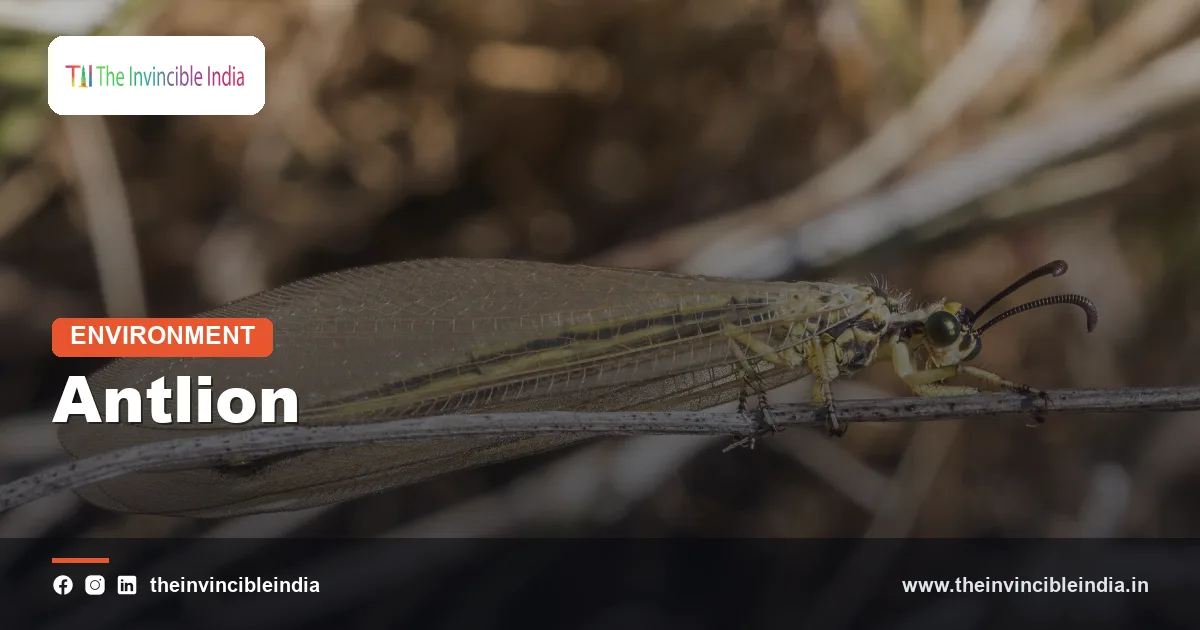
An antlion is a soft-bodied insect of the family Myrmeleontidae whose larva is a patient ambush predator, digging a funnel-shaped pit in loose, dry sand to trap ants and other small crawling prey. The adult looks very different from the larva: it is a slender, four-winged, flying insect that resembles a damselfly but carries short, clubbed antennae.
Antlions are found across India, from the sandy courtyards of Rajasthan and Gujarat to the dusty ground beneath temple eaves, old forts and rock overhangs in the peninsula. Most people know the antlion only by its tiny conical traps, often called “doodlebug pits”, which appear in sheltered patches of fine sand and quietly record a drama that most of us never stop to watch.
| Quick Facts | Antlion |
|---|---|
| Order and family | Neuroptera (net-winged insects), family Myrmeleontidae |
| Common genera in India | Myrmeleon and Euroleon, among many others |
| Size | Larva a few millimetres to about a centimetre or more; adult wingspan typically several centimetres |
| Habitat in India | Dry, loose, sheltered sand and fine dust under eaves, rock overhangs, trees and old buildings |
| Diet | Larva: ants and other small arthropods; adult: mostly small insects or little feeding at all |
| Life cycle | Complete metamorphosis: egg, larva, pupa in a sand-covered cocoon, adult |
| Ecological role | Predator that regulates populations of small ground-dwelling insects |
| Notable features | Pit trap, backward-walking larva, hollow sucking jaws, adult with clubbed antennae |
Key Takeaways
- The antlion larva digs a conical pit in dry sand and waits buried at the bottom, so that ants slip down the loose slope into its jaws.
- The antlion belongs to the insect order Neuroptera, the same order as the green lacewing, owlfly and mantidfly.
- An antlion larva has hollow, sickle-shaped jaws through which it injects digestive fluid into prey and sucks out the liquefied contents.
- The larval stage of an antlion often lasts months to a couple of years, while the winged adult usually lives only a few weeks.
- Adult antlions look like damselflies but are distinguished by their short, club-tipped antennae, weak fluttering flight and mostly night-time activity.
- Not every antlion digs a pit; many species hide in sand, leaf litter or bark and ambush prey without building any trap.
What Is an Antlion?
An antlion is a predatory insect whose larval stage is famous for hunting by trapping, and whose adult stage is a short-lived, delicate flier. The name comes from the larva’s habit of eating ants; the Greek-derived genus name Myrmeleon literally combines the words for “ant” and “lion”.
The family Myrmeleontidae contains hundreds of species worldwide, and many occur in the Indian subcontinent. Because the larvae are small, secretive and sand-coloured, and the adults fly mainly after dark, antlions are noticed far less often than butterflies or dragonflies, even though they live in towns and villages as readily as in wild country.
How is an antlion different from other insects?
An antlion differs from most insects in that its young and adult forms live in entirely different worlds. The larva is a plump, hump-backed, ground-dwelling hunter with enormous jaws, while the adult is a lightweight aerial insect with lacy wings. The larva also has no functional hind gut opening for most of its life, which is unusual and is discussed later in this article.
Where Is the Antlion Found in India?
The antlion is found throughout India wherever there is a patch of loose, dry, fine soil that rain does not wash away. Typical sites include the dust under the overhanging roofs of old houses, the base of a shaded wall, the ground below a large tree, sandy river terraces in the dry season, the shelter of a rock ledge and the quiet corners of temples, ruins and forts.
Shelter matters because a pit built in the open would be flattened by the first monsoon downpour. In regions with long dry seasons, such as Rajasthan, Gujarat, the Deccan plateau and parts of Tamil Nadu and Karnataka, the pits are especially easy to find in the months before the rains. In the wetter parts of the country, antlions persist mainly in dry pockets protected from rain.
- Under the eaves of village houses and old stone buildings
- In sandy yards and the shaded floors of temple compounds
- At the foot of rock overhangs and cave mouths
- Beneath large trees where fallen leaves and dust accumulate
- Along dry sandy stream and river banks outside the monsoon
How Does an Antlion Larva Build Its Sand Pit?
An antlion larva builds its pit by walking backwards in a spiral, using its abdomen as a plough and flicking sand out of the circle with its head. The larva starts by tracing a circle, then moves in progressively tighter loops toward the centre, throwing sand outward until a neat conical funnel forms and the larva sits buried at the bottom with only its open jaws showing.
The finished pit has slopes at roughly the steepest angle at which dry sand can stay stable. This is called the angle of repose, and it is the secret of the trap. The grains are on the edge of sliding, so even the weight of a small ant can start a miniature landslide. A good pit may be only a few centimetres wide and a couple of centimetres deep, yet it is enough to defeat an ant that has no way to grip the shifting sand.
Why does the larva reverse instead of walking forward?
The antlion larva reverses because its body is built for backward movement. Its legs are short and angled to push sand, and its flat head works like a shovel. Walking forward, the larva makes little progress through sand, whereas walking backwards it can burrow quickly and bury itself within moments.
How Does an Antlion Catch Its Prey?
An antlion catches its prey by waiting at the bottom of the pit and seizing whatever slides within reach. When an ant stumbles at the rim, loose grains slip beneath its feet and carry it downward. If the ant begins to scramble up the slope, the larva flicks sand from beneath its head, showering the victim with grains and causing further slippage toward the jaws.
Once the prey is grasped, the larva pulls it beneath the sand. The two mandibles are long, curved and hollow, each paired with a groove in the underside of the head to form a pair of feeding tubes. Through these tubes the larva injects a mixture of venom and digestive enzymes, which paralyse the victim and begin dissolving its tissues. The larva then sucks the liquid contents out of the prey, a style of feeding known as extra-oral digestion.
When the meal is finished, the larva flicks the dry husk out of the pit, repairs any damage to the slopes and settles down to wait again. A larva that has not caught anything for a long time may move and rebuild its pit elsewhere, usually in a larger and deeper form as it grows.
What Does an Antlion Eat?
An antlion larva eats ants and a wide range of other small, ground-dwelling arthropods that fall into its pit, including small beetles, spiders, springtails and the larvae of other insects. Ants make up the greatest share, simply because they walk the same routes constantly and are the commonest ground insects in dry sandy habitats.
Antlion larvae are remarkable for surviving long periods without food. Because the traps are unreliable, a larva may go for days or even weeks between meals, slowing its metabolism and growing only when food is plentiful. The adult antlion, by contrast, feeds little. Many adult antlions take only occasional small insects or no solid food at all, relying on what they stored as larvae.
Does the antlion larva ever excrete waste?
The antlion larva does not pass solid waste during its larval life, because its gut is closed at the rear. Waste products accumulate in the body and are discharged only after the larva has pupated and become an adult. This is why antlion pits are not fouled with droppings, a fact that helps keep the trap clean and effective.
What Is the Life Cycle of an Antlion?
The life cycle of an antlion has four stages: egg, larva, pupa and adult. The cycle is an example of complete metamorphosis, in which the young bear no resemblance to the winged adult, and the form is rebuilt almost entirely inside the pupa.
| Stage | What happens |
|---|---|
| Egg | The female lays tiny eggs singly in sandy soil, often in places sheltered from rain. |
| Larva | The hatchling hunts, grows and moults through three larval stages, building or enlarging its pit as it grows. This stage may last months to a couple of years. |
| Pupa | The mature larva spins a round silken cocoon coated with sand grains and transforms inside it. |
| Adult | The winged adult emerges, mates and lays eggs, living for a few weeks. |
The long larval stage is the main growth phase and explains why antlion pits are seen mostly in the same sheltered corners year after year. The speed of development depends heavily on temperature and food supply, so larvae in cooler or poorer sites take longer to mature.
What Does the Adult Antlion Look Like?
The adult antlion is a slender insect with a long, soft abdomen and two pairs of long, narrow, transparent wings held roof-like over the body at rest. Its overall shape resembles a damselfly, which is why many people mistake it for one, but it can be recognised by its short antennae that thicken into small clubs at the tips, whereas damselflies have tiny, bristle-like antennae.
Adult antlions are mostly active at dusk and at night, and are often drawn to lights. They are weak, fluttering fliers, and during the day they rest on twigs or walls, so well matched in colour with the bark or plaster that they are easily missed. They are harmless to people, with no sting and no habit of biting.
How can you tell an antlion from a damselfly?
The simplest check is the antennae. An antlion has noticeably longer antennae that end in small knobs, while a damselfly’s antennae are tiny and almost invisible. Antlions also fly in a floppy, unsteady way, are active in the evening and rest with the wings folded over the back, whereas damselflies fly by day near water and usually hold their wings alongside the body or in a narrow V.
Do All Antlions Build Pits?
No, not all antlions build pits; only certain groups of species in this family are pit-builders. Many species, including some of the larger ones, instead lie buried in sand, leaf litter or crevices, or even wait on tree bark, and they seize passing prey without building any trap. Some adults of these non-pit species are among the larger and more handsome antlions, with spotted or patterned wings.
The pit-building habit probably evolved in dry, sandy environments where prey crossing open ground has few alternatives. The widespread genera Myrmeleon and Euroleon are among the best-known pit-builders. Non-pit-builders tend to be less conspicuous and less often noticed, which is one reason the pit-builders have come to represent the whole family in popular imagination.
Is the Antlion Useful or Harmful?
The antlion is considered a harmless and mildly useful insect, since it feeds only on other small arthropods and does not damage crops, stored food, buildings or people. In the garden or yard, antlion larvae simply thin out ants and similar ground insects, which makes them a small part of natural pest regulation, though not a major biological control agent.
Antlions are also valued as an easily observed demonstration of predation. Teachers use pits to show how an animal can hunt without chasing, and naturalists find them a good example of the interplay between physics and behaviour. Because antlions need undisturbed, dry, sheltered ground, their pits tend to disappear where yards are paved, regularly swept or watered, which makes the pit a modest sign of a less disturbed patch of earth.
How Can You Watch an Antlion at Work?
You can watch an antlion by searching dry, sheltered, sandy ground in the dry season for the small cone-shaped pits, then dropping a single ant or a tiny grain of dry sand near the edge and keeping still. Good places include the dust under a verandah roof, the base of an old wall and the sand beside a sheltered tree trunk.
- Look in the dry months before the monsoon, when pits are most visible.
- Check places the rain cannot reach, such as under projecting roofs and ledges.
- Avoid disturbing the pit more than necessary; the larva rebuilds slowly.
- Do not feed the larva repeatedly with live ants simply for amusement.
- Never dig up larvae from a site in a protected area without permission.
Patience is the main requirement. A well-fed larva may ignore a passing ant, while a hungry one may react quickly. Watching a single pit over several days also shows how the larva repairs its slopes, deepens the pit and relocates after a failed hunt.
Bottom Line
The antlion is a small, secretive predator that turns physics into a hunting tool, using a sand pit at the angle of repose to trap ants. Its life story, from the long-lived hidden larva to the brief, night-flying adult, makes it one of the most interesting everyday insects of dry Indian ground.
Frequently Asked Questions
What is an antlion?
An antlion is a predatory insect of the family Myrmeleontidae, and the name usually refers to its larva, which traps ants in a conical sand pit. The adult is a slender, winged insect that resembles a damselfly. Antlions are common in dry, sheltered, sandy places across India.
How does an antlion trap its prey?
An antlion larva digs a funnel in loose dry sand and buries itself at the bottom, leaving its jaws open. When an ant slips on the unstable slope, the larva flicks sand to make it slide down. The larva then seizes the ant and sucks out its body fluids.
Is the antlion dangerous to humans?
No, the antlion is not dangerous to humans. The larva is tiny and feeds only on small arthropods, and the adult has no sting. Neither stage is known to carry diseases or damage crops or property.
How long does an antlion live?
An antlion usually spends the greater part of its life as a larva, which may last from several months to a couple of years depending on food and temperature. The pupal stage lasts a few weeks. The winged adult lives only a short time, usually a few weeks.
Is an antlion the same as a doodlebug?
Yes, “doodlebug” is a popular name for the antlion larva, especially in English-speaking regions where the trails left by the larva in sand are called doodles. In India the insect is generally referred to as an antlion. The word doodlebug can also refer to other things in other contexts, so antlion is the clearer term.
Where can I see antlion pits in India?
You can see antlion pits in dry, sheltered, sandy ground, such as under the eaves of old buildings, at the foot of rock overhangs, beneath large trees and in the courtyards of temples and forts. The best time to look is the dry season, before the monsoon rains flatten the pits. Search patiently, since the pits are small and blend into the ground.
{“@context”:”https://schema.org”,”@graph”:[{“@type”:”FAQPage”,”mainEntity”:[{“@type”:”Question”,”name”:”What is an antlion?”,”acceptedAnswer”:{“@type”:”Answer”,”text”:”An antlion is a predatory insect of the family Myrmeleontidae, and the name usually refers to its larva, which traps ants in a conical sand pit. The adult is a slender, winged insect that resembles a damselfly. Antlions are common in dry, sheltered, sandy places across India.”}},{“@type”:”Question”,”name”:”How does an antlion trap its prey?”,”acceptedAnswer”:{“@type”:”Answer”,”text”:”An antlion larva digs a funnel in loose dry sand and buries itself at the bottom, leaving its jaws open. When an ant slips on the unstable slope, the larva flicks sand to make it slide down. The larva then seizes the ant and sucks out its body fluids.”}},{“@type”:”Question”,”name”:”Is the antlion dangerous to humans?”,”acceptedAnswer”:{“@type”:”Answer”,”text”:”No, the antlion is not dangerous to humans. The larva is tiny and feeds only on small arthropods, and the adult has no sting. Neither stage is known to carry diseases or damage crops or property.”}},{“@type”:”Question”,”name”:”How long does an antlion live?”,”acceptedAnswer”:{“@type”:”Answer”,”text”:”An antlion usually spends the greater part of its life as a larva, which may last from several months to a couple of years depending on food and temperature. The pupal stage lasts a few weeks. The winged adult lives only a short time, usually a few weeks.”}},{“@type”:”Question”,”name”:”Is an antlion the same as a doodlebug?”,”acceptedAnswer”:{“@type”:”Answer”,”text”:”Yes, “doodlebug” is a popular name for the antlion larva, especially in English-speaking regions where the trails left by the larva in sand are called doodles. In India the insect is generally referred to as an antlion. The word doodlebug can also refer to other things in other contexts, so antlion is the clearer term.”}},{“@type”:”Question”,”name”:”Where can I see antlion pits in India?”,”acceptedAnswer”:{“@type”:”Answer”,”text”:”You can see antlion pits in dry, sheltered, sandy ground, such as under the eaves of old buildings, at the foot of rock overhangs, beneath large trees and in the courtyards of temples and forts. The best time to look is the dry season, before the monsoon rains flatten the pits. Search patiently, since the pits are small and blend into the ground.”}}]}]}


