

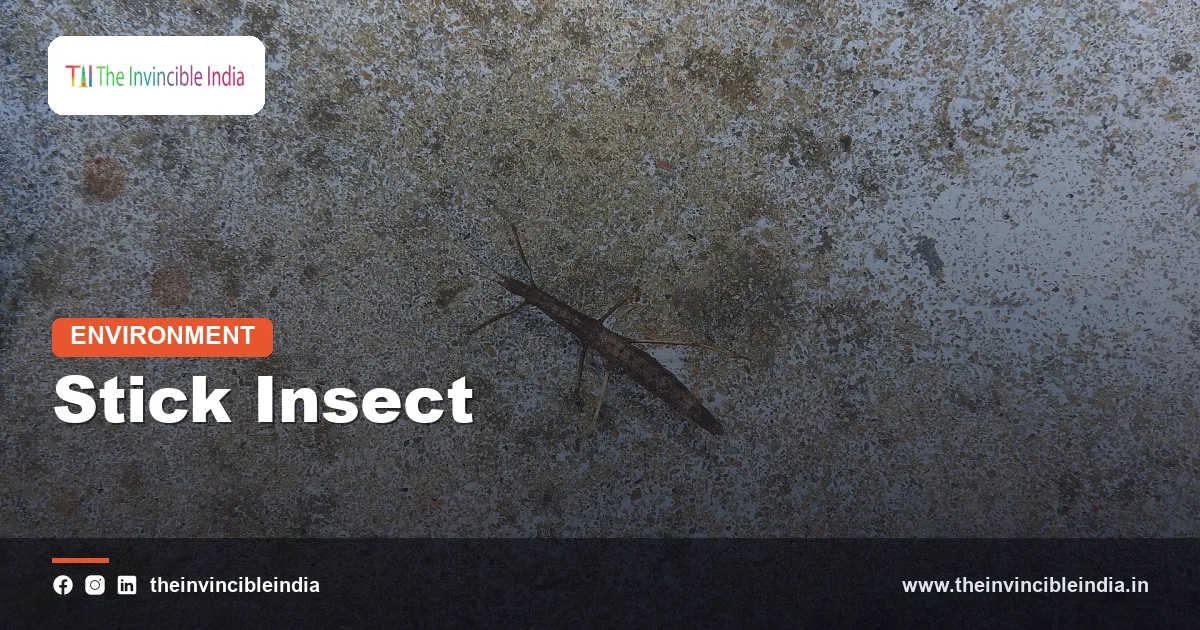
A stick insect is a slow-moving, plant-eating insect of the order Phasmatodea whose long, thin body and legs mimic a twig so closely that it can go unnoticed on a branch even when it is in plain view. Also called a phasmid or walking stick, the stick insect relies on camouflage rather than speed or weapons to survive, and it is one of the best-known examples of mimicry in nature.
Stick insects occur across India, with the greatest variety in the humid forests of the Western Ghats, the Northeast and the Andaman and Nicobar Islands. Most are nocturnal, feeding on leaves after dark and freezing into a twig-like pose by day, so even people living near them rarely realise they are there.
| Quick Facts | Stick insect |
|---|---|
| Order and families | Phasmatodea (phasmids), with families such as Phasmatidae and Lonchodidae |
| Size | Ranges from a few centimetres to well over 20 cm in the largest tropical species |
| Habitat in India | Forests, shrubland, plantations and gardens, with greatest diversity in the Western Ghats and Northeast |
| Diet | Leaves of trees, shrubs and herbs; strictly herbivorous |
| Life cycle | Incomplete metamorphosis: egg, nymph (several moults), adult |
| Ecological role | Leaf-eating herbivore and prey for birds, lizards, bats and spiders |
| Notable features | Twig mimicry, swaying movement, feigned death, limb regeneration, seed-like eggs |
| Reproduction | Both sexual and parthenogenetic (egg-laying without mating) in many species |
Key Takeaways
- The stick insect belongs to the insect order Phasmatodea, and the name “phasmid” comes from a Greek word meaning “apparition” or “ghost”.
- A stick insect avoids predators mainly through camouflage, resembling a twig or branch in shape, colour and posture.
- Stick insects are strictly herbivorous, feeding on leaves, usually at night.
- Stick insects undergo incomplete metamorphosis, so the young that hatch from the eggs look like small, wingless versions of the adult.
- Many stick insect species can reproduce without mating, a process called parthenogenesis, which allows one female to start a new population.
- A stick insect can regrow a lost leg across successive moults when it is still a juvenile.
What Is a Stick Insect?
A stick insect is a herbivorous insect with an elongated, stick-like body, long thin legs and a head that carries long or short antennae, belonging to the order Phasmatodea. The order includes both true stick insects and the leaf insects, which mimic leaves instead of twigs, and altogether it contains several thousand species worldwide, the great majority of them in tropical forests.
The order’s common names include phasmids and walking sticks. Some of the longest insects in the world are stick insects, with the largest tropical species measuring well over twenty centimetres. Others are only a few centimetres long and are easily mistaken for a dry twig or a grass stem.
What Does a Stick Insect Look Like?
A stick insect looks like a slender brown, grey or green rod with six long legs, and its body is divided into the head, a long thorax and an equally long abdomen. The colour usually matches the bark, twigs or leaves of the plants on which the insect lives, while some species have bumps, spines and lobes that imitate nodes, thorns and mossy growth.
Many species are wingless, while others have wings that are folded under short, leathery forewings. When disturbed, winged species may flash brightly coloured hindwings as a startling display before folding them away and disappearing against the foliage. Males are typically thinner and lighter than females, which are heavier because of their eggs.
- Body: long, cylindrical or flattened, in brown, grey or green
- Legs: six, thin and often held stiffly forward or backward along the body
- Antennae: thread-like, from short to long depending on species
- Wings: absent in many species, present in some
- Surface: smooth, ridged, spiny or bark-like
Where Are Stick Insects Found in India?
Stick insects are found in India wherever there is enough foliage for them to feed on, with the greatest diversity in the moist forests of the Western Ghats, the Northeast and the islands of the Bay of Bengal. They also live in scrub, plantations and gardens, wherever shrubs and trees offer both food and cover.
The Northeast and the Western Ghats are especially rich in species, because warm, wet, forested habitats with many types of plants suit the phasmids’ habits. In towns, stick insects occasionally turn up on garden shrubs, hedges, fruit trees and potted plants, where a small green or brown individual may sit motionless for days. Because their camouflage is so effective, finding one in the wild usually requires a careful night-time search with a torch.
Is the Indian stick insect a particular species?
The name “Indian stick insect” is commonly applied to Carausius morosus, a thin, brown-green species widely kept as a pet and laboratory animal worldwide. Despite the name, it is a single species among many, and India is home to a far greater range of stick insects than the pet trade suggests. Wild Indian species include large, spiny forest dwellers as well as slender, grass-like forms.
How Does Stick Insect Camouflage Work?
Stick insect camouflage works by combining shape, colour and behaviour so that the insect resembles a harmless piece of plant. This type of camouflage is called masquerade, in which the animal is seen but mistaken for an uninteresting object, and it is different from simple background-matching, in which the animal blends invisibly into its surroundings.
Several features of the stick insect support the illusion. The body is straight and thin, with colouring that matches twigs. The legs are held along the body axis so that the outline stays rod-like. The insect often hangs motionless in the daytime, and when it needs to move, it does so in a slow, jerky way, swaying gently from side to side like a twig in the breeze. This rocking action is thought to disguise any movement as wind, preventing the insect from standing out to a bird or lizard that is sensitive to motion.
What is the swaying behaviour?
The swaying is a rhythmic side-to-side or forward-and-back rocking that the stick insect performs while standing or walking. It makes the insect resemble a plant stem moved by a draught and is a form of behavioural camouflage. Predators that depend on detecting sudden, straight-line movement are less likely to notice the insect when it moves in this way.
What Other Defences Do Stick Insects Have?
Stick insects have several back-up defences besides camouflage, including feigning death, flashing bright hindwings, releasing chemical sprays and shedding limbs. These tactics come into play once the insect has been detected, when staying still is no longer enough to save it.
| Defence | How it works |
|---|---|
| Masquerade | The body looks like a twig, preventing it from being recognised as food |
| Swaying | Rocking movement imitates a stem moved by wind |
| Death-feigning | The insect drops, stiffens and lies still, looking like a dead twig |
| Startle display | Winged species suddenly flash brightly coloured hindwings |
| Chemical defence | Some species spray a smelly or irritant fluid from glands near the head |
| Limb loss | A leg held by a predator can be shed, and juveniles may regrow it |
Together, these defences give the stick insect a layered form of protection, so that it can fall back on a second or third strategy when the first fails. Even so, many stick insects are eaten by birds, lizards, bats, monkeys, spiders and praying mantises.
What Does a Stick Insect Eat?
A stick insect eats leaves, and nothing else, making it a strict herbivore. Most species feed at night on the foliage of trees, shrubs and climbers, and each species typically has a range of favoured plants, which can include guava, rose, bramble, oak, jamun and various forest trees, depending on the region.
The insect chews leaf edges with strong jaws and eats steadily through the night, resting during the day. In most cases the damage is limited to small notches in leaves and passes unnoticed. In the right conditions, large populations of some stick insect species elsewhere in the world have defoliated forest trees, but such outbreaks are rare and are not a notable problem in India.
What Is the Life Cycle of a Stick Insect?
The life cycle of a stick insect has three stages: egg, nymph and adult, and the insect develops through incomplete metamorphosis. The nymph that hatches from the egg looks like a miniature, wingless adult and grows by shedding its skin several times, gaining size and, in winged species, wing buds until the last moult produces the adult.
The eggs are hard-shelled and often resemble plant seeds in shape and colour. Many species simply drop them to the ground while feeding, scattering them across the forest floor, while some glue them onto plants or bury them in soil. In certain species the egg bears a small fatty knob that attracts ants, which carry the egg to their nests and thereby protect it from parasites and hungry foragers.
Eggs may take several months to hatch, depending on the species and the conditions. Nymphs then take months to mature, and adults may live for several months to a year or more, again depending on the species and the climate.
Can stick insects reproduce without mating?
Yes, many stick insects can reproduce by parthenogenesis, in which an unfertilised female lays eggs that hatch into more females. In some species males are rare or unknown, and populations consist almost wholly of females. This enables a single insect, carried by accident to a new place, to start a colony.
Are Stick Insects Dangerous or Harmful?
Stick insects are not dangerous to humans, as they do not bite, sting or carry diseases. A few species can spray a mild irritant when alarmed, which may sting the eyes if it hits them, so it is sensible to wash hands after handling an insect. Most species are placid and rely on stillness rather than aggression.
They are also rarely a pest. A small number of stick insects eat crop or plantation foliage in some countries, but in India they are mostly part of the natural forest community. Their main impact on people is as objects of curiosity, and as one of the clearest classroom demonstrations of natural selection and camouflage.
Can You Keep a Stick Insect as a Pet?
Yes, stick insects are widely kept as pets and teaching animals, and they are among the easiest insects to care for because they need only fresh leaves, light moisture and a ventilated cage. Carausius morosus, often sold as the Indian stick insect, is the species most commonly kept, and its females can breed without males.
- Provide fresh leaves of a safe food plant, replaced regularly.
- Keep the enclosure ventilated, tall enough for moulting and lightly misted.
- Avoid sprayed leaves, since pesticide residues can kill the insects.
- Handle gently and never pull a leg, as limbs can break away.
- Do not release pet or non-native species into the wild.
Wild stick insects should be observed rather than collected, particularly in protected forests, where taking animals without permission can be an offence under Indian wildlife law.
Bottom Line
The stick insect shows that staying unnoticed can be as effective as strength or speed. Its twig-like body, careful swaying and quiet leaf-eating habits make it an unobtrusive but fascinating member of India’s forests, gardens and hedgerows.
Frequently Asked Questions
What is a stick insect?
A stick insect is a slow-moving, leaf-eating insect of the order Phasmatodea whose long thin body resembles a twig. It uses camouflage and stillness to avoid predators. Stick insects occur across India, with the highest diversity in the Western Ghats and the Northeast.
How does a stick insect hide from predators?
A stick insect hides by looking like a twig in shape and colour and by staying motionless in the daytime. When it moves, it sways gently like a stem in the wind. If found, it may drop and play dead, flash coloured wings or spray a deterrent fluid.
What do stick insects eat?
Stick insects eat only plant leaves. They feed mostly at night on the foliage of trees, shrubs and climbers, with each species favouring particular plants. In captivity they accept leaves such as guava, bramble or rose, depending on the species.
Can a stick insect bite or sting?
No, stick insects do not sting and rarely bite, so they are safe to handle gently. A few species can spray a mild irritant when frightened, and this may sting the eyes. They carry no known diseases dangerous to humans.
Do stick insects need a mate to lay eggs?
No, many stick insects can lay viable eggs without mating through parthenogenesis, and these eggs usually hatch into females. In some species males are rare or unknown. Other species reproduce sexually, with males and females mating before eggs are laid.
How long does a stick insect live?
A stick insect typically lives from several months to a year or more, depending on the species and conditions. It passes through an egg stage lasting several months, then nymph stages with repeated moults, and finally the adult stage. Tropical forest species may take longer to mature than small garden species.
{“@context”:”https://schema.org”,”@graph”:[{“@type”:”FAQPage”,”mainEntity”:[{“@type”:”Question”,”name”:”What is a stick insect?”,”acceptedAnswer”:{“@type”:”Answer”,”text”:”A stick insect is a slow-moving, leaf-eating insect of the order Phasmatodea whose long thin body resembles a twig. It uses camouflage and stillness to avoid predators. Stick insects occur across India, with the highest diversity in the Western Ghats and the Northeast.”}},{“@type”:”Question”,”name”:”How does a stick insect hide from predators?”,”acceptedAnswer”:{“@type”:”Answer”,”text”:”A stick insect hides by looking like a twig in shape and colour and by staying motionless in the daytime. When it moves, it sways gently like a stem in the wind. If found, it may drop and play dead, flash coloured wings or spray a deterrent fluid.”}},{“@type”:”Question”,”name”:”What do stick insects eat?”,”acceptedAnswer”:{“@type”:”Answer”,”text”:”Stick insects eat only plant leaves. They feed mostly at night on the foliage of trees, shrubs and climbers, with each species favouring particular plants. In captivity they accept leaves such as guava, bramble or rose, depending on the species.”}},{“@type”:”Question”,”name”:”Can a stick insect bite or sting?”,”acceptedAnswer”:{“@type”:”Answer”,”text”:”No, stick insects do not sting and rarely bite, so they are safe to handle gently. A few species can spray a mild irritant when frightened, and this may sting the eyes. They carry no known diseases dangerous to humans.”}},{“@type”:”Question”,”name”:”Do stick insects need a mate to lay eggs?”,”acceptedAnswer”:{“@type”:”Answer”,”text”:”No, many stick insects can lay viable eggs without mating through parthenogenesis, and these eggs usually hatch into females. In some species males are rare or unknown. Other species reproduce sexually, with males and females mating before eggs are laid.”}},{“@type”:”Question”,”name”:”How long does a stick insect live?”,”acceptedAnswer”:{“@type”:”Answer”,”text”:”A stick insect typically lives from several months to a year or more, depending on the species and conditions. It passes through an egg stage lasting several months, then nymph stages with repeated moults, and finally the adult stage. Tropical forest species may take longer to mature than small garden species.”}}]}]}


