

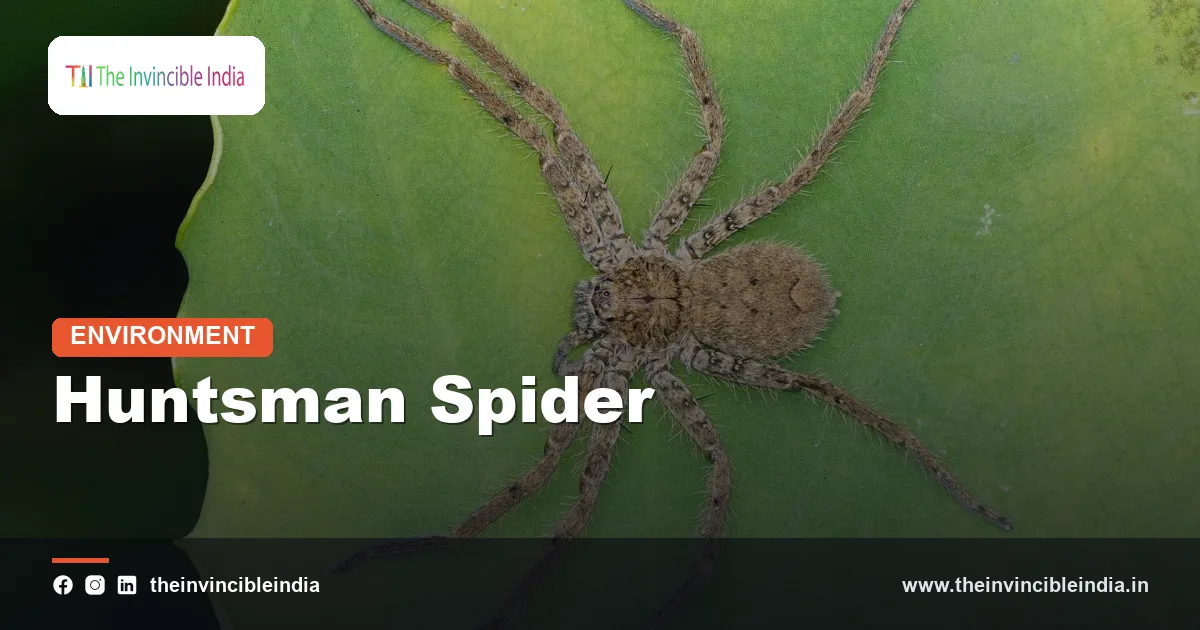
A huntsman spider is a large, flattened, long-legged spider of the family Sparassidae that hunts its prey on the move instead of trapping it in a web, and the species commonly seen on Indian walls and ceilings is harmless to people. Huntsman spiders are brown or grey, move very quickly and sideways like a crab, and are frequently found indoors at night, where they feed on cockroaches, flies, moths and mosquitoes.
Although a huntsman spider can look alarming because of its size and speed, it is shy, avoids human contact and is not dangerous. This explainer covers how to recognise a huntsman spider, where it lives in India, what it eats, how it hunts and breeds, and what to do when one turns up at home.
| Quick Fact | Detail |
|---|---|
| Scientific classification | Class Arachnida, order Araneae (spiders), family Sparassidae; the common house species in India is Heteropoda venatoria, along with other genera such as Olios and Pseudopoda |
| Size | Body of about 1.5 to 3 cm, with a leg span that often reaches 8 to 12 cm in large females |
| Habitat in India | Houses, walls, ceilings, behind picture frames and curtains, tree bark, rock crevices and forest leaf litter |
| Diet | Cockroaches, flies, moths, crickets, mosquitoes and other insects; occasionally small geckos |
| Life cycle | Egg sac carried by the female, spiderlings that moult several times to reach adulthood; commonly lives for a year or two |
| Ecological role | Natural pest control as a predator of household and garden insects; prey for geckos, birds and wasps |
| Notable features | Flat body, legs held out sideways in a crab-like way, eight eyes in two rows, no capture web, very fast movement |
| Danger to humans | Not dangerous; bites are rare and usually cause only minor local pain or swelling |
Key Takeaways
- A huntsman spider is a member of the family Sparassidae that hunts by speed and ambush rather than by building a web.
- The huntsman spider commonly found in Indian homes is not dangerous to humans, and its bite, which is rare, is generally mild and causes only temporary pain.
- Huntsman spiders have flat bodies and legs that point sideways, which lets them squeeze into narrow gaps and move rapidly across walls and ceilings.
- Huntsman spiders eat cockroaches, flies, moths and mosquitoes, so they help to keep household insect numbers down.
- A female huntsman spider carries her egg sac beneath her body and guards it, and the spiderlings disperse after hatching.
- The best response to a huntsman spider indoors is to catch it in a cup, slide a card underneath, and release it outside.
What is a huntsman spider?
A huntsman spider is a free-ranging hunting spider of the family Sparassidae, a large group that includes more than a thousand species worldwide. Members of the family are also called giant crab spiders because of their size and the way their legs are held.
The family belongs to the order Araneae, which contains all spiders. Unlike orb-weavers and funnel-web builders, huntsman spiders do not spin a trapping web. Instead they rely on sharp eyesight, a sense of touch through hairs on their legs, and quick bursts of speed to catch prey.
The name huntsman refers to this hunting style. In India the most familiar species is Heteropoda venatoria, sometimes called the pantropical huntsman, which is widely distributed in warm regions and has made its home in buildings. In hilly and forested areas other genera are found on tree trunks and under bark.
How big is a huntsman spider?
A huntsman spider typically has a body about 1.5 to 3 cm long, and the legs can stretch its overall span to roughly 8 to 12 cm in the larger females of the common house species. Males are usually more slender with relatively longer legs, while females are heavier.
The size is one of the main reasons people fear the animal, although most of the apparent bulk is made up of the long legs. Even the biggest Indian species are small compared with the giant huntsman spider of Laos, which has the longest leg span recorded among spiders, at about 30 cm.
The colour is a mix of tan, brown and grey, often with darker markings and a pale band across the face. This pattern helps the spider blend into wood, plaster and bark. Fine hairs cover the body and legs, and the sturdy legs end in tiny hairy pads that grip smooth walls.
What does a huntsman spider look like?
A huntsman spider looks flat and hairy, with eight long legs that bend forward and outward, giving it a crab-like outline. It has eight eyes arranged in two rows of four, and strong jaws (chelicerae) at the front of the head.
Is a huntsman spider dangerous to humans?
A huntsman spider is not dangerous to humans. Like almost all spiders, it has venom to subdue insects, but the venom has little effect on people and the spider rarely bites unless it is pressed, trapped against skin or handled roughly.
In the uncommon event of a bite, the usual effects are brief local pain, redness and slight swelling, similar to a minor sting. Serious reactions are exceptional, and the species is not regarded as medically significant. Washing the area with soap and water and applying a cold compress is normally enough. A doctor should be consulted if there is an unusual reaction, such as spreading swelling or signs of an allergy.
When disturbed, a huntsman spider almost always flees. It may raise its front legs in a defensive posture and dart away at high speed. The main hazard is indirect: a person startled by a spider that appears on a wall or in a car may react suddenly. For that reason, calm handling is advisable.
- Huntsman spiders do not attack people or pets.
- They do not infest food or damage fabrics and furniture.
- They do not spread diseases to humans.
Why do people fear the huntsman spider?
People fear the huntsman spider mainly because of its size, its sudden speed and its habit of appearing on walls and ceilings without warning. The fear is largely a reaction to appearance. Huntsman spiders are often compared in rumour to dangerous spiders elsewhere in the world, but the species found in Indian homes has no record of causing serious harm, and the animal itself has no interest in people. Knowing that it is a shy night hunter, rather than a threat, usually makes it easier to share a room with one.
Can a huntsman spider climb on a person?
A huntsman spider can run across a person if it is startled or trapped, but it does not seek out people. If one lands on clothing or skin, the best response is to stay still or to brush it off gently, since a sharp swat may provoke a defensive nip. It will usually run away within a second or two.
What does a huntsman spider eat?
A huntsman spider eats insects and other small animals, including cockroaches, crickets, flies, moths and mosquitoes. Large individuals sometimes take small lizards such as house geckos, though insects make up most of the diet.
The spider usually hunts at night. It watches or waits on a wall, ceiling or tree trunk, senses movement with its eyes and the vibration-sensitive hairs on its legs, and then pounces. The prey is seized with the front legs and bitten, and the spider injects venom and digestive fluids. The softened tissues are then sucked up, leaving the hard outer parts behind.
Because common household pests such as cockroaches are on the menu, huntsman spiders are often welcomed by people who know them. A single spider in a room can reduce the number of insects that gather around lights and kitchens.
Where do huntsman spiders live in India?
Huntsman spiders live across most of India, in houses, sheds, gardens, forests and rocky areas, with the common house species especially frequent in warm, humid regions. They are found from the coastal plains to the foothills of the Himalaya.
Indoors, they favour the dark corners and gaps where they can spend the day hidden. Typical resting places are behind photo frames, mirrors and cupboards, under curtains, in the folds of stored cloth and inside the crevices of door frames. Outdoors, they shelter beneath loose bark, in tree hollows, under stones and in leaf litter.
Some species are strongly associated with forests and caves, and a few are restricted to hill ranges such as the Western Ghats and the north-east. These forest species are rarely seen by people but make up a large part of the family’s diversity in the country.
How does a huntsman spider hunt without a web?
A huntsman spider hunts without a web by using speed, camouflage and strong legs to chase or ambush its prey. The spider’s flat body and sideways-pointing legs give it a quick, darting movement across vertical surfaces.
The legs of a huntsman spider turn forward and sideways, a condition called laterigrade, which lets the animal run in any direction, including sideways, with no need to turn around. The flat body allows it to flatten itself into tight gaps and ambush insects from under cover. Special hairs and tiny claws on the feet help the spider cling to smooth plaster, glass and bark.
Huntsman spiders do use silk, but not for trapping. They spin silk to make egg sacs and to leave a safety line when moving. Their vision is better than that of web-spinners, and the large front eyes help with judging distance before a pounce.
How do huntsman spiders reproduce?
Huntsman spiders reproduce by laying eggs in a silk egg sac, which in the common house species is carried and guarded by the female until the young hatch. The male finds a female by following chemical and vibrational signals and approaches her cautiously.
After mating, the female produces a flattened, whitish egg sac that holds many eggs, often a hundred or more. She holds the sac beneath her body with her jaws and palps, moving slowly and guarding it. When the spiderlings hatch, they are tiny, pale copies of the adults and stay close to the mother for a short period before they scatter.
The young grow by moulting, shedding their rigid outer skin several times as they increase in size. The full life span is typically a year or two, though some individuals live longer. People sometimes see a female moving with a round white packet under her body and a crowd of spiderlings emerging, which can be startling but is entirely natural.
How can you tell a huntsman spider from other house spiders?
A huntsman spider can be told apart from other house spiders by its flat body, sideways-held legs, lack of a web and fast, crab-like movement. Several other spiders also share Indian homes, and the table below compares the commonest.
| Spider | Appearance | Habit |
|---|---|---|
| Huntsman spider | Large, flat, brown-grey, legs pointing sideways, eight eyes in two rows | Hunts at night on walls and ceilings; no capture web |
| Cellar or daddy-long-legs spider | Very thin, long legs, small round body | Hangs upside down in a loose, untidy web in corners |
| House jumping spider | Small, compact, large front eyes | Stalks and leaps on prey during the day |
| Orb-weaving spider | Rounded abdomen, often patterned | Builds a wheel-shaped web in gardens and verandahs |
Huntsman spiders are sometimes confused with wolf spiders or tarantulas. Wolf spiders live at ground level and have a more compact shape, and tarantulas are much heavier, hairy burrowers. The huntsman’s flat form, sideways legs and wall-climbing habit are the best clues.
Why are huntsman spiders useful to have at home?
Huntsman spiders are useful at home because they eat cockroaches, flies, moths, mosquitoes and other insects that people find troublesome. They provide pest control without chemicals and rarely cause any nuisance themselves.
A spider that appears in the home also tells something about the house: it means there are enough insects to support a predator. Reducing the source of the insects, by keeping food covered and waste managed, naturally reduces the number of spiders as well.
In gardens and forests, huntsman spiders are part of the food web. They hold down insect numbers and are, in turn, eaten by birds, lizards, wasps and other spiders. They show the connection between predators and prey even in a small space such as a bedroom wall.
What should you do if you find a huntsman spider indoors?
If you find a huntsman spider indoors, the safest and kindest response is to catch it in a container and release it outside, or simply leave it alone because it will usually move on. There is no need to use sprays or to kill it.
- Stay calm and move slowly, since sudden movements make the spider run.
- Place a clear cup or box gently over the spider on the wall or floor.
- Slide a piece of card or thin cardboard between the container and the surface.
- Carry the spider outside and release it near a hedge, tree or wall away from the entrance.
Where the spider is a regular visitor, sealing gaps around windows and doors and keeping the corners clear will reduce its presence. Never grab a spider with bare hands, which is the one situation that may lead to a defensive bite. Pets and children should be taught to leave it alone.
Bottom Line
The huntsman spider is a large but harmless hunter that earns its place in Indian homes by eating cockroaches, flies and mosquitoes. Understanding its flat body, fast movement and shy nature removes most of the fear, and gentle relocation is all that is ever needed.
Frequently Asked Questions
What is a huntsman spider?
A huntsman spider is a large, flat, fast-moving hunting spider of the family Sparassidae. It does not spin a web to catch prey but chases or ambushes insects, often at night. The species commonly seen in Indian homes is Heteropoda venatoria.
Is a huntsman spider poisonous or dangerous?
No, a huntsman spider is not dangerous to humans. It has venom for killing insects, but the venom has little effect on people, and bites are rare. If bitten, a person may feel brief pain and swelling, which settles quickly.
How big can a huntsman spider get?
The common Indian house huntsman spider has a body of about 1.5 to 3 cm and a leg span of roughly 8 to 12 cm in large females. Most of the size comes from the long legs. The largest huntsman spider in the world, found in Laos, reaches a leg span of about 30 cm.
What do huntsman spiders eat?
Huntsman spiders eat insects such as cockroaches, flies, crickets, moths and mosquitoes. They sometimes catch small geckos. The spider usually hunts at night and kills prey with a quick bite and venom.
Should I kill a huntsman spider in my house?
No, there is no need to kill a huntsman spider, because it is harmless and eats household pests. The best course is to catch it under a cup, slide a card beneath, and release it outdoors. If it is left alone it will often leave by itself.
Why does a huntsman spider move so fast and sideways?
A huntsman spider moves fast and sideways because of its flat body and its legs, which point outward and forward in a crab-like arrangement. This lets the spider dash in any direction without turning. The speed helps it to catch insects and to escape threats.
{“@context”:”https://schema.org”,”@graph”:[{“@type”:”FAQPage”,”mainEntity”:[{“@type”:”Question”,”name”:”What is a huntsman spider?”,”acceptedAnswer”:{“@type”:”Answer”,”text”:”A huntsman spider is a large, flat, fast-moving hunting spider of the family Sparassidae. It does not spin a web to catch prey but chases or ambushes insects, often at night. The species commonly seen in Indian homes is Heteropoda venatoria.”}},{“@type”:”Question”,”name”:”Is a huntsman spider poisonous or dangerous?”,”acceptedAnswer”:{“@type”:”Answer”,”text”:”No, a huntsman spider is not dangerous to humans. It has venom for killing insects, but the venom has little effect on people, and bites are rare. If bitten, a person may feel brief pain and swelling, which settles quickly.”}},{“@type”:”Question”,”name”:”How big can a huntsman spider get?”,”acceptedAnswer”:{“@type”:”Answer”,”text”:”The common Indian house huntsman spider has a body of about 1.5 to 3 cm and a leg span of roughly 8 to 12 cm in large females. Most of the size comes from the long legs. The largest huntsman spider in the world, found in Laos, reaches a leg span of about 30 cm.”}},{“@type”:”Question”,”name”:”What do huntsman spiders eat?”,”acceptedAnswer”:{“@type”:”Answer”,”text”:”Huntsman spiders eat insects such as cockroaches, flies, crickets, moths and mosquitoes. They sometimes catch small geckos. The spider usually hunts at night and kills prey with a quick bite and venom.”}},{“@type”:”Question”,”name”:”Should I kill a huntsman spider in my house?”,”acceptedAnswer”:{“@type”:”Answer”,”text”:”No, there is no need to kill a huntsman spider, because it is harmless and eats household pests. The best course is to catch it under a cup, slide a card beneath, and release it outdoors. If it is left alone it will often leave by itself.”}},{“@type”:”Question”,”name”:”Why does a huntsman spider move so fast and sideways?”,”acceptedAnswer”:{“@type”:”Answer”,”text”:”A huntsman spider moves fast and sideways because of its flat body and its legs, which point outward and forward in a crab-like arrangement. This lets the spider dash in any direction without turning. The speed helps it to catch insects and to escape threats.”}}]}]}


