

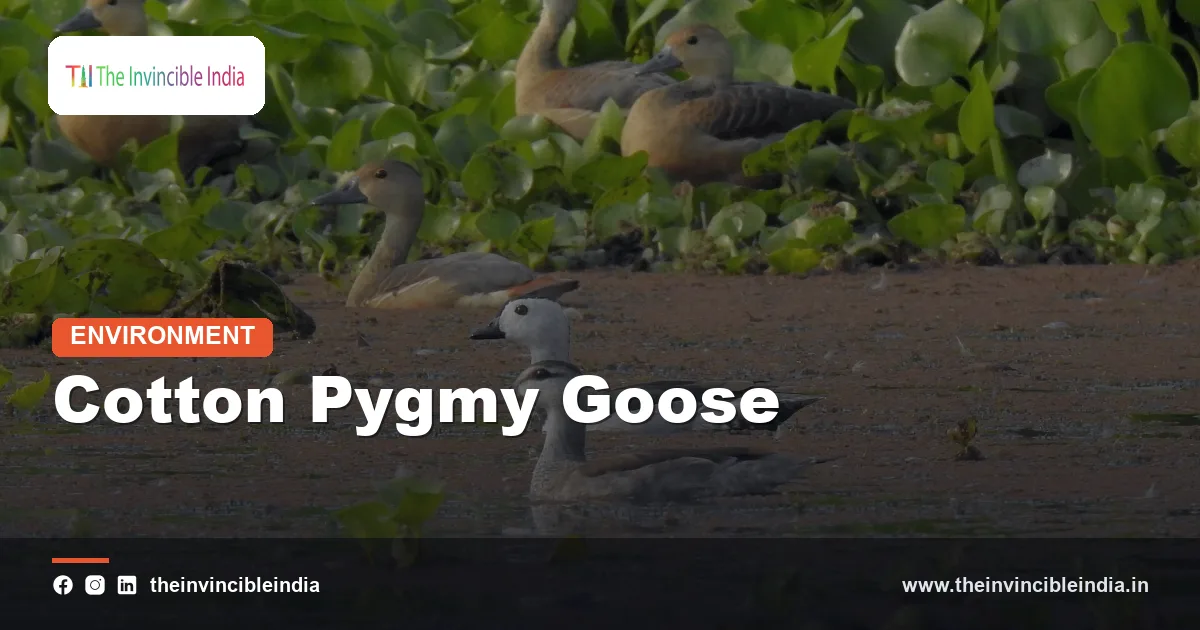
The cotton pygmy goose (Nettapus coromandelianus), also called the cotton teal, is a tiny white-and-green duck that lives on still, weed-covered freshwater ponds and lakes across India, and it is among the smallest waterfowl in the world. Despite its name it is not a true goose, but a miniature perching duck that swims among lily pads, nests in tree holes and feeds mostly on aquatic plants and small insects.
Many people who walk past village tanks and temple ponds never notice this bird, because it is small, shy and often hidden under floating leaves. This explainer covers how to recognise the cotton pygmy goose, where it lives in India, what it eats, how it breeds, whether it migrates and what its conservation status is.
Quick Facts: Cotton Pygmy Goose
| Common names | Cotton pygmy goose, cotton teal |
|---|---|
| Scientific name | Nettapus coromandelianus |
| Family | Anatidae (ducks, geese and swans) |
| Size | About 30 to 37 cm long; weighs only a few hundred grams |
| India range and habitat | Freshwater ponds, tanks, jheels and lakes with floating vegetation, across most of peninsular and northern India, mostly below the hills |
| Diet | Seeds and shoots of water plants, algae, aquatic insects, small snails and tiny fish |
| Breeding | Mainly during the monsoon; nests in tree holes near water; clutches of many small white eggs |
| Movement | Resident with local, rain-driven movements; not a long-distance migrant in India |
| Conservation status | Least Concern on the IUCN Red List, with local declines where ponds are lost |
Key Takeaways
- The cotton pygmy goose is one of the smallest ducks in the world and the smallest duck found in India.
- The cotton pygmy goose is a duck rather than a true goose, and it is closely related to other pygmy geese of Africa and Australasia.
- Male cotton pygmy geese in breeding plumage have a white head and underparts, a dark cap, a black collar and glossy green wings.
- The cotton pygmy goose depends on ponds and lakes covered with floating plants such as lilies and lotus, and it nests in natural tree cavities.
- The cotton pygmy goose breeds mainly in the monsoon months and is largely resident in India, moving locally as water levels change.
- The cotton pygmy goose is rated Least Concern globally, but the loss of village ponds and wetlands is a real local threat.
What is the cotton pygmy goose?
The cotton pygmy goose is a very small species of duck in the family Anatidae, found across South Asia, parts of Southeast Asia and northern Australia. Its scientific name, Nettapus coromandelianus, refers to the Coromandel coast of south-eastern India, where early naturalists first described it.
The English word “goose” in the name is slightly misleading. The cotton pygmy goose has a short, deep bill and a rounded body, and in build it resembles a miniature goose rather than a dabbling duck. Biologically, however, it belongs to the duck group. The genus Nettapus contains three species of pygmy geese: one in Africa, one in Australia and New Guinea, and the cotton pygmy goose, which ranges from India to Southeast Asia and Australia.
The alternative name “cotton teal” comes from the soft white plumage on the head and breast of the male, which looks like a tuft of cotton against the dark water. Both names are used in Indian field guides and by birdwatchers.
How big is the cotton pygmy goose and how can you identify it?
The cotton pygmy goose is about 30 to 37 cm long, roughly the size of a large pigeon or a small domestic hen, which makes it the smallest duck in India. A bird this size is easy to overlook, but the male has a distinctive pattern of colours that is hard to confuse with any other waterfowl.
The male in breeding plumage has a clean white head and neck, a dark brown or black crown, and a narrow black collar around the lower neck. The back and wings are glossy bottle-green with a metallic sheen, the underparts are pure white and the bill is short and dark. In flight a broad white wing bar flashes across the dark wing, which is one of the easiest ways to spot the species. The female is plainer. She has a brownish head with a dark line through the eye, a pale throat and a less glossy back, and she lacks the black collar.
| Feature | Male (breeding) | Female |
|---|---|---|
| Head | White with a dark cap | Brownish with a dark eye-stripe |
| Neck | Black collar | No collar, pale throat |
| Back and wings | Glossy green | Duller brown-green |
| Flight pattern | Broad white wing bar | Narrow or less distinct pale wing bar |
| Underparts | Clean white | Pale, mottled with grey-brown |
Outside the breeding season, the male moults into a duller eclipse plumage that looks much like the female. The black collar fades and the head pattern becomes less clear. At that time of year, the small size, the swimming posture and the white wing bar remain the most reliable features.
Where does the cotton pygmy goose live in India?
The cotton pygmy goose lives on freshwater ponds, tanks, village lakes, marshes and slow-moving backwaters across most of India, usually in lowland areas. It is seen in the plains of the Gangetic belt, in the eastern states, in the Deccan and the peninsular south, and in many protected wetlands.
The species strongly prefers still water that is thick with floating or emergent vegetation. Lily and lotus ponds, weed-choked irrigation tanks, flooded paddy margins and the edges of reservoirs with water hyacinth or duckweed all suit it well. Because the leaves give cover from predators, the goose often sits quietly among them with only its head showing. It also likes waterbodies that have large trees nearby, since it needs hollows in trunks or branches for nesting.
Outside India, the species occurs across Nepal, Bangladesh, Sri Lanka, Myanmar, Thailand, Cambodia, Vietnam and Indonesia, and a separate form is found in northern and eastern Australia. In India it is less often seen in the arid north-west and the high Himalaya, because it needs permanent shallow water with vegetation. Wetland sanctuaries such as Keoladeo National Park in Rajasthan, the marshes of Assam and the tank systems of Tamil Nadu are well-known places to look for it.
What does the cotton pygmy goose eat?
The cotton pygmy goose eats mainly plant material, including the seeds, buds and tender shoots of aquatic plants, along with algae and a smaller share of animal food such as insects and their larvae, small snails and tiny fish. This mixed diet is typical of small ducks that forage at the water surface.
The bird feeds by picking food from the surface or from just below it. It rarely upends like a dabbling duck, and it does not dive deeply. Instead it swims from one lily pad to the next, nibbling at leaves and seeds and snapping up insects that rest on the floating foliage. The short, stout bill is well suited to handling small items.
- Plant food: seeds and shoots of water lilies, duckweed, pondweeds and other aquatic plants.
- Animal food: water insects, insect larvae, small molluscs, crustaceans and occasionally very small fish.
- Feeding style: surface picking and shallow dabbling in still, shaded water.
Young ducklings eat a higher share of insects in their first weeks, because the protein helps them grow quickly. As they mature, the diet shifts toward the plant matter eaten by adults.
How does the cotton pygmy goose breed and nest?
The cotton pygmy goose breeds mainly during the monsoon, when ponds fill and vegetation is lush, and it nests in tree holes or other cavities close to water. In most of India the breeding season runs roughly from July to September, though local timing varies with the rains.
Unlike most ducks, which nest on the ground among reeds, the cotton pygmy goose uses natural hollows in old trees, and sometimes holes in buildings, walls or even disused nests of other birds. The female lays a clutch of several small, creamy-white eggs, often between six and fourteen. She does most of the incubation, and the male usually stays close by.
When the ducklings hatch, they are covered in down and are able to leave the nest within a day or so. Because the nest may be several metres above the ground, the ducklings climb up to the entrance and drop to the ground or water below. Their light bodies and soft down let them land unharmed, and the mother then leads them to the pond to feed.
This nesting habit explains why old, large trees around village ponds are so important for the species. A pond with lilies but no suitable trees may host non-breeding birds, but it will rarely support a breeding pair.
Does the cotton pygmy goose migrate?
The cotton pygmy goose is mostly a resident bird in India and does not undertake long-distance migration, although it makes local movements in response to rainfall and water levels. This makes it different from many wintering ducks, such as the northern pintail or garganey, which arrive from Central Asia and Siberia every winter.
During the dry season, shallow ponds shrink or dry out, and cotton pygmy geese move to larger, permanent waterbodies. When the monsoon refills small ponds, they disperse again to breed. In some regions, numbers seem to rise sharply in the rainy months and fall in summer, which has led some observers to call the bird a partial or local migrant. Birds in the northern parts of the range may move somewhat further than those in the south, but the movements are modest compared with the great flyways used by other waterfowl.
The species is a strong flier despite its size. It flies low and fast over water, with quick wingbeats and a distinctive high, cackling call.
How does the cotton pygmy goose behave?
The cotton pygmy goose is a shy, social bird that usually lives in pairs or small flocks and spends most of its time on the water, resting under overhanging vegetation or perching on branches. The birds often rest on half-submerged logs or on branches over the water, which is unusual for a duck.
Its call is a series of rapid, cackling notes, often compared to a squeaky, repeated “cheenk-cheenk”. Calls are heard most often at dawn and dusk, and during the breeding season. When disturbed, the flock takes off together and may fly to the far side of the pond or into nearby trees.
Why does it hide among lily pads?
Floating leaves provide shade, food and cover. A small bird such as the cotton pygmy goose is a target for predators including raptors, large snakes, monitor lizards and large fish, and the leaf cover reduces the chance of being seen from above.
Is it seen in large flocks?
Flocks are normally small, from a few birds to a few dozen. In the non-breeding season, larger groups can gather at good wetlands, sometimes mixed with other small ducks such as lesser whistling ducks.
Is the cotton pygmy goose endangered?
The cotton pygmy goose is not endangered; the International Union for Conservation of Nature (IUCN) lists it as Least Concern because its range is very large and it is still fairly widespread. In India, however, local populations can decline sharply when ponds are drained, polluted or filled.
The main threats are the loss of village ponds and small wetlands to construction and agriculture, the felling of old hollow trees that provide nest sites, water pollution, and hunting in some regions. Excessive clearing of floating vegetation can also remove cover and food. In some places, the invasive water hyacinth covers the entire surface, which may help or hinder the bird depending on how dense it becomes.
Like other wild birds in India, the cotton pygmy goose is covered by the Wild Life (Protection) Act, 1972, which prohibits hunting and capture of wild birds. Many of its best-known habitats lie inside protected areas and Ramsar-listed wetlands, which offer a measure of safety.
Why does the cotton pygmy goose matter?
The cotton pygmy goose matters because it acts as an indicator of healthy, well-vegetated freshwater habitats, and it plays a role in aquatic food webs by eating plant material, insects and snails. Its presence usually signals a pond that still has clean water, native plants and surrounding trees.
Small wetlands are often ignored in planning, yet they support a large share of India’s freshwater biodiversity. A pond with a pair of cotton pygmy geese typically also supports frogs, fish, dragonflies, kingfishers and herons. Protecting the goose’s habitat therefore protects the wider community of wetland life, as well as the water-storage and groundwater-recharge functions of village tanks.
The bird is also a favourite of birdwatchers and photographers, because of its tiny size and bright colours. This gives local communities an interest in conserving ponds.
How can you watch cotton pygmy geese in the wild?
The best way to watch cotton pygmy geese is to visit a lily-covered pond or shallow lake early in the morning, sit quietly at a distance and scan the vegetation with binoculars. The birds are shy and will flee if approached closely.
- Time of day: early morning and late afternoon, when the birds feed and call.
- Season: the monsoon and post-monsoon months, when numbers are higher and breeding activity is visible.
- Look for: a small, bright white-and-green duck, often perched on a snag, with a white wing bar in flight.
- Equipment: binoculars with 8x or 10x magnification, and a field guide to Indian birds.
- Etiquette: stay on paths, do not disturb nest trees and avoid playback of recorded calls near breeding birds.
Patience matters more than equipment. Standing still near the pond edge for ten or fifteen minutes will often reveal birds that were hidden under the leaves.
Bottom Line
The cotton pygmy goose is a small, colourful and shy duck that depends on weedy freshwater ponds and old nesting trees. It is not threatened globally, but its future in India rests on keeping village tanks and small wetlands clean and tree-lined.
Frequently Asked Questions
Is the cotton pygmy goose a goose or a duck?
The cotton pygmy goose is a duck, not a true goose. It belongs to the family Anatidae and is called a goose only because of its short, stout bill and rounded body. It is one of three species in the genus Nettapus, known as the pygmy geese.
How big is the cotton pygmy goose?
The cotton pygmy goose is about 30 to 37 cm long and weighs only a few hundred grams. This makes it the smallest duck in India and one of the smallest waterfowl in the world. It is comparable in size to a large pigeon.
Where can I see a cotton pygmy goose in India?
The cotton pygmy goose can be seen on weedy freshwater ponds, tanks and lakes across much of India, especially in the plains and the south. Wetlands such as Keoladeo National Park in Rajasthan and the marshes of Assam are well-known sites. Early morning visits to lily-covered ponds give the best chance.
What does a cotton pygmy goose eat?
The cotton pygmy goose eats mainly seeds, shoots and algae from aquatic plants, along with insects, small snails and tiny fish. It feeds at or near the water surface, picking food from floating leaves. Ducklings eat more insects than adults do.
Where does the cotton pygmy goose nest?
The cotton pygmy goose nests in natural holes in trees close to water, which is unusual among ducks. The female lays several small, creamy-white eggs, usually during the monsoon. After hatching, the ducklings jump from the nest hole and follow their mother to the water.
Is the cotton pygmy goose a threatened species?
The cotton pygmy goose is not globally threatened and is listed as Least Concern by the IUCN. It is protected in India under the Wild Life (Protection) Act, 1972. Local populations can still decline when ponds are drained, polluted or stripped of old nesting trees.
{“@context”:”https://schema.org”,”@graph”:[{“@type”:”FAQPage”,”mainEntity”:[{“@type”:”Question”,”name”:”Is the cotton pygmy goose a goose or a duck?”,”acceptedAnswer”:{“@type”:”Answer”,”text”:”The cotton pygmy goose is a duck, not a true goose. It belongs to the family Anatidae and is called a goose only because of its short, stout bill and rounded body. It is one of three species in the genus Nettapus, known as the pygmy geese.”}},{“@type”:”Question”,”name”:”How big is the cotton pygmy goose?”,”acceptedAnswer”:{“@type”:”Answer”,”text”:”The cotton pygmy goose is about 30 to 37 cm long and weighs only a few hundred grams. This makes it the smallest duck in India and one of the smallest waterfowl in the world. It is comparable in size to a large pigeon.”}},{“@type”:”Question”,”name”:”Where can I see a cotton pygmy goose in India?”,”acceptedAnswer”:{“@type”:”Answer”,”text”:”The cotton pygmy goose can be seen on weedy freshwater ponds, tanks and lakes across much of India, especially in the plains and the south. Wetlands such as Keoladeo National Park in Rajasthan and the marshes of Assam are well-known sites. Early morning visits to lily-covered ponds give the best chance.”}},{“@type”:”Question”,”name”:”What does a cotton pygmy goose eat?”,”acceptedAnswer”:{“@type”:”Answer”,”text”:”The cotton pygmy goose eats mainly seeds, shoots and algae from aquatic plants, along with insects, small snails and tiny fish. It feeds at or near the water surface, picking food from floating leaves. Ducklings eat more insects than adults do.”}},{“@type”:”Question”,”name”:”Where does the cotton pygmy goose nest?”,”acceptedAnswer”:{“@type”:”Answer”,”text”:”The cotton pygmy goose nests in natural holes in trees close to water, which is unusual among ducks. The female lays several small, creamy-white eggs, usually during the monsoon. After hatching, the ducklings jump from the nest hole and follow their mother to the water.”}},{“@type”:”Question”,”name”:”Is the cotton pygmy goose a threatened species?”,”acceptedAnswer”:{“@type”:”Answer”,”text”:”The cotton pygmy goose is not globally threatened and is listed as Least Concern by the IUCN. It is protected in India under the Wild Life (Protection) Act, 1972. Local populations can still decline when ponds are drained, polluted or stripped of old nesting trees.”}}]}]}


