

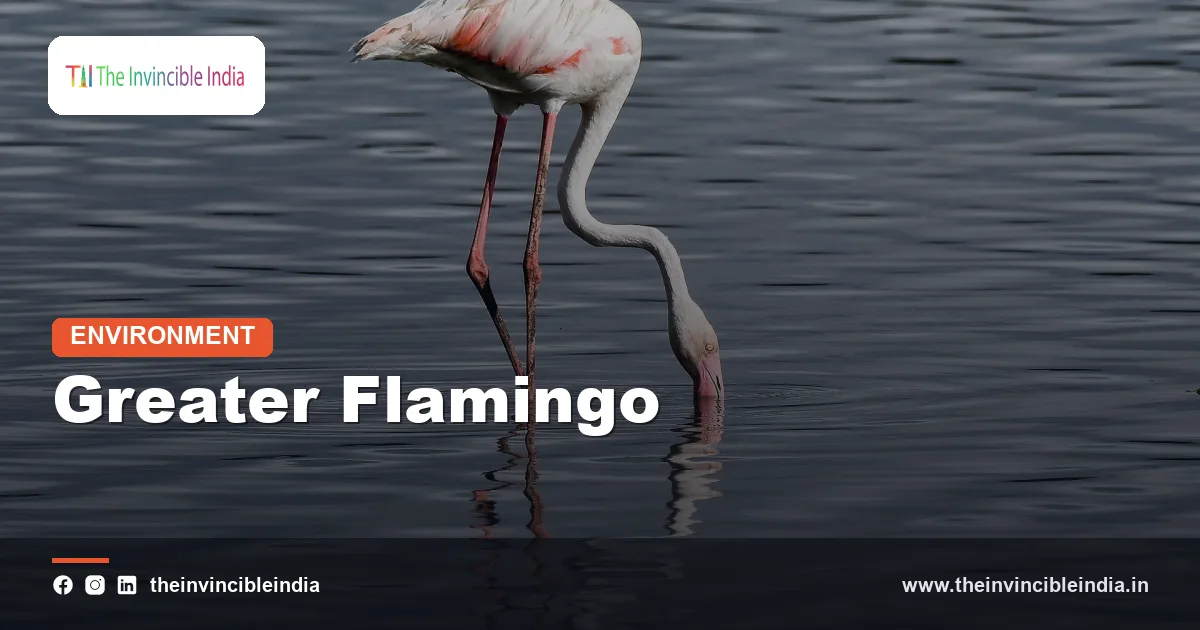
The greater flamingo (Phoenicopterus roseus) is the largest and most widespread species of flamingo, a tall, pale-pink wading bird with a long S-shaped neck and a downward-bent bill that filters food from shallow salty water, and it gathers in thousands at Indian wetlands such as the Rann of Kutch. In India it is both a breeding bird and a winter visitor, and it is the state bird of Gujarat.
Flamingos are among the most recognisable birds in the world, yet many visitors to Indian coastal wetlands are unsure which species they are seeing. This explainer describes how to identify the greater flamingo, where it lives in India, how it feeds and breeds, why it is pink and what threatens it.
Quick Facts: Greater Flamingo
| Scientific name | Phoenicopterus roseus |
|---|---|
| Family | Phoenicopteridae (flamingos) |
| Size | About 110 to 150 cm tall; wingspan roughly 1.4 to 1.7 m; weight about 2 to 4 kg |
| India range and habitat | Salt pans, tidal mudflats, lagoons, saline lakes and shallow wetlands, notably Gujarat, Rajasthan, Maharashtra, Odisha and Tamil Nadu |
| Diet | Brine shrimp, small crustaceans, molluscs, insect larvae, algae and seeds, filtered from mud and water |
| Breeding | Colonial nesting on mud mounds on flooded salt flats; a single egg; breeding depends on rainfall |
| Movement | Partial migrant; local and long-distance movements within India and from Central and West Asia |
| Notable role | State bird of Gujarat |
| Conservation status | Least Concern on the IUCN Red List; protected under Indian law |
Key Takeaways
- The greater flamingo is the largest of the world’s flamingo species and stands roughly as tall as a small child.
- The greater flamingo has whitish-pink plumage, bright pink-red wing patches and a pink bill with a black tip.
- The greater flamingo gets its pink colour from carotenoid pigments in the crustaceans and algae that it eats.
- The greater flamingo breeds in Indian salt flats such as the Great Rann of Kutch, building mud-mound nests and laying a single egg.
- The greater flamingo is the state bird of Gujarat and is a major attraction at Indian wetlands including Thane Creek, Sambhar Lake and Nal Sarovar.
- The greater flamingo is rated Least Concern globally, although Indian populations depend on a small number of coastal and saline wetlands.
What is the greater flamingo?
The greater flamingo is the biggest species in the flamingo family, Phoenicopteridae, and it occurs across parts of Africa, southern Europe, the Middle East and South Asia. The family contains six living species, and the greater flamingo is the only one regularly found across so many regions of the Old World.
Flamingos are wading birds adapted to shallow, salty or alkaline water. They have extremely long legs and necks, webbed feet and an unusual bill that is bent sharply downward. The greater flamingo is the tallest and palest of these species. Its scientific name, Phoenicopterus roseus, means roughly “rose-coloured wing” or “rosy flame-wing”, describing the bright pink-red patches visible when the wings are open.
In India, the greater flamingo is the most commonly seen flamingo, though the smaller lesser flamingo is sometimes more numerous at particular sites, such as the Rann of Kutch and the mudflats near Mumbai. Both species often feed in the same area, which can make identification confusing for new birdwatchers.
How can you identify a greater flamingo?
The greater flamingo can be identified by its large size, very pale pink-white plumage, long neck and legs, and a pink bill with a black tip. Standing up to about 1.5 metres tall, it dwarfs the lesser flamingo and most other wading birds.
Adults are mostly whitish with a soft pink wash, and the wing coverts are bright pinkish red, which becomes striking in flight when the black flight feathers are also visible. The bill is pale pink with a black tip and is sharply bent downward near the middle. The legs are pink and the eye is yellow. Immature birds are greyish-brown and take about three to four years to reach full adult colour.
| Feature | Greater flamingo | Lesser flamingo |
|---|---|---|
| Height | About 110 to 150 cm | About 80 to 100 cm |
| Plumage | Pale pink-white | Deeper pink overall |
| Bill | Pink with black tip | Dark red-maroon with black tip |
| Preferred food | Crustaceans, molluscs, larvae | Microscopic blue-green algae and diatoms |
| Global status | Least Concern | Near Threatened |
In flight, the flamingo stretches its neck and legs fully, with the legs trailing behind and the long neck extended in front. Flocks fly in lines or irregular V-shapes, and a flock in flight shows flashes of pink-red and black. The call is a loud, goose-like honking, and a large flock makes a continuous murmur.
Where does the greater flamingo live in India?
The greater flamingo lives on shallow saline and brackish wetlands in India, including salt pans, tidal creeks, mudflats, coastal lagoons and inland salt lakes. Gujarat is the most important state, but significant populations also gather in Rajasthan, Maharashtra, Odisha, Andhra Pradesh and Tamil Nadu.
- Gujarat: the Great Rann of Kutch and Little Rann of Kutch, the Gulf of Kachchh coast, Nal Sarovar, Khijadiya and Thol.
- Maharashtra: the Thane Creek Flamingo Sanctuary and the Sewri mudflats near Mumbai.
- Rajasthan: Sambhar Salt Lake, India’s largest inland saline lake.
- Odisha: Chilika Lake, a vast brackish lagoon.
- Andhra Pradesh and Tamil Nadu: the Pulicat Lake region and Point Calimere.
The bird needs wide, open, shallow water with a muddy bottom and plenty of invertebrates. It avoids deep water because it feeds by wading and by swimming only in the shallows. Salt pans, which are managed for salt production, are an important secondary habitat because they hold concentrated populations of brine shrimp.
What does the greater flamingo eat?
The greater flamingo eats small invertebrates and plant matter, including brine shrimp, other crustaceans, molluscs, insect larvae, algae and seeds, which it filters from mud and water using its specially shaped bill. Because it feeds on food that lives in the mud, it can also take larger prey than the lesser flamingo can.
The feeding method is unusual. The flamingo lowers its head so that the bill is upside down in the water and sweeps it from side to side. The tongue acts as a piston, pumping water in and out of the bill. Comb-like plates called lamellae along the edges of the bill act as a sieve, trapping small food items while releasing water and mud. Birds also stamp their feet to stir up the bottom and bring food to the surface.
Why is the greater flamingo pink?
The greater flamingo is pink because its diet contains carotenoid pigments, which are broken down in the liver and deposited in the feathers, skin and bill. Chicks hatch with grey-white down and only become pink as they begin to feed on pigment-rich food. A flamingo that cannot find enough of these foods slowly becomes paler.
How does the greater flamingo breed?
The greater flamingo breeds in large colonies on open, flooded flats, building a cone-shaped mud nest and laying a single egg, and breeding in India depends strongly on monsoon rainfall. In years of good rain, the Great Rann of Kutch fills with water and thousands of pairs may nest, but in dry years the birds may not breed at all.
The nest is a mound of mud, up to about 30 cm high, with a shallow cup on top. Both parents share incubation, which lasts roughly a month. After hatching, the chick stays near the nest for a few days and then joins a crèche, a group of young birds guarded by a few adults. Both parents feed the chick with a nutritious fluid called crop milk, which is secreted from the lining of the upper digestive tract and has a red tint from carotenoids. Young flamingos take about ten weeks to fly.
The breeding site in the Great Rann of Kutch is often called “Flamingo City”. It lies on a remote area of the saline desert, where the nests are isolated by water and mud from predators such as foxes and jackals. Human visits are restricted to avoid disturbance.
What are the stages of the greater flamingo life cycle?
The greater flamingo life cycle runs from a single egg on a mud mound to a pink adult that may live for decades. Each stage depends on shallow water and a steady supply of food.
- Egg: one chalky-white egg laid on the mud nest, incubated by both parents for about a month.
- Chick: covered in grey down, fed crop milk by both parents and kept in a crèche with other young birds.
- Juvenile: greyish-brown, with a straight bill that slowly develops its bend; able to fly after around ten weeks.
- Immature: gradually turns paler and pinker over about three to four years.
- Adult: pale pink with bright wing patches; begins to breed when several years old, usually when conditions are favourable.
Does the greater flamingo migrate?
The greater flamingo is a partial migrant in India, meaning some birds stay in the country all year while others arrive in winter from breeding grounds in West and Central Asia. Many Indian birds also move locally between wetlands depending on rainfall, water depth and food supply.
Flamingos often travel at night, in large flocks, and may cover long distances in a single flight. Because their feeding areas are scattered and shift with the seasons, they use a network of wetlands rather than a single site. The Thane Creek and Sewri mudflats near Mumbai, for example, receive large numbers from late autumn through spring, after which many birds disperse to other coastal areas.
Ringing and satellite-tracking studies have confirmed that individual flamingos may travel hundreds or thousands of kilometres across the Arabian Sea region and western India. These movements underline the need to protect a chain of wetlands, not just individual sites.
How do greater flamingos behave?
Greater flamingos are highly social birds that live, feed and breed in flocks, ranging from a few dozen to many thousands. Flocking helps with protection against predators and with finding food and mates.
Before breeding, flocks perform group displays in which birds stretch their necks, flick their heads, raise their wings and march together in synchronised movements. These displays help pairs form and bring birds into breeding condition at the same time. Flamingos famously stand on one leg for long periods, tucking the other leg under the body, which is thought to reduce heat loss and save energy. Birds preen often, spreading oil from a gland near the tail onto their feathers.
The lifespan of a greater flamingo can reach several decades, particularly in captivity, and wild birds are known to live for twenty years or more.
Is the greater flamingo endangered?
The greater flamingo is not endangered; the International Union for Conservation of Nature (IUCN) lists it as Least Concern because it has a very large range and a large global population. In India, it is protected under the Wild Life (Protection) Act, 1972, and the key habitats of the species are often sanctuaries or Ramsar-listed wetlands.
Nevertheless, regional threats are real. Coastal land reclamation, industrial and housing development on mudflats, pollution of creeks, changes in salinity and water flow, and disturbance by people and vehicles can all damage feeding and breeding sites. The best-known flamingo habitats near Mumbai face pressure from urban expansion, while the Rann of Kutch depends on rainfall patterns and careful management of access.
Collisions with power lines and other structures, and occasional poisoning or poaching, can also kill birds. Conservation efforts therefore focus on safeguarding wetland sites, controlling disturbance and monitoring numbers through regular waterbird counts.
Why does the greater flamingo matter to India?
The greater flamingo matters to India as an indicator of healthy saline and coastal wetlands, as a state symbol of Gujarat and as a draw for nature tourism. Flocks of pink birds on tidal flats have become a symbol of wetland conservation in cities such as Mumbai.
Wetlands that support flamingos usually support other waders, ducks, gulls and terns, along with the invertebrates at the base of the food web. Salt-pan workers, fishing communities and local guides often share these habitats with the birds, so flamingo conservation links wildlife and livelihoods. Flamingo festivals and birdwatching events in several states have increased public awareness.
How can you watch greater flamingos?
The best way to watch greater flamingos is to visit a known wetland during the cool months, preferably at high tide or in the early morning, and to observe from a distance with binoculars. Flocks are easily disturbed by close approach, noise and drones.
- Season: broadly November to March for most Indian sites, with breeding in the Rann depending on the monsoon.
- Places: Thane Creek and Sewri near Mumbai, Nal Sarovar, the Little Rann of Kutch, Sambhar Lake, Chilika and Pulicat.
- Behaviour: keep to marked paths, stay quiet and never try to make the flock fly.
- Gear: binoculars or a spotting scope; the birds are often far from the shore.
Bottom Line
The greater flamingo is a tall, pale-pink filter feeder that links India’s coastal mudflats, salt pans and saline lakes into one shared habitat. Protecting these wetlands, and the shallow water and food supply they hold, is what keeps the flocks returning each year.
Frequently Asked Questions
What is the difference between the greater flamingo and the lesser flamingo?
The greater flamingo is taller and paler than the lesser flamingo, with a pink bill tipped in black, while the lesser flamingo is smaller, deeper pink and has a dark red bill. The greater flamingo eats crustaceans and other invertebrates, whereas the lesser flamingo mainly filters microscopic algae. The lesser flamingo is also rated Near Threatened globally.
Why is the greater flamingo pink?
The greater flamingo is pink because of carotenoid pigments in the crustaceans and algae it eats. These pigments are processed in the liver and deposited in its feathers, skin and bill. Chicks are grey-white and turn pink as they feed on pigment-rich food.
Where can I see greater flamingos in India?
Greater flamingos can be seen at the Rann of Kutch, Nal Sarovar and Khijadiya in Gujarat, the Thane Creek Flamingo Sanctuary and Sewri mudflats near Mumbai, Sambhar Lake in Rajasthan, Chilika in Odisha and the Pulicat area. The cool months from November to March are generally best.
What does the greater flamingo eat?
The greater flamingo eats brine shrimp, other small crustaceans, molluscs, insect larvae, algae and seeds. It holds its bill upside down in the water and filters food through comb-like plates. It often stamps its feet to stir food up from the mud.
How does the greater flamingo breed?
The greater flamingo breeds in large colonies on flooded flats, building a cone of mud as a nest and laying a single egg. Both parents incubate the egg and feed the chick with crop milk. In India, a well-known breeding site is the Great Rann of Kutch, where breeding depends on monsoon rain.
Is the greater flamingo a protected bird in India?
The greater flamingo is protected in India under the Wild Life (Protection) Act, 1972. Many of its key sites are sanctuaries or Ramsar wetlands, and it is the state bird of Gujarat. Globally the species is rated Least Concern.
{“@context”:”https://schema.org”,”@graph”:[{“@type”:”FAQPage”,”mainEntity”:[{“@type”:”Question”,”name”:”What is the difference between the greater flamingo and the lesser flamingo?”,”acceptedAnswer”:{“@type”:”Answer”,”text”:”The greater flamingo is taller and paler than the lesser flamingo, with a pink bill tipped in black, while the lesser flamingo is smaller, deeper pink and has a dark red bill. The greater flamingo eats crustaceans and other invertebrates, whereas the lesser flamingo mainly filters microscopic algae. The lesser flamingo is also rated Near Threatened globally.”}},{“@type”:”Question”,”name”:”Why is the greater flamingo pink?”,”acceptedAnswer”:{“@type”:”Answer”,”text”:”The greater flamingo is pink because of carotenoid pigments in the crustaceans and algae it eats. These pigments are processed in the liver and deposited in its feathers, skin and bill. Chicks are grey-white and turn pink as they feed on pigment-rich food.”}},{“@type”:”Question”,”name”:”Where can I see greater flamingos in India?”,”acceptedAnswer”:{“@type”:”Answer”,”text”:”Greater flamingos can be seen at the Rann of Kutch, Nal Sarovar and Khijadiya in Gujarat, the Thane Creek Flamingo Sanctuary and Sewri mudflats near Mumbai, Sambhar Lake in Rajasthan, Chilika in Odisha and the Pulicat area. The cool months from November to March are generally best.”}},{“@type”:”Question”,”name”:”What does the greater flamingo eat?”,”acceptedAnswer”:{“@type”:”Answer”,”text”:”The greater flamingo eats brine shrimp, other small crustaceans, molluscs, insect larvae, algae and seeds. It holds its bill upside down in the water and filters food through comb-like plates. It often stamps its feet to stir food up from the mud.”}},{“@type”:”Question”,”name”:”How does the greater flamingo breed?”,”acceptedAnswer”:{“@type”:”Answer”,”text”:”The greater flamingo breeds in large colonies on flooded flats, building a cone of mud as a nest and laying a single egg. Both parents incubate the egg and feed the chick with crop milk. In India, a well-known breeding site is the Great Rann of Kutch, where breeding depends on monsoon rain.”}},{“@type”:”Question”,”name”:”Is the greater flamingo a protected bird in India?”,”acceptedAnswer”:{“@type”:”Answer”,”text”:”The greater flamingo is protected in India under the Wild Life (Protection) Act, 1972. Many of its key sites are sanctuaries or Ramsar wetlands, and it is the state bird of Gujarat. Globally the species is rated Least Concern.”}}]}]}


