

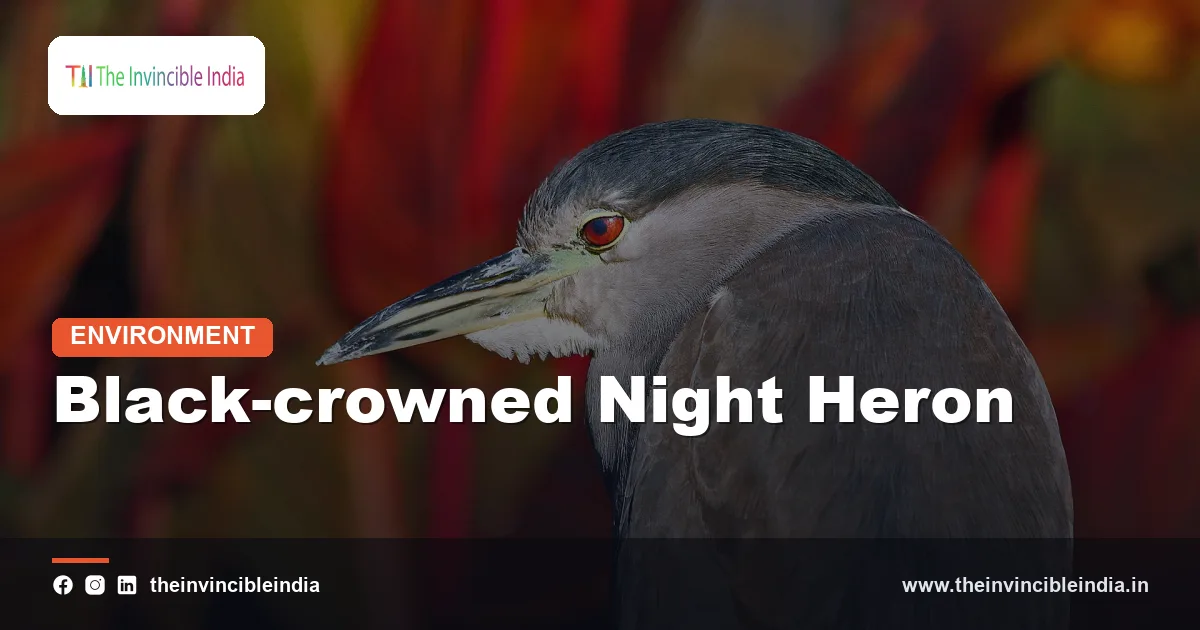
The black-crowned night heron (Nycticorax nycticorax) is a stocky, short-necked heron of the family Ardeidae that hunts mainly at dusk and during the night in ponds, marshes, lakes and rivers, and rests by day in leafy trees and reedbeds. Found across much of India and on every continent except Australasia and Antarctica, the black-crowned night heron is easily recognised by its black cap and back, grey wings, pale underparts and bright red eyes.
Because it feeds in the half-light and roosts in dense cover, the black-crowned night heron is often overlooked, even though it lives in cities, villages and fish farms as well as in protected wetlands. This explainer covers its appearance, habitat, diet, nocturnal habits, breeding colonies and conservation status.
| Common name | Black-crowned night heron (also called night heron) |
|---|---|
| Scientific name | Nycticorax nycticorax |
| Family and order | Ardeidae (herons, egrets and bitterns), order Pelecaniformes |
| Size | About 58 to 65 cm long, with a wingspan of roughly 105 to 112 cm |
| Range in India | Widespread across the plains and peninsula, mostly resident, with local movements and some winter visitors |
| Habitat | Ponds, lakes, marshes, paddy fields, streams, mangroves, canals and wooded wetland edges |
| Diet | Fish, frogs, crustaceans, insects, leeches, small reptiles and occasionally eggs or chicks |
| Breeding | Colonial nester in trees and reeds; usually three to five pale blue-green eggs |
| IUCN status | Least Concern |
Key Takeaways
- The black-crowned night heron (Nycticorax nycticorax) is a stocky heron of the family Ardeidae that is active mainly at dusk, at night and around dawn.
- The adult black-crowned night heron has a glossy black crown and back, grey wings, whitish underparts and red eyes, while young birds are brown and heavily streaked.
- The black-crowned night heron rests by day in dense trees or reeds, often in noisy communal roosts, and flies out to feed at dusk with a hoarse barking call.
- The black-crowned night heron eats fish, frogs, crustaceans, insects and other small animals, and hunts by standing or walking slowly in shallow water.
- The black-crowned night heron nests in colonies, often in mixed heronries with egrets, cormorants and ibises, and usually lays three to five pale blue-green eggs.
- The black-crowned night heron is listed as Least Concern by the IUCN and is one of the most widespread herons in the world.
What Does the Black-crowned Night Heron Look Like?
The black-crowned night heron is a compact, thick-set heron with a large head, a short thick neck, stout dark bill and relatively short legs, and the adult has a glossy black crown and back, pale grey wings and white to pale grey underparts. Its red eyes are large and bright, a feature that supports night vision.
In breeding season adults grow two or three long, thin white plumes from the back of the head, which hang down the nape. The legs, which are yellowish to greenish for most of the year, turn pinkish or reddish at the peak of courtship. The bill is dark, short and heavy, designed for grabbing slippery prey rather than spearing it from a distance like the longer bills of other herons.
When the bird stands relaxed it often hunches with its neck drawn in, appearing squat and almost neckless. When alert it stretches its neck upward and looks taller and slimmer. In flight the head is pulled in, the legs project only slightly beyond the tail, and the wings beat in a steady, rather owl-like rhythm.
What do young black-crowned night herons look like?
Young black-crowned night herons look very different from adults: they are brown above with white spots and streaks, and heavily streaked brown and white below. Their eyes are yellow to orange rather than red, and the bill is yellowish. They take about two to three years to attain full adult colours, and observers often mistake juveniles for bitterns because of the streaked plumage.
Where Does the Black-crowned Night Heron Live in India?
The black-crowned night heron lives throughout most of lowland India, in freshwater and brackish wetlands, wherever there is shallow water and nearby trees or dense vegetation for roosting. It is largely a resident bird in India, but numbers are augmented in some regions in winter by birds arriving from further north.
It uses a wide variety of habitats, including village ponds, irrigation tanks, canals, reservoirs, the margins of rivers, mangrove creeks and flooded paddy fields. It also occurs in city parks and lakes provided that there are quiet trees for daytime roosting. Heronries such as those at Keoladeo National Park in Bharatpur host the species alongside many other waterbirds.
Globally the species has one of the widest ranges of any heron, spanning Eurasia, Africa and the Americas. The Indian birds belong to the same widespread Old World group as those of Europe and Africa. The species generally avoids very high mountains, deserts without water and fast, rocky streams.
Why Is It Called a Night Heron?
The black-crowned night heron is called a night heron because it is mostly active in the evening, at night and around dawn, instead of in bright daylight like the egrets and pond herons. The scientific name Nycticorax comes from Greek words meaning night raven, a reference to the bird’s dark colouring and its harsh, croaking call heard after dark.
Being nocturnal helps the bird in two ways. It avoids competing with day-active herons for the same fish and frogs, and it hunts when many prey animals come into the shallows. Night activity also reduces the risk from some daytime predators such as eagles, although owls and other night hunters can still take young birds.
What Does the Black-crowned Night Heron Eat?
The black-crowned night heron eats a wide range of small animals, including fish, frogs and tadpoles, crustaceans such as crabs and prawns, insects, leeches, earthworms and small reptiles, and it sometimes takes eggs, nestlings and small mammals. It is an opportunistic feeder that adapts its diet to whatever is plentiful.
The bird hunts in several ways. It may stand motionless at the water’s edge in a crouch, waiting for prey to come within reach, or walk slowly through shallows with its neck stretched forward. It sometimes drops a bait item such as a bit of bread or an insect on the water to lure fish, a clever behaviour recorded in several herons. Prey is seized in a quick lunge and swallowed whole.
Where does it hunt?
- Shallow edges of ponds, lakes and reservoirs
- Flooded paddy fields and irrigation channels
- Tidal creeks, mangroves and estuaries
- Fish farms and hatchery tanks, where it can sometimes cause local conflict
- Streams and drains in towns, especially after dark
In regions where fish are farmed, the bird is occasionally regarded as a pest, although the actual damage varies greatly with the size of ponds and the cover available. In natural wetlands, the heron’s feeding usually has little effect on fish numbers and mainly takes small, abundant prey.
How Does the Black-crowned Night Heron Behave?
The black-crowned night heron is a social bird that roosts in groups by day, flies out to feed at dusk, and communicates with loud, hoarse barks. Daytime roosts may hold dozens or even hundreds of birds, usually perched in dense, leafy trees or reed clumps close to water.
At sunset the roosting birds begin to stir. They leave in small flights, often calling in a deep “kwok” or “quark”, and they spread across surrounding wetlands to feed. Before dawn they return to the roost. Some individuals feed in daylight as well, especially when they have chicks to feed or when the weather is cloudy.
The black-crowned night heron is usually wary but can become quite tame around people in city lakes and temple ponds. Its flight is direct and steady with rounded wings, and flocks often fly in loose lines or irregular groups at dusk, which is a good time to count them near a roost.
Does the black-crowned night heron migrate?
The black-crowned night heron migrates only partly in India. Many birds remain in the same region all year and simply move between roosts and feeding areas, while others travel short distances in response to water levels, food supply and the season. Populations in colder parts of its world range move south in winter, which is why Indian wetlands can hold extra birds in the cooler months.
How Does the Black-crowned Night Heron Breed?
The black-crowned night heron breeds in colonies, building a loose stick platform in a tree, bush or reed bed, and laying usually three to five pale blue-green eggs. The nests are often placed in mixed heronries alongside egrets, other herons, cormorants, ibises and storks.
Breeding in India is usually linked to the monsoon and the weeks that follow, when food is plentiful, though timing varies between regions. Males select a nest site and display to attract a female by stretching, bowing and fanning the nape plumes. Both parents incubate the eggs for about three weeks and share the feeding of the chicks, which are fed by regurgitation at the nest.
The young leave the nest after a few weeks, climbing around neighbouring branches before they can fly. In crowded colonies the ground below the nests may be covered in droppings, and some trees may be damaged. This is one reason why heronries in villages are sometimes disturbed, although many communities have traditionally protected them.
| Stage | What happens |
|---|---|
| Courtship | Males display with bows and stretches, showing the white nape plumes |
| Nest building | Pair builds a loose platform of sticks in a tree or reedbed |
| Eggs | Usually three to five pale blue-green eggs |
| Incubation | About three weeks, shared by both parents |
| Chicks | Fed by regurgitation; leave the nest on foot before flying |
| Maturity | Adult plumage is reached over two to three years |
How Is the Black-crowned Night Heron Different from Other Herons?
The black-crowned night heron differs from other Indian herons in its stocky build, short neck and legs, nocturnal habits and red eyes, whereas pond herons and egrets are slimmer, more active in daylight and mostly white or streaked brown. A quick comparison makes identification easier.
- Pond herons are smaller, streaky brown when at rest, and show bright white wings in flight.
- Grey herons are much taller, with longer necks and legs and a long dagger bill.
- Egrets are white and slender, and active during the day.
- Bitterns are brown, streaked and secretive, and live in dense reeds.
- Night herons are stocky, with a black cap and back, grey wings and red eyes.
The juvenile black-crowned night heron is the form most often confused with others, because its brown, spotted plumage looks similar to that of a bittern or young pond heron. The stout bill, large head and heavy body help to separate it.
How long does the black-crowned night heron live?
The black-crowned night heron can live for more than a decade in the wild, although many young birds die in their first year from predation, starvation and accidents. Adults that survive the early months are hardy and adaptable, which helps the species recover quickly when good wetlands and safe roost trees are available.
Is the Black-crowned Night Heron Threatened?
The black-crowned night heron is not globally threatened and is listed as Least Concern by the IUCN because it has a very large range and a large population. Its numbers are stable or fluctuating in most areas, although local declines happen where wetlands are drained or heronries are destroyed.
The main pressures on the species are loss of wetlands, felling of roost and nest trees, pollution and pesticides, and disturbance or hunting at colonies. Persecution at fish farms and the collection of chicks or eggs have affected some local populations. Even so, the bird is adaptable and can live near people, and conserving ponds with tall trees in towns and villages is often enough to retain a roost.
Why Does the Black-crowned Night Heron Matter?
The black-crowned night heron matters because it links aquatic and land food webs, controls populations of small animals, and acts as a sign of healthy wetlands. A flourishing roost or heronry normally indicates clean water, abundant prey and secure trees.
By hunting at night, the bird fills a role that most wading birds leave open. It eats insects, crabs, frogs and small fish that other birds miss, and its droppings in heronries recycle nutrients into surrounding soils. Scientists also study the species as an indicator of contaminants, because as a predator it can accumulate pollutants in its tissues.
How can the black-crowned night heron be watched?
The easiest way to watch the black-crowned night heron is to visit a known roost or heronry just before sunset and look for birds flying out. Binoculars help, and a quiet, distant position prevents disturbance. Daytime visits to heronries reveal the sleeping birds hunched on branches, typically with their heads tucked in.
Bottom Line
The black-crowned night heron is a stocky, red-eyed heron that hunts at night, roosts in noisy groups by day and nests in busy colonies. It remains common and widespread, but it depends on shallow wetlands and tall, quiet trees, both of which need protection in a rapidly changing India.
Frequently Asked Questions
What is a black-crowned night heron?
A black-crowned night heron is a stocky heron of the species Nycticorax nycticorax that feeds mainly at dusk and at night. The adult has a black crown and back, grey wings, whitish underparts and red eyes. It lives in wetlands across India and much of the world.
Why is the black-crowned night heron active at night?
The black-crowned night heron is active at night because many of its prey animals, such as frogs, fish and crustaceans, come into shallow water after dark. Hunting at night also reduces competition with day-active herons and egrets. Its large, red eyes help it see in low light.
What does the black-crowned night heron eat?
The black-crowned night heron eats fish, frogs, tadpoles, crustaceans, insects, leeches and small reptiles, and it sometimes takes eggs and chicks. It hunts by standing still or walking slowly in shallow water and seizing prey with a quick lunge. It adapts its diet to whatever food is plentiful.
Where does the black-crowned night heron live in India?
The black-crowned night heron lives in lowland wetlands across most of India, including ponds, lakes, marshes, canals, paddy fields and mangroves. It is mostly a resident bird, with some local movements. It roosts by day in dense trees or reeds near water.
How does the black-crowned night heron breed?
The black-crowned night heron breeds in colonies, building a stick nest in a tree or reedbed and laying usually three to five pale blue-green eggs. Both parents incubate for about three weeks and feed the chicks. Nesting is often timed with the monsoon, though it varies by region.
Is the black-crowned night heron endangered?
No, the black-crowned night heron is not endangered and is listed as Least Concern by the IUCN. It has a very large range and a large global population. Local declines can still occur when wetlands are drained or heronries and roost trees are destroyed.
{“@context”:”https://schema.org”,”@graph”:[{“@type”:”FAQPage”,”mainEntity”:[{“@type”:”Question”,”name”:”What is a black-crowned night heron?”,”acceptedAnswer”:{“@type”:”Answer”,”text”:”A black-crowned night heron is a stocky heron of the species Nycticorax nycticorax that feeds mainly at dusk and at night. The adult has a black crown and back, grey wings, whitish underparts and red eyes. It lives in wetlands across India and much of the world.”}},{“@type”:”Question”,”name”:”Why is the black-crowned night heron active at night?”,”acceptedAnswer”:{“@type”:”Answer”,”text”:”The black-crowned night heron is active at night because many of its prey animals, such as frogs, fish and crustaceans, come into shallow water after dark. Hunting at night also reduces competition with day-active herons and egrets. Its large, red eyes help it see in low light.”}},{“@type”:”Question”,”name”:”What does the black-crowned night heron eat?”,”acceptedAnswer”:{“@type”:”Answer”,”text”:”The black-crowned night heron eats fish, frogs, tadpoles, crustaceans, insects, leeches and small reptiles, and it sometimes takes eggs and chicks. It hunts by standing still or walking slowly in shallow water and seizing prey with a quick lunge. It adapts its diet to whatever food is plentiful.”}},{“@type”:”Question”,”name”:”Where does the black-crowned night heron live in India?”,”acceptedAnswer”:{“@type”:”Answer”,”text”:”The black-crowned night heron lives in lowland wetlands across most of India, including ponds, lakes, marshes, canals, paddy fields and mangroves. It is mostly a resident bird, with some local movements. It roosts by day in dense trees or reeds near water.”}},{“@type”:”Question”,”name”:”How does the black-crowned night heron breed?”,”acceptedAnswer”:{“@type”:”Answer”,”text”:”The black-crowned night heron breeds in colonies, building a stick nest in a tree or reedbed and laying usually three to five pale blue-green eggs. Both parents incubate for about three weeks and feed the chicks. Nesting is often timed with the monsoon, though it varies by region.”}},{“@type”:”Question”,”name”:”Is the black-crowned night heron endangered?”,”acceptedAnswer”:{“@type”:”Answer”,”text”:”No, the black-crowned night heron is not endangered and is listed as Least Concern by the IUCN. It has a very large range and a large global population. Local declines can still occur when wetlands are drained or heronries and roost trees are destroyed.”}}]}]}


