

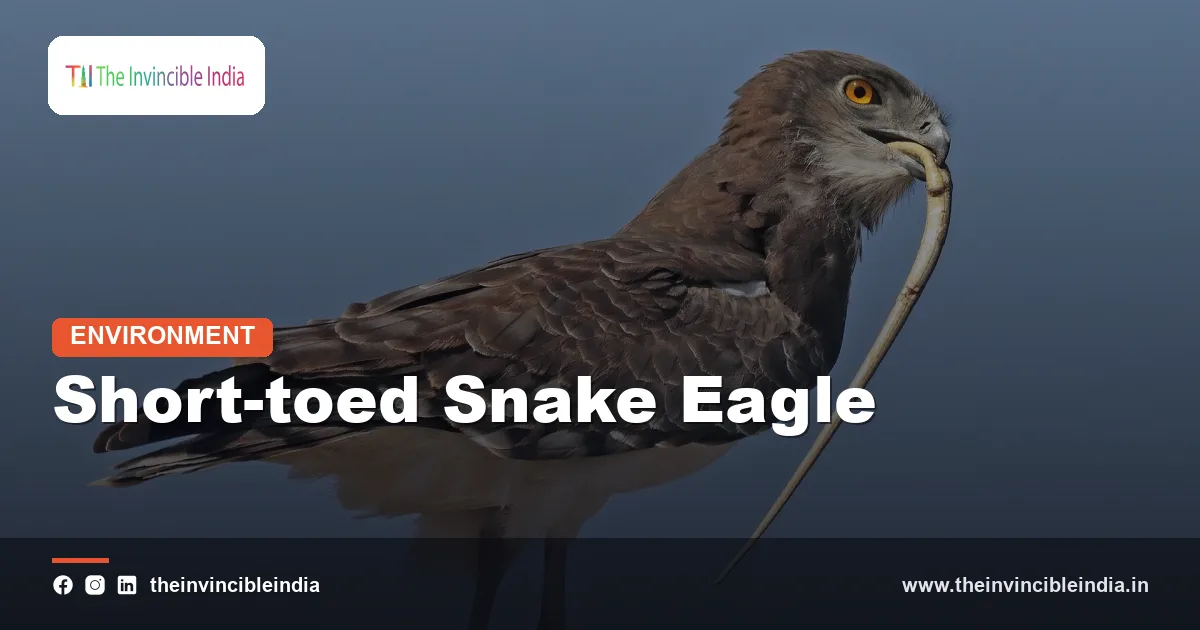
The short-toed snake eagle (Circaetus gallicus) is a large, pale bird of prey of the hawk and eagle family Accipitridae that specialises in hunting snakes across the open, dry and scrubby country of India and much of the Old World. It is easily recognised by its big, round, yellow eyes, its owl-like head, its whitish underparts and its habit of hovering in the air like a giant kestrel while scanning the ground for reptiles.
The short-toed snake eagle is widely seen in India, from the plains and plateaus of the peninsula to the dry foothills of the north, though it is rarely noticed by people who do not look up. This article explains how to identify the bird, what it eats, how it deals with venomous prey, how it breeds and why it matters in everyday Indian landscapes.
| Quick Facts: Short-toed Snake Eagle | |
|---|---|
| Common name | Short-toed snake eagle (also called short-toed eagle) |
| Scientific name | Circaetus gallicus |
| Family | Accipitridae (hawks, eagles, kites and relatives) |
| Size | About 62 to 67 cm in length, with a wingspan of roughly 170 to 195 cm |
| Range and habitat in India | Dry open country, scrub, semi-desert, farmland edges, wooded hills and forest clearings across most of the country |
| Diet | Mainly snakes, plus lizards and occasionally frogs and small mammals |
| Breeding and movement | Builds a small stick nest in a tree and lays a single egg; resident Indian birds are joined by winter visitors from further north and west |
| Conservation status | Least Concern on the IUCN Red List; protected under the Wildlife (Protection) Act, 1972 |
Key Takeaways
- The short-toed snake eagle is a large raptor of the family Accipitridae that feeds mainly on snakes and is found across most of open India.
- A short-toed snake eagle can be recognised by its large yellow eyes, owl-like head, pale underparts and a habit of hovering above open ground.
- The short-toed snake eagle gets its name from its short, stout toes, which are covered in tough, rough scales that help protect the bird from snake bites.
- A female short-toed snake eagle lays only one egg per breeding attempt, and the chick is fed snakes by its parents for about ten weeks.
- The short-toed snake eagle is listed as Least Concern globally, but it depends on open habitat and healthy reptile populations in India.
- By preying on snakes and rodent-eating reptiles, the short-toed snake eagle forms a natural link in the food chain of Indian grasslands, scrub and farmland.
What is the short-toed snake eagle?
The short-toed snake eagle is a medium-large eagle in the genus Circaetus, a group of snake-hunting raptors found in Europe, Asia and Africa. The species is sometimes called the short-toed eagle, and Circaetus gallicus is its scientific name. The word gallicus refers to Gaul, the old name for France, because the bird was first formally described from European specimens.
The bird is built for patient aerial hunting rather than speed. It has long, broad wings, a fairly long tail and a big head. An adult usually weighs between roughly 1.2 and 2.3 kg, with females somewhat heavier than males. Compared with many other Indian eagles, the short-toed snake eagle looks pale from below, which makes it stand out against a blue sky.
In India the bird is a regular sight for people who spend time in rural areas, scrub forest and hilly country. It is not as famous as the tiger or the peacock, but it is one of the more striking raptors that an ordinary observer can learn to spot.
How can you identify a short-toed snake eagle?
A short-toed snake eagle is identified mainly by its pale underside, its dark brown hood and upper breast, and its large, forward-facing yellow eyes. The head is rounded and looks oversized, a bit like that of an owl. When the bird perches upright, it appears heavy-headed and rather upright and slender-legged.
Plumage
The upperparts of an adult are greyish brown. The head, neck and upper chest are darker brown, forming a hood, while the rest of the underparts are whitish with fine brown barring. The tail has three or four dark bands. The underwing is pale, sometimes almost white, with dark wingtips and faint barring, and this is often the first feature that observers notice in flight.
Variation between birds
Individual short-toed snake eagles vary a good deal. Some birds have a very dark hood and others have a paler one. Young birds are usually paler and more mottled, and they can appear almost white-headed. This variation makes the bird a good lesson in why a single field mark is rarely enough to name a raptor.
Voice
The bird is mostly silent away from its nest. During the breeding season it gives clear, fluting whistles, which carry across open country, especially in display flight.
Why is it called the short-toed snake eagle?
The short-toed snake eagle is called that because it hunts snakes and has toes that are noticeably short and thick compared with those of most other eagles. The feet are not designed for crushing large mammals or birds. They are designed for gripping a writhing, slippery reptile without being injured by it.
The toes and the lower legs are covered in hard, rough, closely set scales. These scales act like armour and can reduce the chance of a venomous snake delivering a damaging bite. The legs are also unfeathered at the lower end, so there are no feathers for fangs to snag in. Researchers who study the bird consider these features a classic example of a body shaped by its diet.
Another adaptation is the bird’s thick skin and dense, tightly packed feathers around the head and neck. Even so, snake eagles are not immune to venom, and a bite from a large and aggressive snake can injure or kill them. The bird relies mainly on skill, quick judgement and a strong grip rather than on resistance to venom.
Where is the short-toed snake eagle found in India?
The short-toed snake eagle is found across most of India in dry, open habitats, with resident birds in the peninsula and the plains and additional winter visitors from colder regions. It prefers open country with scattered trees, because it needs both open ground to hunt over and trees or rocky outcrops to rest and nest.
Typical Indian habitats include:
- Dry deciduous forest edges and scrub jungle
- Semi-arid grasslands and rocky plateaus
- Farmland with hedgerows, field bunds and scattered trees
- Low hills and foothills with thin tree cover
- Open clearings inside larger forests
The bird generally avoids dense, closed-canopy rainforest, where it cannot hover or see the ground. It also avoids heavily built-up areas. Because it needs space and prey, the species is seen more often in protected areas, ravines, wasteland and quiet rural landscapes than in crowded cities.
What does the short-toed snake eagle eat?
The short-toed snake eagle eats mainly snakes, and it is one of the most specialised snake-hunters among Indian raptors. It also takes lizards, and it occasionally eats frogs, small mammals and large insects, especially when snakes are scarce or hard to catch.
Its prey often includes both harmless and venomous species. Common targets are rat snakes, sand boas, racers and other medium-sized snakes, while venomous species may also be taken. The exact mix depends on what is locally common. A single adult needs a meal of this kind fairly regularly, and a pair feeding a chick must catch a snake almost daily.
| Prey type | Role in the diet |
|---|---|
| Snakes | Main food, taken throughout the year |
| Lizards | Secondary food, especially larger ground-dwelling species |
| Frogs and toads | Occasional, mostly after rain |
| Small mammals and birds | Occasional and opportunistic |
| Large insects | Minor supplement |
How does the short-toed snake eagle hunt?
The short-toed snake eagle hunts mostly by flying or hovering over open ground, spotting a snake from a height, and then dropping onto it with its feet extended. Its large eyes and sharp eyesight let it detect small movements in dry grass or on bare earth from far away.
Hovering and soaring
The bird often hangs in the air on beating wings, facing into the wind, and may stay in place for several seconds at a time. This behaviour is unusual among eagles. It is more typical of kestrels and some kites, and it gives the short-toed snake eagle a recognisable shape in the sky. When the weather is favourable the bird also soars on thermals, covering large areas with little effort.
Perch hunting
The bird sometimes hunts from a high perch such as a tree, pole or rocky ledge. It waits, watches the surroundings and then glides down when it sees movement.
Catching and killing the snake
The eagle usually pins the snake with its strong feet near the head or behind it. It then bites the head or neck. Small snakes are often swallowed whole, head first, while still moving. Larger snakes may be partly swallowed and the tail left hanging out of the bill until the rest is digested. The bird can carry a snake to its nest in this way to feed its chick.
Is the short-toed snake eagle resident or migratory in India?
The short-toed snake eagle is both: India has resident breeding birds, and it also receives winter visitors from the northern parts of the species’ range. This mix is common among Indian raptors and makes the real picture of local numbers a little harder to read.
In parts of Europe, North Africa and western Asia, short-toed snake eagles breed in summer and then move south for the winter, because snakes become inactive in the cold and the bird loses its main food. Some of these migrants reach the Indian subcontinent. Resident Indian birds, by contrast, stay in the same general area throughout the year and make only local movements.
Birdwatchers often see the species most clearly during the cooler months, when the air is clear, grasses are dry and thermals carry the birds high enough to be noticed. Observers who keep records of sightings in different seasons help ornithologists understand how many birds are visitors and how many are residents.
How does the short-toed snake eagle breed?
The short-toed snake eagle breeds by building a small nest of sticks high in a tree and laying a single egg, which is incubated mostly by the female while the male brings food. The slow rate of reproduction means that each breeding attempt matters for the local population.
The nest is relatively small for such a large bird, often built of dry twigs and lined with green leaves. It is usually placed in the crown of a tree with a good view of the surrounding country. The single egg is white, and the incubation period lasts roughly six weeks. After hatching, the chick is brooded by the female and fed regularly on snakes. It stays in the nest for around ten weeks before it can fly, and it depends on its parents for some time afterwards.
Because only one young is raised each year, the species cannot recover quickly from heavy losses. This is one reason why undisturbed nesting trees and peaceful surroundings are valuable.
How does the short-toed snake eagle differ from similar Indian raptors?
The short-toed snake eagle differs from other Indian raptors mainly in its pale underparts, big yellow eyes, hovering habit and snake-based diet. A few other large birds of prey can be confused with it, so comparing them side by side is useful.
| Bird | Key difference from the short-toed snake eagle |
|---|---|
| Crested serpent eagle | Another snake hunter, but darker, forest-dwelling, with a dark crest and a distinct spotted pattern |
| Osprey | Fish-eating, has a dark eye-stripe and a bent-winged flight shape and is seen near water |
| Booted eagle | Smaller, with pale and dark forms, and hunts mainly birds and mammals |
| Eurasian marsh harrier | Flies low with wings held in a shallow V over wetlands and reed beds |
| Egyptian vulture | Has a wedge-shaped tail and a yellow face, and feeds largely on carrion and scraps |
A good rule is to look at the head and the underwing. A large, round, pale-bellied raptor with a brown hood and a hovering flight over open ground is very likely to be a short-toed snake eagle.
Why does the short-toed snake eagle matter, and is it threatened?
The short-toed snake eagle matters because it is a top predator of reptiles and indicates the health of dry, open habitats, and it is not currently classed as globally threatened. The IUCN Red List treats it as a species of Least Concern, and it is legally protected in India under the Wildlife (Protection) Act, 1972.
Even so, the bird faces pressures. Open habitats such as scrub, grassland and wasteland are often undervalued and are converted into farmland, plantations or construction sites. Loss of large trees removes nesting sites. Heavy use of pesticides can affect reptiles and, in turn, the birds that feed on them. Electrocution on power lines and disturbance at nest sites are additional risks.
People can help in simple ways: leaving old, large trees in farmland, avoiding the killing of harmless snakes and reporting sightings to community bird-recording platforms. Understanding the role of snake-eating raptors also reduces unnecessary fear of the reptiles on which they depend.
Bottom Line
The short-toed snake eagle is a pale, big-eyed, hovering eagle of India’s open country that has evolved short, armoured toes to hunt snakes. It lays one egg a year, is protected by law and remains common enough to be seen by patient observers. Its survival depends on keeping open habitat, old trees and healthy reptile populations in rural India.
Frequently Asked Questions
What is a short-toed snake eagle?
A short-toed snake eagle is a large bird of prey of the family Accipitridae that hunts mainly snakes. It has big yellow eyes, a rounded owl-like head and pale underparts. The scientific name is Circaetus gallicus, and the bird is found across open habitats in India and much of the Old World.
Does the short-toed snake eagle eat venomous snakes?
Yes, the short-toed snake eagle can eat venomous snakes as well as harmless ones. Its short toes are covered in tough scales, and it usually pins the snake near the head before biting it. The bird is not immune to venom, so it relies on speed and a precise grip.
How can I tell a short-toed snake eagle in flight?
You can recognise a short-toed snake eagle in flight by its pale underwings, dark brown hood, banded tail and large head. It often hovers over open ground, which most other eagles rarely do. The combination of pale body and hovering flight is a reliable clue.
Is the short-toed snake eagle found all over India?
The short-toed snake eagle is found across most of India in suitable open, dry or scrubby habitats. It is less likely in dense rainforest or crowded cities. Some birds are residents, and others arrive as winter visitors from further north.
How many eggs does a short-toed snake eagle lay?
A short-toed snake eagle lays a single egg in each breeding attempt. The female incubates the egg for roughly six weeks, and the chick remains in the nest for around ten weeks. This slow breeding rate makes undisturbed nest trees important.
Is the short-toed snake eagle endangered?
No, the short-toed snake eagle is not endangered and is listed as Least Concern by the IUCN. It is still protected in India under the Wildlife (Protection) Act, 1972. Habitat loss, loss of large trees and pesticide use are the main local concerns.
{“@context”:”https://schema.org”,”@graph”:[{“@type”:”FAQPage”,”mainEntity”:[{“@type”:”Question”,”name”:”What is a short-toed snake eagle?”,”acceptedAnswer”:{“@type”:”Answer”,”text”:”A short-toed snake eagle is a large bird of prey of the family Accipitridae that hunts mainly snakes. It has big yellow eyes, a rounded owl-like head and pale underparts. The scientific name is Circaetus gallicus, and the bird is found across open habitats in India and much of the Old World.”}},{“@type”:”Question”,”name”:”Does the short-toed snake eagle eat venomous snakes?”,”acceptedAnswer”:{“@type”:”Answer”,”text”:”Yes, the short-toed snake eagle can eat venomous snakes as well as harmless ones. Its short toes are covered in tough scales, and it usually pins the snake near the head before biting it. The bird is not immune to venom, so it relies on speed and a precise grip.”}},{“@type”:”Question”,”name”:”How can I tell a short-toed snake eagle in flight?”,”acceptedAnswer”:{“@type”:”Answer”,”text”:”You can recognise a short-toed snake eagle in flight by its pale underwings, dark brown hood, banded tail and large head. It often hovers over open ground, which most other eagles rarely do. The combination of pale body and hovering flight is a reliable clue.”}},{“@type”:”Question”,”name”:”Is the short-toed snake eagle found all over India?”,”acceptedAnswer”:{“@type”:”Answer”,”text”:”The short-toed snake eagle is found across most of India in suitable open, dry or scrubby habitats. It is less likely in dense rainforest or crowded cities. Some birds are residents, and others arrive as winter visitors from further north.”}},{“@type”:”Question”,”name”:”How many eggs does a short-toed snake eagle lay?”,”acceptedAnswer”:{“@type”:”Answer”,”text”:”A short-toed snake eagle lays a single egg in each breeding attempt. The female incubates the egg for roughly six weeks, and the chick remains in the nest for around ten weeks. This slow breeding rate makes undisturbed nest trees important.”}},{“@type”:”Question”,”name”:”Is the short-toed snake eagle endangered?”,”acceptedAnswer”:{“@type”:”Answer”,”text”:”No, the short-toed snake eagle is not endangered and is listed as Least Concern by the IUCN. It is still protected in India under the Wildlife (Protection) Act, 1972. Habitat loss, loss of large trees and pesticide use are the main local concerns.”}}]}]}


