

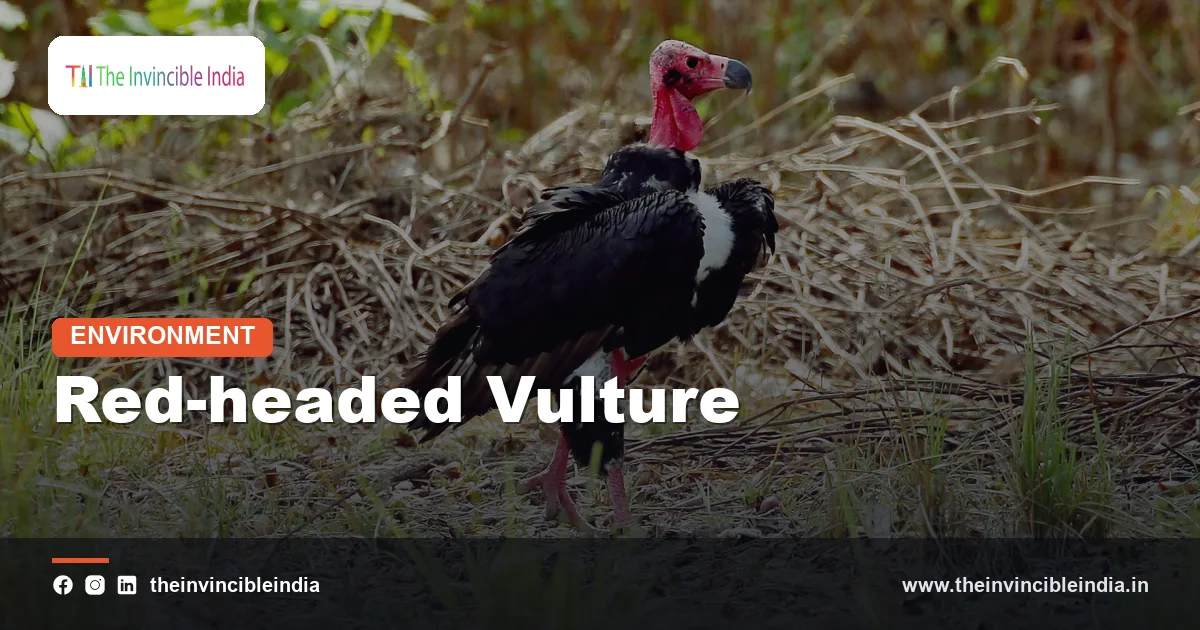
The red-headed vulture (Sarcogyps calvus), also called the Asian king vulture or Pondicherry vulture, is a large black scavenging bird of prey with a bare red-to-orange head and neck, found in open country and woodland across the Indian subcontinent and Southeast Asia and now Critically Endangered. Usually seen alone or in pairs rather than in big flocks, the red-headed vulture lost most of its population in recent decades, largely because of the veterinary drug diclofenac.
This explainer sets out what the red-headed vulture is, how to recognise it, where it lives, what it eats, how it nests, why it declined, and what is being done to protect it.
Quick Facts
| Common names | Red-headed vulture, Asian king vulture, Pondicherry vulture |
|---|---|
| Scientific name | Sarcogyps calvus |
| Family | Accipitridae (hawks, eagles, kites and Old World vultures) |
| Size | About 76 to 86 cm long, with a wingspan of roughly 2 to 2.6 metres and a weight of about 3.5 to 6.3 kg |
| India range and habitat | Thinly spread resident in open plains, dry forest, foothills and river valleys across much of the country, now patchy |
| Diet | Carrion, including large carcasses; it often tears open hide that smaller vultures cannot |
| Breeding | Nests alone in tall trees; lays a single egg, generally in the cooler months |
| Conservation status | Critically Endangered on the IUCN Red List; protected under the Wildlife (Protection) Act, 1972 |
Key Takeaways
- The red-headed vulture (Sarcogyps calvus) is a black-bodied Old World vulture with a bare red head, fleshy neck folds and pale thighs.
- The red-headed vulture is the only living member of its genus, Sarcogyps, and is not closely related to the Gyps vultures such as the Indian vulture and the white-rumped vulture.
- The red-headed vulture usually lives alone or in pairs and nests alone in tall trees, unlike the colony-nesting Gyps vultures.
- The red-headed vulture is classified as Critically Endangered, with surveys showing very large declines since the early 1990s.
- Diclofenac poisoning from treated livestock carcasses is considered the main cause of the red-headed vulture decline, with nest-tree loss and disturbance as additional pressures.
- The red-headed vulture often feeds first at a carcass, tearing through tough hide and thereby giving smaller vultures access to the meat.
What is the red-headed vulture?
The red-headed vulture is a medium-large Old World vulture with a black body and a striking bare red head, which feeds on carrion and lives across South and Southeast Asia, including much of India. It is the sole species in the genus Sarcogyps, and it belongs to the family Accipitridae along with eagles, kites and hawks.
It has several common names. “Asian king vulture” refers to its dominant behaviour at carcasses, as it often displaces other vultures. “Pondicherry vulture” is an older name linked to Pondicherry (now Puducherry) in southern India. Some authors also called it the black vulture, though that name is now used for different birds in other parts of the world.
The red-headed vulture is less social than most other Asian vultures. While Gyps vultures roost and feed in big groups, the red-headed vulture is more often found singly or in pairs, and at carcasses it joins other species but keeps some distance and asserts itself when feeding.
How can you identify the red-headed vulture?
The red-headed vulture can be identified by its bare red or orange-red head, fleshy folds of skin called lappets on the sides of the neck, black plumage and pale thighs. The combination of red head and black body makes it one of the easiest vultures in India to recognise.
- Head and neck: bare skin that ranges from deep red to orange-red, with drooping wattles or lappets at the ear region.
- Body: mostly black or very dark brown, with a ruff of pale feathers around the base of the neck.
- Underparts: white or pale thighs, and pale streaks on the breast and flanks.
- Eyes: adult males typically have pale yellowish eyes, while females have dark brown eyes, which is a rare case of eye colour differing between the sexes in vultures.
- Juveniles: browner, with less colourful heads and fine downy feathering.
In flight, the red-headed vulture shows long, broad wings with a straight rear edge and a relatively short tail. The black body and wings with pale thighs are visible even at a distance. Its red head is often hard to see from far away, so the pale thigh patches are a useful field clue.
Where does the red-headed vulture live in India?
The red-headed vulture lives in open plains, dry deciduous forest, foothills and river valleys across India, where it is a resident that does not migrate. It occurs at low densities and was never as numerous as the Gyps vultures, but it was formerly widespread across most of the country.
Today, the bird is found in a scattered pattern. It is recorded in parts of central India, the Gangetic and Terai plains, the north-east, and some southern and western regions, often inside or close to protected areas. Because it requires tall trees for nesting and open ground or woodland edges for foraging, it does best where forest and farmland meet.
Beyond India, the red-headed vulture occurs in Nepal, Bangladesh, Myanmar and other parts of Southeast Asia, though its range there has also shrunk. Individuals can range widely each day while searching for food.
What does the red-headed vulture eat?
The red-headed vulture eats carrion, including the carcasses of cattle, buffalo, deer and other large animals, and it sometimes takes small prey or scraps near human settlements. It is mainly a scavenger and finds food by soaring and by watching other vultures.
Its role at a carcass is distinctive. The red-headed vulture has a strong bill and neck and can tear through the tough skin and muscle of fresh carcasses. Gyps vultures, with a weaker bill, often find it easier to feed after the larger bird has opened the body. The red-headed vulture also tends to dominate feeding, so it may take its share first and let others approach later.
This division of labour among scavengers is one reason why several vulture species together clear carcasses faster than any one species could. When one species declines, the effect on the group may be greater than its numbers alone suggest.
| Feature | Red-headed vulture | Gyps vultures (e.g. Indian and white-rumped) |
|---|---|---|
| Social behaviour | Alone or in pairs | Flocks and colonies |
| Head colour | Bright red or orange-red | Dull dark or whitish down |
| Nesting | Single pairs in tall trees | Colonies on cliffs or in trees |
| Feeding role | Tears open hide, dominates carcass | Feeds in groups on soft tissue |
| Typical abundance in the past | Thinly spread | Very abundant |
How does the red-headed vulture breed?
The red-headed vulture breeds in solitary pairs, building a large stick nest high in a tall tree and laying a single egg, usually during the cooler months of the year. Unlike many other Indian vultures, it does not form dense nesting colonies.
The nest is a platform of sticks, often placed in the upper branches of a large tree such as a banyan, peepal, silk cotton or other tall tree standing in open country or at a forest edge. Both parents take part in incubation, which lasts about seven weeks, and both feed the chick by regurgitation. The chick fledges after a few months, and juveniles take several years to reach adult plumage and breed.
Like other vultures, the red-headed vulture has a very low breeding rate. A pair raises at most one chick each year, so a population cannot recover quickly from losses. The use of tall, undisturbed trees also means that felling of old trees can remove nest sites that are hard to replace.
Why did the red-headed vulture decline?
The red-headed vulture declined mainly because of poisoning by diclofenac, a veterinary painkiller that causes kidney failure in vultures that eat treated carcasses, with loss of nest trees and food shortages adding to the pressure. Population surveys showed very large falls from the early 1990s, including losses of more than 90 per cent in some assessments.
Diclofenac was widely used on cattle because it was cheap and effective, and farmers had good reasons to use it. The effect on vultures was an unintended side effect that became evident only after dramatic declines in Gyps vultures were investigated. Research then showed that other vultures, including the red-headed vulture, were also vulnerable.
Because the red-headed vulture is a thinly distributed species, it was less visible in early surveys than the abundant white-rumped vulture. However, later monitoring confirmed that it too had suffered steep losses, and it was moved to the Critically Endangered category on the IUCN Red List in the mid-2000s.
Additional threats include felling of large nesting trees, disturbance near nests, declining availability of safe carcasses in some regions, and occasional poisoning or persecution. These factors are generally considered secondary to drug poisoning, but they matter for a species that now exists in small numbers.
Why does the red-headed vulture matter?
The red-headed vulture matters because it helps remove carcasses from the countryside, reducing the spread of disease and keeping the ecosystem clean, and because it opens carcasses that other scavengers cannot easily use. Its loss weakens the whole scavenger community.
Vultures as a group provide a public service that people rarely notice until it stops. Where vultures decline, carcasses persist for longer and feral dogs and other scavengers may increase, which can have knock-on effects on health and on other wildlife. The exact scale of these effects is still being studied and is described cautiously, but the principle that scavengers deliver a free sanitation service is widely accepted.
The red-headed vulture is also an indicator species. Its survival reflects the health of both the open landscape and the veterinary drug environment, and it signals whether conservation measures for vultures are working.
What is being done to protect the red-headed vulture?
The red-headed vulture benefits from the same protective measures as other Indian vultures: the ban on veterinary diclofenac, safer drug alternatives, vulture safe zones, monitoring and captive-breeding work. These measures are described in India’s national vulture action plans.
- Legal protection: the red-headed vulture is protected under the Wildlife (Protection) Act, 1972, and hunting or trade is prohibited.
- Drug controls: India banned veterinary diclofenac in 2006, and regulators have since reviewed other drugs for vulture safety.
- Safer alternatives: meloxicam is promoted as an effective painkiller that is safe for vultures.
- Safe zones and nest protection: areas where carcass food is monitored and nesting trees are left undisturbed.
- Conservation breeding: captive populations are maintained at specialised centres, including those run with the Bombay Natural History Society (BNHS), though the red-headed vulture has been less central to breeding programmes than the Gyps species.
Because the red-headed vulture nests alone and in low numbers, conservation depends strongly on protecting individual nest trees and on keeping the wider landscape free from toxic drugs. Local communities, forest staff and veterinarians all have a role to play.
Can the red-headed vulture recover?
The red-headed vulture can recover only slowly, because it raises one chick a year, lives at low density, and still faces risks from drugs and habitat loss. Recovery depends on keeping carcass food safe and protecting large trees.
Reports from some surveyed areas suggest that declines have slowed since the diclofenac ban, but the species is still considered to be at very high risk of extinction in the wild. Careful monitoring of both the vulture and the drugs used on livestock will be needed for many years.
Bottom Line
The red-headed vulture is easy to recognise but increasingly hard to find. Its survival depends on the same simple conditions as for India’s other vultures: safe carcasses, standing nest trees, and continued attention from scientists, officials and local communities.
Frequently Asked Questions
What is the red-headed vulture?
The red-headed vulture is a large black vulture with a bare red head, scientifically named Sarcogyps calvus and also called the Asian king vulture. It scavenges across South and Southeast Asia and is Critically Endangered.
Why is it called the king vulture?
The red-headed vulture is called the king vulture because it often dominates carcasses and feeds first, with other vultures waiting or keeping their distance. It is not related to the American king vulture, which is a different species.
Is the red-headed vulture endangered in India?
Yes, the red-headed vulture is classified as Critically Endangered on the IUCN Red List and is legally protected in India. Its numbers have fallen steeply since the early 1990s, and it survives in scattered, small populations.
What does the red-headed vulture eat?
The red-headed vulture eats carrion, mainly the carcasses of cattle and other large animals. Its strong bill lets it tear through tough hide, which often helps smaller vultures reach the meat.
How is the red-headed vulture different from the Indian and white-rumped vultures?
The red-headed vulture has a bare red head, a black body and pale thighs and usually lives alone or in pairs, while the Indian and white-rumped vultures are pale-bodied Gyps vultures that live in flocks. The red-headed vulture also nests alone in trees, not in colonies.
What caused the red-headed vulture to decline?
The main cause of decline was poisoning by diclofenac, a veterinary painkiller found in treated cattle carcasses. Loss of large nesting trees and disturbance near nests have added to the pressure.
{“@context”:”https://schema.org”,”@graph”:[{“@type”:”FAQPage”,”mainEntity”:[{“@type”:”Question”,”name”:”What is the red-headed vulture?”,”acceptedAnswer”:{“@type”:”Answer”,”text”:”The red-headed vulture is a large black vulture with a bare red head, scientifically named Sarcogyps calvus and also called the Asian king vulture. It scavenges across South and Southeast Asia and is Critically Endangered.”}},{“@type”:”Question”,”name”:”Why is it called the king vulture?”,”acceptedAnswer”:{“@type”:”Answer”,”text”:”The red-headed vulture is called the king vulture because it often dominates carcasses and feeds first, with other vultures waiting or keeping their distance. It is not related to the American king vulture, which is a different species.”}},{“@type”:”Question”,”name”:”Is the red-headed vulture endangered in India?”,”acceptedAnswer”:{“@type”:”Answer”,”text”:”Yes, the red-headed vulture is classified as Critically Endangered on the IUCN Red List and is legally protected in India. Its numbers have fallen steeply since the early 1990s, and it survives in scattered, small populations.”}},{“@type”:”Question”,”name”:”What does the red-headed vulture eat?”,”acceptedAnswer”:{“@type”:”Answer”,”text”:”The red-headed vulture eats carrion, mainly the carcasses of cattle and other large animals. Its strong bill lets it tear through tough hide, which often helps smaller vultures reach the meat.”}},{“@type”:”Question”,”name”:”How is the red-headed vulture different from the Indian and white-rumped vultures?”,”acceptedAnswer”:{“@type”:”Answer”,”text”:”The red-headed vulture has a bare red head, a black body and pale thighs and usually lives alone or in pairs, while the Indian and white-rumped vultures are pale-bodied Gyps vultures that live in flocks. The red-headed vulture also nests alone in trees, not in colonies.”}},{“@type”:”Question”,”name”:”What caused the red-headed vulture to decline?”,”acceptedAnswer”:{“@type”:”Answer”,”text”:”The main cause of decline was poisoning by diclofenac, a veterinary painkiller found in treated cattle carcasses. Loss of large nesting trees and disturbance near nests have added to the pressure.”}}]}]}


