

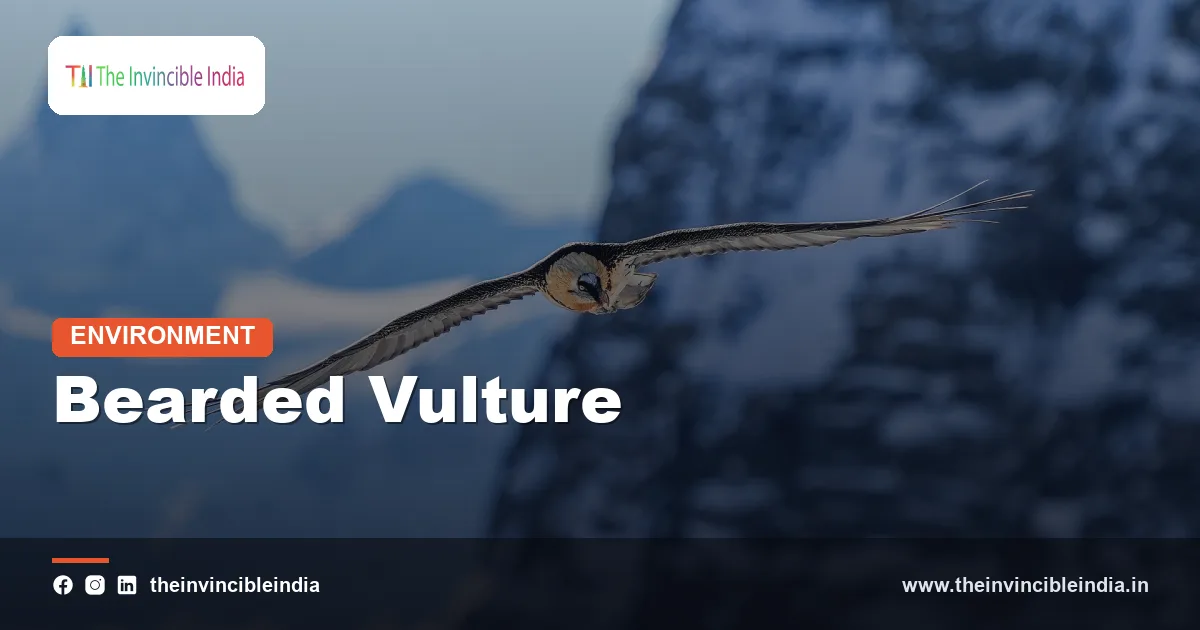
The bearded vulture, also known as the lammergeier, is a large, long-winged raptor (Gypaetus barbatus) of high mountain cliffs that feeds mainly on the bones of dead animals, which it can swallow whole or drop from the air to shatter on rocks. In India it lives in the Himalaya, where its orange-washed underparts, narrow wings and diamond-shaped tail make it one of the most distinctive birds of the high ranges.
Unlike most vultures, the bearded vulture has a fully feathered head and takes carrion that other scavengers leave behind. This guide explains how to identify the bird, where it lives in India, why it eats bones, how it nests in the dead of winter and what threatens its small mountain population.
| Common names | Bearded vulture, lammergeier, lammergeyer |
|---|---|
| Scientific name | Gypaetus barbatus (the Himalayan population is the subspecies grandis) |
| Family | Accipitridae (hawks, eagles, kites and Old World vultures) |
| Size | About 95 to 125 cm long; wingspan roughly 2.3 to 2.8 metres |
| Range in India | High Himalaya from Ladakh and Himachal Pradesh through Uttarakhand to Sikkim and Arunachal Pradesh |
| Habitat | Rugged mountains, cliffs, gorges and alpine pastures, mostly above 2,000 metres |
| Diet | Mostly bones and bone marrow from carcasses, plus some meat and small scraps |
| Breeding | Nests on sheltered cliff ledges or in caves; eggs laid in winter; usually one chick survives |
| Conservation status | Near Threatened (IUCN); protected under the Wildlife (Protection) Act, 1972 |
Key Takeaways
- The bearded vulture (lammergeier) is the only living member of its genus, Gypaetus, and is not a close relative of the typical griffon vultures.
- The bearded vulture feeds mainly on bone, with a diet that is often described as about nine-tenths bones and marrow.
- The bearded vulture carries large bones into the air and drops them onto rocks to break them, a behaviour that has earned its feeding sites the name “ossuaries”.
- The bearded vulture gets its rusty orange colour from rubbing iron-rich soil and mud on its feathers, not from natural pigment alone.
- The bearded vulture nests in winter, lays two eggs but usually raises only one chick, and breeds slowly.
- The bearded vulture is Near Threatened worldwide and legally protected in India, where its mountain population is small and thinly spread.
What is the bearded vulture?
The bearded vulture is a large bird of prey in the family Accipitridae that specialises in eating bones and is found in mountain ranges of Europe, Africa and Asia. Its other English name, lammergeier, comes from German words meaning “lamb vulture”, a name given because of an old and mistaken belief that the bird carried off lambs.
The species sits on its own branch of the vulture family tree. Its closest relatives are thought to be the Egyptian vulture and the palm-nut vulture rather than the big griffons, and it is the only bird in the genus Gypaetus. It differs from most vultures in three ways: its head is feathered, its wings are long and narrow rather than broad, and its tail is long and wedge-shaped.
The name “bearded” refers to a tuft of stiff black bristles beneath the bill that looks like a goatee. Scientists have several ideas about its purpose, but it adds to the bird’s unusual appearance and makes identification easy at close range.
How can you identify a bearded vulture?
A bearded vulture can be recognised by its long, narrow, pointed wings, its long diamond-shaped tail and its pale orange or creamy head and underparts, which contrast with dark grey-black upperwings. In the air it looks more like a huge falcon or a long-tailed eagle than a typical vulture.
Key identification features include:
- Wedge-shaped tail: The long tail narrows to a point and is a strong clue, particularly when the bird is seen soaring.
- Black mask and beard: A black band runs through the eye and a tuft of bristles hangs beneath the bill.
- Red eye ring: The pale eye is surrounded by a scarlet ring of tissue (the sclera) that can be seen at close range.
- Orange-rust body: The underparts range from creamy to deep orange-rust, depending on the bird and how much it has dust-bathed.
- Dark juveniles: Young birds are dark brown to blackish with a dark head and take about five years to reach full adult plumage.
The bird flies with slow, deliberate wingbeats and spends long periods gliding along ridges. It often travels alone or as a pair rather than in the large flocks typical of griffons.
Where does the bearded vulture live in India?
The bearded vulture lives in the Himalaya of northern India, including Ladakh, Jammu and Kashmir, Himachal Pradesh, Uttarakhand, Sikkim and Arunachal Pradesh. It is generally a resident that stays on or near its home range, though birds may move up and down the slopes with the seasons.
Its habitat is dramatic, open and steep, and it is usually seen in:
- Alpine and sub-alpine pastures where herders graze yaks, sheep and goats.
- Deep gorges and rocky ridges with cliffs that offer both nesting sites and strong updrafts.
- Cold, dry trans-Himalayan valleys such as those of Ladakh and Spiti.
- Mountain passes and high plateaus where carcasses are visible from the air.
Outside India the species occurs in the Alps, the Pyrenees, parts of the Mediterranean, the Caucasus, East Africa and Ethiopia, and across the Tibetan plateau and Central Asia. Each region holds a separate, often small population, which makes the Himalayan birds an important part of the species’ overall range.
Why does the bearded vulture eat bones?
The bearded vulture eats bones because they are a rich and reliable food source that other scavengers cannot use. Bone marrow is packed with fat and calories, and by specialising in it the bearded vulture avoids competing with griffons and eagles that take the soft flesh first.
The way the bird handles bones is remarkable:
- Swallowing whole: The bearded vulture can swallow bones up to the size of a sheep’s leg bone. Its throat is extremely elastic.
- Powerful digestion: Its stomach acid is extremely strong, and it can dissolve bone in a matter of hours.
- Dropping bones: For bones that are too large to swallow, the bird carries them high into the air, then drops them onto a rock slope. It may repeat the process several times until the bone splinters and exposes the marrow.
- Using the same site: Individuals often return to the same drop zones, which become littered with fragments and are called ossuaries.
Bones are by far the main part of the diet, but the bird will also take small scraps of meat, skin and tendon, and it occasionally takes small live animals such as tortoises or rodents. Its role in a mountain ecosystem is to finish the clean-up that other scavengers begin, leaving very little behind.
Why is the bearded vulture orange?
The bearded vulture is orange mainly because it stains its feathers by rubbing them with iron-rich soil, clay or water from mountain springs. The colour is therefore cosmetic and acquired, and it varies from bird to bird and from one season to another.
Researchers have suggested several explanations for this unusual habit. One is that a deeper rusty colour may signal an individual’s health, age or status to other bearded vultures, since a bird that is dominant or experienced can afford to spend time and effort on grooming. Another is that the stain may protect the feathers or reduce skin parasites. No single explanation has been fully proven, and the answer may be a combination.
The result is that some Himalayan bearded vultures look almost golden, while others appear mostly creamy white, depending on the iron-rich soils they have visited.
How does the bearded vulture breed?
The bearded vulture breeds in winter, building a large nest of sticks lined with wool, hair and soft material in a cave or on a sheltered cliff ledge. A pair usually lays one or two eggs, and incubation takes around eight weeks.
Several features of its breeding biology are unusual:
- Winter nesting: Laying in the cold season means the chick hatches when carcasses are most available, because animals die more often in harsh weather.
- Big nests: Pairs reuse nests year after year and add material, so old sites can become very large and thick.
- Usually one survivor: If two eggs hatch, the older chick often dominates and the younger one rarely survives.
- Long dependence: The chick stays in the nest for around four months and may rely on its parents for further weeks after leaving.
- Territorial pairs: Pairs defend large home ranges and may remain together for many years.
Because the bearded vulture raises at most one chick per year and does not breed until it is several years old, it recovers slowly from losses. This slow pace is one of the main reasons that even small increases in adult deaths can hurt the population.
What is the bearded vulture’s role in the Himalayan ecosystem?
The bearded vulture plays the role of final scavenger in the Himalayan ecosystem, recycling bone and marrow that no other animal can use. By dispersing and shattering bones it speeds the return of calcium and other nutrients to the soil and keeps carcass sites clean.
Together with other mountain scavengers, it forms a dependable clean-up crew. Griffons strip the flesh, eagles and ravens pick at the remainder, and the bearded vulture takes the bone. A healthy community of scavengers removes dead animals rapidly and reduces the risk of disease at grazing grounds.
The bird also holds a place in the culture of mountain peoples. In Tibetan and Himalayan communities it is associated with the high places and the open sky. In many parts of Europe, hunters once wrongly blamed it for killing livestock and even children, which led to near-extinction in the Alps before it was reintroduced there in recent decades.
What threats does the bearded vulture face?
The bearded vulture faces threats from poisoning, persecution, collisions with man-made structures and disturbance of its nesting areas. Its low breeding rate and small population in the Indian Himalaya make it sensitive even to modest losses.
The main concerns include:
- Poisoned baits: Carcasses laid out to control predators can kill scavengers that feed on them.
- Veterinary drugs: Drugs such as diclofenac that devastated lowland vultures are a risk if present in livestock carcasses, although the bearded vulture is thought to be less affected than the griffons because it eats mostly bone.
- Power lines and wind turbines: Collisions and electrocution can kill large soaring birds in the mountains.
- Disturbance: Road building, tourism and construction near cliffs can cause pairs to abandon nests.
- Persecution: In some regions the species is still shot or trapped because of old myths.
- Climate and land-use change: Shifts in grazing patterns and in livestock numbers can alter the supply of carcasses.
The bearded vulture is protected in India under the Wildlife (Protection) Act, 1972. Conservation measures include monitoring nests, working with herding communities and creating vulture-safe areas.
How does the bearded vulture compare with other Himalayan scavengers?
The bearded vulture differs from other Himalayan scavengers mainly in its diet, its wing shape and its feathered head. The table below sets out the main differences between it and the larger griffon that shares its mountains.
| Feature | Bearded vulture | Himalayan griffon |
|---|---|---|
| Main food | Bones and marrow | Flesh and soft tissue of carcasses |
| Head and neck | Feathered, with a black beard and mask | Bare, with white down and a white ruff |
| Wings | Long, narrow and pointed | Very broad with long fingered tips |
| Tail | Long and diamond-shaped | Short and slightly wedge-shaped |
| Social behaviour | Mostly alone or in pairs | Gathers in groups at carcasses |
| Colour | Dark above, orange and cream below | Pale sandy body, dark flight feathers |
The two birds are complementary rather than competing. The griffon opens and eats the carcass, and the bearded vulture arrives to collect the bones, so together they leave little waste.
How can you spot a bearded vulture in the Himalaya?
The best way to spot a bearded vulture is to scan high ridges and cliff faces on sunny mornings and afternoons in Himalayan valleys, watching for a long-tailed, narrow-winged raptor gliding close to the rock. It often skims slopes at low height, checking for carcasses.
A few practical suggestions can improve your chances:
- Visit areas with livestock herding, such as the valleys of Ladakh, Spiti and Uttarakhand, where bones are more available.
- Look for the diamond-shaped tail first; it is a more reliable clue than the colour, which can look dark against the sun.
- Watch for birds carrying bones in the talons or beak and dropping them on rocky slopes.
- Keep well away from nest sites in winter and early spring, when disturbance can make a pair abandon its eggs.
- Use binoculars and a patient approach, as the bird usually covers long distances while looking for food.
Bottom Line
The bearded vulture is a specialised bone-eater, a rust-coloured glider of the high Himalaya and an important part of the mountain clean-up crew. Protecting it means keeping carcasses safe from poison and drugs, leaving nest cliffs undisturbed and preserving the traditional herding landscapes that feed it.
Frequently Asked Questions
What is a bearded vulture?
A bearded vulture, also called a lammergeier, is a large mountain raptor that feeds mainly on bones. It is found in the Himalaya of northern India and is recognised by its long wedge-shaped tail, narrow wings, black facial mask and tuft of bristles under the bill.
Why is it called the lammergeier?
The name lammergeier comes from German words meaning lamb vulture. It was given because of an old and mistaken belief that the bird carried off lambs, whereas the bearded vulture actually feeds almost entirely on bones from dead animals.
How does the bearded vulture eat bones?
The bearded vulture swallows small bones whole and drops large ones from a height onto rocks to break them open. Its highly acidic stomach then digests the bone and marrow within hours.
Where is the bearded vulture found in India?
The bearded vulture is found in the high Himalaya of India, including Ladakh, Himachal Pradesh, Uttarakhand, Sikkim and Arunachal Pradesh. It lives mostly on cliffs and in gorges and valleys, usually above about 2,000 metres.
Is the bearded vulture endangered?
The bearded vulture is listed as Near Threatened by the IUCN, so it is not yet endangered but is at risk. It is protected in India under the Wildlife (Protection) Act, 1972, and is threatened by poisoning, collisions, disturbance and its slow breeding rate.
Why are bearded vultures orange?
Bearded vultures look orange because they rub iron-rich soil and mud onto their feathers, staining the pale underparts a rusty colour. Scientists think the colour may act as a signal of health or status, though the exact reason is not fully settled.
{“@context”:”https://schema.org”,”@graph”:[{“@type”:”FAQPage”,”mainEntity”:[{“@type”:”Question”,”name”:”What is a bearded vulture?”,”acceptedAnswer”:{“@type”:”Answer”,”text”:”A bearded vulture, also called a lammergeier, is a large mountain raptor that feeds mainly on bones. It is found in the Himalaya of northern India and is recognised by its long wedge-shaped tail, narrow wings, black facial mask and tuft of bristles under the bill.”}},{“@type”:”Question”,”name”:”Why is it called the lammergeier?”,”acceptedAnswer”:{“@type”:”Answer”,”text”:”The name lammergeier comes from German words meaning lamb vulture. It was given because of an old and mistaken belief that the bird carried off lambs, whereas the bearded vulture actually feeds almost entirely on bones from dead animals.”}},{“@type”:”Question”,”name”:”How does the bearded vulture eat bones?”,”acceptedAnswer”:{“@type”:”Answer”,”text”:”The bearded vulture swallows small bones whole and drops large ones from a height onto rocks to break them open. Its highly acidic stomach then digests the bone and marrow within hours.”}},{“@type”:”Question”,”name”:”Where is the bearded vulture found in India?”,”acceptedAnswer”:{“@type”:”Answer”,”text”:”The bearded vulture is found in the high Himalaya of India, including Ladakh, Himachal Pradesh, Uttarakhand, Sikkim and Arunachal Pradesh. It lives mostly on cliffs and in gorges and valleys, usually above about 2,000 metres.”}},{“@type”:”Question”,”name”:”Is the bearded vulture endangered?”,”acceptedAnswer”:{“@type”:”Answer”,”text”:”The bearded vulture is listed as Near Threatened by the IUCN, so it is not yet endangered but is at risk. It is protected in India under the Wildlife (Protection) Act, 1972, and is threatened by poisoning, collisions, disturbance and its slow breeding rate.”}},{“@type”:”Question”,”name”:”Why are bearded vultures orange?”,”acceptedAnswer”:{“@type”:”Answer”,”text”:”Bearded vultures look orange because they rub iron-rich soil and mud onto their feathers, staining the pale underparts a rusty colour. Scientists think the colour may act as a signal of health or status, though the exact reason is not fully settled.”}}]}]}


