

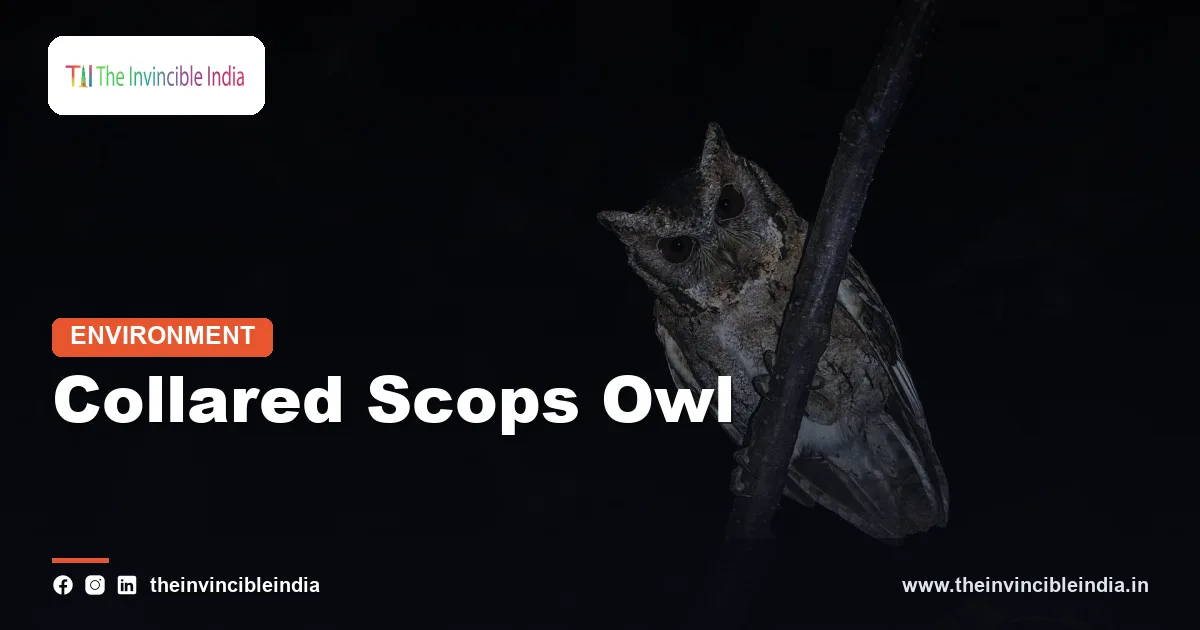
The collared scops owl (Otus lettia) is a small, nocturnal, ear-tufted owl with a pale buff collar across the back of its neck, found in gardens, light woodland and forest edges across much of Asia, including the Indian subcontinent. Roughly the size of a pigeon, the collared scops owl is grey-brown or rufous in colour, hides by day in tree holes or against trunks, and is usually noticed by its soft, repeated “wuk” call after dark.
The bird is common near people but seldom seen, because its bark-like plumage and still posture make it almost invisible during the day. This explainer describes how to recognise the collared scops owl, where it lives in India, what it eats, how it breeds and why taxonomists sometimes separate it from the Indian scops owl.
| Attribute | Details |
|---|---|
| Common name | Collared scops owl (formerly part of the Indian scops owl complex) |
| Scientific name | Otus lettia |
| Family and order | Strigidae (typical owls), order Strigiformes |
| Size | Roughly 23 to 25 cm long, with prominent ear tufts |
| Range and habitat in India | Gardens, groves, light deciduous and evergreen woodland, plantations and forest edges, mainly in the Himalayan foothills, the north-east and other wooded parts of the country |
| Diet | Insects such as beetles, moths and grasshoppers, plus small lizards, rodents and birds |
| Breeding | Nests in tree hollows, mostly in the dry season; typically 3 to 5 white eggs |
| Conservation status | Least Concern on the IUCN Red List; owls are legally protected in India |
Key Takeaways
- The collared scops owl is a small owl, about 23 to 25 cm long, with ear tufts, dark brown eyes and a buff collar on the hind neck.
- Collared scops owls are strictly nocturnal and spend the day roosting motionless in tree holes or pressed against branches.
- The collared scops owl’s usual call is a soft, single “wuk” or “whut” note repeated at intervals through the night.
- Collared scops owls feed mainly on insects, catching them in flight or from a perch, and also take small lizards, rodents and birds.
- The collared scops owl nests in natural tree cavities and old woodpecker holes and lays about three to five white eggs.
- The collared scops owl is classed as Least Concern by the IUCN, and all owls are protected under India’s Wildlife (Protection) Act, 1972.
What is the collared scops owl?
The collared scops owl is a small member of the owl family Strigidae and the genus Otus, a large group of scops owls found across Europe, Africa, Asia and Australasia. The English name comes from the pale buff or whitish half-collar visible on the back and sides of the neck, and the word “scops” is derived from a Greek term for a small owl.
Scops owls are among the smallest of the eared owls. The collared scops owl is resident across much of its range, meaning that most birds stay in the same area throughout the year. It is one of the commonest small owls of Asian gardens and parks, which is why it features frequently in urban bird surveys.
Why the name sometimes changes
For many years, the collared scops owl was treated as a subspecies of a single widespread bird called the Indian scops owl or collared scops owl. More recent taxonomic studies, based on voice and genetics, split the group into several species. Under this treatment, Otus lettia is the collared scops owl of the Himalayan region, the north-east and mainland Asia, while peninsular Indian birds are often placed in the Indian scops owl (Otus bakkamoena). Field guides and checklists differ in how they apply these names, so it is worth checking which list a book or app follows.
How can you identify a collared scops owl?
A collared scops owl can be identified by its small size, short ear tufts, dark brown eyes and a pale buff collar on the back of the neck, set against grey-brown plumage streaked and mottled like bark. When alarmed, the bird compresses its feathers, raises its ear tufts and stands upright to look like a broken branch stub.
The following features are useful for identification:
- Ear tufts: Short feather tufts rise from the sides of the head and are most visible when the bird is alert.
- Eyes: The iris is dark brown, which separates the species from small owls with yellow eyes, such as the owlets and the spotted owlet.
- Collar: A buff to whitish band runs around the hind neck, giving the bird its name.
- Colour morphs: Birds occur in a grey-brown form and a more rufous form, with the paler form being the more usual.
- Underparts: The breast and belly are buff or whitish, marked with dark streaks and fine cross-bars.
Males and females look alike. Young birds are fluffier and paler, with less clearly marked streaking, and often stay near their parents for several weeks after leaving the nest.
Where does the collared scops owl live in India?
The collared scops owl lives in gardens, orchards, groves and light woodland in many parts of India, and it is especially common in the Himalayan foothills and the north-east. It prefers places with large trees that offer both roosting cavities and open spaces for hunting insects.
The bird occupies a range of habitats:
- Large gardens, campuses and tree-lined avenues in towns
- Mango groves, teak plantations and other cultivated woodland
- Deciduous and semi-evergreen forests and forest edges
- Hill forests in the foothills of the Himalaya, at low to middle elevations
Across the wider Indian subcontinent, the nearby Indian scops owl and the closely related oriental scops owl overlap partly in range, so identification by voice is often more reliable than by appearance. The collared scops owl avoids dense, closed rainforest and treeless plains, but adapts well to parks and suburbs with mature trees.
What does the collared scops owl eat?
The collared scops owl eats mainly insects, including beetles, moths, grasshoppers and crickets, and it also takes small lizards, rodents, frogs and small birds. The bird hunts at night from a low perch and uses sharp hearing and vision to locate prey in the dark.
The hunting method is simple and effective. The owl sits quietly on a branch overlooking a clearing, tracks movement, then glides down or flutters out to seize its target in its feet. Moths drawn to street lights and garden lamps are a convenient food source, so the bird is often seen near lit areas in towns and villages.
- Insects: Beetles, moths, crickets, grasshoppers and termites make up the bulk of the diet.
- Small vertebrates: Lizards, mice and occasionally small roosting birds are also taken.
- Prey handling: Small items are swallowed whole, and indigestible parts are later regurgitated as pellets.
By eating large numbers of insects and some rodents, the collared scops owl provides a natural pest-control service in farms, orchards and gardens.
What does a collared scops owl sound like?
A collared scops owl gives a soft, short “wuk” or “whut” note, repeated every few seconds and sometimes answered by a second bird with a slightly different tone. The call is hollow and quiet rather than a hoot, and it can be heard throughout the night, especially in the breeding season.
The voice is the most reliable way to separate scops owls from each other. Different species and populations have distinct calls, which is one reason modern taxonomy relies heavily on sound recordings. A pair may call back and forth, and the female’s call is often higher than the male’s.
Listeners can find the bird by walking slowly toward the sound with a torch kept low and dim. Because the owl freezes when disturbed, it is easy to scare it away, and patient listening usually gives better results than approaching quickly.
How does the collared scops owl hide during the day?
The collared scops owl hides during the day by roosting in a tree hole or pressing itself against a trunk, where its mottled grey-brown plumage matches bark and lichen. This camouflage, called cryptic colouration, helps the owl avoid predators and the mobbing attention of small birds.
The bird uses several tricks while resting:
- It stands upright and narrows its body so that it resembles a stub of a broken branch.
- It half-closes its eyes, leaving only thin slits, so that the dark eyes do not give it away.
- It raises its ear tufts to break up the outline of the head.
- It chooses roosts next to trunks, in dense foliage or in hollows, often returning to the same spot for many days.
Roosting birds sometimes give themselves away when crows, babblers or mynas gather and scold them. Observers who notice such mobbing may be able to find the owl by looking carefully into the tree that is attracting the birds.
How does the collared scops owl breed?
The collared scops owl breeds in tree cavities, usually in the drier months of the year, and lays about three to five white eggs. The nest is typically a natural hollow or an old woodpecker or barbet hole, with little or no lining apart from wood dust and debris.
The female incubates the eggs while the male brings food and guards the territory. After hatching, the chicks are covered in white down and remain in the hole for several weeks while both parents feed them with insects and other small prey. Young owls leave the cavity before they can fly well and may climb out onto nearby branches, which sometimes leads well-meaning people to pick them up.
Anyone who finds a fluffy young owl on the ground in the breeding season should generally leave it alone, because the parents are usually nearby and still feeding it. A bird that is clearly injured can be reported to the local forest department or a wildlife rescue group.
How is the collared scops owl different from other small Indian owls?
The collared scops owl differs from other small Indian owls mainly in its ear tufts, dark eyes and its soft one-note call. The table below compares it with three commonly seen species.
| Feature | Collared scops owl | Oriental scops owl | Spotted owlet | Jungle owlet |
|---|---|---|---|---|
| Scientific name | Otus lettia | Otus sunia | Athene brama | Glaucidium radiatum |
| Ear tufts | Present | Present | Absent | Absent |
| Eye colour | Dark brown | Yellow | Yellow | Yellow |
| Collar | Pale buff collar | No clear collar | No collar | No collar |
| Call | Soft single “wuk” | Sharp, repeated “tuk-tuk-tuk-tuk” phrases | Harsh, chattering | Rising, ringing series |
| Typical habitat | Gardens, groves, light woods | Forests and wooded country | Villages and towns | Deciduous forest |
Eye colour and ear tufts together separate most of these species quickly, and voice settles any doubt between the two scops owls.
Is the collared scops owl threatened?
The collared scops owl is not globally threatened and is classified as Least Concern on the IUCN Red List because of its wide range and adaptability. Local numbers can still fall where large trees are felled, forest is cleared or insecticides reduce food.
Several pressures affect scops owls and other Indian owls:
- Loss of mature trees: Cavity nesters need old trees with holes, which are often removed in towns and plantations.
- Light and pollution: Bright artificial lighting and pesticides may alter insect populations and the owl’s hunting success.
- Persecution: In some regions, owls are captured or killed because of superstitions, despite legal protection.
- Traffic: Birds crossing roads at night may be struck by vehicles.
Owls are protected under the Wildlife (Protection) Act, 1972, and are covered by CITES, which regulates international trade. Retaining old trees, avoiding the trimming of hollow branches in the nesting season and limiting night-time lighting are simple actions that help.
How can you find and watch scops owls responsibly?
You can find scops owls responsibly by listening for their calls at dusk, scanning tree trunks and holes in daylight, and keeping a respectful distance. Responsible watching avoids stress to the bird and protects nests.
- Learn the call: Recordings of the “wuk” note help in recognising the bird at night.
- Check regular roosts: Owls often use the same tree hole or branch for many days, so repeat visits can be fruitful.
- Avoid flash: Strong light and camera flash can disturb a roosting or hunting owl.
- Do not use playback repeatedly: Recorded calls can cause territorial stress, especially during nesting.
- Do not reveal nest sites: Posting exact locations online may attract crowds and put the nest at risk.
Bottom Line
The collared scops owl is a small, ear-tufted, bark-coloured owl of Asian gardens and woodland whose soft “wuk” call and brown eyes set it apart from the yellow-eyed owlets. It is common, adaptable and protected, and it benefits from the simple step of keeping old trees with hollows.
Frequently Asked Questions
What is a collared scops owl?
A collared scops owl is a small, nocturnal, ear-tufted owl, Otus lettia, with a pale buff collar on the back of its neck. It is about 23 to 25 cm long and lives in gardens, groves and light woodland across much of Asia. It belongs to the owl family Strigidae.
What does a collared scops owl sound like?
A collared scops owl makes a soft, short “wuk” or “whut” note, repeated every few seconds through the night. The sound is hollow and quiet rather than a true hoot. Pairs often call back and forth, particularly in the breeding season.
Is the collared scops owl the same as the Indian scops owl?
Not always, because the two names refer to closely related birds that were once treated as one species. Under newer classifications, Otus lettia is the collared scops owl, while many peninsular Indian birds are placed in the Indian scops owl, Otus bakkamoena. Checklists differ, so the name depends on which taxonomy a guide follows.
What does the collared scops owl eat?
The collared scops owl eats mainly insects such as beetles, moths, grasshoppers and crickets. It also catches small lizards, rodents and occasionally small birds. It hunts at night from a low perch and swallows small prey whole.
How do you spot a collared scops owl in the daytime?
A collared scops owl in the daytime is usually found by checking tree holes and the sides of trunks where it roosts upright and motionless. Its bark-like plumage makes it very hard to see, so agitated small birds mobbing a tree are a helpful clue. Look for ear tufts and a thin slit of dark eye.
Is the collared scops owl protected in India?
Yes, owls including the collared scops owl are protected under India’s Wildlife (Protection) Act, 1972, which prohibits capturing, killing and trading them. The species is also rated Least Concern by the IUCN. Loss of old hollow trees and superstition-related persecution are the main local threats.
{“@context”:”https://schema.org”,”@graph”:[{“@type”:”FAQPage”,”mainEntity”:[{“@type”:”Question”,”name”:”What is a collared scops owl?”,”acceptedAnswer”:{“@type”:”Answer”,”text”:”A collared scops owl is a small, nocturnal, ear-tufted owl, Otus lettia, with a pale buff collar on the back of its neck. It is about 23 to 25 cm long and lives in gardens, groves and light woodland across much of Asia. It belongs to the owl family Strigidae.”}},{“@type”:”Question”,”name”:”What does a collared scops owl sound like?”,”acceptedAnswer”:{“@type”:”Answer”,”text”:”A collared scops owl makes a soft, short “wuk” or “whut” note, repeated every few seconds through the night. The sound is hollow and quiet rather than a true hoot. Pairs often call back and forth, particularly in the breeding season.”}},{“@type”:”Question”,”name”:”Is the collared scops owl the same as the Indian scops owl?”,”acceptedAnswer”:{“@type”:”Answer”,”text”:”Not always, because the two names refer to closely related birds that were once treated as one species. Under newer classifications, Otus lettia is the collared scops owl, while many peninsular Indian birds are placed in the Indian scops owl, Otus bakkamoena. Checklists differ, so the name depends on which taxonomy a guide follows.”}},{“@type”:”Question”,”name”:”What does the collared scops owl eat?”,”acceptedAnswer”:{“@type”:”Answer”,”text”:”The collared scops owl eats mainly insects such as beetles, moths, grasshoppers and crickets. It also catches small lizards, rodents and occasionally small birds. It hunts at night from a low perch and swallows small prey whole.”}},{“@type”:”Question”,”name”:”How do you spot a collared scops owl in the daytime?”,”acceptedAnswer”:{“@type”:”Answer”,”text”:”A collared scops owl in the daytime is usually found by checking tree holes and the sides of trunks where it roosts upright and motionless. Its bark-like plumage makes it very hard to see, so agitated small birds mobbing a tree are a helpful clue. Look for ear tufts and a thin slit of dark eye.”}},{“@type”:”Question”,”name”:”Is the collared scops owl protected in India?”,”acceptedAnswer”:{“@type”:”Answer”,”text”:”Yes, owls including the collared scops owl are protected under India’s Wildlife (Protection) Act, 1972, which prohibits capturing, killing and trading them. The species is also rated Least Concern by the IUCN. Loss of old hollow trees and superstition-related persecution are the main local threats.”}}]}]}


