

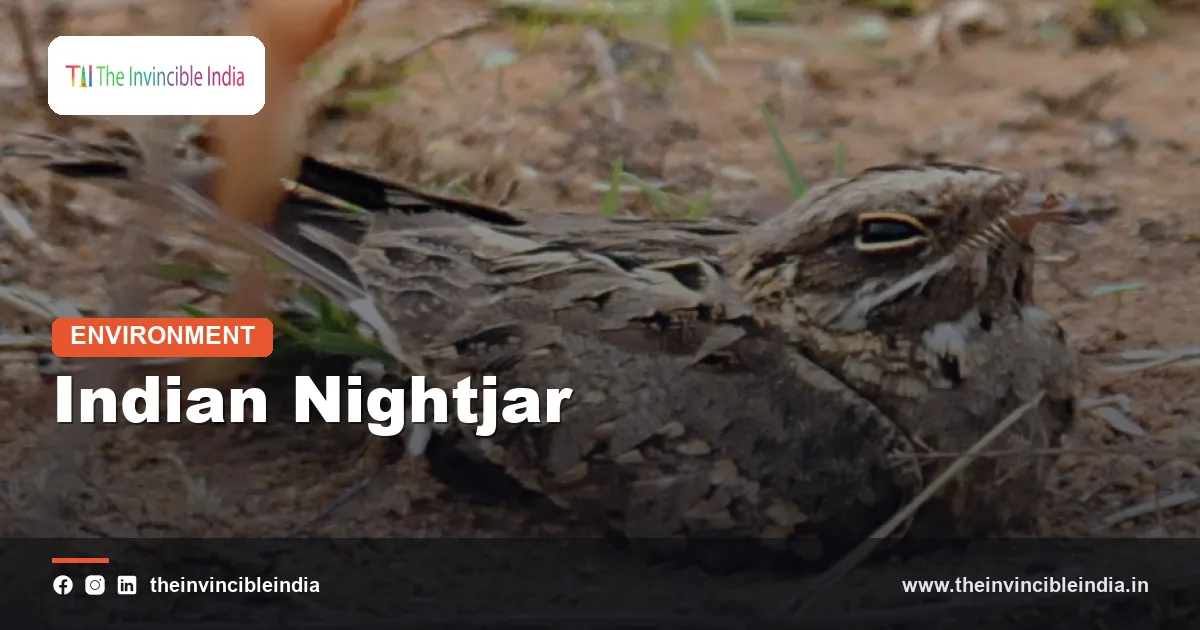
The Indian nightjar (Caprimulgus asiaticus) is a small, cryptic, ground-roosting bird of dry scrub, open woodland and rocky country in the Indian subcontinent that hunts flying insects at dusk and dawn and is known for a repetitive “chuk-chuk-chuk-chukroo” call. With mottled brown, grey and buff plumage that matches dry leaves and soil, the Indian nightjar is almost invisible by day and is most often noticed when it flushes from the roadside or when its eyes glow orange in vehicle headlights.
Few Indian birds are as familiar by sound and as rarely seen by sight. This explainer covers how to recognise the Indian nightjar, where it lives, how it feeds with its wide mouth, how it nests on bare ground and how it differs from other nightjars found in India.
| Attribute | Details |
|---|---|
| Common name | Indian nightjar (also called common Indian nightjar) |
| Scientific name | Caprimulgus asiaticus |
| Family and order | Caprimulgidae (nightjars), order Caprimulgiformes |
| Size | Roughly 22 to 24 cm long, with long wings and a long tail |
| Range and habitat in India | Dry scrub, open woodland, rocky hillsides, farmland edges and dusty roadsides across much of the Indian plains and peninsula |
| Diet | Flying insects such as moths, beetles, flying termites and grasshoppers |
| Breeding | Lays two eggs on bare ground without a built nest, mostly in the dry season from late winter to early summer |
| Conservation status | Least Concern on the IUCN Red List |
Key Takeaways
- The Indian nightjar is a small nocturnal bird, about 22 to 24 cm long, with mottled brown and buff plumage that matches dry ground.
- Indian nightjars roost on the ground during the day and rely on camouflage rather than flight to avoid predators.
- The Indian nightjar’s best-known call is a rapid “chuk-chuk-chuk-chukroo” that sounds like a stone skipping on a hard surface.
- Indian nightjars catch moths, beetles and other flying insects at dusk and dawn using a very wide mouth and fine bristles around the bill.
- The Indian nightjar lays two eggs directly on bare ground, with no nest, and the parents rely on the eggs’ camouflage.
- The Indian nightjar is classed as Least Concern by the IUCN, although many nightjars are killed by vehicles on rural roads.
What is the Indian nightjar?
The Indian nightjar is a medium-small, insect-eating, nocturnal bird in the nightjar family Caprimulgidae and the genus Caprimulgus. The family name comes from Latin words meaning “goat-milker”, a reference to an old, incorrect belief that these birds sucked milk from goats at night.
Nightjars are not related to owls, although they share a nocturnal lifestyle and soft, silent flight. Their closest relatives include the frogmouths and the potoos. The Indian nightjar is a resident species in most of its range, which means it stays in the same region through the year, though some local movements follow rainfall and insect abundance.
The bird is also known by regional names in different Indian languages, often connected with its call or with its habit of sitting on the road at night.
How can you identify an Indian nightjar?
An Indian nightjar can be identified by its small size, mottled grey-brown plumage, buff collar on the hind neck and, in males, white patches on the wings and tail visible in flight. The bird has a large, flat head, big dark eyes, a tiny bill that opens into a very wide mouth, and a long tail.
- Plumage: The upperparts are a complex mix of grey, brown, black and buff, with fine vermiculations that resemble tree bark and dried leaves.
- Throat patch: A pale or whitish patch on the throat is visible when the bird calls or turns its head, and it is larger and cleaner in males.
- Collar: A buff or rufous half-collar on the hind neck is a useful feature of the species.
- Wing and tail markings: Males show white spots on the outer wing feathers and white tips on the outer tail feathers, while females have buffier markings.
- Eyes: The large dark eyes reflect a red-orange glow in torchlight and headlights.
Because nightjars sit lengthwise along a branch or lie flat on the ground, their outline looks like a lump of earth or a broken twig rather than a bird. The long wings extend past the tail tip at rest, helping the outline stay low and flat.
Where does the Indian nightjar live in India?
The Indian nightjar lives in dry, open habitats across much of India, including scrub jungle, thorn forest, rocky hillsides, fallow fields and dusty tracks. It is more a bird of the plains and the peninsula than of dense forest or high mountains, and it tends to prefer places with bare soil, scattered bushes and low vegetation.
Typical habitats include:
- Thorn scrub and dry deciduous forest
- Rocky outcrops and gravel-covered hillsides
- Edges of cultivated fields, orchards and plantations
- Unpaved roads, forest tracks and railway embankments
- Dry river beds and open wasteland
Beyond India, the bird occurs in neighbouring countries of the subcontinent and in parts of South-East Asia. Nightjar species overlap in some regions, so a bird seen in one locality could be an Indian nightjar, a savanna nightjar, a jungle nightjar or a large-tailed nightjar, depending on habitat and region.
Why does the Indian nightjar sit on roads at night?
The Indian nightjar sits on roads at night because the bare, warm surface offers a good place to rest and a clear view for catching insects that fly up above it. Unmetalled roads and village tracks are especially attractive, because their colour and texture resemble the natural soil on which nightjars roost.
The habit makes the bird easy to spot after dark, since its eyes reflect a bright orange or red glow in headlights. It also exposes the bird to danger. Nightjars on roads often wait until the very last moment to fly, and vehicle collisions are a significant cause of death for nightjars in many parts of the world.
Drivers on rural roads can help by slowing down at dusk and at night on tracks that cross scrub or forest, and by honking gently when a pair of orange eyes appears ahead.
How does the Indian nightjar catch insects?
The Indian nightjar catches insects by flying low and silently at dusk and dawn, then scooping moths, beetles and flying termites into a very wide mouth. The bird’s bill looks tiny from the side, but it opens into a huge gape that works like a net.
Several special features support this feeding method:
- Wide gape: The mouth opens wide enough to take large moths and beetles in flight.
- Rictal bristles: Stiff bristles around the bill help funnel insects into the mouth.
- Large eyes: The eyes are adapted for dim light and provide excellent night vision.
- Soft plumage: The feathers have a velvety texture that muffles wing noise and makes the flight almost silent.
- Weak feet: The legs are short and the feet are small, so the bird rarely walks or perches in the usual way.
The bird may hunt from the ground, making short flights up to catch an insect and returning to the same spot. It is also often seen hawking along roadsides and forest edges, where streetlights and open areas draw moths and beetles. By eating large numbers of night-flying insects, nightjars help to keep populations of crop pests and other insects in check.
What does the Indian nightjar sound like?
The Indian nightjar produces a rapid series of hard “chuk-chuk-chuk-chukroo” notes that rise slightly at the end, resembling a stone being skipped across a flat surface. The song is repeated many times in succession, often from a low perch such as a rock, mound or fence post.
Most calling happens at dusk, through moonlit nights and just before dawn. Males call to claim territory and to attract females, and the song is loudest in the breeding season. Because the bird itself is so difficult to see, the call is the main way surveyors detect nightjars in a landscape.
When disturbed on the ground, the bird may give a quieter alarm note or a soft clapping sound made by its wings as it takes off. Its flight is buoyant and erratic, with deep, slow wingbeats and sudden changes of direction.
How does the Indian nightjar nest?
The Indian nightjar nests by laying two eggs directly on bare ground, in a shallow scrape or among stones and leaf litter, without building a nest. The eggs are pinkish or cream, blotched and speckled with brown and grey, so they blend into the surroundings.
The breeding cycle has a clear pattern:
- Season: Nesting usually takes place in the dry months, from late winter into early summer, although timing varies by region.
- Site: The pair chooses a spot on open ground, often near a bush, a stone or a clod of earth that offers a little shade.
- Incubation: The parents take turns sitting on the eggs, relying on their plumage for camouflage.
- Chicks: The downy chicks are well camouflaged and can move short distances soon after hatching, and the parents feed them with insects.
If a predator or person approaches the nest, the sitting bird usually stays until the last moment, then flies off with a clatter and may pretend to be injured to lead the intruder away. Ground nesting means that eggs are vulnerable to trampling by cattle, dogs and vehicles, and to disturbance by ploughing and construction.
How is the Indian nightjar different from other nightjars?
The Indian nightjar differs from other Indian nightjars in its size, call, habitat and plumage details, particularly the buff collar and the pattern of white on the wings and tail. The table below compares it with three nightjars that occur in India.
| Feature | Indian nightjar | Savanna nightjar | Jungle nightjar | Large-tailed nightjar |
|---|---|---|---|---|
| Scientific name | Caprimulgus asiaticus | Caprimulgus affinis | Caprimulgus indicus | Caprimulgus macrurus |
| Typical call | Fast “chuk-chuk-chukroo” series | Sharp, wheezy “tzweee” note | Repeated, knocking “chunk” notes | Hollow, wood-knocking “tonk” notes |
| Habitat | Dry scrub, open fields, roadsides | Open country, rocky ground, scrub | Forest, hills and plantations | Forest edges and clearings in wetter, wooded regions |
| Distinctive feature | Buff hind-neck collar | Similar in size, with white outer tail feathers in males | Larger and darker | Larger, with a long tail and white wing spots |
The calls are the easiest way to tell the species apart, because plumage differences are subtle and the birds are usually seen only briefly. Experienced observers often check range maps and call recordings before confirming a sighting.
Is the Indian nightjar threatened?
The Indian nightjar is not globally threatened and is listed as Least Concern on the IUCN Red List because of its wide range and adaptability to dry, open land. Local populations may still decline where scrub is cleared, roads are busy or insects are heavily reduced by pesticides.
The main risks to nightjars in India include:
- Road mortality: Birds resting on roads at night are frequently hit by vehicles.
- Habitat conversion: Scrubland and wasteland are often converted to farms, plantations and construction sites.
- Pesticides: Heavy chemical use can reduce the insects that nightjars need to eat.
- Nest disturbance: Ground nests can be crushed by livestock, dogs and farm machinery.
- Superstition: In some places nightjars are regarded as ill omens and are killed unnecessarily.
Wild birds in India, including nightjars, are broadly covered by the Wildlife (Protection) Act, 1972. Because the species lives in open, unprotected land rather than reserves, wider awareness among drivers and farmers matters more than formal protected areas.
How can you see an Indian nightjar?
You can see an Indian nightjar by visiting scrub, dry forest tracks or open farmland at dusk, listening for the “chukroo” song and scanning the ground with a dim torch or the beam of a vehicle. Guided night safaris on forest roads, where permitted, often provide the best views.
- Time: The half hour after sunset and the half hour before sunrise are the most active periods.
- Place: Dusty forest tracks and rocky scrub give the highest chance of success.
- Light: Use a dim, red-filtered torch and keep the beam off the bird for as long as possible.
- Distance: Do not walk close to a roosting bird or nest, since the bird may flush and leave its eggs exposed.
- Photography: Avoid flash, particularly during the breeding season.
Daytime searches can occasionally reveal a roosting nightjar, but most are found only when they take off, so careful scanning of leaf litter and stony ground is needed.
Bottom Line
The Indian nightjar is a camouflaged, insect-eating bird of dry Indian scrub that roosts and nests on the ground and announces itself with a rapid “chuk-chuk-chukroo” call. It is common enough to be of Least Concern, and slower driving on rural roads at night is one of the simplest ways to protect it.
Frequently Asked Questions
What is the Indian nightjar?
The Indian nightjar is a small, nocturnal, insect-eating bird, Caprimulgus asiaticus, that roosts and nests on the ground in dry scrub and open country. It is about 22 to 24 cm long and has mottled brown and buff plumage. It belongs to the nightjar family Caprimulgidae and is not an owl.
What does the Indian nightjar sound like?
The Indian nightjar gives a rapid series of hard “chuk-chuk-chuk-chukroo” notes that resemble a stone skipping across a flat surface. The call is repeated many times at dusk, on moonlit nights and before dawn. It is the main way the bird is detected, because it is so difficult to see.
Why do nightjars have glowing eyes at night?
Nightjar eyes glow orange or red in headlights because a reflective layer at the back of the eye bounces light back toward its source. This layer improves night vision by giving the retina a second chance to catch dim light. The glow often reveals birds resting on roads and tracks.
What does the Indian nightjar eat?
The Indian nightjar eats flying insects, mainly moths, beetles, flying termites and grasshoppers. It catches them in flight at dusk and dawn with a very wide mouth and bristles around the bill. It sometimes hunts from a perch on the ground, flying up to snatch an insect.
Where does the Indian nightjar nest?
The Indian nightjar nests on bare ground, laying two camouflaged eggs in a shallow scrape without building a nest. The site is usually in open scrub, near a stone or a bush. The eggs are blotched with brown and grey so that they blend into the soil.
Is the Indian nightjar threatened?
No, the Indian nightjar is classed as Least Concern on the IUCN Red List because it has a wide range and uses dry, open habitats. Local risks include road deaths, scrub clearance, pesticide use and nest disturbance. Slowing down on rural roads at night helps reduce vehicle collisions.
{“@context”:”https://schema.org”,”@graph”:[{“@type”:”FAQPage”,”mainEntity”:[{“@type”:”Question”,”name”:”What is the Indian nightjar?”,”acceptedAnswer”:{“@type”:”Answer”,”text”:”The Indian nightjar is a small, nocturnal, insect-eating bird, Caprimulgus asiaticus, that roosts and nests on the ground in dry scrub and open country. It is about 22 to 24 cm long and has mottled brown and buff plumage. It belongs to the nightjar family Caprimulgidae and is not an owl.”}},{“@type”:”Question”,”name”:”What does the Indian nightjar sound like?”,”acceptedAnswer”:{“@type”:”Answer”,”text”:”The Indian nightjar gives a rapid series of hard “chuk-chuk-chuk-chukroo” notes that resemble a stone skipping across a flat surface. The call is repeated many times at dusk, on moonlit nights and before dawn. It is the main way the bird is detected, because it is so difficult to see.”}},{“@type”:”Question”,”name”:”Why do nightjars have glowing eyes at night?”,”acceptedAnswer”:{“@type”:”Answer”,”text”:”Nightjar eyes glow orange or red in headlights because a reflective layer at the back of the eye bounces light back toward its source. This layer improves night vision by giving the retina a second chance to catch dim light. The glow often reveals birds resting on roads and tracks.”}},{“@type”:”Question”,”name”:”What does the Indian nightjar eat?”,”acceptedAnswer”:{“@type”:”Answer”,”text”:”The Indian nightjar eats flying insects, mainly moths, beetles, flying termites and grasshoppers. It catches them in flight at dusk and dawn with a very wide mouth and bristles around the bill. It sometimes hunts from a perch on the ground, flying up to snatch an insect.”}},{“@type”:”Question”,”name”:”Where does the Indian nightjar nest?”,”acceptedAnswer”:{“@type”:”Answer”,”text”:”The Indian nightjar nests on bare ground, laying two camouflaged eggs in a shallow scrape without building a nest. The site is usually in open scrub, near a stone or a bush. The eggs are blotched with brown and grey so that they blend into the soil.”}},{“@type”:”Question”,”name”:”Is the Indian nightjar threatened?”,”acceptedAnswer”:{“@type”:”Answer”,”text”:”No, the Indian nightjar is classed as Least Concern on the IUCN Red List because it has a wide range and uses dry, open habitats. Local risks include road deaths, scrub clearance, pesticide use and nest disturbance. Slowing down on rural roads at night helps reduce vehicle collisions.”}}]}]}


