

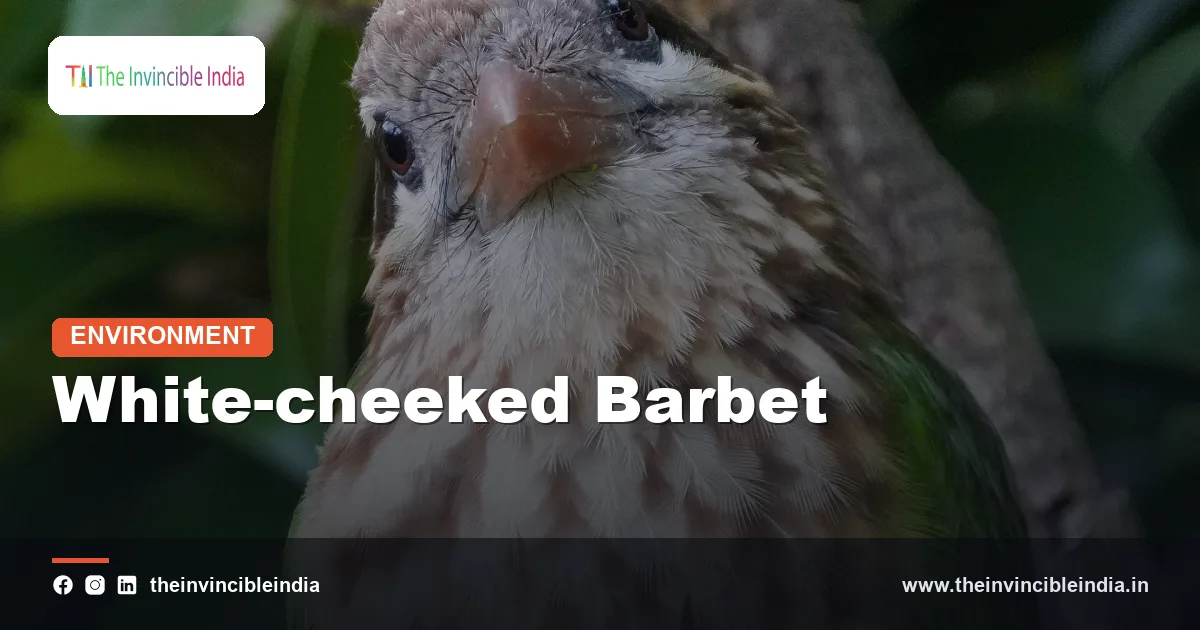
The white-cheeked barbet (Psilopogon viridis) is a plump, leaf-green fruit-eating bird endemic to peninsular India, recognised by its streaked brown head, broad white cheek and eyebrow stripes and a stout, pale bill. It is a bird of gardens, orchards, plantations and open forests of southern India, and it is heard far more often than it is seen, thanks to a loud, monotonous call that repeats for long stretches in the warm months.
The white-cheeked barbet is found only in India, which makes it one of the country’s endemic birds, and it is a familiar neighbour in many southern towns. This explainer covers how to identify the bird, its range and habitat, its diet and role in seed dispersal, its call, its tree-hole nesting, its conservation status and how it differs from related Indian barbets.
| Quick Facts: White-cheeked Barbet | |
|---|---|
| Common name | White-cheeked barbet |
| Scientific name | Psilopogon viridis (formerly placed in the genus Megalaima) |
| Family | Megalaimidae (Asian barbets), order Piciformes |
| Size | About 23 cm long; a plump, short-tailed, big-headed bird |
| Key field marks | Green body, brown streaked head, white cheek and eyebrow stripes, stout bill with bristles at its base |
| India range and habitat | Endemic to peninsular India, mainly the Western Ghats and southern hills and adjoining plains; gardens, orchards, plantations and forest |
| Diet | Fruit, especially figs, along with flowers, nectar, seeds and insects |
| Breeding | Excavates a nest hole in a dead branch or trunk; both parents incubate and feed the chicks |
| Conservation status | Least Concern (IUCN); legally protected under the Wildlife (Protection) Act, 1972 |
Key Takeaways
- The white-cheeked barbet is a green, fruit-eating bird found only in peninsular India, which makes it an Indian endemic species.
- The white-cheeked barbet has a streaked brown head, white cheek and eyebrow stripes and a stout bill with bristles around its base.
- The white-cheeked barbet lives in forests, plantations, orchards and gardens, including many town and city parks in southern India.
- The white-cheeked barbet eats mostly fruit, especially figs, and so helps disperse the seeds of many forest and garden trees.
- The white-cheeked barbet digs its own nest hole in a dead branch or trunk, and the abandoned holes are later used by other birds and animals.
- The white-cheeked barbet is classed as Least Concern by the IUCN and is common wherever fruiting trees and old trees remain.
What is the white-cheeked barbet?
The white-cheeked barbet is an Asian barbet in the family Megalaimidae, a group of chunky, brightly coloured, fruit-eating birds related to woodpeckers. It is restricted to the Indian peninsula, where it lives in woodland, gardens and plantations from the Western Ghats to the plains and hills of the south.
The name “barbet” comes from the stiff bristles, or barbs, that surround the base of the bill. These bristles are thought to help the bird handle food and may protect the face while feeding. Barbets belong to the same order as woodpeckers (Piciformes), and like woodpeckers they nest in tree cavities, but they feed mainly on fruit rather than boring insects.
Older books place the bird in the genus Megalaima, and some Indian field guides still use that name. Recent classifications merge many Asian barbets into Psilopogon, so both names appear in the literature.
How can you identify the white-cheeked barbet?
You can identify the white-cheeked barbet by its green body, dark brown streaked head and neck, clear white eyebrow stripe and cheek patch, and heavy yellowish-to-orange bill. The tail is short and the bird often looks round-bodied when it sits upright in a tree.
Key field marks
- Head: brown with fine pale streaking on the crown, nape and breast, with white streaks above and below the eye.
- Body: leaf-green on the back, wings and belly, which blends well with foliage.
- Bill: thick, slightly curved and pale, with bristles at the base and a pinkish or yellowish tint.
- Legs: reddish-grey or dull orange, strong and used for clinging to branches.
- Tail: short and green, giving a stubby shape compared with parakeets.
Male and female look alike. Young birds are duller, with less distinct streaking. The green colour is excellent camouflage, which is why the white-cheeked barbet can be overhead for minutes and still be missed by a casual observer.
The bird is often mistaken for the coppersmith barbet, which is smaller and has a red forehead and yellow throat, or for the brown-headed barbet, which has a more uniformly brown head. The white face stripes are the key mark.
Where does the white-cheeked barbet live in India?
The white-cheeked barbet lives in peninsular India, and it is especially common in the Western Ghats, the southern hills and many plains areas of the south. As an endemic species it does not occur outside India.
Typical habitats include:
- Evergreen and moist deciduous forest in the hills, where the bird forages in fruiting canopy trees.
- Plantations of coffee, tea, cardamom, areca and shade trees, which offer plenty of fruit and nest sites.
- Gardens, parks and avenues in towns and cities, where fig, banyan and mango trees attract the bird.
- Orchards and farmland edges with scattered large trees.
The bird is adaptable and tolerates human settlements as long as large trees remain. It is often recorded in the green parts of cities such as Bengaluru, Chennai, Hyderabad and Mysuru, and it is a familiar bird in the campuses and old gardens of many southern towns.
What does the white-cheeked barbet eat?
The white-cheeked barbet eats mainly fruit, especially figs, and it supplements this diet with flower nectar, petals, seeds and insects. Fruit makes up the bulk of its food through the year, and a single fruiting fig tree can attract several barbets together.
Typical foods
- Figs and other wild fruits: banyan, peepal, other fig species, and small forest berries.
- Cultivated fruit: papaya, banana, guava, mango and chikoo in gardens and orchards.
- Flowers: nectar and petals from trees such as silk cotton, coral tree and other flowering species.
- Insects: termites, ants, beetles and caterpillars, especially during breeding, when chicks need protein.
The bird hops along branches and plucks fruit with its strong bill, often swallowing it whole. Because it swallows whole fruits and later passes the seeds, the white-cheeked barbet is an important seed disperser, helping fig trees and many other plants spread across the landscape. In orchards it may take some fruit, but the damage is usually minor and is generally balanced by the insects it eats.
What does the white-cheeked barbet sound like?
The white-cheeked barbet gives a loud, repetitive, monotonous call that is delivered from a high perch and repeated for long periods. The sound is a series of rolling, rhythmic notes that carry a long way through woodland and gardens, and it is one of the most characteristic sounds of the southern Indian summer.
The call is often compared to a mechanical or hammering sound, and it can continue for many minutes without a pause. Birds are most vocal in the early morning and late afternoon, and in the breeding season, when the call helps defend a territory and attract a mate. The singing bird sits on an exposed branch with its head thrown back and its bill open, but its green plumage blends into the leaves, so it is easy to hear and hard to find.
Related barbets have their own songs, and learning the white-cheeked barbet’s call is one of the first steps for beginners in southern India. The bird also gives short, chattering and chuckling notes when feeding in groups.
How does the white-cheeked barbet breed?
The white-cheeked barbet breeds by excavating a nest hole in a dead or decaying branch or trunk, and both parents share the work of digging, incubating and feeding. The cavity is typically drilled into soft, rotting wood, which is easier to excavate than live timber.
The breeding season in India falls largely in the warmer, drier months before the monsoon, although timing varies from place to place. The female lays a small clutch of white eggs, usually a few, and both adults incubate them. After hatching, the chicks are fed fruit and a good deal of insect food and leave the hole after several weeks.
Old barbet holes are valuable to other wildlife. Once the barbets have left, the cavities are often reused by smaller birds such as mynas, parakeets, sparrows and owlets, as well as by squirrels, bats and insects. Retaining dead trees and snags, where safe, therefore supports a wider community of cavity-nesting species.
How does the white-cheeked barbet differ from other Indian barbets?
The white-cheeked barbet differs from other Indian barbets mainly in its brown streaked head with white face stripes, its size, and its range, which is limited to peninsular India. The table below compares it with three common barbets.
| Species | Size | Head and face | Call | Range in India |
|---|---|---|---|---|
| White-cheeked barbet | About 23 cm | Brown streaked head, white cheek and eyebrow stripes | Loud, monotonous, repeated notes | Peninsular India (endemic) |
| Brown-headed barbet | About 27 cm | Brown head and breast with a bare orange patch around the eye | Loud repeated “kutroo” notes | Most of India, in towns and woods |
| Coppersmith barbet | About 17 cm | Red forehead and breast patch, yellow throat and eye ring | Metallic “tuk-tuk-tuk” | Across much of India, in gardens and cities |
| Malabar barbet | About 17 cm | Bright green with a blue throat and red patches on head and nape | Short, bubbling and trilling notes | Western Ghats (endemic) |
Among these species, the coppersmith barbet is the best known in towns across India, while the white-cheeked barbet is the typical large barbet of southern gardens and forests.
Why is the white-cheeked barbet important to the ecosystem?
The white-cheeked barbet is important to the ecosystem because it disperses the seeds of many fruiting trees and creates nest cavities that other animals later use. In this way a single common bird supports both forest regeneration and the survival of hole-nesting wildlife.
Seed dispersal
When the white-cheeked barbet swallows a fig or berry whole, the seeds pass through its gut and are dropped some distance from the parent tree. This helps plants colonise new sites, including forest gaps, plantation edges and urban green spaces. Fig trees in particular depend on fruit-eating birds, and they in turn feed barbets, bulbuls, hornbills, parakeets and many other animals through the year.
Cavity creation
Many small birds cannot dig their own nest holes. By carving cavities in soft, dead wood, the white-cheeked barbet provides ready-made homes for species such as mynas, sparrows and owlets, as well as for squirrels and bats. Where dead trees are removed from parks and plantations, such species may struggle to find nesting sites.
A sign of tree-rich habitat
Because the white-cheeked barbet needs fruiting trees for food and old or dead wood for nesting, its presence usually indicates a landscape with good tree cover. Gardens with fig trees, native fruiting species and a few standing dead branches are likely to host the bird, which makes it a simple and cheerful indicator of green-space quality in southern towns.
Is the white-cheeked barbet threatened?
The white-cheeked barbet is not threatened and is classified as Least Concern by the IUCN, since it is common in a variety of habitats within its range. Its adaptability to gardens and plantations helps it persist where forest has been fragmented.
Even so, certain local pressures can reduce numbers:
- Removal of old trees that provide nest sites and fruit, such as figs, along roads and in cities.
- Loss of forest cover in the Western Ghats and southern hills due to clearing and conversion.
- Heavy pesticide use in plantations, which can reduce insect food and harm the birds.
- Window and traffic collisions in towns.
All native wild birds, including the white-cheeked barbet, are protected in India under the Wildlife (Protection) Act, 1972. Planting native fruiting trees, protecting old and dead trees where safe and keeping gardens pesticide-free are simple ways to support the species.
Where and when can you see a white-cheeked barbet?
You can see a white-cheeked barbet throughout the year in southern India, usually in tall trees in gardens, parks, plantations and forest edges, and it is most active in the early morning. Fruiting fig trees are the best place to watch for it.
Tips for watching
- Follow the loud, repeated call to a tall tree, then scan the canopy slowly with binoculars.
- Check fruiting figs, banyans and peepals, where several barbets and other fruit-eaters gather.
- Look for a bird sitting upright and still in the upper branches, with its head thrown back when calling.
- Visit parks and old campuses in southern cities in the early morning, when the birds are calling most.
- Observe nest holes from a distance and never disturb them.
Bottom Line
The white-cheeked barbet is a green, round-bodied fruit-eater unique to peninsular India, known by its streaked brown head, white face stripes and relentless call. It thrives in gardens and forests alike, disperses seeds as it feeds, and depends on old trees for nest holes.
Frequently Asked Questions
What is the white-cheeked barbet?
The white-cheeked barbet is a green, fruit-eating bird endemic to peninsular India, with a streaked brown head and white cheek and eyebrow stripes. It belongs to the barbet family, which is related to woodpeckers. It lives in forests, plantations and gardens of the south.
Where is the white-cheeked barbet found?
The white-cheeked barbet is found in peninsular India, especially the Western Ghats, the southern hills and adjoining plains. It is endemic, so it does not occur outside India. It lives in gardens, plantations, orchards and open forests as long as large fruiting trees are present.
What does the white-cheeked barbet eat?
The white-cheeked barbet eats mainly fruit, especially figs, along with flowers, nectar, seeds and insects. It also takes cultivated fruit such as papaya and banana. Insects become more important when the birds are feeding chicks.
Why does the white-cheeked barbet call so much?
The white-cheeked barbet calls so much because the loud, repeated song defends its territory and attracts a mate. The sound carries far through woodland, and the bird often calls for many minutes from a high perch. Calling is most frequent in the early morning and in the breeding season.
Where does the white-cheeked barbet nest?
The white-cheeked barbet nests in a hole that it digs itself in a dead or rotting branch or trunk. Both parents help excavate the cavity, incubate the eggs and feed the chicks. After the birds leave, other birds and small animals often use the old hole.
Is the white-cheeked barbet endangered?
The white-cheeked barbet is not endangered and is classified as Least Concern by the IUCN. It is common in southern gardens and forests and adapts well to human-modified areas. It is protected in India under the Wildlife (Protection) Act, 1972, and benefits from the preservation of old fruiting trees.
{“@context”:”https://schema.org”,”@graph”:[{“@type”:”FAQPage”,”mainEntity”:[{“@type”:”Question”,”name”:”What is the white-cheeked barbet?”,”acceptedAnswer”:{“@type”:”Answer”,”text”:”The white-cheeked barbet is a green, fruit-eating bird endemic to peninsular India, with a streaked brown head and white cheek and eyebrow stripes. It belongs to the barbet family, which is related to woodpeckers. It lives in forests, plantations and gardens of the south.”}},{“@type”:”Question”,”name”:”Where is the white-cheeked barbet found?”,”acceptedAnswer”:{“@type”:”Answer”,”text”:”The white-cheeked barbet is found in peninsular India, especially the Western Ghats, the southern hills and adjoining plains. It is endemic, so it does not occur outside India. It lives in gardens, plantations, orchards and open forests as long as large fruiting trees are present.”}},{“@type”:”Question”,”name”:”What does the white-cheeked barbet eat?”,”acceptedAnswer”:{“@type”:”Answer”,”text”:”The white-cheeked barbet eats mainly fruit, especially figs, along with flowers, nectar, seeds and insects. It also takes cultivated fruit such as papaya and banana. Insects become more important when the birds are feeding chicks.”}},{“@type”:”Question”,”name”:”Why does the white-cheeked barbet call so much?”,”acceptedAnswer”:{“@type”:”Answer”,”text”:”The white-cheeked barbet calls so much because the loud, repeated song defends its territory and attracts a mate. The sound carries far through woodland, and the bird often calls for many minutes from a high perch. Calling is most frequent in the early morning and in the breeding season.”}},{“@type”:”Question”,”name”:”Where does the white-cheeked barbet nest?”,”acceptedAnswer”:{“@type”:”Answer”,”text”:”The white-cheeked barbet nests in a hole that it digs itself in a dead or rotting branch or trunk. Both parents help excavate the cavity, incubate the eggs and feed the chicks. After the birds leave, other birds and small animals often use the old hole.”}},{“@type”:”Question”,”name”:”Is the white-cheeked barbet endangered?”,”acceptedAnswer”:{“@type”:”Answer”,”text”:”The white-cheeked barbet is not endangered and is classified as Least Concern by the IUCN. It is common in southern gardens and forests and adapts well to human-modified areas. It is protected in India under the Wildlife (Protection) Act, 1972, and benefits from the preservation of old fruiting trees.”}}]}]}


